
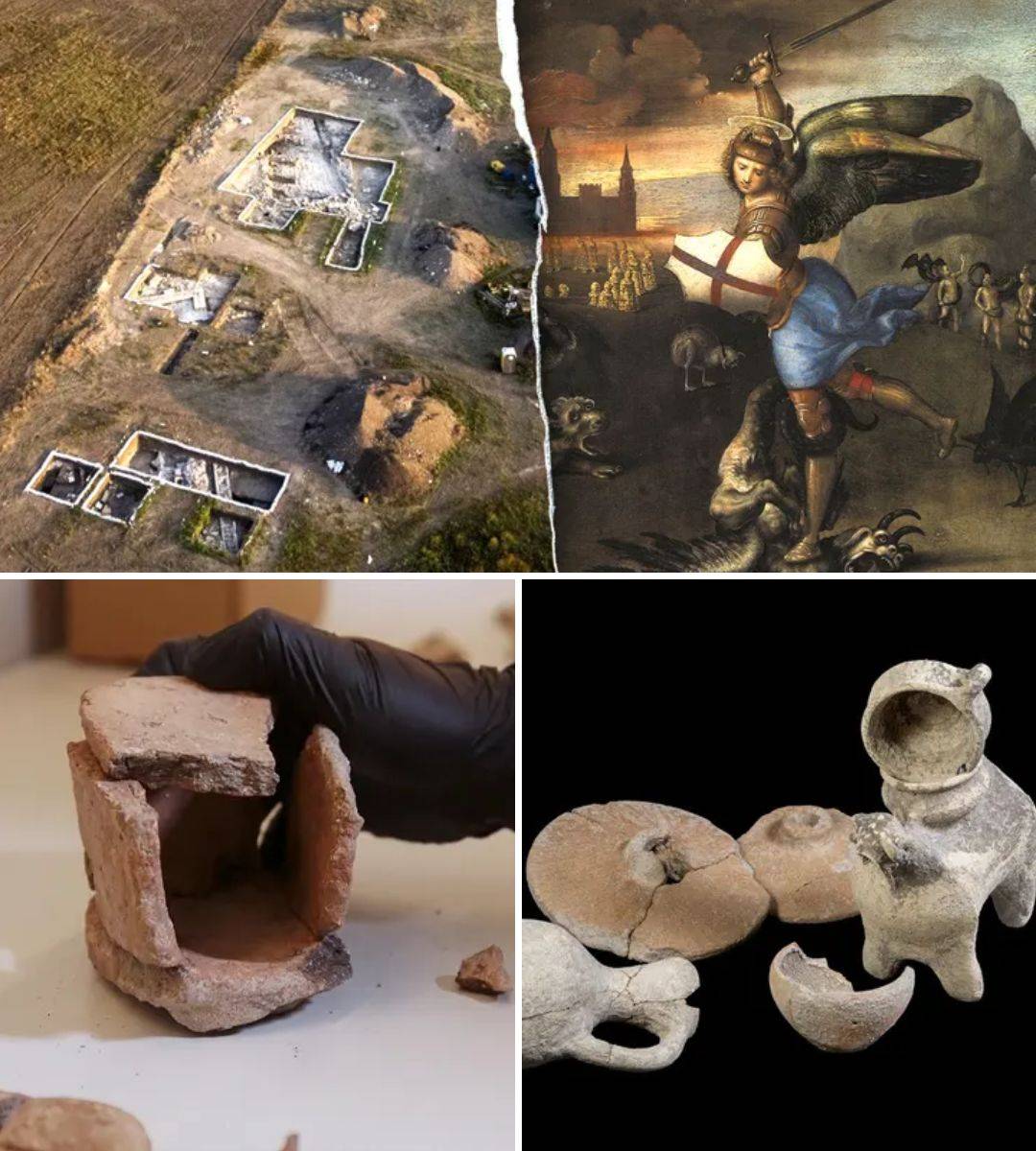
In a stunning archaeological revelation, experts have unearthed a treasure trove of ancient ritual artifacts linked to the Canaanites, a civilization mentioned in the Old Testament, at the historic site of Tel Megiddo in Israel. This discovery, announced by the Israel Antiquities Authority (IAA) on November 5, includes a remarkable 5,000-year-old winepress and ceremonial vessels that shed light on ancient religious practices.

The excavation, which took place during the construction of Highway 66 in the Jezreel Valley, has brought to light artifacts dating back as far as 3000 B.C. to around 1270 B.C. Among the standout finds is a rock-carved winepress, hailed as the oldest ever discovered in Israel, providing concrete evidence of early wine production in the region.
“This wine press is unique, one of very few known from such an ancient period when urbanization first took place in our region,” officials stated. They emphasized that while there had been indirect evidence of wine production from 5,000 years ago, this discovery offers definitive proof of its existence.

In addition to the winepress, archaeologists discovered a wealth of artifacts from a Canaanite folk cult, including a ceramic shrine model and animal-shaped ritual vessels, all dating back approximately 3,300 years. The IAA noted that these vessels were meticulously buried as ritual offerings, suggesting a deep spiritual significance.
The findings indicate that a folk cult may have operated outside the main city, allowing local farmers, who were likely unable to access the central temple, to make offerings of valuable liquids and agricultural produce. Some of the offerings were found alongside a large rock outcrop, possibly serving as an open-air altar for the Canaanite community.

“This excavation reveals a new layer of history intertwined with the known settlements of the city,” officials explained. They highlighted how the ancient wine-making facilities and the evidence of folk worship provide insights into the daily lives and beliefs of the people who once inhabited the area.
Eli Escusido, director of the IAA, expressed excitement over the discoveries, stating that they are “revealing, layer by layer, the wealth of history hidden and embedded in the soil here.” He emphasized that these findings allow for a greater understanding of the region’s historical and cultural evolution over thousands of years.
This isn’t the first significant discovery at Tel Megiddo. Earlier this year, archaeologists reported evidence of a biblical battle, further unraveling the complex history of this iconic site. Assaf Kleiman, an archaeologist involved in the project, noted that the pottery found suggests the presence of an Egyptian army, possibly linked to the defeat of King Josiah.
As experts continue to sift through the layers of history at Tel Megiddo, one can’t help but wonder what other secrets lie waiting to be uncovered in this ancient landscape.


