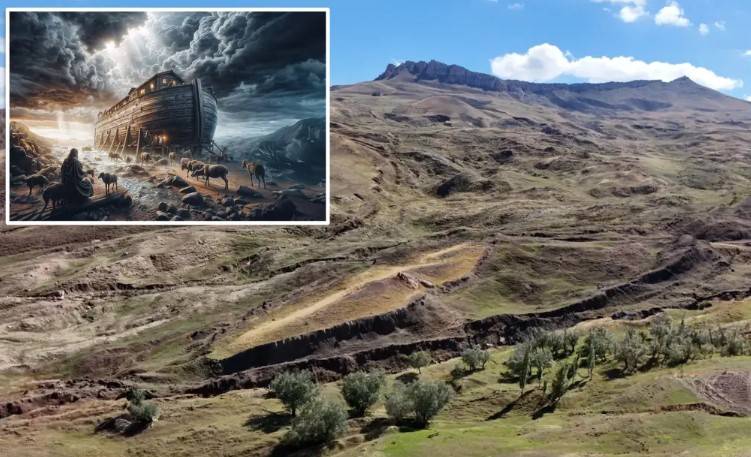

Could the legendary Noah’s Ark be hidden in plain sight? A remarkable discovery in Turkey has researchers buzzing with excitement as they explore a geological formation that some believe may be the ancient vessel described in the Bible. This intriguing site is reigniting debates about faith, history, and the mysteries of the past.

Located approximately 19 miles from Mount Ararat and near the Armenian border, the Durupinar Formation has garnered attention since 2021. Experts from Istanbul Technical University and Agri Ibrahim Cecen University have been investigating this peculiar structure, which some claim could be the fossilized remains of Noah’s Ark. Their findings were highlighted in an article on Arkeonews published on March 16, 2025.
The story of Noah, as recounted in Genesis, tells of a man given a divine task: to construct a colossal ark to save his family and pairs of every animal species from an impending flood. This narrative, which also appears in the Quran, has inspired countless adaptations across literature, film, and television, making it one of the most recognized tales in religious history.

However, the origins of Noah’s story remain a topic of debate among scholars. The earliest known manuscripts of the Old Testament are believed to date back to the eighth century BCE, recounting events that may have been passed down through oral tradition. The concept of a great flood has various interpretations, with some viewing it as an allegory rather than a literal occurrence.
While geological evidence suggests that significant flooding events likely took place in the region, some researchers argue that the scale of the flood described in Genesis may not be feasible. A 2023 article from LiveScience proposed a theory that a surge from the Mediterranean Sea into the Black Sea around 7,000 years ago could have inspired local myths about a monumental ark.

The Durupinar Formation measures an impressive 538 feet long and exhibits a shape that aligns intriguingly with biblical descriptions of the ark’s dimensions. Turkish archaeologists have noted this resemblance and collected thirty samples from the site, revealing altered clay and marine sediments. Some of these traces date back to approximately 3000 BCE.
So, could this geological formation truly be the resting place of Noah’s Ark, lying undisturbed for nearly 5,000 years? While the excitement surrounding this discovery is palpable, skepticism remains. Scholars caution against potential biases in the research, yet there is a growing call for a comprehensive excavation to uncover the truth behind this age-old mystery.
As the quest to find Noah’s Ark continues, one question lingers: what secrets might this ancient site still hold?