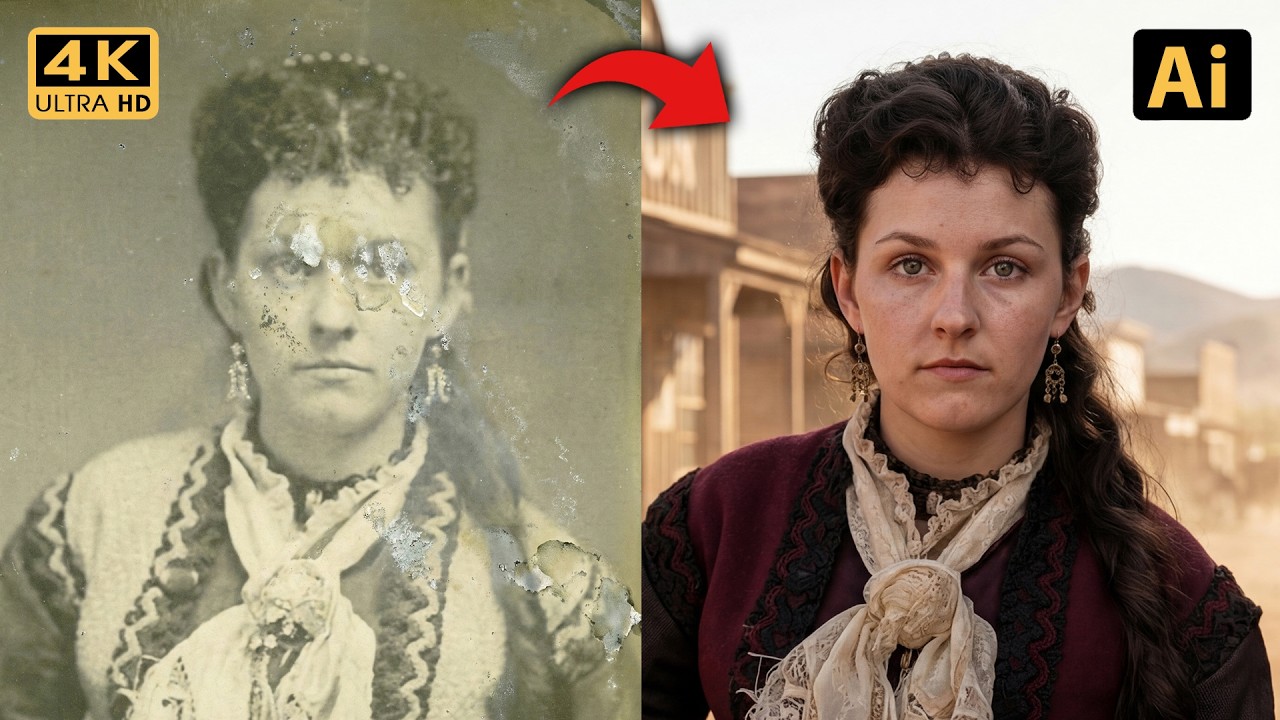
The American Wild West has been resurrected through artificial intelligence, offering an unprecedented and deeply human look at the twenty most iconic figures of the frontier, revealing faces and stories never before seen with such clarity and emotional depth. A new video series, released today, uses advanced AI technology to generate hyper-realistic, moving portraits of legends like Geronimo, Sitting Bull, and Wild Bill Hickok, stripping away the dust of myth to expose the raw, brutal, and often heartbreaking realities of their lives. This is not a simple gallery of old photographs; it is a digital reanimation of history, bringing viewers face-to-face with the men and women who shaped a lawless era.
The project begins with Geronimo, the Apache leader whose life was defined by a single, devastating moment of violence. Born around 1829, he watched Mexican soldiers murder his mother, his wife, and his three children. That loss ignited a thirty-year campaign of vengeance against both Mexico and the United States.
 With only a handful of fighters, he became a phantom, breaking out of reservations three times and vanishing into the Sierra Madre mountains. The United States Army deployed five thousand troops, but they could not catch him. He finally surrendered at Skeleton Canyon in 1886, marking the last armed resistance on American soil.
He was shipped to Florida, then Alabama, then Oklahoma, a prisoner of war for twenty-three years. He never saw Arizona again. At eighty years old, he fell off a horse and lay outside all night, dying of pneumonia, still in captivity.
His name, however, lives on, shouted by paratroopers every time they jump from a plane.
Sitting Bull, born around 1831, is presented not as a war chief who sought conflict, but as a man who desperately wanted peace. He wanted to be left alone. When that failed, he united the Lakota, Cheyenne, and Arapaho nations against General George Custer at the Battle of Little Bighorn in 1876.
Washington could not forgive that victory. He fled to Canada, holding out for years before returning, starving, to the United States. Then something strange happened.
He toured with Buffalo Bill’s Wild West show. The same country that had wanted him dead now paid to watch him perform. Back on the Standing Rock reservation, the government feared he would spark another uprising.
Indian police came for him one December morning. Shooting erupted. Sitting Bull died in his own doorway.
The Lakota still remember him not as a warrior, but as the man who refused to sell his people’s land.
Wild Bill Hickok, born in 1837, became a legend after shooting a man across a public square in Springfield, Missouri. Newspapers built him into the fastest gun alive. He kept order in the lawless cow towns of Kansas, killing only when he had to.
But the legend grew faster than the man. His eyesight failed. His drinking worsened.
Jobs dried up. He ended up in Deadwood, South Dakota, gambling for rent. He always chose a seat facing the door, a habit born of paranoia.
One August afternoon, he did not. A man named Jack McCall shot him from behind during a poker game. He was thirty-nine years old.
The cards in his hand were aces and eights. They still call it the dead man’s hand.
Bass Reeves was born into slavery around 1838 and escaped during the Civil War into Indian Territory. He learned the languages of the Creek and Seminole tribes and lived among them. In 1875, Judge Isaac Parker needed a deputy U.
S. marshal who could work the vast, dangerous territory. He picked Reeves.
Over thirty years, Reeves hauled in around three thousand fugitives. He could not read, so he memorized every warrant by ear. He would disguise himself, talk his way close to a suspect, then slap on the handcuffs.
He never took a bullet. When his own son killed a woman, Reeves arrested him personally. He died in 1910, mostly forgotten.
A bronze statue now stands in Fort Smith, Arkansas, depicting a Black lawman on horseback, badge and rifle in hand, right where outlaws were once hanged.
Chief Joseph led eight hundred Nez Perce men, women, and children on a fighting retreat across fourteen hundred miles of Idaho, Montana, and Wyoming. For three months, they outran the entire United States Army. They were trapped just forty miles from the Canadian border at the Bearpaw Mountains in 1877.
He surrendered with a speech that still echoes through history. Washington promised he could return to his homeland in Oregon. Instead, they sent him to Oklahoma.
He watched his people die in the heat. He spent years petitioning presidents Hayes, McKinley, and Roosevelt for the return of the Wallowa Valley. He never got it.
He died at the Colville Reservation in 1904. His doctor wrote the cause as a broken heart. The Nez Perce have not forgotten what was promised.
 Cole Younger grew up in Missouri’s border wars. He was fourteen when raiders killed his father and burned the family farm. He rode with Quantrill’s guerrillas and kept fighting after the Civil War surrender, unable to stop.
The James-Younger gang robbed banks and trains for a decade. Soldiers who never got a piece of the action, they said. In 1876, they tried to rob a bank in Northfield, Minnesota.
The entire town shot back. Younger took eleven bullets and lost an eye. He spent twenty-five years in prison.
He got out old and scarred, spending his last years warning young men about the futility of violence. He died where he started, in Lee’s Summit, Missouri. His grave still flies a Confederate flag with a captain’s rank, as if the war never ended.
Quanah Parker’s mother was a white captive, his father a Comanche war chief. He grew up raiding across the Texas plains. He led seven hundred warriors against buffalo hunters at Adobe Walls in 1874, but he lost.
The army slaughtered the buffalo herds and starved his people into submission. He was the last of his band to surrender at Fort Sill in 1875. Then he did something nobody expected.
He built schools. He started a cattle ranch. He leased tribal land to keep money flowing in.
He hunted with President Theodore Roosevelt on weekends. He wore braids and kept five wives, never apologizing for either world. He died in 1911.
His tombstone reads, Last chief of the Comanches.
Buffalo Bill Cody killed buffalo for the railroad, scouted for the cavalry, and then figured out the real money was in pretending to do it on stage. His Wild West show packed arenas across America and Europe. 𝒻𝒶𝓀𝑒 gunfights, staged rescues, and real Native American performers.
Queen Victoria watched. The Pope blessed it. For thirty years, he sold the frontier as entertainment while the actual frontier vanished.
It made him the world’s first cowboy celebrity and then broke him. He died in Denver, owing everyone money. Tens of thousands came to his funeral anyway.
Every western movie ever made owes something to that show.
Jesse James robbed his first bank at eighteen, straight from riding with Confederate guerrillas. Newspapers called him Robin Hood, but he was not. The money stayed with the gang.
For sixteen years, he hit banks, trains, and stagecoaches across the Midwest. After the disastrous Northfield raid, the old crew was dead or locked up. He picked new men.
It was a bad move. In April 1882, Jesse was fixing a crooked picture frame in his home when Robert Ford shot him in the back of the head. He was thirty-four.
A ballad spread about the dirty little coward who shot Mr. Howard. Jesse James was bigger dead than alive.
He still is.
Wyatt Earp became America’s most famous lawman over the course of about thirty seconds. In Tombstone, Arizona, in 1881, he, his brothers, and Doc Holliday faced the Clantons near the O. K.
Corral. Three men died. Wyatt was the only one not hit.
Then everything broke. His brother Virgil was ambushed and crippled. His brother Morgan was murdered.
 Wyatt hunted the men he blamed, killed them, and fled Arizona before anyone could charge him. The rest of his life looked nothing like the legend. He worked mining claims and real estate and hung around early Hollywood sets in California.
He died old in Los Angeles at eighty years old. A biographer polished the story after he was gone. That version became every western you have ever seen.
Belle Starr was called the bandit queen by newspapers, but the real story was smaller. She grew up in Missouri around guerrillas and outlaws and married two of them. Her ranch on the Canadian River hid horse thieves and rustlers.
She ran the operation, moving the stock and sheltering the men. Judge Parker convicted her of horse theft in 1883, making her one of the few women tried in his court. After her husband was killed, her protection was gone.
Someone shot her in the back while she was riding home in February 1889. The murder was never solved. She was forty-one.
The legend outgrew her fast through dime novels and Hollywood. The real Belle was smaller, harder, and more interesting.
Pat Garrett is remembered for one thing: shooting Billy the Kid. In a dark room at Fort Sumner in July 1881, someone walked in and Garrett fired. His career was made.
Everything after that went wrong. He wrote a book about Billy, ran for office, lost friends, and piled up debts. Fame should have set him up, but it stuck to him like a bad smell.
People hated him for it or would not talk about anything else. In February 1908, somebody shot him on a dirt road near Las Cruces, New Mexico, over an argument about goat grazing rights. The shooter walked free.
Garrett was fifty-seven, a long way from Fort Sumner.
Hec Thomas scared outlaws so badly that the Dalton gang robbed two banks at once just to outrun him. It did not work. He was a deputy marshal under Judge Parker.
Thomas hunted men through Indian Territory for decades, tracking horse thieves, killers, and bootleggers. He and two others became known as the Three Guardsmen, bringing in three hundred fugitives. Thomas tracked Bill Doolin himself and shot him dead in 1896.
The leader of the largest gang was gone. Thomas ended up as Lawton, Oklahoma’s first police chief. He had seven quiet years before dying of kidney disease at sixty-two.
The outlaws who survived him remembered his name longer than the public ever did.
Big Nose Kate was born in Budapest, the daughter of a doctor. By twenty, she was working saloons in Dodge City. She met Doc Holliday in Texas.
They fought, split, came back, and fought again for years. She followed him to Tombstone. She once accused him of robbery under oath, then took it back.
After Holliday died, she kept going. She changed names, nursed the sick, and ran boarding houses. She outlived every one of them, the Earps, the cowboys, the whole crowd.
She died at the Pioneers Home in Prescott, Arizona, in 1940 at ninety years old. From Budapest to Dodge City to Tombstone to a quiet room in Arizona, nobody in the West had that range.
Morgan Earp stood next to Wyatt at the O. K. Corral.
He took a bullet but stayed on his feet. He should have left Tombstone after that. The cowboys wanted revenge.
Virgil was ambushed and crippled. Morgan sent his wife to California but would not leave his brothers. In March 1882, he was playing pool when a shot came through the back window and hit his spine.
 He was dead inside an hour. He was thirty years old. Wyatt put the body on a train to California, then rode back into Arizona and started killing every cowboy he could find.
The gunfight took thirty seconds. What followed cost the Earps everything.
Doc Holliday graduated from dental school in Pennsylvania and opened a practice in Atlanta. Then tuberculosis found his lungs, and he went west, figuring he would die soon anyway. He turned out to be better at cards and killing than dentistry.
He drifted through Texas, New Mexico, and Colorado. He saved Wyatt Earp’s life once, and that settled it. He stood with the Earps at the O.
K. Corral and rode the vendetta. He coughed blood for years in rented rooms.
He died at thirty-six in a hotel in Glenwood Springs, Colorado. They say he looked down at his bare feet and laughed. He had always figured on dying with his boots on.
Nat Love was born enslaved in Tennessee. He left at fifteen, rode into Dodge City, and got hired as a cowboy. For twenty years, he drove cattle from Texas to Kansas to Dakota, covering thousands of miles.
On the Fourth of July in 1876, he swept every contest at a Deadwood rodeo, roping, shooting, and bronc riding. The crowd named him Deadwood Dick right there. When railroads killed the long cattle drives, he became a Pullman porter.
He moved to Los Angeles and wrote his autobiography in 1907. He was one of the few Black cowboys who put it all on paper. Some details were probably stretched, but it does not matter.
He was born property and died his own man.
Billy the Kid was dead at twenty-one. Legend says he killed twenty-one men, one for every year of his life. He did not.
The number was probably under ten. He was orphaned young, drifted into New Mexico, and fell into the Lincoln County War, a business feud dressed up as justice. He killed a sheriff and was sentenced to hang.
He broke out by killing both guards. He was free for two months. Then Pat Garrett found him at Fort Sumner.
They have vandalized his grave so many times that it now sits in an iron cage. Over a century of arguments about who he really was. Twenty-one years old.
The kid would have liked that.
Annie Oakley started shooting to put food on the table, hunting rabbits and quail in rural Ohio and selling them to restaurants. Her mother’s mortgage was paid off before she turned fifteen. She outshot a professional marksman named Frank Butler at a Cincinnati match, hitting twenty-five out of twenty-five.
He missed one. She married him. She starred in Buffalo Bill’s show for seventeen years, splitting playing cards edge-on and shooting cigarettes from Butler’s lips.
Sitting Bull called her Little Sure Shot. At sixty-two, she still hit one hundred clay targets in a row. She taught thousands of women to shoot.
She died in Ohio at sixty-six. Frank died eighteen days later. He could not do it without her.
Tom Horn tracked Geronimo for the army, worked Pinkerton cases, and then hired out to Wyoming cattle barons as their killer. Ranchers paid him. Lawmen looked away.
In July 1901, someone shot a fourteen-year-old boy named Willie Nickell off his horse on a dirt road. Horn bragged about it while drunk to a man who was recording every word. Did he actually pull the trigger?
It is still argued today. It did not save him. He was hanged in Cheyenne, Wyoming, the day before his forty-third birthday.
He smoked a cigar on the scaffold and never flinched. The Old West needed men like Tom Horn. Then it needed to hang one to prove it was over.