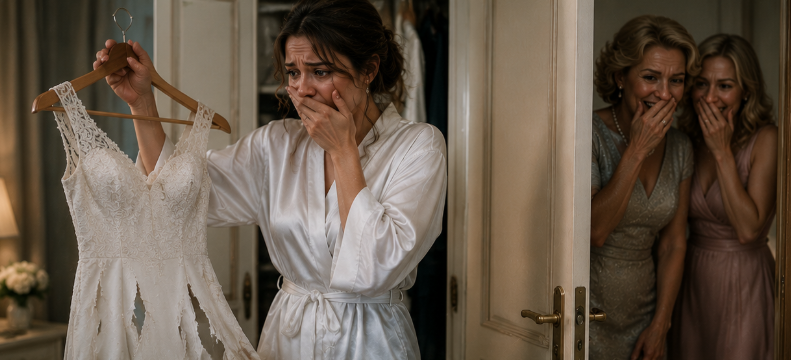
It started at her engagement party, the moment everything cracked open inside me. My sister pulled me aside near the kitchen and whispered, “Maybe you should stand near the back in photos. The lighting isn’t flattering for everyone. ” She said it like she was doing me a favor, like she was protecting me from embarrassment.
I was 25 then. I had a quiet job as an administrative assistant, a small rented apartment, and a casual dating life. She was going to be a partner at a prestigious law firm, owned a house with a wraparound porch, and was about to marry a surgeon. Growing up, she had been the sun in our family’s solar system.
Everyone orbited around her. She was three years older, effortlessly beautiful, academically gifted, and she knew exactly how to position herself in every room to catch the most flattering light. I learned early that there wasn’t enough oxygen for both of us to thrive. When I won a spelling bee in fourth grade, she announced her acceptance to a gifted program at dinner that same night.
When I got my first boyfriend at 16, she got engaged to a medical student the following month. Every milestone I reached, she’d already passed or immediately surpassed with something grander. The worst part was how she did it. With a warm smile, a squeeze of my shoulder, a gentle, “I’m so proud of you,” that somehow made me feel smaller than if she’d said nothing at all.
That night, after her engagement party, I went home and made a decision. I wasn’t going to fight for space in her spotlight anymore. I was going to build my own empire brick by brick. I started small.
A blog about vintage furniture restoration, something she’d always mocked as my sad little hobby. I posted tutorials, connected with collectors, and learned the business side of things. Within a year, I had a following. Within two, I had a storefront in the city’s trendy arts district.
By year three, my restoration business was pulling in more than her junior associate salary ever had. I didn’t tell my family a word. When they asked what I was up to, I smiled and said, “Same old things. ” When they invited me to holiday dinners, I showed up in my same modest clothes and deflected their questions.
My sister loved those dinners. She’d update everyone on her cases, her renovations, her vacation plans to Italy and Greece. I’d nod and pass the potatoes without comment. What she didn’t know was that I’d been featured in three national magazines, that a celebrity had commissioned me to restore her grandmother’s heirloom vanity, that I’d just signed a deal for my own television show on a major network.
The announcement was scheduled for the week before her wedding. I’d planned every detail meticulously. The press release, the social media reveal, an exclusive interview that would air on the morning of her rehearsal dinner. After 30 years of being diminished, I was about to become completely undeniable.
But the night before the announcement, I got a call that changed everything. It was Mom, sobbing uncontrollably. My sister had been in an accident. She was in the ICU, and they weren’t sure she would make it through the night.
I stood in my warehouse, surrounded by furniture worth more than our childhood home, and felt the revenge I’d been savoring turn to ash in my mouth. My phone buzzed with a text from my publicist. Ready for tomorrow? I didn’t answer.
Instead, I drove to the hospital. In the waiting room, I found my parents collapsed against each other. Dad looked up at me with hollow eyes and said four words that shattered something deep inside me. “She was coming to you.
”
I couldn’t process it. My brain refused to arrange the words into anything that made sense. My sister had never come to me for anything except to compare herself favorably or to offer advice I hadn’t asked for. “What do you mean?
” My voice came out as barely a whisper. Mom lifted her head from Dad’s shoulder. Her mascara had carved dark rivers down her cheeks. “She found out about your business, your show.
She saw the early press release. I don’t know how. She was driving to your warehouse to talk to you. ”
The floor beneath me seemed to tilt.
I grabbed the back of a plastic chair to steady myself. “She called us from the car,” Dad continued, his voice cracking on every other word. “She was crying, saying she needed to apologize to you before anyone else found out that she’d been… terrible.
That she finally understood. ”
A nurse appeared in the doorway. “Family of Vivian Ashford. ”
We all stood at once, a broken constellation of grief and fear.
The nurse’s expression was carefully neutral, the kind of professional blankness that could tip either direction. “She’s stable for now. The next few hours are critical. You can see her one at a time.
”
Mom went first, then Dad. When it was my turn, I walked down that fluorescent corridor feeling like I was moving through water. Each step took enormous effort. My mind kept cycling through the same thoughts.
She knew. She was coming to me. She wanted to apologize. The woman in the hospital bed barely resembled my sister.
Tubes and wires connected her to machines that beeped and hummed in a mechanical chorus. Her face was swollen, purple bruises blooming across her left side, a white bandage wrapped around her head like a terrible crown. I sat in the chair beside her bed and watched her chest rise and fall with the rhythm of the ventilator. “I was going to humiliate you,” I whispered.
“I planned it for months. The timing, the interviews, everything. I wanted to watch you realize that while you were patting me on the head and telling me to stand in the back, I was becoming someone you could never diminish again. ”
The machines beeped.
My sister didn’t respond. “But you were coming to apologize. ”
I pressed the heels of my hands against my eyes. You were finally going to see me, and I was so focused on revenge that I couldn’t even imagine that was possible.
I stayed with her until the nurse came to tell me visiting hours were over. By then, I’d called my publicist and told her to push everything back indefinitely. “Family emergency,” I said. She didn’t argue.
The next three weeks were a blur of hospital waiting rooms and whispered conversations with doctors who used words like “traumatic brain injury” and “uncertain prognosis. ” My parents aged a decade in those weeks. I watched them shrink into themselves, watched the worry carve new lines into their faces. The wedding was postponed indefinitely.
Her fiancé, a surgeon named Theodore, barely left the hospital. I’d always thought of him as an accessory to her perfection, another achievement to list on her resume. But watching him hold her unresponsive hand for hours, reading to her from her favorite books, I realized I’d never actually known him at all. On day 22, she opened her eyes.
I wasn’t there for it. Mom called me at 3:00 a. m. , her voice bright with the first hope we’d heard in weeks.
“She’s awake. She’s asking for you. ”
I drove to the hospital in my pajamas. Didn’t even think to change.
When I walked into her room, my sister turned her head slowly toward the door. Half her face was still swollen, and her eyes had a glassy, unfocused quality that made my heart clench. “Hey,” she said. Her voice was barely audible.
“Hey. ” I didn’t know what else to say. Three decades of history hung between us. A wall built brick by brick from small cruelties and constant competition.
“Mom told me,” she paused to catch her breath. Even that small amount of speaking seemed to exhaust her. “About your business, your show. ”
I nodded, waiting for the familiar sting of her diminishment.
“I’m so proud of you. ”
But this time, the words didn’t feel small. They didn’t feel like a weapon disguised as support. They were just words, ragged and sincere, from a woman who’d nearly died trying to say them to my face.
“I’m sorry,” she continued. “For all of it. The photos, the announcements, the way I always made everything about me. ” Tears leaked from the corners of her eyes, running down into the bandages.
“I was so scared of being ordinary that I couldn’t let anyone else be extraordinary. ”
I reached out and took her hand. It felt fragile, like holding a bird. “I was going to ruin your wedding,” I admitted.
“I timed my announcement specifically to overshadow you. ”
She let out a sound that might have been a laugh if she’d had more strength. “I know. Theodore showed me the press release date.
I figured it out. ”
“And you still wanted to apologize. ”
“Because I deserved it. ” She squeezed my fingers weakly.
“I’ve spent my whole life making you feel small so I could feel big. That’s not your fault. That’s mine. ”
We sat in silence for a long moment, the machines continuing their quiet symphony around us.
I thought about all the years I’d spent building my success in secret, hoarding it like ammunition. I thought about the satisfaction I’d imagined feeling when I finally detonated it in her face. It seemed so hollow now, so pointless. “I don’t want to fight anymore,” I said finally.
“Me neither. ” She closed her eyes, exhausted. “Can we start over? ”
I didn’t answer right away.
The question was bigger than she probably intended. Starting over meant letting go of 30 years of accumulated hurt. It meant trusting someone who’d never given me a reason to trust her. “I don’t know if we can start over,” I said honestly.
“But maybe we can start from here. ”
She nodded slightly, already drifting back toward sleep. “That’s enough. ”
The recovery was long and difficult.
My sister had to relearn how to walk, how to write, how to do a hundred small things she’d always taken for granted. Her wedding was pushed back a full year. Theodore never wavered, and I found myself grudgingly respecting him more with each passing month. I rescheduled my announcement for six months after her accident, with her blessing.
She insisted on being there for the reveal party, even though she was still using a cane and tired easily. When the cameras turned to her for a comment, she said something that made me cry in front of everyone. “My sister built an empire while I wasn’t paying attention. That’s entirely my loss, and I’m grateful I finally get to see it.
”
The show premiered that fall to strong ratings. I called it Second Chances, a title that meant something different to me than it would to most viewers. Each episode featured furniture with a story, pieces that had been abandoned or damaged or forgotten, brought back to life with patience and skill. My sister watched every episode.
She texted me after each one with her thoughts, sometimes critical, always supportive in a way that finally felt genuine. We were learning how to be sisters for the first time, figuring out a relationship that had never been allowed to develop naturally. But if I’m being honest, and I’ve decided to be honest from now on, the healing wasn’t a straight line. There were setbacks, moments when old patterns tried to reassert themselves.
It happened about eight months after the accident. My sister had recovered enough to return to work part-time, and we’d established a new rhythm of weekly dinners at my apartment. One evening, while she was admiring a piece I just finished restoring—a beautiful art deco dresser from the 1920s—she made an off-hand comment that landed wrong. “You know, I had a dresser just like this when I was in law school.
I gave it to Goodwill when I upgraded to the custom Italian pieces. ”
Something in her tone, or maybe something in my imagination, made it sound like she was comparing my precious restoration to her castoff furniture. I felt the familiar heat rise in my chest, the defensive walls going up. “How nice for you,” I said, my voice clipped.
She looked at me, confused. “What? ”
“Nothing. Just, I’m sure your Italian pieces are very impressive.
”
My sister set down the fork she’d been using to eat the takeout I’d ordered. “I wasn’t trying to—” She stopped, took a breath. “Okay, I can see how that came out wrong. I was trying to say that seeing what you do with these pieces makes me regret not appreciating what I had.
But I said it in a way that made it about me again. ”
The acknowledgment caught me off guard. The old version of my sister would have told me I was being too sensitive, that I always took things the wrong way. This version was actually examining her own words.
“I’m sorry,” I said. “I think I’m still waiting for the other shoe to drop sometimes. ”
“I know. ” She picked up her fork again.
“I earned that. It’s going to take more than eight months for you to trust that I’ve changed. ”
“It helps that you understand that. ”
We finished dinner, and something shifted between us again.
Another small step forward. That was how it went for the next year. Two steps forward, one step back. Sometimes a lateral move that left us circling but not advancing.
It was messy and complicated and nothing like the dramatic reconciliation scenes I’d seen in movies. But it was real. The true test came on the day of her rescheduled wedding. I’d been asked to be a bridesmaid this time.
Not just a background attendee meant to stand in unflattering light. My sister had given me the place of honor. Maid of honor, actually, a position I’d never imagined occupying. The morning of the ceremony, I found her alone in the bridal suite, staring at her reflection in the mirror.
She was in her dress, a simple but elegant gown she’d chosen after her recovery. The original dress, the elaborate princess confection she’d selected before the accident, had been donated to a charity that provided wedding dresses to women who couldn’t afford them. “You look beautiful,” I said from the doorway. She turned, and I saw that she was crying.
Not delicate, photogenic tears, but real crying. The kind that left your face blotchy and your nose red. “I almost didn’t get to do this,” she said. “I almost died trying to tell you I was sorry.
”
I crossed the room and took her hands in mine. “But you didn’t die. You’re here, and you’re about to marry a man who read you The Great Gatsby every day for three weeks while you were in a coma. ”
She laughed through her tears.
“He has terrible taste in books. I’ve always hated Fitzgerald. ”
“I know. He told me you woke up specifically to make him stop reading.
”
That got a real laugh out of her. The kind that scrunched up her whole face. She looked younger when she laughed like that. More like the little girl I remembered from before she became the family’s golden child.
“I need to tell you something,” she said, her expression growing serious again. “And I need you to let me finish before you respond. ”
I nodded, bracing myself for whatever confession was coming. “When we were kids, I was jealous of you.
”
Whatever I’d expected, it wasn’t that. “Jealous of me? ”
“You had everything. Everyone loved you.
Everyone loved me because I performed being lovable. You were just yourself, and people liked you anyway. ” She released one of my hands to wipe her eyes. “You remember Mr.
Graham, our next door neighbor? ”
I nodded. Mr. Graham had been an elderly widower who lived alone with his garden and his cats.
He’d passed away when I was about 12. “He used to give you his best tomatoes from his garden. Not me. You.
Because you were the one who stopped to pet his cats every day. You didn’t even notice you were doing something special. But I noticed. ”
She took a shaky breath.
“I started working hard to be the best at everything because I thought that was the only way I could compete with someone who was naturally good. I never knew you felt that way because I couldn’t admit it. Admitting it would mean admitting I wasn’t actually superior, just more practiced at looking superior. ”
She squeezed my hand.
“I wasted so many years competing with you instead of just being your sister. I’m sorry. ”
I pulled her into a hug, careful not to crush the dress. We stood there for a long moment, 30 years of hurt and misunderstanding slowly releasing into the air around us.
“You know,” I said into her hair, “I spent the last three years building a secret business empire specifically so I could upstage you. I’m not exactly innocent in this competition. ”
She pulled back, smiling through her remaining tears. “I read that celebrity profile piece.
The part where you talked about wanting to become undeniable. I figured out who you were talking about. ”
“Not my most gracious moment. ”
“It was an extremely gracious moment for someone who’d spent three decades being treated like a supporting character in their own life.
” She turned back to the mirror, adjusting her veil. “Can we agree that we were both terrible in different ways and move on? ”
“I think that’s the healthiest thing either of us has ever said. ”
The wedding was beautiful.
Not the grand spectacle that had been originally planned, but something warmer and more intimate. Only close friends and family, held in the garden of Theodore’s family home. My sister walked down the aisle with a barely perceptible limp, a reminder of everything she’d been through to get here. When Theodore said his vows, he talked about the moment he’d known she was the one.
It wasn’t any of the impressive things—her partnership, her accomplishments, her beauty. It was a night early in their relationship when she’d spent three hours helping him practice for a presentation he was nervous about. Going over every slide, asking questions she didn’t know the answers to, making him explain things until he truly understood them. “That’s when I knew you weren’t just accomplished,” he said, his voice thick with emotion.
“You were kind. You just didn’t always let people see it. ”
I watched my sister’s face as he spoke. She was crying again, but differently now.
Tears of recognition, of being truly seen for maybe the first time in her adult life. After the ceremony, during the reception, my parents found me standing near the drinks table. They looked older than I remembered, more weathered by the year of hospitals and uncertainty. “We owe you an apology too,” Mom said without preamble.
I started to deflect the way I always had. “You don’t have to—”
“Yes, we do. ” Dad put his hand on my shoulder. “We let your sister take up all the oxygen in this family.
We encouraged it, even. It was easier to focus on one successful child than to see both of our daughters clearly. ”
“We’re proud of what you’ve built,” Mom added. “Not just the business, but the person you’ve become.
We should have said that years ago. ”
I didn’t know how to respond to their honesty. It was so different from the family dynamic I’d grown up with, where everything important went unsaid and feelings were expressed through actions that could always be interpreted multiple ways. “Thank you,” I finally managed.
“That means a lot. ”
Dad nodded, his eyes glistening in a way I’d never seen before. “Your grandmother would have loved watching your show. She was always saying you had a gift for bringing things back to life.
”
I hadn’t thought about Grandma in years. She’d died when I was 15, a quiet woman who’d seemed more interested in her garden than in the family drama swirling around her. But I remembered her teaching me how to refinish a wooden chair when I was maybe six or seven. Her hands guiding mine over the sandpaper, showing me how to feel when the wood was ready for stain.
“She taught me,” I said, realizing it for the first time. “She’s the reason I do this. ”
Mom smiled sadly. “She recognized something in you that none of us saw clearly.
I wish we’d listened to her more. ”
The reception continued around us. Laughter and music and the clink of glasses. My sister danced with Theodore, then with Dad, then with a group of her friends from law school.
I watched her move through the evening, radiant in a way that had nothing to do with competition or performance. For the first time in my life, I didn’t feel overshadowed by her happiness. I just felt happy alongside her. The months after the wedding brought their own challenges.
My show was doing well, but success came with pressures I hadn’t anticipated. Network executives wanted bigger drama, more conflict, the kind of manufactured tension that got ratings but betrayed the soul of what I’d built. “They want you to cry more,” my producer told me during one particularly frustrating meeting. “The focus groups respond to vulnerability.
”
“I’m not going to fake cry over a damaged armoire. ”
“Then can you at least be more enthusiastic? The deadpan thing works for some hosts, but they’re worried you come across as—” She hesitated. “Emotionally unavailable.
”
I almost laughed. After 30 years of suppressing my feelings to survive my family, now I wasn’t emotional enough. The irony was almost too perfect. “Let me think about it,” I said, which we both knew meant no.
The network pressure intensified over the following weeks. They suggested bringing in a co-host, someone more dynamic, and rebranding the show around competition. “Furniture restoration battles,” they called it. Teams competing to restore pieces in limited time, judges scoring on arbitrary criteria.
Everything I’d built was being dismantled piece by piece, transformed into exactly the kind of content I’d sworn to avoid. I called my sister for advice. A year ago, that would have been unthinkable. Now it felt natural.
“They want to turn your art into a game show? ” she asked, her voice crackling through the car speaker. She was driving home from work, still putting in full days despite the lingering effects of her accident. “Basically, yes.
”
“Tell them no. ”
“It’s not that simple. They own the rights to the format. They could cancel me and do it anyway with someone else.
”
There was a long pause. “Then what if they didn’t own the rights anymore? ”
I’d thought about that. Buying back the rights would be expensive, prohibitively so.
I’d made good money, but not enough to compete with the network’s resources. I’d need investors, major ones. “What about your celebrity clients? The ones you’ve done work for?
”
The idea hadn’t occurred to me. Over the past few years, I’d restored pieces for a few well-known collectors, wealthy people who appreciated craftsmanship and had money to spare. But asking them to invest felt like crossing a line I’d carefully maintained between my art and commerce. “I don’t want to turn relationships into transactions.
”
“Then don’t think of it as a transaction. Think of it as an invitation. ” My sister’s voice was thoughtful, the same tone she used when working through complex legal problems. “You’re not asking them to give you money.
You’re asking them to help you preserve something they’ve already shown they care about. ”
It was good advice. I hated that it was good advice. “When did you become wise?
”
“Almost dying recalibrates your perspective. Also, Theodore makes me watch a lot of inspirational documentaries. The man loves a redemption arc. ”
I laughed genuinely and without restraint.
A year ago, a conversation like this would have been impossible. Now it was just Tuesday. I spent the next month reaching out to people I’d worked with. A retired tech executive whose grandmother’s rocking chair I’d restored.
A young heiress who’d commissioned me to fix the antique desk her late father had used to build his company. A best-selling author who’d wept when she saw what I’d done with her mother’s hope chest. The response surprised me. Nearly everyone said yes.
Not just yes, but enthusiastic yes. “What took you so long? ” “Yes. ” “I’ve been waiting for this opportunity.
” “Yes. ”
By the time I walked into the network meeting two months later, I had enough backing to buy out my contract and start my own production company. The executives looked stunned. “You can’t be serious,” the head of programming said.
“You’re walking away from a guaranteed platform. ”
“I’m walking toward a better one. ” I slid a folder across the table. “My lawyers will be in touch about the details.
”
I left that meeting feeling lighter than I had in years. The empire I’d built wasn’t going to be dismantled by someone else’s vision. It was going to grow on my own terms. The new show launched six months later, distributed through a streaming service that gave me complete creative control.
No manufactured drama, no fake tears. Just beautiful old furniture and the stories they carried, brought back to life with care and skill. My sister watched the premiere with me at my apartment. The same apartment I’d lived in for years, though I could afford better now.
Some habits were worth keeping. “It’s better than the old show,” she said as the credits rolled. “It feels more like you. ”
“That’s because it is more like me.
No one’s telling me to be someone else. ”
She curled her feet under her on my couch, holding a glass of wine. “I used to think I had to be someone else, too. The perfect daughter, the successful lawyer, the beautiful bride.
It was exhausting. Now I just try to be someone my husband isn’t embarrassed to introduce at parties. ” She grinned. “The bar is lower, but I’m happier.
”
We sat in comfortable silence, something that would have been impossible before. The years of competition had left no room for peace. Now there was space for both of us to exist without collision. “Can I ask you something?
” I said. “Always. ”
“The night of your accident. What were you going to say to me?
If you’d made it to the warehouse, what were you planning to say? ”
My sister was quiet for a long moment, staring into her wine glass. “I was going to tell you that I’d spent my whole life being afraid. Afraid of not being the best.
Afraid of being ordinary. Afraid of anyone else outshining me. ” She looked up. “And I was going to tell you that watching you build something so extraordinary without any of the advantages I’d been given made me realize my fear had been a prison.
One I built myself. ”
“That’s a lot to say to someone while they’re surrounded by sawdust and power tools. ”
She laughed. “I’d been rehearsing it in the car for an hour.
I had a whole speech planned. Very dramatic, very lawyer-like. ”
“I’m sure it was beautiful. ”
“It was pretentious as hell.
Theodore read it later and told me I needed to learn to speak like a human. ” She set down her wine glass. “But the core of it was true. I was proud of you, and I was ashamed of myself, and I wanted you to know both things before the rest of the world found out about your success.
”
“The rest of the world finding out was kind of the point of my revenge plan. ”
“I know. And honestly, I would have deserved it. Every moment of public comparison, every reminder of what you’d accomplished while I was busy diminishing you.
” She met my eyes. “But I’m glad I crashed my car instead. ”
“That’s a dark way to phrase it. ”
“It’s true, though.
If I hadn’t crashed, you would have had your revenge, and it would have felt good for about five minutes. Then you would have realized that destroying me didn’t build anything. It just made both of us smaller. ”
I thought about the press release still saved on my computer, the one my publicist had drafted for maximum impact.
The interviews I’d been going to give, painting myself as the overlooked sister who’d finally risen to prove everyone wrong. It would have been satisfying in the moment. But my sister was right. It wouldn’t have built anything lasting.
“When did you get so insightful? ” I asked. “Brain injury. It scrambled some things around, and apparently wisdom got moved to the front.
” She stood, stretching. “I should get home. Theodore is making his famous pasta, which means I need to be there to supervise or he’ll burn down the kitchen. ”
I walked her to the door, where she paused with her hand on the frame.
“Thank you for giving me another chance,” she said. “I know I didn’t deserve it. ”
“You almost died trying to apologize. That seemed like sufficient groveling.
”
She hugged me then. A real hug, the kind we’d never exchanged as children. Her arms around me felt like the closing of a very old wound. “I love you,” she said.
“I should have said that more when we were growing up. ”
“I love you, too. ” The words came easier than I’d expected. “We can say it now.
That’s what matters. ”
After she left, I stood in my apartment looking at the furniture that surrounded me. Pieces I’d restored, pieces I’d collected, pieces that told stories of families and histories and second chances. My grandmother’s refinished chair sat in the corner, the one she’d taught me to sand when I was barely old enough to hold the paper.
I thought about the empire I’d built from nothing. Brick by brick. I thought about the revenge that had driven me, the satisfaction I’d anticipated from finally being undeniable. And I thought about how different my life would be if my sister’s car had made it to my warehouse that night.
The revenge would have felt good. The public vindication, the shift in our family’s attention, the proof that I’d been worth seeing all along. But it would have poisoned everything that came after. My relationship with my parents, already strained, might have shattered completely.
My sister and I would have become enemies rather than the hesitant friends we were learning to be. And I would have spent the rest of my life defining myself by what I’d destroyed rather than what I’d created. The phone rang. My publicist, calling about an interview request from a major magazine.
They wanted to do a feature on women entrepreneurs who’d built businesses outside the traditional spotlight. “They specifically asked about your story,” she said. “The secret business, the family dynamics, the decision to step away from the network deal. It’s a great opportunity.
”
I thought about how I’d tell that story now. Not as a revenge narrative, not as a tale of the overlooked sister finally getting her due, but as something more complicated and more honest. A story about two women who’d hurt each other for decades and were finally learning how to stop. “Set it up,” I said.
“But I want approval on the final piece, and I want my sister included. ”
“Your sister? That seems like an unusual choice for a profile on you. ”
“Maybe.
But my story doesn’t make sense without her. We’re finally learning that. ”
There was a pause. “That’s actually a better angle.
The reconciliation narrative. People love that. ”
“It’s not an angle. It’s the truth.
”
I hung up and looked out my window at the city lights. Somewhere across town, my sister was eating burnt pasta and laughing with her husband. My parents were probably settling in for their evening news ritual, the same one they’d followed for 30 years. And I was here, in the middle of the life I’d built, finally at peace with all of it.
The shadow my sister had cast over me was still there in some way. You can’t erase three decades of history. But shadows only exist because of light. And I’d finally stopped trying to extinguish hers.
Instead, I’d learned to stand in my own light, letting our shadows fall in different directions. It was enough. It was more than enough. It was everything I’d actually wanted once I stopped wanting revenge.
Two years after my sister’s accident, something unexpected happened. She called me one morning, her voice carrying an excitement I hadn’t heard since before the crash. “I need you to sit down,” she said. “I’m already sitting.
It’s 7:00 in the morning. I’m barely awake. ”
“Theodore and I are pregnant. ”
The news hit me differently than I would have expected.
There was no jealousy, no automatic comparison to my own life circumstances. Just pure, uncomplicated happiness for my sister. “That’s amazing,” I said, and meant it completely. “How far along?
”
“Twelve weeks. We wanted to wait until we were sure before telling anyone. ”
“And I’m the first person you’re calling. ”
“You’re the first person I’m calling.
” I could hear the smile in her voice. “I wanted you to know before Mom and Dad. I wanted you to have something first for once. ”
It was such a small gesture, but it meant everything.
After a lifetime of being second, of hearing every piece of news filtered through my sister’s achievements first, she was consciously putting me at the front of the line. “Thank you,” I said. “That actually means more than you probably realize. ”
“I realize.
That’s why I did it. ”
The pregnancy was difficult. My sister had complications from her accident that made carrying a child risky. She spent her third trimester on bed rest, working from home while Theodore fussed over her like she was made of glass.
I visited every week, bringing her food and magazines and updates on the business. We talked about things we’d never discussed before. Our childhoods, our fears, the moments that had shaped us into the people we’d become. “Do you want kids?
” she asked one afternoon while we were folding baby clothes together. It was a question I’d avoided for years. “I don’t know. I spent so long focused on building the business that I never really thought about it.
”
“That’s not an answer. ”
“I know. ” I folded a tiny onesie, marveling at how small it was. “I think I was afraid I’d be a terrible mother.
That I’d repeat the patterns from our childhood, compete with my own kids, or make them compete with each other. ”
My sister was quiet for a moment. “You wouldn’t do that. ”
“How do you know?
”
“Because you’re aware of it. The people who repeat patterns are the ones who never examine them. ” She shifted on her pile of pillows, trying to get comfortable. “I’ve been thinking about that a lot, actually.
How to raise this baby without creating the same dynamics we grew up with. ”
“Any conclusions? ”
“Just one. I’m going to tell them over and over that their worth isn’t tied to their achievements.
That being ordinary is just as valuable as being exceptional. That I’ll love them exactly the same whether they win first place or last. ”
“That’s good. That’s really good.
”
“It’s what Mom and Dad should have told us. ” She looked at me with an expression I couldn’t quite read. “But I think we can break the cycle, both of us. Whether you have kids or not, you’re going to be an amazing aunt.
”
I hadn’t thought about that. Being an aunt, having a presence in a child’s life that was supportive rather than competitive, loving without the complicated dynamics of parenthood. “I could teach them furniture restoration,” I said, the idea forming as I spoke. “Like Grandma taught me.
”
“They would love that. And you would love that. ”
She was right. I would.
The baby arrived on a sunny morning in April. A girl, 7 pounds 3 ounces, with a surprisingly full head of dark hair and her father’s serious expression. They named her Eleanor, after Theodore’s grandmother, a woman I’d never met, but who by all accounts had been kind and generous and completely unimpressed by status or achievement. I met my niece for the first time in the hospital while my sister was still exhausted from delivery and Theodore was crying happy tears in the corner.
“She’s so small,” I whispered, cradling Eleanor’s tiny body against my chest. “She’ll get bigger. ” My sister smiled weakly from the bed. “But for now, yes, she’s impossibly small.
”
“I can’t believe you made a whole person. ”
“Theodore helped. ”
“Barely,” Theodore interjected from his corner. “I contributed genetic material and then mostly just brought you snacks.
”
My sister laughed, the sound tired but genuine. I looked down at Eleanor’s face, at her closed eyes and her perfect tiny fingers, and felt something shift inside me. A new kind of love, different from anything I’d experienced before. “I’m going to spoil you rotten,” I told her quietly.
“I’m going to teach you everything I know about restoration and antiques and building things that last. And I’m never, ever going to make you feel like you have to compete for my love. ”
Eleanor yawned, completely unimpressed by my promises. It was the perfect response.
The next few years were a blur of development and growth. Eleanor’s and my own. I watched my niece learn to crawl, then walk, then run through my sister’s house with the reckless energy of toddlers everywhere. I watched her discover the world one small wonder at a time, and I watched my relationship with my sister continue to evolve.
We weren’t the same people who’d spent decades circling each other warily. We were something new, something better. Sisters in a way we’d never been allowed to be before. When Eleanor was three, I took her to my warehouse for the first time.
She wandered through the rows of furniture in progress, her small hand in mine, asking questions about everything. “What’s this? ”
“That’s a dresser from the 1940s. I’m fixing the drawers.
”
“Why is it broken? ”
“It’s just old. Things get worn out over time. But that doesn’t mean they’re not worth saving.
”
She considered this with a gravity that only small children can muster. “Can I help? ”
“When you’re bigger, I’ll teach you. Just like my grandma taught me.
”
Eleanor nodded solemnly, accepting this promise as binding contract. She would hold me to it. I knew she was already showing signs of her mother’s determination and her father’s patience, a combination that would either save the world or drive it to distraction. I hoped for the former.
My mother visited the warehouse that same week, something she’d never done before. She walked through the space slowly, taking in the tools and materials and pieces in various stages of restoration. “It’s bigger than I expected,” she said. “We expanded last year.
The streaming show needed more space for filming. ”
She stopped in front of a Victorian writing desk that I was particularly proud of, a beautiful piece that had been water damaged and half rotted when I found it. “This is what you do,” she said, her voice carrying a wonder that I’d never heard from her before. “You take broken things and make them whole again.
”
“That’s one way to put it. ”
“It’s a gift. I should have seen it sooner. ” She turned to face me.
“Your father and I, we got so caught up in your sister’s achievements that we forgot to look for what you were building. We looked at the surface and missed the depth. ”
“It’s okay, Mom. ”
“It’s not, though.
That’s what I’m trying to say. It’s not okay, and it’s not forgivable. And the only thing I can do now is acknowledge it and promise to do better. ” Her eyes were shining.
“You’ve built something beautiful here. Something that will last. I’m proud of you. ”
I hugged her then, something I hadn’t done voluntarily in years.
She felt smaller than I remembered, more fragile. Age was catching up with my parents, reminding me that time moved forward whether we were ready or not. “Thank you,” I said into her shoulder. “That means more than you know.
”
“I know exactly how much it means. That’s why it took me so long to say it. ”
We stood there for a moment, mother and daughter finally seeing each other clearly after all these years. Eleanor turned five and started asking questions about competition.
“Why does Lily get a bigger trophy than me? ” she demanded after a soccer game where she’d been awarded participation recognition while another girl got first place. My sister looked at me silently, asking for help. “Lily scored more goals,” I said, kneeling down to Eleanor’s level.
“The trophy is for scoring goals. But you know what you did that was special? ”
Eleanor shook her head, still pouting. “You helped Gina when she fell down.
You stopped playing to make sure she was okay. That doesn’t come with a trophy, but it’s more important. ”
“More important than winning? ”
“Way more important.
Trophies sit on shelves and get dusty. Being kind to people changes who you are forever. ”
Eleanor considered this with her usual seriousness. “Can I still get a trophy sometime?
”
“Probably. But whether you do or don’t, I’m going to love you exactly the same amount. And so will your mom and dad. ”
She nodded slowly, the concept settling into her young mind.
I hoped it would take root there, growing into something stronger than the competitive mindset my sister and I had inherited. My sister caught my eye over Eleanor’s head and mouthed two words: “Thank you. ”
I smiled back. This was what being an aunt was for.
Reinforcing the lessons that parents sometimes struggled to teach on their own. A decade after my sister’s accident, I stood on a stage accepting an award for lifetime achievement in craftsmanship. The irony wasn’t lost on me. At 40, I was hardly at the end of my life or career, but the industry had decided to honor me anyway, and I’d learned to accept recognition gracefully rather than deflecting it.
My sister was in the front row, Eleanor beside her, now a lanky preteen with opinions about everything. Theodore had stayed home with their younger son, born three years after Eleanor, a quiet boy who preferred books to parties. When it was time for my speech, I looked out at the audience. Collectors, craftspeople, industry executives, reporters.
And I thought about everything that had led me here. The years of secret building, the planned revenge, the accident that changed everything. “I’m supposed to tell you about my journey,” I began. “About how I built this business from nothing.
And I could do that. But I think there’s a more honest story to tell. ”
I saw my sister lean forward, curious. “I spent most of my life competing with someone I love.
We both did. We were caught in a cycle of comparison that neither of us knew how to break. And when I finally built something worth noticing, my first instinct wasn’t to celebrate. It was to weaponize it.
”
A murmur went through the crowd. This wasn’t the typical acceptance speech. “I was going to use my success to humiliate my sister. To prove that I’d been worth seeing all along, at the expense of her happiness.
I thought that was the only way to claim my space in the world. ” I took a breath. My sister’s eyes were glistening. “But then something happened that made me realize revenge doesn’t build anything.
It just tears things down. And I’d rather be someone who builds. ”
I looked directly at my sister. “The person I was competing with is here tonight.
She’s my biggest supporter now, and I’m hers. It took us 30 years and a near tragedy to figure out that we never had to be opponents. We could have been teammates all along. ”
I raised my award, a beautiful handcrafted piece of metalwork that I genuinely appreciated.
“This is for everyone who thinks they have to destroy someone else to matter. You don’t. There’s enough light for all of us. You just have to stop trying to block someone else’s sun.
”
The applause was warm, though I suspected some people were confused by the unconventional speech. But my sister was on her feet, clapping harder than anyone, tears streaming down her face. After the ceremony, she found me in the crowd and pulled me into a fierce hug. “You didn’t have to do that,” she said.
“I know. I wanted to. ”
“Everyone’s going to ask me about it now. The sister who got publicly called out and forgiven.
”
“Is that a problem? ”
She pulled back, smiling through her tears. “No. It’s perfect.
It’s the story I want people to know. ”
Eleanor appeared beside us, rolling her eyes at our emotional display. “Are you two done being weird? There’s a dessert table and I want cake.
”
We laughed and let her lead us toward the food. The three of us moving through the crowd together. My parents were at a table in the corner, watching with expressions that suggested they understood something important had happened, even if they didn’t fully grasp the details. This was what success looked like, I realized.
Not the award in my hand or the applause still echoing in my ears. This. My family around me, my niece demanding cake, my sister finally standing beside me instead of in front of me. I’d spent so long thinking I needed to become undeniable.
What I’d actually needed was to become myself, fully and completely, without comparison or competition. The empire I’d built wasn’t made of business ventures and television shows. It was made of relationships rebuilt, wounds healed, and a future that belonged to all of us. And that was worth more than any revenge could ever be.
Eleanor turned 16 and asked me to teach her furniture restoration. She showed up at my warehouse one summer morning with determination in her eyes and absolutely no practical skills. “I want to learn what you know,” she said. “All of it.
”
I handed her a piece of sandpaper and pointed to a damaged chair I’d been saving for exactly this moment. “Start here. Feel the wood. Learn to tell when it’s ready for the next step.
”
She took the sandpaper with the same seriousness she brought to everything. For the next hour, I watched her work, gently correcting her technique, remembering how my grandmother had done the same for me so many years ago. “Why did you and Mom fight for so long? ” Eleanor asked without looking up from her sanding.
The question caught me off guard. I’d never discussed my history with my sister in detail with Eleanor. She was too young to understand the complexity, or so I’d assumed. “We were both trying to be seen,” I said after a moment.
“And we thought there was only room for one of us in the spotlight. ”
“That’s dumb. ”
“Yes, it was. ”
“So how did you stop?
”
I thought about the accident, the hospital room, the years of slow rebuilding. “Your mom almost died. That made both of us realize we’d been wasting time on something that didn’t matter. ”
Eleanor stopped sanding and looked up at me.
“I don’t want to compete with my brother. He’s annoying, but I don’t want to fight with him for the rest of my life. ”
“Then choose differently. You’re not your mom and me.
You can learn from our mistakes instead of repeating them. ”
She nodded slowly, processing this. Then she returned to her sanding, her movements more confident now. I watched her work and felt something settle in my chest.
This was the legacy I wanted to leave. Not furniture, not television shows, not business empires. This. A 16-year-old girl learning that competition wasn’t the only way to matter.
That cooperation could build something stronger than rivalry ever could. My sister stopped by the warehouse later that afternoon to pick up Eleanor. She watched her daughter work for a few minutes, a soft smile on her face. “She’s got Grandma’s hands,” she said quietly.
“I noticed that too. ”
“Thank you for teaching her. For being the aunt I never thought you’d be. ”
“I never thought I’d be this aunt either.
But it turns out I like it. ”
My sister leaned against a workbench, her eyes still on Eleanor. “I was thinking about what you said in that speech. About how we could have been teammates all along.
”
“What about it? ”
“I keep wondering what our lives would have been like if we’d figured that out earlier. If we’d supported each other instead of competing. ”
“We’d probably be insufferable.
Two successful, supportive sisters with a healthy relationship. No one would be able to stand us. ”
She laughed. “Fair point.
Maybe we needed the conflict to become who we are. ”
“Or maybe we became who we are despite the conflict. Not because of it. ”
Eleanor looked up from her work.
“Are you two going to be philosophical all day? Or can someone order pizza? I’m starving. ”
We ordered pizza.
We ate it surrounded by furniture and sawdust and the accumulated evidence of years of building. And when my sister left with Eleanor that evening, I stood in my warehouse and felt nothing but gratitude for the life I’d built. Not an empire constructed from revenge. Something better, something lasting.
A family rebuilt from the broken pieces, restored with patience and skill and love. I was 50 when I handed the business over to Eleanor. She’d spent years learning the craft. First as my apprentice, then as my partner, and finally as the natural successor to everything I’d built.
She had talent I’d never possessed, an eye for design that made her restorations not just faithful, but transcendent. The transition ceremony was small. Just family and close friends gathered in the warehouse where it had all begun. My sister was there, gray-haired now but still sharp.
Theodore stood beside her, distinguished in that way surgeons age into. Their son, now a young man studying environmental law, had flown in from across the country for the occasion. I gave a short speech about legacy and the difference between building something for yourself and building something that outlasts you. Eleanor received the keys to the warehouse with the same seriousness she’d brought to everything since childhood.
“Don’t screw it up,” I told her, keeping my voice light. “I’ll try not to. You set a pretty high bar. ”
After the ceremony, my sister found me standing alone near the entrance, looking out at the city lights.
“How does it feel? ” she asked. “Strange? ”
“Good.
A little terrifying. ”
“That sounds about right for letting go of something you’ve spent decades building. ”
I turned to face her. We were both older now, softened by time and experience.
The sharp edges that had once cut each other had worn smooth. “Thank you,” I said. “For what specifically? I feel like there’s a lot to choose from.
”
“For not dying. For apologizing. For becoming my sister instead of my competitor. ” I paused, searching for the right words.
“For showing me that revenge wasn’t the answer. ”
She was quiet for a moment. “I think we saved each other in different ways, maybe. But you were the one who got in a car and tried to reach me before it was too late.
That took courage. ”
“It took stubbornness. I’d like to pretend it was courage, but mostly I was just too stubborn to let things end the way they were going to end. ”
I laughed.
“Stubbornness runs in the family. ”
“It certainly does. ”
We stood there together, two sisters, at the end of a very long journey. Behind us, Eleanor was giving her first interview as the new owner, handling questions with the same confidence she’d shown in everything she’d done.
“She’s going to be better at this than I ever was,” I said. “Probably. ” She smiled. “That’s the point, isn’t it?
To build something the next generation can improve on. ”
It was the perfect note to end on. I’d spent so many years trying to become undeniable, to prove that I was worth seeing. But the real victory wasn’t in being seen myself.
It was in creating something that would continue to exist after I was gone, in the hands of someone I loved. My sister linked her arm through mine. And together, we walked back toward the celebration. The shadow she’d once cast over me had long since faded.
We stood in our own light now, side by side. Finally, the teammates we should have been from the start.