For years, I was the one holding my family together with duct tape and a credit card. If something needed fixing, I fixed it. If someone needed help, I helped. School fees, broken cars, rent, birthdays—I was the one they came to, not because I was wealthy, but because I never said no.
That was my mistake. My dad died when I was fifteen, and I became the unofficial man of the house. My mom crumbled, and my younger sister Vanessa leaned on me for everything. I never minded.
But something shifted after college. My generosity turned into her entitlement. Vanessa is twenty-nine now, living like a socialite on an entry-level salary. She complains about the wrong brand of almond milk while forgetting I co-signed her car and paid the first two years of payments.
My mom is sweet in public, but has a passive-aggressive streak that could slice through steel. Every time I mention feeling overwhelmed, she says, “Your father would have wanted us to stick together. You’re the strong one, David. ” And I fall back into silence.
This year, I volunteered to host Christmas. It wasn’t really a discussion. Vanessa said, “You should host. Your place is the nicest,” and everyone nodded.
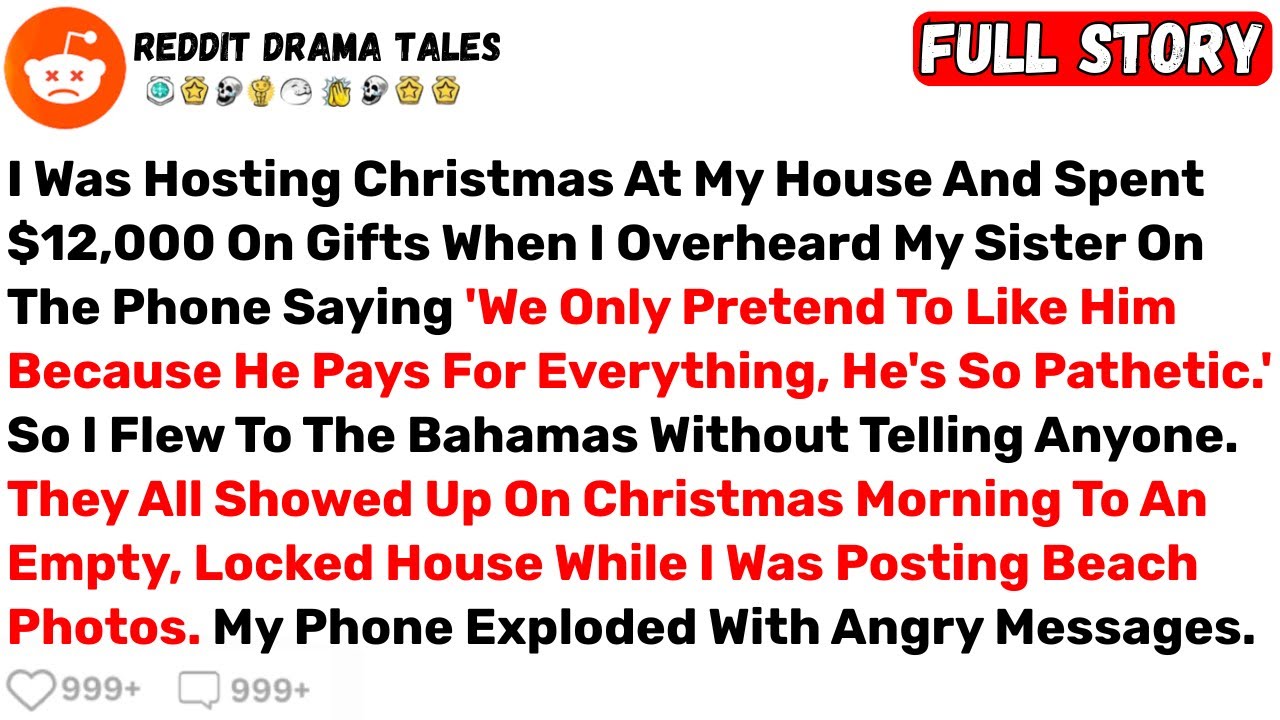
I went all in—full decor, custom stockings, a catered meal, and I dropped twelve thousand dollars on gifts. I wanted it to be perfect. I hoped that if I gave enough, they’d finally see me, not just the wallet. The week before Christmas, Vanessa stayed over early, claiming she wanted to help.
One night, I passed her door and heard her talking on the phone, loud enough to be overheard. I froze when I heard my name. “We only pretend to like him because he pays for everything,” she said, with a fake breathy laugh. “It’s kind of pathetic.
”
My heart pounded. My brain tried to explain it away, but then she added, “I mean, don’t get me wrong, I love how generous he is. But if he stopped paying for stuff, what would even be the point? ”
She was on speaker with our cousin Ashley.
I heard Ashley chime in, “He’s like the family ATM. I don’t even think he realizes it. ”
Then Vanessa said, “Ugh, I just hope he got me the right version of the Dyson. If it’s the cheap one, I’m leaving it behind.
”
I backed away and sat in the dark hallway for what felt like hours. I didn’t sleep that night. By morning, I made a quiet, cold decision. I had five days until Christmas, and for once, I wasn’t going to say yes.
I pretended nothing was wrong. I smiled, I cooked, I let Vanessa use my Amazon Prime account. Two days later, Ashley arrived early with her boyfriend. Without even saying hi, she whipped out her phone and said loudly, “I told you he’s so extra.
Wait till you see the gifts. He probably spent five figures again. He’ll cry if we don’t do a group photo. ”
By Christmas Eve, the house was full.
Vanessa invited three friends without asking. One of them used my toothbrush and laughed about it. Uncle Peter stumbled in drunk, knocked over the nativity set I’d spent an hour arranging, and said, “Man, you’ve really gone soft since high school. You were cooler when you had a backbone.
”
I barely slept that night. My house didn’t feel like mine anymore. It felt like I was renting it to strangers who saw me as staff. Then came Christmas morning.
I woke up early, loaded my bags into the car, and booked a flight to Nassau. I had a beachfront villa for the week. I didn’t want a scene. I wanted silence.
Before I left, I stayed just long enough. Vanessa walked down the stairs in her silk robe and said, “Ugh, where’s the coffee? I thought David always made it. ”
I stepped into the room.
“I’m leaving. ”
“Leaving where? ”
“Vacation. Merry Christmas.
”
Her jaw dropped. “You’re joking. You can’t just leave. Everyone’s coming over.
The presents, the food. You said you were hosting. ”
I walked past her, opened the front door, and drove away. Two hours later, at the airport, my phone buzzed.
It was a text from Vanessa: “Where did you put the gifts? You better not have taken them with you. ”
I typed back: “They’re under the tree. ” I lied.
Before I left, I’d moved every present into a locked storage closet in my basement. Fifteen minutes later, my phone exploded. Call after call from Vanessa, my mom, Ashley, even Uncle Peter. Then the texts poured in.
“Open the damn door or I’m calling the cops. ”
I posted a single selfie to the family group chat—me on the tarmac, palm trees in the distance. “Merry Christmas from the Bahamas. ”
Chaos.
Accusations. Cruelty. I locked my phone and boarded the plane. But the real betrayal came later that evening, once I landed and opened my phone again.
There was a voicemail from my mom. Her voice was shaking, not with sadness, with rage. “You embarrassed me in front of everyone,” she snapped. “You humiliated your sister.
After everything we’ve done for you, this is how you repay us? You’re not the generous man you think you are, David. You’re just a sad little boy who needs to buy love because he never learned how to earn it. ”
I sat there frozen, not because her words hurt, but because I realized she believed them.
That I owed them. That my pain didn’t matter. They didn’t just take me for granted—they resented me for it. I spent the rest of that Christmas day in silence.
No beach walk, no celebratory rum punch. I lay on my side, fully clothed, staring at the ceiling fan. I thought about the graduation party I paid for, the mortgage payments I covered, every moment I handed over my time and money like a receipt for belonging. I’d built a house of cards made of approval, and it collapsed with one voicemail.
The next morning, I stepped outside for the first time. The villa opened onto a private stretch of beach. No tourists, no demands, no interruptions. I didn’t have to perform.
I was free. And it terrified me, because I didn’t know who I was outside of them. So I started small. I made breakfast just for me.
I went for a swim. I read books I hadn’t touched in years. I journaled. I even drew one night—badly—but it reminded me that once, before the family chaos, I wanted to be an illustrator.
That version of me had been buried under invoices and expectations. I posted a single photo on day three: a seashell in my palm. “Not everything beautiful has to be earned. ” I didn’t tag anyone.
I didn’t check comments. The messages began to die down. Vanessa posted a dramatic story about being abandoned on Christmas, but I didn’t engage. I knew the truth now.
They needed me to stay small so they could feel bigger. The turning point came on the fifth night. I was walking down the beach at sunset, watching a group of kids build a sandcastle while their dad snapped photos. It hit me like a wave.
I wanted the freedom to build something for myself—something joyful, something real. When I got back to the villa, I made a list. I titled it “Things I gave away too easily. ” Money, time, holidays.
Then it got deeper. Self-worth, boundaries, creative dreams. By the end of the page, I was crying. Not because I was sad, but because I was angry at myself for how long I let it happen.
Beneath the list, I wrote in big letters: NO MORE. When I returned home a week later, the house was exactly as I’d left it—untouched, clean, peaceful. I returned almost all the gifts. I stopped answering Vanessa’s texts.
I left the family group chat. When my mom called a week later, I let it ring out, then sent a short message: “I need time to heal. Please respect that. ” She didn’t reply.
For the first time, her silence didn’t hurt. In the months that followed, I started therapy. I picked up a sketch pad again. I joined a local hiking group and made a few friends who liked me for me.
One of them was a woman named Marissa, who asked about the sketch I was holding at an art exhibit. When I told her about the Bahamas and the whole saga, she didn’t pity me. She said, “Good. It’s about time someone did what you did.
”
Rock bottom wasn’t the end. It was the door—the one I had to hit. So I finally stopped knocking on all the wrong ones. What truly snapped something in me wasn’t the voicemail or the guilt texts.
It was what came a month later. I got a letter in the mail from my mother. It wasn’t an apology. It was a request.
She was planning Vanessa’s thirtieth birthday party, and she wanted me to host it at my house. Not if I wanted to. She wrote, “We are assuming you’ll do it since your place is the nicest and you’ve always been the most organized. ” She listed the expected headcount—forty-plus—menu themes, decor packages I could purchase.
A PS at the bottom: “Please don’t be dramatic like Christmas. Vanessa’s been through enough. ”
I stared at that letter for ten minutes, then laughed. I laughed so hard I had to sit down.
And then I got very, very quiet. I wasn’t going to burn bridges. No, I was going to rebuild one so I could walk them across it and pull the support beams out from underneath them at the perfect moment. I wrote my mother back on thick ivory stationery.
“Dear Mom, thank you for the letter. I’d be happy to help host as long as a few ground rules are respected. I’ll handle the house, but I’d like to delegate the gift coordination, decorations, and entertainment. Let me know if that works.
Warmly, David. ”
It looked polite on the surface, but it was laced with quiet control. I was saying yes, but on my terms. She texted me two days later: “So glad you’re back to normal.
Vanessa will be so touched. ”
Back to normal. That phrase sat with me like a bitter pill. They still didn’t get it.
But they would. Over the next few weeks, I prepared like a general. I made spreadsheets. I mapped out roles.
I cherry-picked the guest list—not for who they wanted, but who I needed. People who liked drama, who loved to talk, who would spread a story like wildfire. I started with Ashley. I took her to brunch, paid for everything, dropped hints about how much I’d spent over the years, how Vanessa never thanked me, how this might be my last big thing before stepping away.
I played humble and vulnerable just enough for her to sniff a secret. Then I reached out to my cousin Liam, the black sheep, the one always talked over at gatherings. I asked if he wanted to help me film the party as a “family documentary. ” He was a film student who always felt overlooked.
He lit up. I bought him a 4K camera and audio gear. “Just shoot everything,” I told him. “We’ll cut it down later.
”
I also invited people from Vanessa’s past—not enemies, but people she’d used and ghosted. An old roommate she stiffed on rent. A former friend she called trashy. I told them Vanessa wanted to reconnect with everyone from her journey.
Most RSVP’d yes. Curiosity is a powerful thing. The party planning moved like a machine. Vanessa barely lifted a finger.
She sent Pinterest boards and texts like, “Can we do an all-white theme? I want to feel expensive. ” I said yes to everything. I wanted her comfortable, convinced I’d slipped back into my old role.
Meanwhile, I planted seeds everywhere. I casually shared old receipts. “Did you know I spent three thousand two hundred dollars on her graduation party? Crazy, right?
” Or, “I once covered her rent for four months when she didn’t tell anyone she’d lost her job. ” I never sounded bitter, just like someone finally connecting the dots out loud. Ashley texted me late one night: “Vanessa told me you never helped her financially. Is that true?
” I responded with a screenshot of a Venmo transfer labeled “rent – April. ”
Silence. Then: “Yikes. She said you were just trying to buy her love.
”
I didn’t respond. Three days before the party, I pulled the final string. I scheduled a delivery to my front door—a beautiful white envelope, hand-lettered. Inside was a printed speech I was going to give at the party, addressed to Vanessa.
It started with praise, sweet memories, childhood stories. Then halfway through, it shifted. It listed every dollar I’d spent. Not angrily—just factually, just documented.
Then it spoke about love, and how real love doesn’t come with conditions, and how sometimes the people who give the most are the ones you see the least until they’re gone. I had no intention of reading it aloud. But I wanted her to wonder. She read it.
Ashley confirmed it. Vanessa called her crying that night. “He’s going to embarrass me. He’s going to make me look ungrateful.
”
And Ashley, God bless her, responded, “Well, are you? ”
The day of the party arrived. The house looked perfect—white roses, crystal glasses, soft music. I was dressed in a crisp navy suit, smiling, hosting, pouring champagne like nothing had changed.
Vanessa walked around like she owned the world, hugging people she hadn’t spoken to in years, dropping names, tossing her hair over her shoulder like she was walking a red carpet. She hugged me and whispered, “You didn’t have to go all out like this, but I’m glad you did. ”
I just smiled. “Of course.
You deserve it. ”
She beamed. She had no idea. Around nine, we gathered everyone around the pool for the toast.
Vanessa stood on the raised stone platform, arms open wide, bathed in candlelight. She tapped her glass. “I just want to say,” she began, her voice slightly slurred, “this is honestly one of the most amazing nights of my life, and I owe it all to my big brother, David. You’ve always gone above and beyond for me.
You’re like my guardian angel or something. ”
Everyone clapped. Someone shouted, “Speech! ” Others joined in.
She turned to me, giggling. “Come on, David. Say something. ”
I stepped forward slowly, feeling my heartbeat in my ears.
Liam was behind me, camera rolling. “Vanessa, you’ve always had a way of making an entrance,” I said. She laughed. The crowd laughed.
“I’m not usually the one holding the microphone, but tonight I wanted to do something a little different, because turning thirty is a milestone, and you only get one shot to say something that really matters. ”
The crowd went quiet. I reached into my pocket and pulled out a small stack of thick, cream-colored envelopes tied with a gold ribbon. “Tonight, I want to give you a gift that isn’t on your wish list.
In fact, it’s not just for you. It’s for all of you. ”
Vanessa shifted. “Wait, what’s going on?
”
I handed envelopes to Liam and motioned for him to pass them around. “Inside these envelopes are receipts, literal and emotional. These are records of the last ten years—what I’ve spent, what I’ve covered, what I’ve forgiven. There’s no shame in them.
No bitterness. Just truth. Because sometimes we get so comfortable being taken care of, we forget to ask what it’s costing the other person. ”
Vanessa stepped forward, eyes wide.
“David, what is this? ”
I met her gaze. “A mirror. ”
Some guests were already reading.
The whispers spread. Liam kept his camera aimed at Vanessa as she flipped open an envelope and scanned the pages. Her face drained of color. “What is this supposed to be?
” she said, her voice rising. “This is petty. This is manipulative. You’re making me look like a monster.
”
“No,” I said calmly. “You did that all by yourself. I’m just turning on the lights. ”
Gasps rippled through the crowd.
One of Vanessa’s old roommates held up a page. “Is this real? You paid her rent for six months? ”
“Ten,” I said softly.
“The sixth was just the last I could prove. ”
Vanessa’s jaw tightened. “Why are you doing this on my birthday? ”
“Because you made Christmas about yourself,” I said.
“And when I finally stood up for myself, you told everyone I was heartless, that I abandoned the family, that I was pathetic. I overheard the phone call, Vanessa. I heard you say you only pretend to like me because I pay for everything. ”
Silence.
Then Ashley said under her breath, “He’s not lying. ”
Vanessa turned to her. “Excuse me? ”
Ashley crossed her arms.
“You’ve said worse. Don’t act surprised. You’ve been using David for years, and you know it. ”
The guests looked around uncomfortably.
One by one, the illusion unraveled. People began backing away. Some returned the envelopes to me quietly, nodding in understanding. Others looked at Vanessa with a mixture of pity and disbelief.
My mother stepped forward to save face. “David, this was cruel. I don’t know what you think this accomplishes. ”
“I think it accomplishes freedom,” I replied.
“For the first time in my life, I’m not hiding behind my own generosity. I’m showing my work, and if that makes people uncomfortable, so be it. ”
She tried to speak again, but I held up a hand. “No more guilt, Mom.
No more manipulation. I’m not the family vault. I’m not your safety net. I’m a human being, and I’m done being quiet about how much I’ve given.
”
Then I turned to the guests, holding my glass. “To anyone here who ever wondered if I was okay, thank you. I’m doing better now than I ever have. I don’t need applause.
I just need space. ”
I raised the glass. “To truth. ”
A few people clinked theirs in return.
Others stood frozen. Vanessa looked stunned, her bottom lip quivering—not from sadness, from rage. “You ruined my birthday,” she spat. “No,” I said.
“I redefined it. ”
I walked back inside. I didn’t slam the door. I didn’t shout.
I just left them blinking in the glow of fairy lights and the weight of exposure. Later that night, after the guests trickled out and the house was silent again, I stood by the window and watched Vanessa leave with her heels in her hand, mascara streaked, arguing with my mother as they got into a car. Liam stayed behind. He handed me the camera footage.
“You want me to edit this? ” he asked. I shook my head. “No.
Just keep it. One day I might. ”
He nodded and left quietly. I poured myself a glass of whiskey, sat on the couch, and let the silence settle like dust.
It was over. No more pretending. No more performance. I’d pulled back the curtain, and I hadn’t lost myself in the process.
For once, they weren’t the loudest voices in the room. I was—and I didn’t raise my voice to do it. Sometimes, the most powerful revenge isn’t destroying someone.
It’s making sure they finally see themselves.