“Ma’am,” the bank officer said, not even looking up from his screen. “According to our records, you’ve been divorced for eight months. ”
I didn’t move. I didn’t blink.
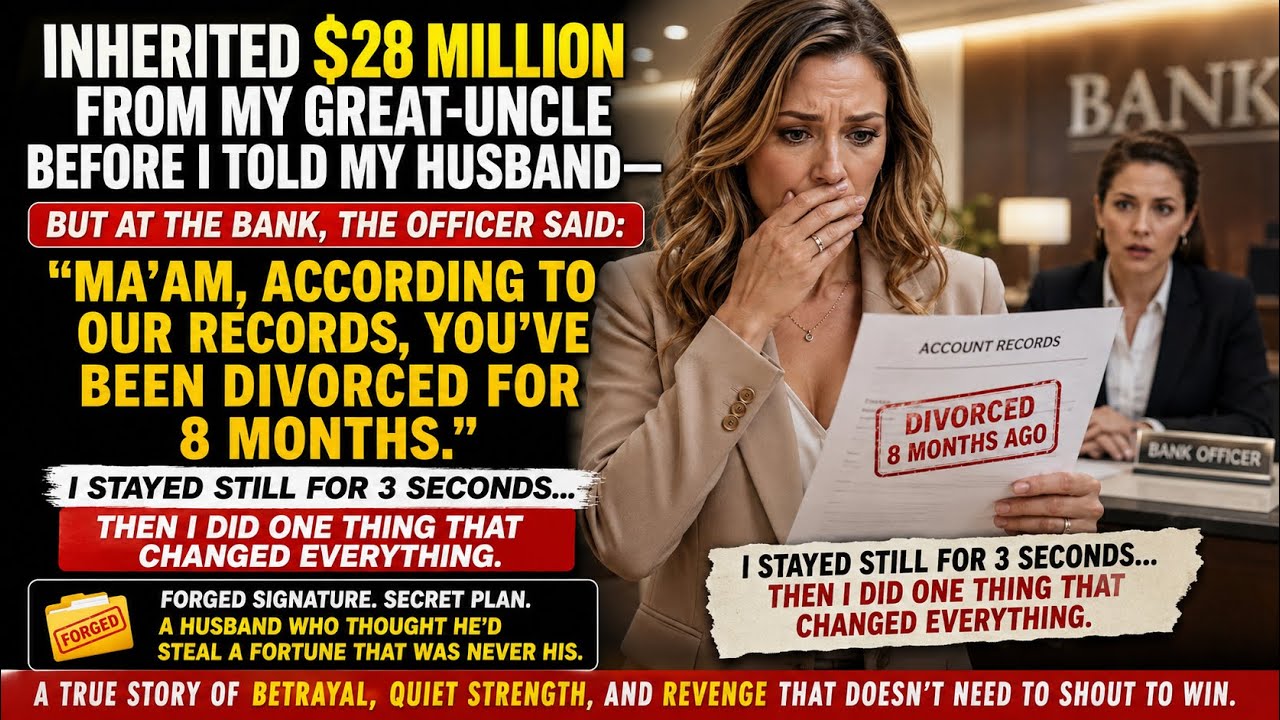
For three full seconds, I just sat there, my hands resting on the folder that held the biggest news of my life — a $28 million inheritance I hadn’t even told my husband about yet. Divorced. Eight months. I was still wearing my wedding ring.
I had made my husband breakfast that morning. And according to a bank in the city where I’d lived my whole married life, I wasn’t his wife anymore. I smiled at the officer. I thanked him for the information.
Then I asked him, very calmly, to print me a copy of that record. That one request changed everything. My name is Elena. Six years ago, I married a man named Marcus.
We weren’t rich — we weren’t even comfortable. Marcus worked in insurance sales; I taught third grade at a public school. We lived in a small rented house, drove used cars, and counted every dollar before the fifteenth of the month. What we did have was my great uncle, Walter.
He was my grandmother’s brother, a quiet man who’d built a shipping and logistics company from nothing. Most of my family had drifted away from him over the years. He was difficult and blunt and had no patience for people who only called when they needed something. But I visited him.
Not because I wanted anything. I visited because when I was a little girl, he was the only person who ever sat with me for hours and just let me talk. When he passed away that spring, I cried for him — not for what he had. I didn’t even think about money.
I only found out weeks later, through his estate lawyer, that he’d left almost everything to me. Twenty-eight million dollars, held in trust, with one condition written into the paperwork that I didn’t fully understand yet — a condition about my marital status. I decided I wanted to tell Marcus in person, calmly, once everything was confirmed. I didn’t want money to change how we talked to each other.
So I kept it quiet for two weeks while the lawyers finished the paperwork. That silence, it turned out, gave someone else time to move first. The lawyer told me I needed to open a new account before the trust could release the first transfer. So on a Tuesday morning, I walked into the bank with my ID, my marriage certificate, and a folder full of documents, expecting a routine appointment.
That’s when the officer said the sentence that stopped my heart. *You’ve been divorced for eight months. *
I asked him to explain. He turned his screen toward me.
There it was — a filing date, a case number, and a signature that looked almost exactly like mine. But it wasn’t mine. I had never signed divorce papers. I had never even sat down with a lawyer to discuss one.
As far as I knew, Marcus and I were happily married, arguing over whose turn it was to do the dishes — not over lawyers and court dates. Someone had filed for divorce using my name eight months earlier. And I had never even known. I left the bank that day holding a copy of a divorce decree I had never agreed to.
Instead of going home, I drove straight to my uncle’s estate lawyer, a sharp older woman named Ms. Whitcomb, who had handled Uncle Walter’s affairs for twenty years. She was the one who finally explained the condition in the trust that I’d skimmed past without understanding. Uncle Walter had written a clause into his will, born from decades of watching relatives lose family fortunes in ugly divorces and legal disputes.
His trust stated that any heir must be unmarried at the time the inheritance transferred, to keep the money fully protected and outside of any spouse’s legal claim. Ms. Whitcomb looked at the forged decree in my hands, then looked at me, and asked a question that made the room go cold. “Elena — did your husband know about this inheritance before you did?
”
I thought about it. I remembered that his cousin worked as a paralegal at a firm two floors below Uncle Walter’s lawyer’s office. They had lunch together sometimes. Marcus had mentioned it once, months ago, almost in passing.
He had known. And somehow, eight months ago, a fake divorce had appeared with my name on it. That night, I didn’t confront Marcus. I made dinner like any other evening, and I watched him closely instead.
I noticed things I had brushed off before — a new phone he was strangely private about, a folder in his desk drawer he always kept locked, a habit of stepping outside to take certain calls. Quietly, over the next several days, I gathered what I could. I hired a lawyer of my own — a calm, thorough man named Mr. Alvarez — and I told him everything.
He explained something I hadn’t considered. Filing a fraudulent legal document, forging a signature on a court filing — that wasn’t just a betrayal. It was a crime. Mr.
Alvarez helped me request the full case file from the court. What we found was worse than I expected. Marcus had used a low-cost paperwork service to file an uncontested divorce in my name, using a signature he’d clearly traced from an old document of mine. The case had gone through quietly because I never contested it — because I never even knew it existed.
The final piece fell into place when Mr. Alvarez explained Marcus’s likely plan. If I was legally divorced when the trust paid out, the twenty-eight million would be fully protected in my name alone, exactly as Uncle Walter intended. Marcus was betting that once the money cleared and the trust conditions were satisfied, he could simply suggest we get remarried — framing it as romantic, a fresh start — while quietly asking me to sign a new agreement afterward that would give him a claim to half of everything I now owned.
He hadn’t left me. He had erased me on paper, just long enough to steal a door into my fortune. I’ll admit, in that first week, I wanted to scream at him across the kitchen table. I wanted to throw the forged papers in his face and demand answers right then.
But I kept thinking about those three seconds at the bank — the stillness I felt before I chose to stay calm and ask for a copy instead of causing a scene. That stillness had already worked for me once. So I decided to use it again. I didn’t tell Marcus I knew.
I let him keep believing his plan was working perfectly. I let him bring home flowers for no reason. I let him start dropping little hints about how much he missed being married to me, about maybe having a small ceremony again someday, just for us. Every conversation, every hint — Mr.
Alvarez helped me document it. We built a clear timeline: the forged filing, the timing of his cousin’s inside knowledge, his sudden interest in remarriage right as the trust neared release. It was no longer just a suspicion. It was evidence.
The trust finally cleared. The twenty-eight million dollars moved into an account with only my name on it, exactly as Uncle Walter had planned. Two days later, Marcus sat me down at that same kitchen table, took my hand, and asked me to marry him again. Properly this time — as if we were starting a beautiful new chapter.
I let him finish. I let him hold my hand through the whole speech. Then I placed a folder on the table in front of him. The forged divorce decree.
The paralegal cousin’s messages Mr. Alvarez had legally obtained. A formal letter from my lawyer. “Marcus,” I said quietly, “I know about the divorce you filed eight months ago.
The one with my forged signature on it. ”
His face went pale. He tried to explain, tried to call it a misunderstanding, a paperwork mix-up. But there’s no innocent explanation for tracing someone’s signature onto a legal filing sent to a courthouse.
I told him the truth as calmly as I could. He had already legally divorced me on paper before the trust paid out. The inheritance was mine alone, protected exactly the way my uncle intended. His scheme had accidentally sealed the money away from him forever.
And now, thanks to the evidence my lawyer had gathered, he was facing something far more serious than losing access to my money. He was facing a real investigation into forgery and fraud. I didn’t seek anything dramatic. I didn’t need to raise my voice or throw anything across the room.
I simply let the truth and the law do what they were designed to do. Marcus lost far more than access to twenty-eight million dollars that was never his to begin with. He lost the trust of everyone who found out what he had done. The forged filing became a legal matter handled by prosecutors, not by me.
I moved into a life that was, for the first time, entirely my own — one where my name on a document actually meant something true. I used part of the inheritance to set up a small scholarship fund in Uncle Walter’s name, for kids who — like me at nine years old — just needed one adult willing to sit with them and listen. I kept teaching for a while longer. Not because I needed the paycheck, but because it reminded me who I was before any of this happened.
Looking back, I think about those three seconds in the bank more than I think about the money. In that pause, I chose not to react with anger, but with patience and quiet strength. That pause gave me time to see the whole truth clearly instead of reacting to only half of it. Sometimes the biggest betrayals don’t come with shouting or slammed doors.
Sometimes they come quietly, on a piece of paper, months before you even know to look for them. And sometimes the calmest response — staying still, staying sharp, and letting the truth surface on its own — is the strongest revenge of all.


