The wine hit my face before I even saw his hand move. Cold, red, dripping down my cheek onto the diamond necklace he’d bought me three years ago, onto the white dress I’d picked out that morning, humming, actually humming, because I thought tonight was going to be beautiful. Two hundred guests went silent. Crystal glasses froze halfway to lips.
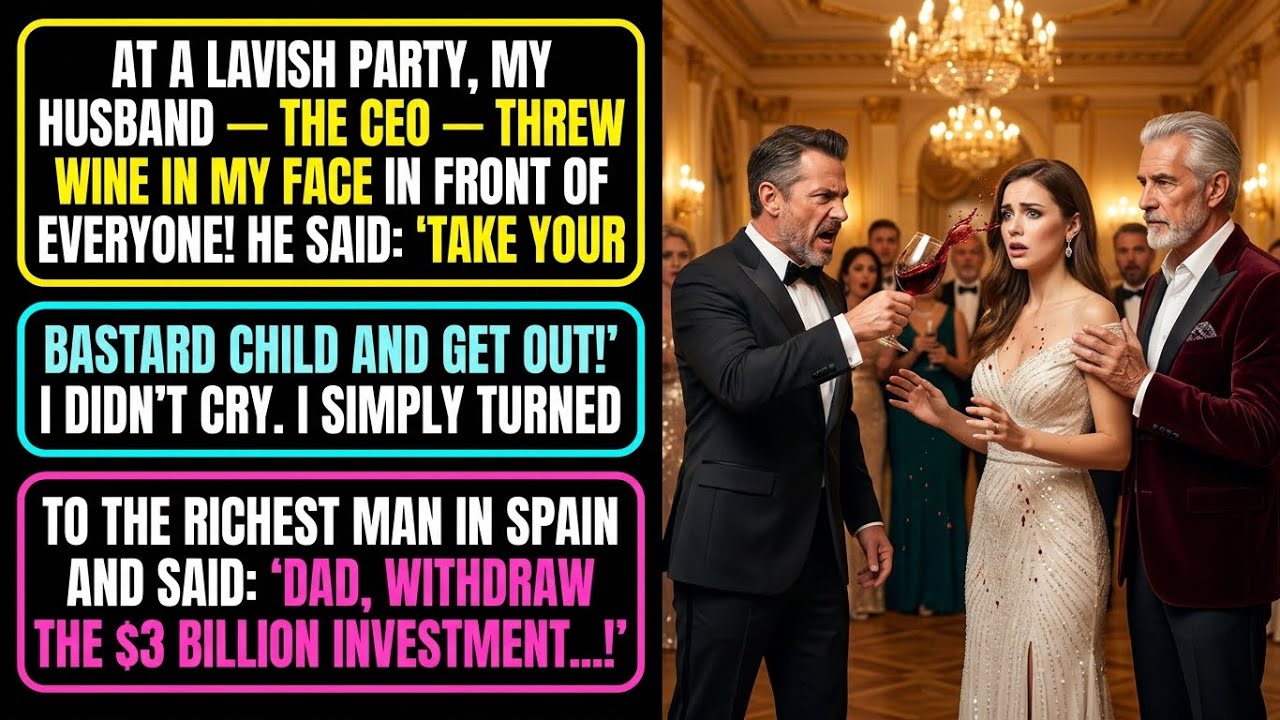
A string quartet stopped mid-note. My husband, Julian Marsh, CEO of one of the fastest-growing shipping empires in Europe, stood in front of everyone. His face was twisted with a rage I had never seen even after five years of marriage. “Take your bastard child,” he said, loud enough for every camera phone in that ballroom to catch it, “and get out of my house.
”
I didn’t cry. I wiped the wine from my cheek with the back of my hand and turned not to him, not to the doors, but to the tall silver-haired man standing three feet away, the man everyone in that room had spent all night trying to shake hands with. “Dad,” I said calmly, “withdraw the three billion dollar investment. ”
The room didn’t just go quiet.
It stopped breathing. Because nobody in that ballroom, including my husband, knew who my father really was. And in about ten seconds, his entire company was going to find out. My name is Elena Marsh.
Before that night, most people at that party knew me as Julian’s quiet, pretty wife, the one who smiled at galas, signed thank-you cards, and never said much in board meetings. What they didn’t know was my maiden name: Elena Duarte. Daughter of Rafael Duarte, a man Forbes had once called the most private billionaire in Spain. My father built a shipping and logistics fortune from nothing and did it by staying completely out of the spotlight.
No interviews. No photos at galas. Just quiet, devastating business instincts. When I met Julian six years ago, I never told him who my father was.
I wanted, for once in my life, to be loved for me, not for what I could open doors to. So I used my mother’s maiden name, Elaine Vance, when we met at a charity dinner. I let him believe I was a marketing coordinator with a modest inheritance. We fell in love.
Or at least, I did. Two years into our marriage, Julian’s shipping company hit a wall. Contracts fell through. Investors pulled out.
He was one bad quarter away from losing everything his family had built. That’s when, quietly, without ever telling him the real reason, I picked up the phone and called my father. “There’s a company that needs saving,” I told him. “Will you look at it?
”
My father, who trusted my judgment more than anyone alive, agreed. Three billion dollars, structured through an investment holding company with a name Julian never bothered to trace back to Spain, poured into Marsh Shipping over the following years. It saved his company. It made him a legend in his industry.
He never knew his wife was the reason he still had a business. Success changed him. Slowly, then all at once. The Julian who used to bring me coffee in bed started coming home at midnight smelling of perfume that wasn’t mine.
The man who once said my quiet nature was peaceful started calling it boring in front of his colleagues. He started going to dinners without me. Business trips got longer. Phone calls got shorter.
I found out I was pregnant the same week I found lipstick on his collar that wasn’t a shade I owned. I told myself it was stress. I told myself new fathers get scared. I told myself a lot of things, because the truth was too heavy to hold alone.
Our daughter, Mia, was born the following spring. Julian held her once in the hospital, took a photo for social media, and left for a meeting two hours later. By the time Mia turned two, the whispers among his staff had grown too loud to ignore. His assistant, a young woman named Priya, was suddenly attending every dinner, every trip, every event I wasn’t invited to.
I asked him once, gently, if something was going on. “You’re imagining things,” he said. “You always do. ”
That phrase, “You always do,” became his answer to everything.
My exhaustion after childbirth. My questions about late nights. My hurt when he forgot our anniversary two years running. I started to believe him.
I started to believe I really was the problem. I didn’t know yet that the party, his company’s biggest gala of the year, the night meant to celebrate five years of growth funded by my father’s money, was going to be the night everything I’d been ignoring exploded into the open. The gala was Julian’s idea of a victory lap. Five hundred guests.
A ballroom in gold light. Half the city’s business elite in one room. My father had flown in quietly the day before, not for the party, but to see his granddaughter, whom he adored. I hadn’t planned to bring him.
He insisted. “I want to see how he treats you when the cameras are on,” my father said simply. I should have listened to the weight in those words. Mia stayed home with her nanny.
I wore white. Julian barely looked at me when we arrived, already deep in conversation with investors, his hand resting a little too comfortably on Priya’s lower back as he introduced her as his head of strategic partnerships. I smiled through it. I always smiled through it.
Then, near the dessert table, I heard Priya laugh at something and say, just loud enough, “When are you finally going to tell her about us? ”
Julian didn’t deny it. He just looked annoyed that she’d said it out loud. I walked toward him, my heart hammering, and asked quietly if we could talk.
That was my mistake. Asking quietly in front of people for the truth. Because Julian, three drinks deep and terrified of losing face in front of his biggest investors, didn’t answer quietly. He grabbed the wine glass from the waiter’s tray.
And he threw it. “Take your bastard child,” he said, “and get out of my house. ”
He said it because he wanted witnesses to believe I was the liar, the embarrassment, the problem. He said it because two years of guilt needed somewhere to go, and he chose to aim it at me in front of everyone who mattered to his career.
He had no idea he had just said it in front of the one man who could end that career in a single phone call. I stood there, wine running down my dress, and for one long second, the old version of me, the one who apologized for things that weren’t her fault, almost surfaced. Then I looked past Julian’s shoulder and saw my father’s face. Not angry.
Not shouting. Just still, in that terrifyingly calm way he got right before he made a decision that couldn’t be undone. I turned to him. “Dad,” I said, my voice steady even though my hands were shaking, “withdraw the three billion dollar investment.
”
For a moment, nobody moved. Then a ripple of confusion spread through the crowd. “Dad? ”
People began whispering.
Phones quietly turned to record. Julian’s face went from fury to confusion to something close to panic. “What is she talking about? ” he said, laughing nervously toward his board members.
“She doesn’t know anything about the business. ”
My father stepped forward. And when Rafael Duarte spoke, rooms listened. “Julian,” he said.
“I don’t believe we’ve been properly introduced. Rafael Duarte. I own Duarte Holdings, the fund that has provided seventy percent of your company’s expansion for the last three years. ”
The color drained from Julian’s face.
“And this,” my father continued, gesturing to me, “is my daughter, Elena Duarte. The bastard child you just insulted is my granddaughter. ”
Julian’s mouth opened, but nothing came out. Around him, his board members, the very investors he’d spent all night impressing, began stepping backward.
Phones lowered. Faces went pale, as the truth rearranged everything they thought they knew about the man they worked for. “You’ve had three billion reasons to treat my daughter with respect,” my father said, “and you chose to humiliate her in front of five hundred people instead. So, effective immediately, Duarte Holdings is beginning the formal withdrawal of its investment from Marsh Shipping.
”
“Wait, Rafael, please. We can talk about this. ”
Julian’s voice cracked. All his composure was gone.
“You had five years to talk to me,” my father said. “You chose tonight instead. ”
I watched the man I had loved for six years shrink in real time. Watched him realize that every contract he’d signed, every expansion he’d bragged about, every dollar of the empire he was so proud of had my name quietly written underneath it the entire time.
Priya had already slipped toward the exit, her face a mixture of shock and calculation, clearly reassessing whether the man she’d been sleeping with was still worth the trouble now that his company was collapsing in real time. I didn’t gloat. I didn’t need to. I simply picked up Mia’s diaper bag from where I’d left it by the coat check earlier.
A small, deliberate detail. Because some part of me had already known I wasn’t going home with him that night. And I walked out on my father’s arm, my head high, the wine still drying on my dress like a badge instead of a stain. The withdrawal of three billion dollars doesn’t happen quietly.
Within seventy-two hours, news outlets were reporting on the sudden collapse of Marsh Shipping’s primary funding partner. Julian’s remaining investors, spooked by the public scene and the financial exodus, began pulling out one by one. Within six weeks, Marsh Shipping filed for restructuring. Within four months, Julian had lost his title, his company, and the mansion he’d once told me was too good for a girl like me to fully appreciate.
He tried calling me dozens of times. He showed up outside my father’s estate once, and security politely turned him away. He wrote a long email eventually, full of apologies that arrived five years too late, asking if there was any way to fix things for Mia’s sake, if not his own. I didn’t hate him by then.
Hate takes energy I no longer wanted to spend on him. I simply replied with one line: “Mia will always have a father who loves her. She just won’t have one who lied to her mother. ”
I filed for divorce the following week.
Custody was never a real fight. The video from the party and Priya’s own public statements to a tabloid trying to sell her side of the story made sure of that. I think about that night sometimes. Not the wine.
Not the humiliation. But the moment right after, when I had a choice. I could have run. I could have cried and let him see exactly how much he’d broken me.
Instead, I chose to stand in the truth I’d been hiding for six years. That I was never small. I was never just his quiet wife. I had simply chosen, out of love, to make myself smaller than I was.
And love like that, the kind that asks you to disappear, was never love worth keeping. If there’s one thing I’d want anyone watching this to remember, it’s this: the people who humiliate you in public are almost always terrified of what you’re capable of in private. Don’t ever let someone convince you that your silence is the same thing as your weakness. Sometimes the strongest thing you can do isn’t to shout back.
It’s to calmly say six words, and let the truth do the rest.