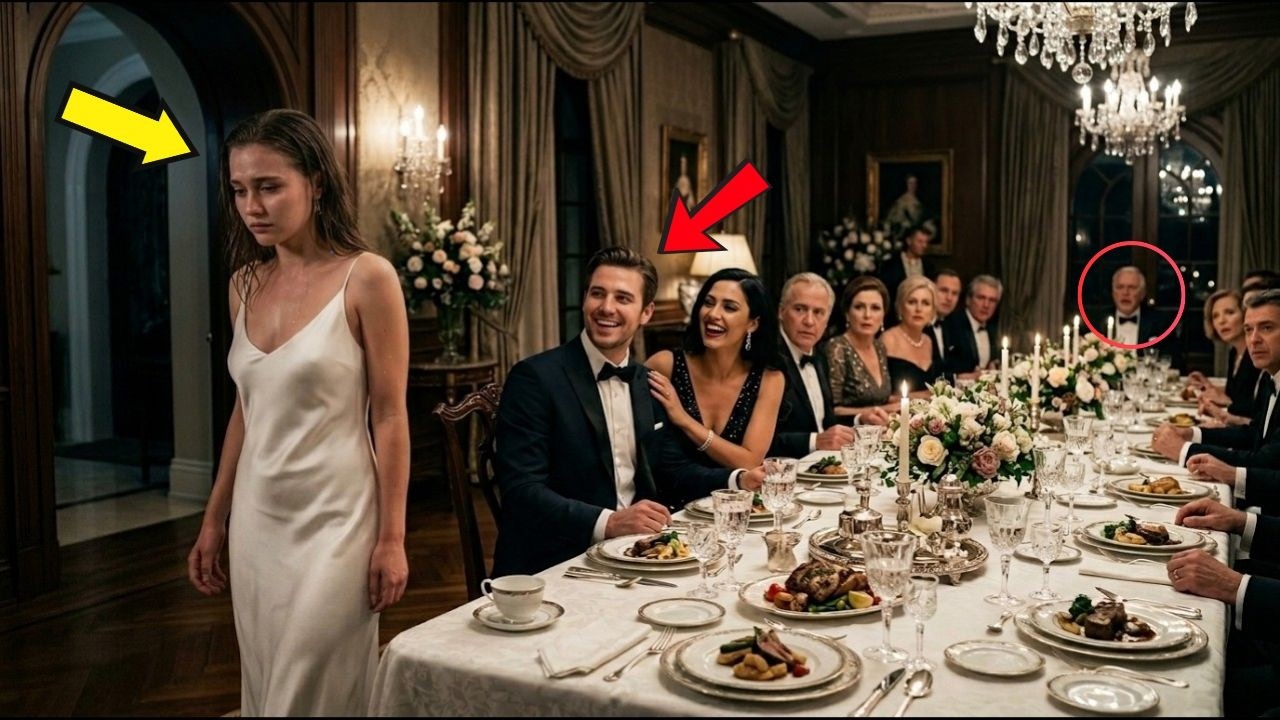
We were sitting at dinner on an ordinary Tuesday evening when Daniel mentioned, casually, that he’d stopped by the office after work. That was why he’d been running two hours late. I nodded and accepted the explanation without a second thought, the way I always did. Then my seven-year-old daughter, Emma, reached across the table, tugged gently on my sleeve, and whispered two words I will never forget.

“Daddy lied. ”
I froze. I looked at my husband, who simply smiled and asked, “What? ” Emma immediately looked down at her plate.
I asked her as gently as I could what she meant. She whispered, “Daddy wasn’t at the office. ”
I wanted to believe she was confused. She was only seven, and children misunderstand things all the time.
But three days later, I found a receipt that made me realize my daughter hadn’t been confused at all. My name is Rachel Bennett, and I’m thirty-six years old. I work as a financial analyst outside Charlotte, North Carolina. It’s a career that trained me to notice small inconsistencies in numbers, patterns that don’t quite add up.
That skill turned out to matter far more in my personal life than I ever expected. Daniel and I had been married for nine years. He works as a regional sales director, charming and dependable in the way that made people trust him instantly. The kind of husband who remembered anniversaries and showed up for birthday parties and school pickups.
We had built, or so I believed, a comfortable, stable suburban life together. Looking back, there were small things I’d noticed over the previous year. Daniel’s phone had started staying face down on the counter. He occasionally worked later than his schedule seemed to require.
There were small unexplained expenses on our joint statements, amounts I’d ask about and receive vague, plausible-sounding answers. “It’s just work,” he’d say, and I’d let it go. Mostly because I didn’t want Emma growing up in a home defined by constant tension. I told myself I was choosing peace.
Looking back, I understand I was choosing not to look too closely. The evening everything began to unravel started ordinarily enough. Daniel arrived home nearly two hours late, explaining he needed to stay at the office to finish something up. I mentioned he hadn’t said anything about it that morning.
“It came up,” he said with the same easy, unbothered tone. Then Emma spoke up quietly from her seat. “Daddy wasn’t at the office. ”
I asked how she knew that.
“I saw him,” she said, but wouldn’t explain further, growing visibly uncomfortable when I pressed gently. I made a deliberate choice not to push her. I didn’t want to turn my seven-year-old into an unwilling investigator. I let the conversation move on, though something about it stayed with me for the rest of the evening.
Three days later, I was cleaning out Daniel’s car, gathering the accumulated clutter of coffee cups and gas receipts. Beneath the passenger seat, I found a crumpled receipt. It was from an upscale hotel, dated the exact evening Daniel had claimed to be working late. The timestamp read 7:42 p.
m. I remember him telling me that same evening he’d been stuck in a conference call until almost 9. The receipt was oddly specific in a way that didn’t fit the shape of a simple affair. It listed dinner for two, a purchase from what appeared to be a children’s gift shop inside the hotel, and a parking fee.
The children’s gift purchase caught my attention most sharply. I asked him about it casually a few days later, busying my hands with folding laundry so I didn’t have to look at him directly. “Did you go somewhere after work on Tuesday? ”
“No,” he said immediately, without a flicker of hesitation.
I watched his face carefully. Something in that easy, instant denial told me clearly that this wasn’t confusion. He wasn’t uncertain. He was lying deliberately and smoothly, in a way that suggested he’d had practice.
I sat with Emma that evening, choosing my words carefully. “Sweetheart, when you said Daddy lied, what did you see? ”
She was nervous, twisting the hem of her shirt before finally answering. I told her, “You’re not in trouble, sweetheart.
I just want to understand. ”
She explained that she’d been in the car with Daniel earlier that week. He told her they were going to pick out something special for me. Instead, he took her somewhere else entirely.
“Where? ” I asked. “The hotel,” she said. I felt my stomach drop.
But the full truth, once it finally emerged, turned out to be considerably more complicated than a simple affair. Daniel had taken Emma to meet his older daughter from a previous relationship. A fifteen-year-old named Sophie. I want to be honest about how completely this blindsided me.
Daniel had always told me that Sophie lived with her mother, that the two of them rarely communicated, that it was a painful but largely settled part of his past. I never pushed for more information, respecting what I believed was a genuinely difficult subject. The reality was very different. Daniel had secretly maintained an ongoing relationship with Sophie for years, meeting her regularly, staying involved in her life in ways he had never once mentioned to me.
This wasn’t romantic betrayal in the way I’d first feared. The deeper betrayal was something else entirely. He had been hiding an entire ongoing part of his life from me for the better part of our marriage. And there was a financial dimension as well.
One that, given my career, I understood with particular clarity. Daniel had been secretly using money from our joint account to cover hotel stays for his visits with Sophie, contributions toward her school expenses, occasional medical bills, and various gifts. All quietly folded into our shared finances without my knowledge or consent. I remember sitting at my kitchen table late one night, spreadsheet open on my laptop, cross-referencing dates against my own calendar.
The work felt strangely familiar. The same methodical process I applied every day at my job, except this time the numbers I was reconciling belonged to my own marriage. I want to be honest about something important. I wasn’t devastated that Daniel had a daughter from a previous relationship.
That on its own wouldn’t have been a betrayal at all. What devastated me was the deliberate, sustained choice to hide her existence so completely and to use our shared financial resources in secret rather than simply telling me the truth. I didn’t confront Daniel immediately. I spent the following several days quietly gathering everything I could.
Bank statements going back months, the crumpled receipt, additional records I found once I knew where to look. I kept everything organized in a single folder, tucked away at my desk at work rather than at home. Finally, one evening after Emma had gone to bed, I sat down across from Daniel and asked him directly, “Who is Sophie? ”
I watched something shift across his face.
A kind of genuine fear I’d honestly never seen from him before in nine years of marriage. He didn’t try to deny it. He admitted everything. The ongoing relationship with Sophie, the secret visits, the money quietly diverted from our joint account.
He told me, “I was protecting you. ”
“You weren’t protecting me,” I said, my voice steadier than I expected. “You were protecting yourself from having to tell me the truth. ”
I didn’t raise my voice.
What I felt more than anything was a kind of profound, exhausted clarity. The recognition that nine years of what I believed was an honest partnership had actually included an entire carefully hidden dimension I’d never had access to. The full picture became public in a smaller family sense during a dinner with Daniel’s mother, who had for years subtly criticized me for what she perceived as coldness toward the idea of Sophie’s existence, without ever explaining the full situation to me herself. During that dinner, she said somewhat pointedly, “You never wanted Sophie.
”
I answered as calmly as I could. “I didn’t even know she was coming. ”
The silence that followed told me everything about how completely Daniel had managed the narrative around his own family. His mother’s expression shifted from mild accusation into genuine confusion, clearly realizing for the first time that I had never been given the full story either.
At that point, I laid out what I’d found. The receipts, the account records, the timeline. His family finally understood the actual shape of what had been happening. In the weeks and months that followed, Daniel faced consequences that felt proportionate to what he’d actually done.
He had to account fully for the money he’d spent, agreeing to a transparent financial arrangement going forward. He had to admit fully what he’d been hiding and why. Our relationship was seriously damaged. Trust that had taken nine years to build now required an entirely different kind of rebuilding.
Most importantly, he finally had to be honest about Sophie’s place in his life rather than continuing to manage her existence as a carefully hidden secret. I want to be clear about something that mattered enormously to me. Sophie was not the villain in this story. She was another person entirely caught inside the web of Daniel’s choices.
A teenager who, I would eventually learn, had also been lied to in her own way. I met Sophie myself a few weeks after everything came out. She was quiet at first, understandably weary, a fifteen-year-old navigating an enormously complicated situation that the adults around her had created without much consideration. We met at a small café somewhere neutral.
I watched her carefully study me across the table, clearly trying to gauge whether I was about to be angry with her for something that was never remotely her fault. I made a point early in that conversation of telling her plainly that none of this was her responsibility. I watched something in her shoulders relax slightly at that reassurance, and the conversation from there became easier, more honest. I learned during that conversation that Sophie had been led to believe at various points that I knew about her and simply preferred not to be involved.
An explanation that had clearly caused her real pain over time, believing herself unwanted by a stepmother she never actually had the chance to know. I told Daniel plainly during one of our difficult conversations in the weeks that followed, “I don’t blame a child for the secrets adults create. ” I meant that completely. Whatever consequences Daniel faced for his choices, I was determined that Sophie wouldn’t be made to carry any of that weight herself.
I made a deliberate choice to build slowly and carefully an honest relationship with her going forward. I also made a firm decision that whatever happened to my marriage, Emma would not grow up believing that love means keeping secrets. Months after everything came fully into the open, I had established real financial independence. I insisted on complete transparency in every account we shared going forward, and built alongside that my own separate savings that gave me genuine security regardless of what ultimately happened between Daniel and me.
Daniel, for his part, was still working through the consequences of his deception in therapy, learning what it actually meant to be fully honest with the people who loved him. Some weeks were harder than others. There were evenings I still found myself checking his location on my phone without fully meaning to. Emma and I, through all of this, grew closer than we had ever been before.
One evening, sitting together on her bed before I turned off her light, I asked her quietly, “Are you still mad at Daddy? ”
“I’m disappointed,” I told her. “But I’m not going to let his choices decide who we become. ”
She was quiet for a moment, processing that before asking, “So, I did the right thing when I told you?
”
I pulled her into a hug, holding her a little longer than usual. “You did,” I told her. For three days after that dinner where Emma first whispered those two words, I genuinely believed my daughter had simply misunderstood something. Then I found the receipt tucked beneath the passenger seat of my husband’s car and understood slowly, and then all at once, that she hadn’t misunderstood anything at all.
What I discovered wasn’t just a single lie about where my husband had been on one particular evening. It was an entire life he had been quietly living alongside the one we shared. A life I had never been given any real access to, despite nine years of believing our marriage was built on honesty. The receipt itself didn’t break my family.
I thought about that distinction often since everything happened. It was the secrets accumulated quietly over years that had already done the real damage long before I ever found the physical proof of them. Sometimes the smallest piece of evidence isn’t actually what destroys a lie on its own. It’s simply what finally gives you permission to stop believing it.
The truth doesn’t always arrive dramatically with a tearful confession. Sometimes it arrives quietly on a crumpled receipt found beneath a car seat, in the small uncertain voice of a child saying the one simple honest thing that every adult around her had spent years too afraid to say themselves. I think about that often now whenever Emma tells me something that seems at first too small or strange to matter.
I’ve learned not to dismiss those small uncertain moments quite so quickly anymore.