I woke to the sound of metal hitting the floor. For a long moment, I didn’t know where I was. White walls. A bed rail.

A curtain drawn halfway. The lights were too bright, and the silence felt too loud. Then I heard his voice. Carl.
My son. He was speaking to a nurse, calm and businesslike. “Yeah, she doesn’t remember anything. She’s been confused for weeks.
You know how it is. ”
The nurse said something about me saying his name when I came in. He laughed. “She’s imagining things.
She does that. It’s just the age. She’s not capable of living on her own anymore. ”
I tried to speak, but only a dry rasp came out.
I lifted my hand toward him. He didn’t even look. He said louder, so the nurse could hear every word: “Catherine hasn’t been herself for a long time. Keeping her at home only makes everything harder for us.
She doesn’t belong there anymore. ”
Us. He said *us*, as if I had already been pushed outside the family door. “Leaving her here is the right choice.
Let the professionals deal with her. At home, she just gets in the way. ”
The cruelty wasn’t new. What stung was the ease.
He spoke about me like I was furniture being cleared out of a rented room. I remembered the glass of water he’d handed me last night. The bitterness on my tongue. My question: “What is this?
” His answer: “Just something to help you rest. ”
Now, as I shifted, something crinkled beneath my hand. I reached into the pocket of the sweater he had shoved onto me when they hurried me out of the house. My fingers found the corner of an envelope.
The paper was worn soft, creased like it had been handled many times, sealed long ago. I didn’t open it. Not yet. But holding it made something stir inside me.
A quiet, persistent thrum, like a heartbeat trapped under paper. I hid it beneath the blanket just as Carl turned toward me, eyes flat. “Do you see? She can’t even sit up without help.
”
I wanted to say his name. To remind him of the woman who stitched his Halloween costumes, who stayed awake through every fever. But nothing came out. He said, “She’s safer here.
Better here for everyone. ” Then he walked away. I once believed pain had limits. Then I gave birth.
I don’t remember the screams. I only remember the silence after hours of struggle. One of my sons never cried. He never opened his eyes.
He slipped away before I could touch him. The doctors said the bleeding wouldn’t stop, so they removed my uterus. Jim stood in the doorway, not taking my hand. He punched the wall and looked at me with a hatred I’d never seen.
“You couldn’t even keep my son alive,” he said. “You can’t even do the one thing a woman is supposed to do. ”
I spent the first night alone, staring at the empty bassinet where a baby’s blanket still lay folded. Years passed.
Then we adopted Carl, an infant with no family to claim him. I thought life was giving us a second chance. I poured every piece of love I had into that child. I held him against my chest until our heartbeats fell into rhythm.
I told myself that even if I couldn’t bring life into the world, I could still raise it. But Jim never truly accepted Carl. And he made sure Carl felt that difference. When Carl was six or seven, Jim planted the first seed.
Carl walked into the living room holding a drawing he’d made at school. Jim glanced at him, just one glance. “You don’t look like me,” he said. “Ask your mother what she was doing when I wasn’t around.
”
Poison sinks slowly, then permanently. Jim repeated versions of that line for years. Sometimes drunk. Sometimes in front of relatives.
And Carl, who once ran into my arms when thunder scared him, started looking at me differently, like he was waiting for me to confess something I hadn’t done. One day, Carl came home shaking, eyes blazing. He confronted me with all the fury a child can hold. “Dad left us because of you!
He left because you betrayed him. Tell me the truth. Tell me what you did. ”
“No, Carl, I never —”
“Stop lying!
Everyone knows. Why won’t you say it? ”
I showed him the medical records. The surgery report.
The doctor’s notes explaining why I couldn’t have biological children. He slapped them from my hands. “I don’t want papers. I want the truth.
”
I almost told him then that he was adopted. That he had been chosen with love. But behind his anger, I saw fear. If he learned he wasn’t Jim’s son, he would feel fully abandoned, unanchored in a world that had already mocked him for being different.
So I chose silence over defending myself. And in that silence, Jim’s lies took root. I wish I could say the night before Carl took me to the nursing home was a blur. But I remember every terrible word.
I had gone to bed early because my joints were aching. I heard Carl and his wife talking in the kitchen. At first, I thought they were discussing bills. Then her voice slipped through the doorway, careless and cruel.
“We can’t get the loan if she’s still living here. The bank requires the property to be in our possession legally. Fully. ”
Carl muttered something, but she cut him off.
“And her clutter. Her old furniture. Her room. All of it takes up space we could use.
We need a nursery. We need an office. We can’t build a future around a woman who can’t even remember what day it is. ”
I felt a sting in my eyes, the kind that comes from humiliation.
Then Carl answered: “She’s been making me look bad my entire life. People still talk about the past. They think I’m the product of her mistakes. ”
The *product*.
Not the child. Not the son. A product. His wife clicked her tongue.
“So stop dragging this out. Just give her the pills. If she sleeps through the drive, she won’t fight. Once she’s in the nursing home, the staff will take her.
They always do. ”
Carl hesitated. “What if she remembers too much? ”
She laughed softly.
“She hardly remembers who she is. The less she knows, the easier it is for us. We sign the papers, get the house, and we move forward. It’s time to clean the slate.
”
Clean the slate. Erase me. Then Carl walked into my room. He held a glass of water and two white pills.
His expression was strangely polite, like a doctor who has already decided the diagnosis. “Mom,” he said. “You need rest. Take these.
”
I looked into his eyes, searching for the boy I once rocked to sleep. I found nothing. His wife stood behind him, arms folded. “If she refuses, we’ll be here all night.
And I’m done waiting. ”
I took the pills. What choice did I have? There is no defense against betrayal from your own blood.
I heard them packing quickly. My clothes. My toothbrush. A sweater.
They didn’t let me choose anything. I heard the soft rip of drawers, the metallic clink of hangers. Then something unexpected happened. Carl’s hands searched through my closet, and I heard the unmistakable sound of paper rubbing against fabric.
He muttered, “What is this old thing? ” Then he shoved something into the pocket of my sweater. I couldn’t see it then. I barely registered the gesture.
Only later would I know it was the envelope. Just before everything went dark, I heard the final words. “No one needs her anymore,” his wife said. And Carl replied with a calmness colder than any winter.
“Exactly. This is the best decision for all of us. ”
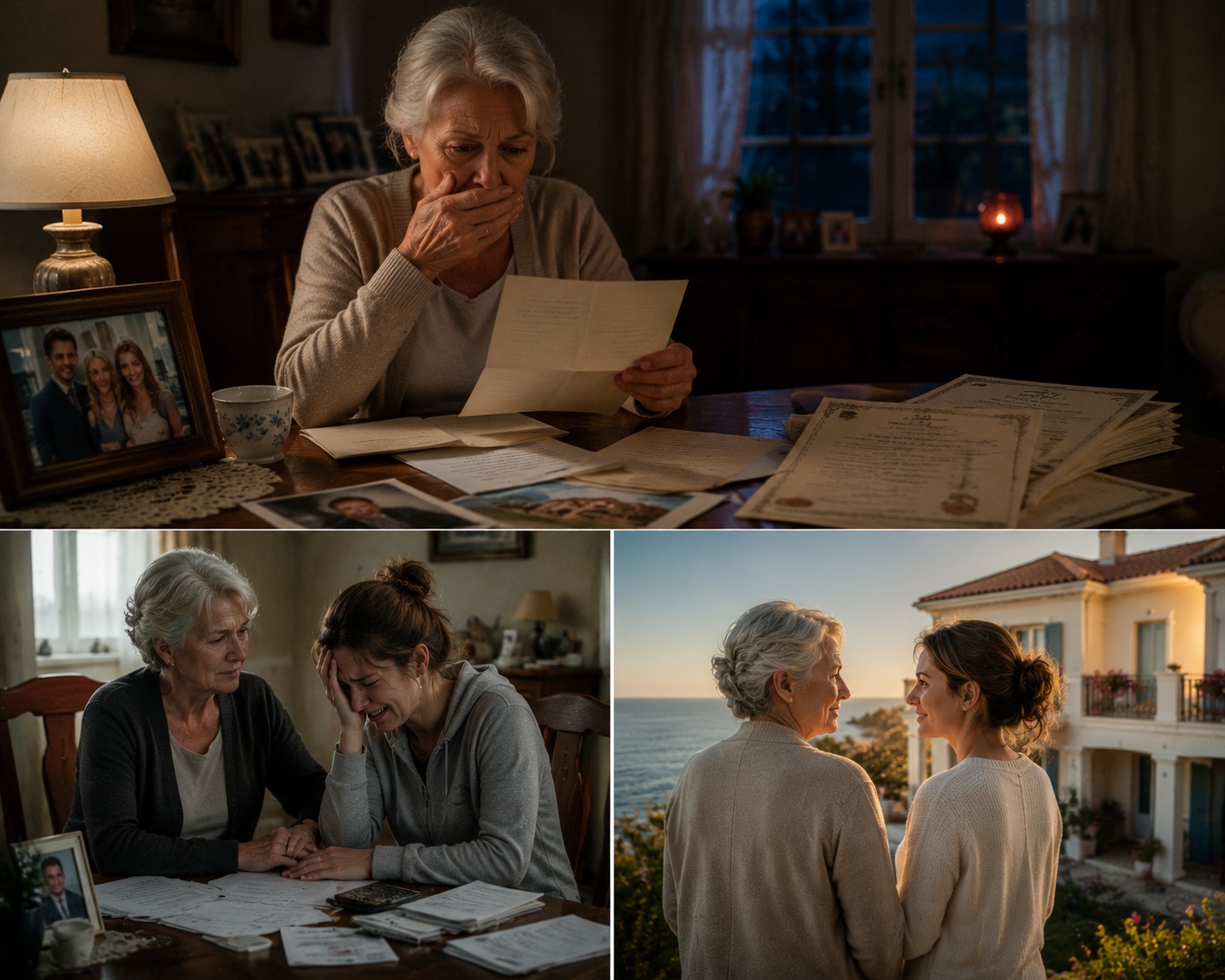
I waited until the room fell silent, until the nurse’s footsteps faded down the hall. Only then did I pull out the envelope I had hidden against my ribs.
My hands trembled as I slid a finger beneath the brittle flap. The seal cracked open like thin ice. The first page made the world shift. A death certificate.
Male infant. Twin B. The date matched Carl’s birthday, and the day I almost died. I touched the ink, the only trace of the child I never got to hold.
The next document was the surgical report. Emergency hysterectomy required to save patient’s life. Everything I lost in a single line. I reached for the final paper.
My breath caught. Carl’s name. The adoption certificate. The truth I carried alone for twenty years, now trembling in my hands.
There was a letter too, from the doctor who handled Carl’s adoption. “Mrs. Dunn. This child needs a home.
You are saving a life whether you see it that way or not. ”
And near the bottom, one last piece of paper. Yellowed with age. My handwriting.
“My dear Carl, I need to tell you something important. ”
It was a letter I started when he was twelve, a letter I never finished. I had stopped halfway, terrified that telling him he had no blood connection to Jim would break him entirely. I folded it and pressed it to my chest.
A single whisper slipped out: “You were the child I chose, Carl. ”
Carl returned the next afternoon. He entered without greeting me. He dropped a stack of papers onto the small table at the foot of my bed with a violent thud.
“Sign,” he said. “Sign all of it. You don’t even know what day it is, so don’t pretend you know what these are. ”
I didn’t reach for the papers.
I reached into the drawer where I had hidden the envelope through the night. I placed it on the table beside his stack and pushed it toward him. “What is this supposed to be? ” he said.
“Another excuse? Another story? Mother, I’m not in the mood for your games. ”
I didn’t speak.
He snatched the envelope and tore it open. The first paper slipped out. His brow furrowed. “What is this?
A death certificate? Who is this? ”
He scanned the words, confusion creeping across his face. “Twin B, male, newborn.
” His voice grew smaller. Then he looked at me sharply. “You had twins? Why did nobody tell me?
”
I held his gaze. My silence was an answer he didn’t want. He shook his head violently and unfolded the second document. His hand trembled as he read the first line.
“Emergency hysterectomy. Permanent infertility. ” His lips parted as if the air had been knocked out of him. “So you… you could never have children after that.
You never told me anything. ”
He reached for the third document. His fingers froze midair when he saw his own name at the top. The adoption certificate.
Something inside him cracked open. Shock first. Then denial. Then terror.
“No. No. This can’t be real. You adopted me?
Does this mean I was abandoned? That I was someone nobody wanted? That you took me because you had no other choice? Was I a replacement?
”
My heart clenched. Not from his words, but from the child inside him who was still bruised, still desperate for belonging. “Carl,” I said softly. But he stepped back, shaking his head violently.
“No, no. You’re lying. You always pretend to be the victim. Tell me this is fake.
Tell me you made this up to get sympathy. ”
“No, Carl. ” My voice was quiet, steady. “I wasn’t able to carry a child again.
I lost my son. I lost my body. I lost the life I thought I would have. I was empty.
I was grieving. And then I found you. ”
His breath hitched. “I chose you,” I said, “not because I had no other choice, but because when I held you, I felt something I thought I had lost forever.
I thought the world was giving me a second chance. ”
He stared at me, eyes wet, jaw trembling. “But I was wrong,” I added, not cruelly, but with the weight of all the years between us. “I thought loving you would heal the wounds inside me.
But instead, you believed every voice except mine. ”
He made a sound like a broken breath, somewhere between a sob and a question. His legs seemed to give way. He dropped into the chair beside the bed, burying his face in his hands.
“I didn’t tell you because I wanted you to feel like you belonged,” I whispered. “I wanted you to believe you were wanted. Chosen. Loved.
Not an accident. Not a burden. So I carried that truth alone. ”
Carl cried.
Not the controlled tears of a man, but the wild, broken tears of a child who had never truly grown past his wounds. He sat hunched forward, unable to look at me. Then he whispered, barely audible: “Dad told me I wasn’t his. ”
The words didn’t surprise me.
It was an old wound. “He told me that you… that you had someone else. That he stayed with you out of pity. That he tried to be a father, but he couldn’t pretend when he looked at me.
He said you were the reason our family fell apart. That I was the reminder. ”
He was shaking. Not from anger at Jim, but from the realization that he had built his entire identity on a lie told by a man who abandoned both of us.
I let the silence settle. Then I asked the only question that mattered. “Carl, when he said those things, who did you believe? ”
He stared ahead at nothing.
“I believed whatever made everything hurt less. If I believed you were guilty, then I didn’t have to wonder why I was so different. I didn’t have to face the possibility that he might not have wanted me at all. Blaming you was easier.
”
I nodded slowly. I had known that truth long before he said it. “Your father wanted to leave long before you were old enough to understand anything,” I said quietly. “Blaming me allowed him to walk out without looking like the one who ran.
”
Carl finally looked at me, eyes wide with something fragile and painful. “Did he ever love me? ”
I took a moment before answering. “Jim loved what made him feel powerful.
But true love doesn’t turn its back and throw stones at those left behind. ”
Carl swallowed hard. “I wanted to believe him. I wanted to think he had a reason to stay away from me.
I wanted to think you were the problem. Because if you were the problem, then I didn’t have to wonder what was wrong with me. ”
I said softly, “It’s easier to hate the person who stays than the one who walks away. ”
He closed his eyes.
For a moment, he was a boy of seven again. When he opened them, they met mine with a rawness I hadn’t seen in decades. “I’m sorry,” he said. “I didn’t want to know the truth then.
I don’t know if I can accept it now. ”
I nodded once. “It’s not the truth that hurts,” I said. “It’s how long you chose to live without it.
”
For the first time since he was a child, Carl had no defense, no accusation, no shield. Only the quiet collapse of a belief that had shaped his entire life. I didn’t sleep that night. Not because of fear.
Not because of the unfamiliar bed. I stayed awake because, for the first time in years, I knew exactly what I had to do. By sunrise, a nurse came in to check on me. She asked whether I wanted breakfast.
“No,” I said. “What I want is a pen. ”
She brought one without question. I sat up slowly, pulled the papers the social worker had given me, read every word.
Then I asked to make a call. They let me speak privately to an attorney the facility worked with. I told him I needed my will rewritten. When he asked who I wanted my estate to go to, I said: “Children who don’t have a home.
Children who were abandoned before they even learned to walk. Children like the infant Carl once was. ”
There was a pause. “Mrs.
Dunn,” he said gently. “Do you understand that means your son? ”
“My son,” I interrupted quietly, “made himself a stranger long ago. ”
He asked whether I wanted to remove Carl from all inheritance and legal authority.
My answer came without trembling. “Yes. Remove him entirely. ”
When I hung up, I felt lighter, as if a chain had come off my chest.
Later that afternoon, two representatives from adult protective services arrived. The nurse had reported the bruising on my arm and the unusual sedation the night I was admitted. I didn’t want revenge. But I told the truth, word for word.
The pills. The forced ride. The dismissive cruelty. One of them asked, “Mrs.
Dunn, do you feel safe with your son? ”
I said the only thing I could: “I don’t feel like his mother anymore. ”
Late in the afternoon, Carl returned. He looked as though someone had shaken him awake violently.
In his hands were the papers I had signed with the attorney. “How could you do this? ” he demanded, though the anger in his voice faltered. “How could you cut me out?
All of it? Everything? I am your son. ”
I folded my hands in my lap.
“Are you? ” I asked softly. His mouth opened, then closed. Before he could speak again, the APS agents entered the room.
“Carl Dunn? ” one of them asked. “We need to inform you that an investigation has been opened regarding the sedation and unauthorized relocation of your mother. ”
He turned to me, betrayed.
“You told them? ”
“I told the truth,” I said. “Something you avoided for twenty years. ”
“I was trying to take care of you.
”
“No,” I interrupted gently. “You were trying to get rid of me. ”
His entire body sagged. He slowly approached my bedside, ignoring the agents’ presence.
“Mother,” he whispered, his voice cracking. “I’m sorry. I swear I’m sorry. I didn’t know.
I didn’t know any of it. ”
His knees weakened into a trembling crouch. He clutched the blanket near my hand like a drowning man grabbing a piece of wood. “Please,” he begged.
“Give me a chance to make this right. Let me be your son again. Let me take care of you. Let me start over.
Please. ”
He reached for my hand. For the briefest moment, I almost let him hold it. Old habits almost pulled me back into the role I had lived my whole life.
The mother who forgives. The mother who absorbs all blame. But I had made too many promises to myself in the dark hours of the morning. I pulled my hand away.
The movement was small, but it was the clearest sentence I had spoken all day. Carl stared at me, stunned. “Mom. ”
I looked at him steadily, letting the weight of two decades settle between us.
“I kept the truth from you so you wouldn’t feel abandoned,” I said. “But you abandoned me long before today. I carried your pain. Even when you used it to blame me.
I carried your father’s lies so you could keep a piece of him to love. I carried the weight of your anger because I thought someday you would see me clearly. But now I’m setting both of us free. ”
His face crumpled.
“No. No. Please don’t say that. Please don’t do this to me.
”
I stood. My legs were weak, but my resolve was not. “From today on,” I whispered, “you are no longer my son. I release you.
The way you have released me your entire life. ”
He collapsed forward, sobbing so loudly the hallway echoed with it. The agents stepped closer, uncertain whether to intervene. I lifted a hand to stop them.
I did not look back at him. I walked toward the door, every step closing a chapter I had clung to for far too long. Just before I crossed the threshold, I heard Carl’s voice break into a desperate cry. “Mother, don’t leave me.
”
But he had left me years ago. And this time, I kept walking. I didn’t expect peace to arrive quietly. Yet it did.
It came in the form of a key placed in my palm. The manager of the senior apartment smiled as he handed it over. “Unit 3B. It’s small, but it’s yours.
”
*Mine. * A word that had not belonged to me in a long time. I moved into a modest apartment for independent seniors. The walls were thin, the floors creaked, but I slept better there than I had in years.
I hung only one picture on the wall. The photograph the hospital had taken of my lost twin, the baby who never inhaled his first full breath. His small hand was curled into a perfect, peaceful fist. I traced the blur of his cheek with my thumb.
There were no pictures of Carl. Not because I hated him. Not because I wished to erase him. But because loving him had consumed my life, and losing him had consumed everything else.
I needed a space where his shadow did not reach. Within a week, small packages began arriving at my door. A bag of fruit. A box of supplements.
A warm blanket still folded from the store. A pair of slippers in my size. Each item came with a note. The handwriting was familiar in the way a scar is familiar.
You recognize it even when you wish you didn’t. “For mom. Stay warm. Hope you’re eating.
”
Carl never signed his name. Perhaps he thought the omission softened the weight of what he had done. But I recognized every curve of every letter. I opened none of it.
Instead, I carried each package down the hallway to the common room, where the other residents gathered to play cards or read newspapers. I chose someone each time. A woman with trembling hands. A man with thin socks.
A widow who had stopped expecting kindness. “This was sent to me by mistake,” I would say. “I think you need it more than I do. ”
No one questioned me.
They simply accepted the gift with gratitude. And in that small exchange, I felt something heal inside me. Giving away Carl’s offerings didn’t hurt. What hurt was knowing these gestures were the closest he would ever come to an apology.
Every few evenings, I noticed a shadow outside, just beyond the courtyard near the fence. Tall. Still familiar. Carl.
He never approached. He never called out. He stood there, half hidden behind a tree, watching the window he believed was mine. I never opened the window.
I never opened the door. I never said his name. I had spent too many years waiting for him to see me. I would not spend the rest of my life waiting for him to forgive himself.
One winter afternoon during a small community gathering, someone asked me to share a piece of wisdom. The others had spoken before me. Stories of marriages, war, grandchildren, heartbreak. I cleared my throat.
“I used to be terrified of losing my son,” I said. “But I learned something the hard way. You cannot lose someone who never chose to stay. ”
Some gasped softly.
Others nodded, understanding more than they wished they did. “I did not lose a child,” I continued. “I lost the illusion of a child I thought I had. And in letting go of that illusion, I found something I had forgotten.
”
I placed a hand over my heart. “Myself. ”
Silence followed. A kind silence.
The kind shared by people who know grief intimately. After the gathering, a woman touched my arm. “I hope your son comes back to you,” she said. I smiled gently.
“He already did,” I whispered. “Just not in the way he meant to. ”
She looked confused, but I didn’t explain. Some truths are not meant to be spoken aloud.
Some are meant to be carried quietly, like a photograph of a child you never got to raise, or the memory of a son who walked away long before he realized what he was losing. Each night when I turned off the light and looked at the single picture on my wall, I felt peace. Not joy. Not triumph.
Just peace. Healing does not always come with reunions. Sometimes healing is simply choosing not to bleed anymore.
And I had finally chosen that.