The final chapter of Wyatt Earp’s life unfolded not in the dusty streets of Tombstone, but in the sun-drenched, rapidly evolving landscape of early Hollywood, where the legendary lawman spent his last years among movie stars and gold seekers, dying in relative obscurity just as his fame was about to explode. In a letter written in December 1928, the aging frontier figure, then 80 years old, expressed hope that his health might improve once the ongoing work on his life story was finally completed. History would prove him mistaken on two counts.
Within a few weeks, Earp passed away, and the fame that had largely eluded him during his lifetime was about to grow dramatically, transforming him into an American icon he never lived to see.
 Although others would later profit handsomely from books, films, and adaptations based on his experiences, Earp himself saw little financial benefit from the legend that surrounded his name. To understand how this happened, we must leave the frontier behind and travel to an unexpected place, early Hollywood. At the beginning of the 20th century, several ambitious film entrepreneurs arrived in Southern California seeking opportunities far from the established centers of power in the East.
The small community of Hollywood offered sunshine, open land, and distance from the legal and business disputes that were reshaping the young motion picture industry.
One of the most influential figures in that industry was inventor Thomas Edison. Beginning around 1908, Edison and several major companies formed the Motion Picture Patents Company, often called the Trust. Through ownership of key patents involving cameras, projectors, and film technology, the organization exercised significant control over film production and distribution in the United States.
Independent filmmakers frequently found themselves at odds with the Trust’s restrictions and licensing requirements. Many moved westward to California, where they could operate farther from the organization’s influence and take advantage of favorable filming conditions. Hollywood’s proximity to Mexico also offered practical advantages should legal disputes arise.
Before long, Hollywood became a gathering place for risk-takers, innovators, and entrepreneurs eager to challenge the industry’s established order. Among the newcomers were Adolph Zukor, Carl Laemmle, Jack Warner, and Wilhelm Fuchs, better known as William Fox. Though not outlaws in the literal sense, they were often viewed as rebels against the existing system.
Their impact on American entertainment would be enormous. Zukor helped build Paramount Pictures. Fox founded the company that eventually became 20th Century Fox.
Jack Warner and his brothers established Warner Brothers, while Carl Laemmle played a leading role in creating Universal Pictures. Together, these pioneers transformed Hollywood into the center of the global film industry, a world that Wyatt Earp would unexpectedly become part of during the final years of his remarkable life.
In 1923, the famous Hollywood sign was constructed at a cost of approximately $21,000. Originally, it read Hollywoodland and served as a temporary advertisement for a new real estate development in the hills above Los Angeles. Although it was intended to stand for only about 18 months, the rapid growth of the motion picture industry transformed the sign into a lasting symbol of American entertainment.
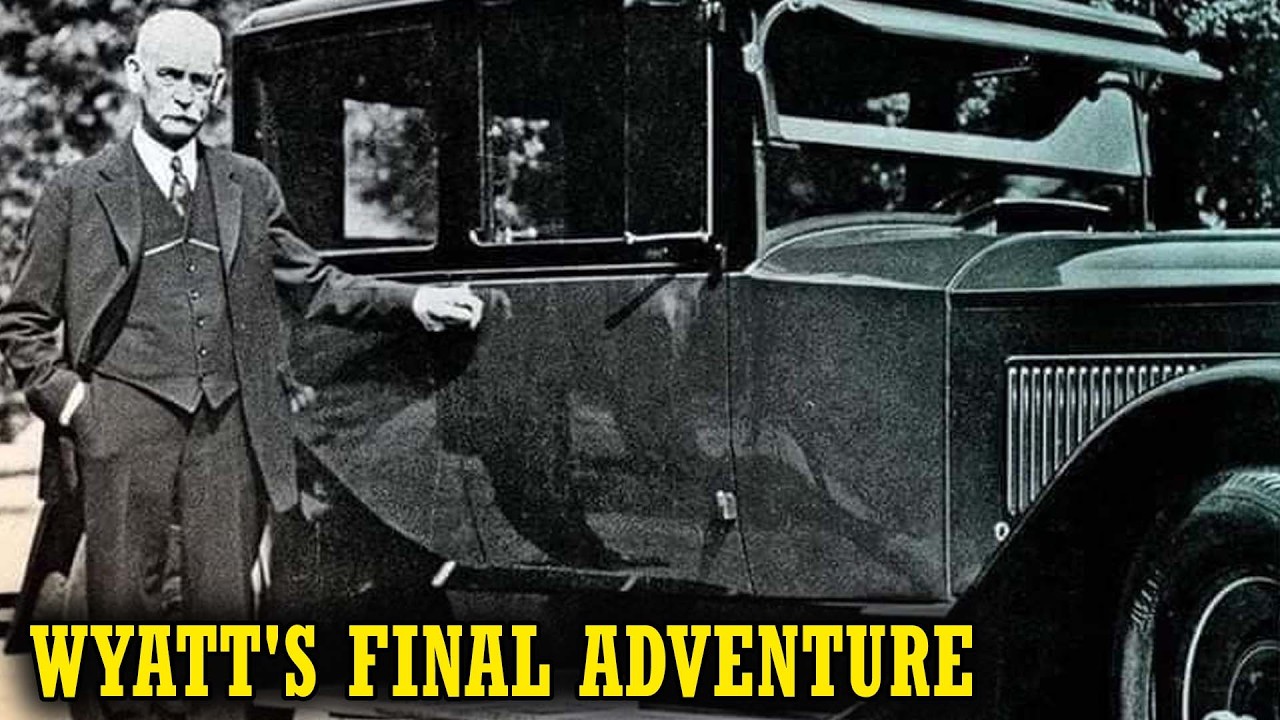
In 1949, the Hollywood Chamber of Commerce restored the aging landmark and shortened it to the single word Hollywood. During the same era, Wyatt Earp found himself spending time among the emerging stars of the film industry. One well-known photograph shows him standing beside a 1926 Packard model 326 Opera Coupe, a vehicle believed by some historians to have been owned by silent film actor William S.
Hart.
Earp also developed a friendship with Western star Tom Mix, whose success in Hollywood allowed him to enjoy a lavish lifestyle. At the height of his career, Mix earned thousands of dollars per week, making him one of the highest-paid performers of the silent film era. Despite his growing circle of influential friends, Wyatt struggled to generate serious interest in adapting his life story for the screen.
Ironically, a man whose name had become closely associated with frontier history found it difficult to gain traction in the movie business. The phrase couldn’t get arrested became an appropriate Hollywood metaphor for Earp’s situation. In reality, his long and complicated life had included various legal disputes, investigations, and accusations in several Western territories.
Historians continue to debate many of these incidents, and some allegations were never fully resolved or resulted in convictions. These controversies added complexity to his public image, but did not necessarily make him an attractive subject for film producers of the time. Even so, Earp was far from unknown in Los Angeles.
A 1911 article in the Los Angeles Times helped introduce many readers to dramatic accounts of his frontier experiences. The publicity attracted the attention of notable figures, including actor William S. Hart, Western star Tom Mix, and author Jack London, all of whom expressed interest in the legendary lawman and the fading world he represented.
Yet despite Hollywood’s constant search for fresh material, few filmmakers recognized the cinematic potential of Wyatt Earp’s extraordinary life. The man who had witnessed some of the most famous events of the frontier era spent his final years surrounded by storytellers, while his own story remained largely untold on the screen.
During the early years of Hollywood, few people were as prolific as Gilbert M. Anderson, better known to audiences as Bronco Billy. Between 1903 and 1915, he wrote, produced, and starred in hundreds of Western films.
By some estimates, nearly 375. Anderson later joked that he made movies as quickly as popcorn, often creating a story in the morning and filming it the same day. His remarkable success earned him an income of roughly $125,000 per year, an enormous sum for the era.
What makes Wyatt Earp’s experience in Hollywood so surprising is that despite having lived a life filled with dramatic events, few filmmakers seemed interested in turning his story into a major motion picture. Even his friends in the industry, including Western stars William S. Hart and Tom Mix, never succeeded in bringing his life to the screen.
For a town constantly searching for new stories, Hollywood largely overlooked one of the most famous figures of the frontier. Earp spent considerable time around movie productions and undoubtedly witnessed the growing fortunes being made from fictionalized versions of the West. Some historians believe these experiences may have influenced the way he later recounted episodes from his own life, particularly as public interest in frontier legends continued to grow.
 One of Earp’s favorite gathering places was Gower Gulch, located near Sunset Boulevard and Gower Street in Los Angeles. The area became famous as a meeting spot where aspiring cowboys, Native American performers, and other Western extras gathered each morning hoping to find work on film sets. Many arrived dressed in their own costumes, ready for a day’s work in the rapidly expanding movie industry.
Film pioneer Allan Dwan later claimed that Earp appeared briefly in the background of the 1916 film The Half-Breed. However, no verified footage or photographs have been discovered that conclusively identify Wyatt Earp on screen. As a result, the claim remains an intriguing but unproven piece of Hollywood lore.
By the 1920s, Earp had formed a close friendship with William S. Hart and Tom Mix. The three men were often seen together at popular Los Angeles establishments such as Al Levy’s Tavern and the Musso and Frank Grill.
According to a frequently repeated story, Mix once decided that he and Wyatt should broaden their literary horizons and bought a volume of Shakespeare for them to read. Afterward, Earp reportedly remarked that Hamlet talked far too much and would not have fared well on the frontier, a comment that perfectly reflected his practical outlook.
Earp also left behind an interesting observation about the changing nature of American cities. In 1924, actress Lotta Crabtree died with an estate valued at approximately 1. 2 million dollars and no clearly established heirs.
During legal proceedings in 1926 involving a claimed relative from Tombstone, Arizona, Earp was called to provide testimony. When asked about law and order in Tombstone during its boomtown years, Earp gave an answer that surprised many listeners. He stated that the town’s reputation had been exaggerated and suggested that in his view, Tombstone had been less troublesome than Los Angeles in the 1920s.
Whether one agrees with his assessment or not, the comment reveals how dramatically American cities had changed since the days of the frontier.
From 1911 until his death in 1929, Wyatt Earp and his wife, Josephine Sadie Earp, followed a seasonal routine. They typically spent their summers in Los Angeles and their winters at the Happy Days mine, located near Vidal, California, along the Colorado River. The arrangement allowed Earp to enjoy both the comforts of the growing city and the quieter life of a mining camp.
According to family accounts, the journey to their winter residence was an adventure in itself. After traveling by train to San Bernardino, the couple would obtain a wagon and stock it with supplies before heading east. Their route reportedly took them through areas that are now known as Yucca Valley, Joshua Tree, and 29 Palms before crossing the rugged Mojave Desert on the way to Vidal.
One of the most cherished images of the couple comes from this period. Historians generally regard it as the only confirmed photograph showing Wyatt and Sadie together. Also visible in the picture is their dog, affectionately named Earpy.
The aging lawman appeared to enjoy his time at the mining camp. When writer John Flood Jr. worked with Earp on a manuscript during the mid-1920s, he recorded Wyatt’s fond memories of the Southwest.
Earp spoke warmly of the landscapes and clear skies of Arizona, which lay just across the Colorado River from his winter home. The camp also became a destination for visitors interested in frontier history. Among them was Billy Breakenridge, a former deputy who had served under Sheriff John Behan in Tombstone.
During his visit, Breakenridge gathered information from Earp for his own research. However, when his 1928 book, Helldorado, was published, it presented a highly critical interpretation of the famous 1881 confrontation near the OK Corral. Many historians have noted that accounts of the event differed sharply depending on the witness, participant, or author, making it one of the most debated episodes in Western history.
Meanwhile, Wyatt’s reputation continued to grow among Hollywood’s early Western stars. One of his greatest admirers was actor William S. Hart, who also held deep respect for famed lawman and journalist Bat Masterson.
In October 1921, Hart visited Masterson at his New York newspaper office and posed for a memorable photograph with him. Just weeks before his 69th birthday, Masterson passed away while working at his desk.
Hart later honored his friend by dedicating his 1923 film Wild Bill Hickok to Masterson’s memory. Wyatt Earp served as a technical advisor on the production, helping filmmakers recreate aspects of frontier life. According to family recollections, Sadie Earp enjoyed the movie so much that she watched it twice in a single day.
Although Wild Bill Hickok marked the first time Wyatt’s name appeared in connection with a major motion picture, Hollywood was still years away from fully embracing his life story. His transformation into a cinematic legend would not occur until the 1930s and beyond. Bat Masterson’s influence reached even further into American popular culture.
Writer Damon Runyon became fascinated by Masterson’s stories about gambling, travel, and colorful characters throughout the West.
 These tales helped inspire Runyon’s fictional gambler, Sky Masterson, who appeared in the 1933 short story, The Idyll of Miss Sarah Brown. That story eventually evolved into the celebrated Broadway musical, Guys and Dolls. When the musical was adapted for film in 1955, actor Marlon Brando portrayed Sky Masterson.
Many observers have noted that Brando’s appearance in the role bears a striking resemblance to photographs of the young Bat Masterson, creating yet another link between the real Old West and Hollywood’s enduring fascination with it. John Flood Jr. had good intentions, but his background was in engineering rather than professional writing.
Nevertheless, Wyatt and Josephine Sarah Earp became convinced that Flood could help transform Wyatt’s life story into a successful book. They hoped the project would finally bring both recognition and financial reward.
Sadie, in particular, became the driving force behind the effort. Most Sundays, Flood would visit the Earps’ modest rented bungalow in Los Angeles. There he would sit with Wyatt, who often enjoyed a cigar and a glass of whiskey while discussing episodes from his long and eventful life.
However, according to later accounts, the sessions were not always structured interviews. Instead, conversations frequently drifted, and Sadie often stepped in to influence how certain stories were presented. She was especially concerned with Wyatt’s public image.
Whenever she felt a passage reflected poorly on him, she reportedly objected and encouraged revisions. Sadie also wanted the manuscript to be exciting and dramatic, believing readers expected colorful dialogue and fast-moving action.
As a result, the manuscript sometimes adopted a style more reminiscent of popular adventure fiction than a traditional biography. One example can be found in the chapter describing the famous 1881 confrontation in Tombstone. The manuscript relied heavily on dramatic sound effects and exaggerated action sequences, creating a version of events that differed significantly from most historical accounts.
Modern historians generally agree that the actual encounter lasted only a short time and involved far fewer shots than the manuscript suggested. Sadie also encouraged the inclusion of heroic episodes that would present Wyatt in a favorable light. One chapter described him rescuing two women during a major fire in Tombstone.
She reportedly believed this story was even more compelling than the many frontier disputes and confrontations associated with Wyatt’s reputation.
While historians remain skeptical of some details, the story may not have been entirely fictional. Tombstone did experience a significant fire in September 1881, and Wyatt was living there at the time. Historical records show that he later served as secretary of the town’s volunteer fire brigade.
Whether the dramatic rescue occurred exactly as described remains uncertain, but the broader setting was rooted in real events. The completed manuscript eventually grew to approximately 348 pages. The Earps and Floods submitted it to numerous publishers, hoping it would launch Wyatt’s long-awaited literary career.
Unfortunately, publishers consistently rejected the work, criticizing its overly elaborate style and lack of professional polish. Today, the Flood manuscript remains an important historical document, not because it is considered fully reliable, but because it reveals how Wyatt and Sadie wanted his story to be remembered.
Historians generally treat it with caution, viewing it as a mixture of genuine memories, personal interpretations, and efforts to shape a lasting public legacy. Walter Noble Burns was a Chicago journalist who had already achieved considerable success with his 1924 book, The Saga of Billy the Kid. Seeking another compelling subject from the American frontier, he became interested in Wyatt Earp after meeting him in Los Angeles.
Burns initially offered to write Earp’s biography. Wyatt declined, explaining that he had already committed to working with John Flood Jr. on the project.
Rather than abandon the opportunity, Burns changed his approach and asked Wyatt to share stories about his long-time friend Doc Holliday. Earp agreed, providing Burns with valuable recollections and first-hand insights.
The following year, Burns published Tombstone, an Iliad of the Southwest. Although the book covered a wide range of frontier history, Wyatt Earp emerged as one of its central figures. The publication helped introduce Earp to a new generation of readers, but Wyatt was reportedly frustrated by the result.
He feared that other writers were shaping his public image before he had successfully told his own story. As the years passed, it became increasingly clear that the manuscript prepared by John Flood Jr. was unlikely to attract a publisher.
Searching for alternatives, Wyatt approached other writers, but none were willing to take on the project. Eventually, a young writer named Stuart Lake entered the picture and offered to write Earp’s life story. Lake gained the confidence of both Wyatt and Josephine Sarah Earp by promising to present the former lawman’s life in a respectful and favorable manner.
 An agreement was reached in which the Earps would share in any profits generated by the book. However, the project was still in its early stages when Wyatt Earp died on January 13, 1929. The timing proved significant.
During the late 1920s and early 1930s, audiences were fascinated by stories involving organized crime, ambitious law enforcers, and struggles for power. At the same time, industry leaders and censorship advocates became concerned about films that appeared to glamorize criminal figures. Hollywood soon discovered that many of the same themes could be explored through Westerns.
Frontier stories offered dramatic conflicts, larger-than-life personalities, and moral questions while remaining rooted in America’s past. In this environment, Wyatt Earp’s life suddenly became far more appealing to filmmakers and publishers.
Part of Earp’s appeal was his complexity. Throughout his life, he had worked in a variety of occupations, including law enforcement, gambling, business ventures, and mining. This combination made him a figure who did not fit neatly into a single category.
To Hollywood storytellers, he represented a character who could move between order and disorder, civilization and frontier independence. During the 1930s, Western films increasingly borrowed storytelling elements from contemporary crime dramas. Rival groups, contested territories, and struggles for influence became common themes in both genres.
As a result, the events in Tombstone and the famous 1881 confrontation near the OK Corral began to resonate with audiences familiar with the headlines of the Prohibition era. Although the historical events were separated by nearly half a century, many writers and filmmakers drew parallels between frontier conflicts and modern organized crime stories.
This connection helped transform Wyatt Earp from a largely forgotten former lawman into one of the most recognizable legends of the American West. When Stuart Lake finally began interviewing Wyatt Earp, he quickly discovered that the former lawman was not an easy subject. Earp was known for giving brief, straightforward answers, often responding with little more than yes, no, or I don’t remember.
For a writer hoping to create a detailed biography, extracting stories and colorful quotations proved challenging. As a result, Lake relied heavily on his own storytelling abilities when writing Wyatt Earp, Frontier Marshal. Since Wyatt passed away in January 1929 after only a handful of meetings, Lake was left with considerable freedom to shape the narrative.
Many historians believe that portions of the book reflect Lake’s interpretation of Earp, rather than Earp’s exact words.
One famous example involves the legendary Buntline Special, a Colt revolver supposedly fitted with an unusually long barrel and presented to several Dodge City lawmen by dime novelist Ned Buntline in 1876. In Lake’s biography, Earp is quoted describing the firearm in detail and praising its usefulness. However, modern researchers have found little contemporary evidence supporting the story.
No surviving records from the period conclusively prove that such weapons were distributed as Lake described. Even so, Lake himself appears to have believed the tale. He reportedly searched for evidence of the firearm’s existence, convinced that the story was authentic.
Over time, the Buntline Special became one of the most enduring myths associated with Wyatt Earp, despite continuing debate among historians.
Following Earp’s death and the publication of Wyatt Earp, Frontier Marshal in 1931, Hollywood finally began to take a serious interest in his life. By that point, Western films had already been a popular genre for decades and producers were constantly searching for new frontier stories to bring to audiences. Early adaptations often took creative liberties with the historical record.
In one version of the Tombstone story, the famous 1881 confrontation was relocated from its actual setting near the OK Corral to an OK Corral. Apparently, because filmmakers believed the revised location sounded more dramatic. Similar alterations became common as screenwriters reshaped real events to fit audience expectations.
As the years passed, a formula emerged that proved enormously successful. Wyatt Earp was increasingly portrayed as an almost flawless symbol of frontier justice, and his story became one of Hollywood’s most valuable Western properties.
Numerous books, films, radio programs, and television series drew inspiration from his life. The influence of the Earp legend spread far beyond traditional biographies. More than 40 feature films have portrayed Wyatt Earp or events connected to Tombstone.
Television audiences embraced series such as The Life and Legend of Wyatt Earp, while other programs borrowed heavily from the same themes and character traits. Many historians have also noted similarities between Wyatt Earp’s popular image and later fictional lawmen, including characters such as Matt Dillon from Gunsmoke. The legend continued to expand through magazine articles, comic books, toys, collectibles, and even neighborhoods and businesses bearing Earp’s name.
What had once been the story of a retired frontier figure evolved into a major part of American popular culture.
Ironically, Wyatt Earp never lived to see the enormous commercial success of the legend that grew around him. The books, films, and merchandise that generated substantial revenue appeared only after his death. While others benefited financially from the enduring fascination with his life, Earp himself received none of the rewards.
Wyatt Earp’s final great adventure was not fought on a dusty frontier street, but in the emerging world of Hollywood, where his life was transformed into one of America’s most enduring legends. Ironically, the man who inspired countless books, films, and television shows never lived to see just how famous he would become. His story reminds us that history is often shaped as much by storytellers as by the people who lived it.