The stagecoach arrived in Holt’s Crossing on a Tuesday afternoon, carrying a woman who would unravel everything Everett Cobb believed he wanted. He had written the letter six weeks earlier, sealed it himself, and ridden to town in the quiet hours of morning, certain he had been clear. He wanted a plain woman, someone comfortable with hard work, unbothered by silence.
He had written that beauty brought expectations he could not meet. He had been wrong about what he needed.
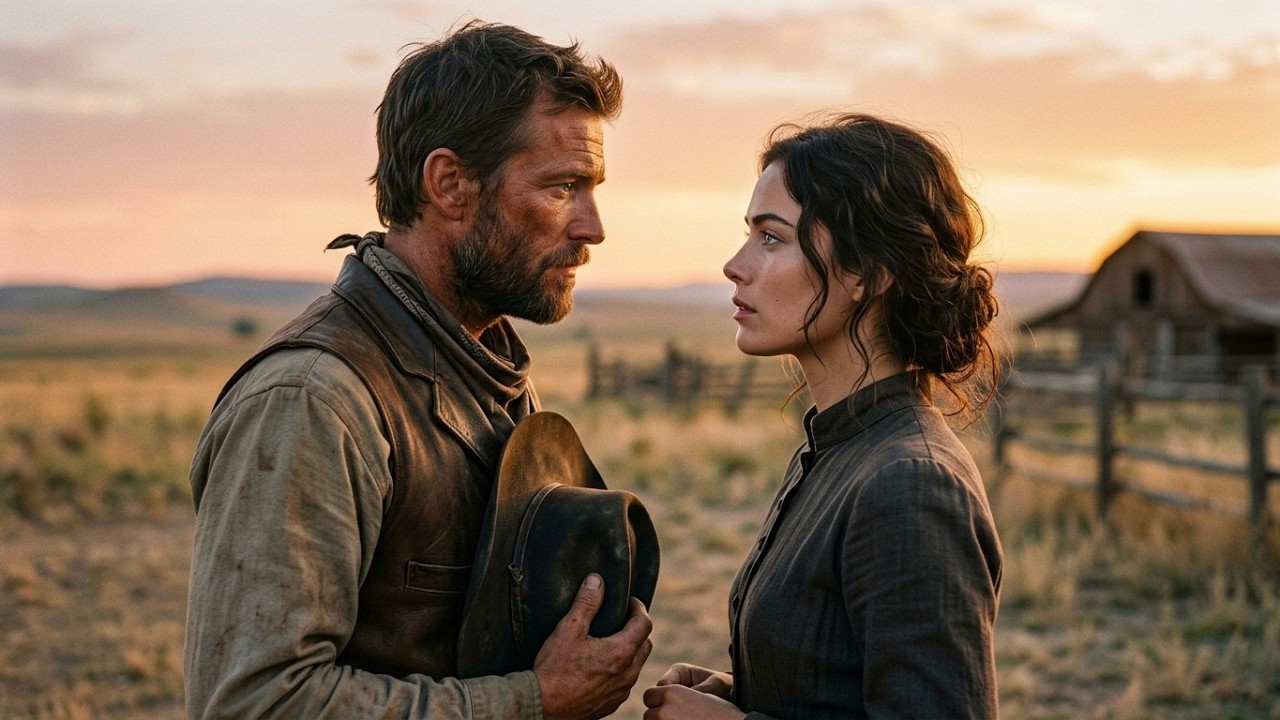 The letter traveled east to an arrangement service that promised matches based on character and compatibility. Everett Cobb, a rancher in his late thirties with a locked room in his house and a grief he had not named in four years, specified a partner who would ask few questions and accept the answers she was given. The service assured him they would comply.
They did not.
When the stage door opened on that Tuesday, two men stepped out first, a drummer with a satchel and an older gentleman in a worn coat. Then a pause, the kind that pulls at the eye even when you try not to look. She stepped down without assistance, one hand on the door frame, the other smoothing her skirt with practiced calm.
She was tall, her hair dark and pinned with plain wooden pins, her dress simple gray wool. But the way she stood on that dusty road, scanning the street with steady gray eyes, she looked less like a woman arriving and more like a woman returning to a place she had already decided was hers.
Everett did not move. He had come to town for wire and a box of nails, but something had made him linger near the livery. He told himself later he had not been waiting.
He nearly believed it. Up close, she was composed in the way of someone who had practiced composure until it became second nature, which told him instinctively there had been a time when it was not. Her eyes moved quickly, not nervously, strategically, glancing at the stage driver, the street behind her, the mouth of the alley beside the general store, all in the space of a breath.
She crossed the street toward him with a small leather bag in her hand and said simply, Mr. Cobb. Not a question, a confirmation.
He said Miss, and meant to say more, but did not. Up close, she was something quieter and more unsettling than beautiful. She had the kind of face that made a man aware suddenly and uncomfortably that he had been looking at it too long.
He looked away, then against his better judgment, looked back. She had already found him.
The wagon ride to the ranch was silent for the first mile. She did not ask about the house or the hands or the work. She asked about the land.
Is it flat all the way? she said, looking out at the grass that stretched to the edge of the sky. Mostly, he said.
There is a ridge to the north. Creek runs along it. Does it flood in spring?
she asked. He glanced at her sideways. It has, he said.
 But you have managed it, she said. I have managed it, he said. She said almost to herself, Good.
That means it can be managed again.
The ranch house was two rooms and a lean-to kitchen. He had cleaned it the day before, which amounted to removing everything from the floor and stacking it against the walls. She walked through it without comment, touching nothing, looking at everything, the windows, the door hinges, the gap under the back door where the wind came in November.
She paused at the back room, the locked one. Store room, he said before she asked. She turned and looked at him with that unreadable expression.
Of course, she said, and moved on.
That night, he ate alone on the porch while she organized the kitchen with quiet efficiency. He could hear the soft sounds of it, a pot moved, a drawer closed, something set down with precision rather than convenience. Sounds that had not existed in this house for a long time.
After a while, the sounds stopped, and he sat with his coffee going cold and listened to the crickets and tried not to think about the way she had looked at the street when she stepped off the stage, that quick, careful scan, not the look of a woman arriving in a new place, but the look of a woman making sure she had not been followed.
In the early mornings, before she thought anyone was watching, she stood at the window with coffee in both hands, looking north toward the ridge, not admiring the view, watching it, still and alert in a way that had nothing to do with the morning light and everything to do with whatever was running behind those gray eyes. After the first week, she quietly moved her small leather bag from the bedroom shelf to underneath the bed. He saw this only by accident and said nothing, but he noticed the bag was always within reach of where she slept, always.
More than once in those early weeks, one of the hands addressed her cheerfully as Mrs. Cobb. Each time she answered without hesitation.
Each time, just after, there was a half second where something in her face reset, a small recalibration, like a person remembering which name they were using today. He told himself he was imagining it. He was not imagining it.
The thing that cracked it open was a letter. He had gone to town for supplies on a Thursday. The postmaster, a thin, cheerful man named Garrett who asked no questions largely because he already knew the answers, handed him his usual bundle, a feed invoice, a notice from the county, and then held up a third envelope with a look on his face that was trying hard to be nothing.
This one came addressed to the ranch, Garrett said. Not to you personally. Care of a Miss F.
 Windermir.
The envelope was cream colored and heavy, the kind of paper that cost money. It was sealed with wax, not a simple seal, but a crest of some kind, pressed clean and precise. Everett did not recognize it.
He put it in his coat pocket and did not look at it again until he was past the edge of town. He gave it to her at supper without comment, setting it beside her plate the way you would set down a tool, plainly, without ceremony. She looked at it.
The color left her face so quickly and so completely that he thought for a moment she might be ill. Then the color returned, controlled, and she picked up the envelope and put it in her apron pocket in one smooth motion and said, Thank you, in a voice that gave away exactly nothing.
They finished supper in silence. She washed the dishes. He sat on the porch.
When he came back inside an hour later, the envelope was gone, and whatever was in it had been committed to memory or ashes. He could not tell which, and he understood without being told that he was not to ask. He asked anyway, not that night, but a week later, on a Sunday afternoon when the ranch was quiet and she was sitting in the yard mending one of his work shirts with the focused attention she brought to every task.
Francesca, he said. She looked up. He almost never used her name, and they both knew it.
The letter, he said. Was it trouble? A pause.
The needle went still in her hand. Why do you ask? she said.
Because your face went white when you saw it. She looked at him for a long moment. He held the look, which he suspected not many people had done, and which he also suspected was exactly what she needed, someone who would not look away first.
It was from my father, she said finally. You are not close, he said, also not a question. No, she said, we are not close.
He wants to know where I am. And you did not want him to know, he said. The needle moved again.
 He found out anyway, she said quietly. He usually does.
A hawk moved in slow circles above the north field. The wind pushed through the grass and flattened it and let it rise again. Is he going to be a problem?
Everett asked. She lifted her eyes to his, and there it was again, that careful assessment, weighing something behind a door she had not decided yet to open. He may send someone, she said.
To collect me. Collect you? Everett repeated, and the flatness in his voice was not indifference.
It was something colder and more deliberate than that.
I was arranged to marry a man in Philadelphia, she said. Her voice was steady, but the way a person is steady when they have rehearsed something so many times it has gone beyond feeling. A business arrangement between my father and a man named Hargrove.
I declined. They did not accept the decline. My father, she said carefully, does not accept things he has not decided.
Silence stretched between them. Then Everett said, How long have you been running? She flinched, just slightly, just enough.
Four months, she said. Before I found the arrangement service. Before I found, she stopped, before I came here.
He nodded slowly. He looked at the north field again. He thought about the bag beneath her bed, always within reach, the scanning eyes on the main road the day she arrived, the name, her real name, Windermir, not Cobb, that she answered to with that half second of recalibration.
He thought about the locked room at the back of the house and the reason he kept it locked and the fact that he had not yet told her about that and the uncomfortable recognition that they were both of them people who carried things they had not yet put down.
You should have told me, he said, not angry, just direct. I know, she said. I do not like surprises on my land, he said.
I understand, she said. If someone comes here looking for you,