
The quiet that had settled over Caldwell Flats for seven years was shattered on a Thursday afternoon when a woman stepped off the stagecoach and into the life of the town’s most feared man, setting in motion a chain of events that would test the very fabric of the community.
Garrett Masterson was not a man who inspired casual conversation. He was the largest landowner for forty miles, a man of his word who paid fair wages, yet he was a ghost in his own town. He ate alone, rode alone, and had not darkened the door of the church in seven years.
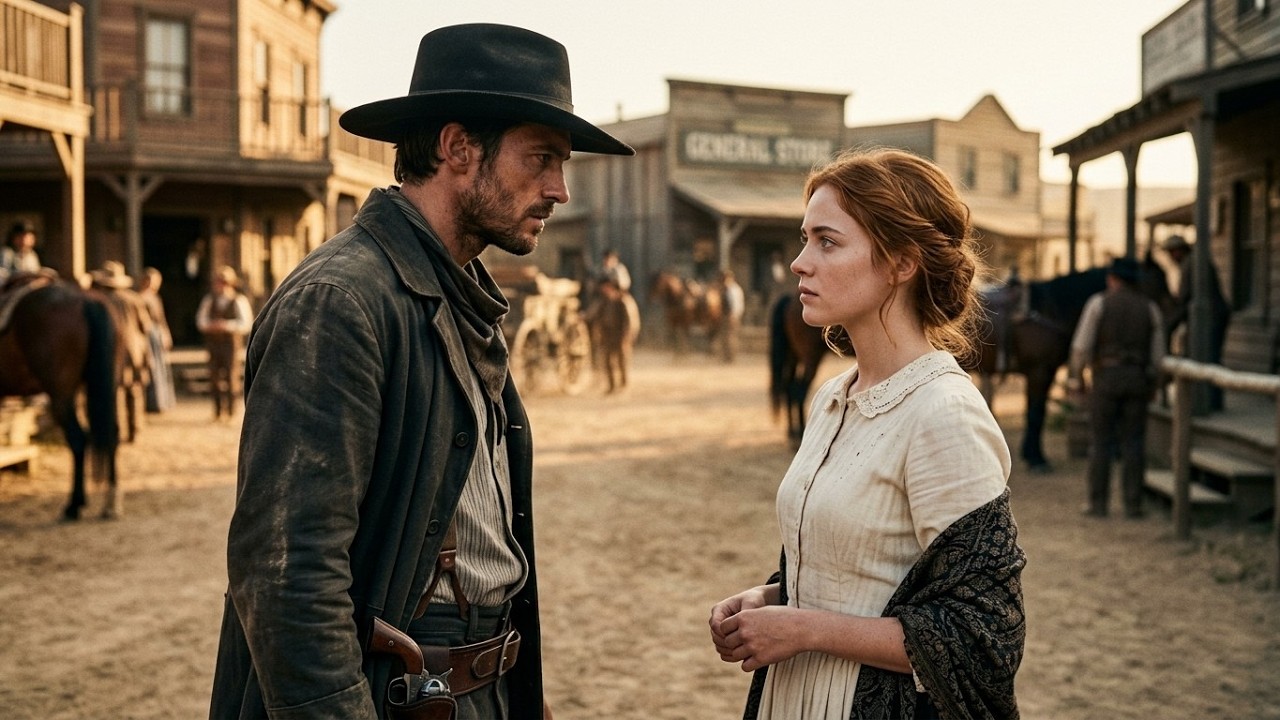 The townsfolk whispered that something had gone quiet in him long ago, a silence they found more unsettling than any outburst of cruelty. He was a figure of respect and fear, a man who seemed to exist outside the warmth of human connection, a monument to solitude standing against the vast, unforgiving landscape.
The arrival of three letters, addressed to Masterson from a woman in Harlan County, Kentucky, was the first crack in that monolithic facade. The postmaster read the return address twice, and the whispers began before the wax on the first seal was even broken. The letters were from Eliza Calloway, a 24-year-old woman with seventeen dollars to her name and a situation at home that had become untenable.
She had found Masterson’s name in a land registry notice, a blunt advertisement for a wife and household manager. In a world of few options, she saw in his cold, clipped wording a potential for honesty she craved.
Eliza’s letters were not the desperate pleas of a woman seeking rescue, but the measured correspondence of a survivor. She wrote of her capability, her willingness to work, and her modest means. She did not pretend to be delicate.
In her third letter, after two replies in his careful, guarded handwriting, she laid bare the truth: she needed to leave, and she believed they could build something decent together. His reply was four sentences long, an invitation to come on the 15th, a promise to meet the stage, and a directive to bring only what she needed. It was a contract, not a romance, but it was a door opening.
When the stage rolled into Caldwell Flats, the dust cloud drew the town to their porches. Eliza pressed her face to the window and saw her future: a single main street, timber-front buildings, and a man standing apart from the crowd. He was tall, with a dark hat pulled low, his expression unreadable as he watched the stage approach.
He did not wait to be invited. He walked toward her with unhurried strides and stopped two feet away, a distance that felt both intimate and challenging. “Miss Calloway,” he said.
“Mr. Masterson,” she replied. He picked up her trunk without a word and carried it to his wagon, the murmurs of the town rising behind them like a swarm of bees.
The ride to the ranch was mostly silent, the landscape stretching out before them, vast and pale. “The house is plain,” he offered. “That’s fine,” she said.
He warned her that the town would have opinions, that a mail-order bride would be a subject of gossip. “People generally do,” she said. He admitted she was not what he expected.
“Someone more nervous,” he confessed. Eliza looked at the wide, flat land and replied with a quiet steel that would define her time in Caldwell Flats: “Oh, I’m nervous. I’m just not going to show you that on the first day.”
For half a second, she caught a flicker of a smile on his face before it settled back into its usual stillness. It was enough to steady something inside her that had been unsteady for a long time.
The house was plain but solid, with a covered porch that looked west toward the hills. In the late afternoon light, it glowed amber, and Eliza stopped on the steps to simply look. Garrett waited for her, not rushing her, and she noted the porch was good.
“I’ve always thought so,” he said. For three days, they moved around each other with the careful respect of two honest people who did not yet feel comfort but were too respectful to manufacture friction. He showed her the ledgers, the kitchen stores, the land.
She asked clear questions and remembered the answers. On the fourth morning, over coffee, he proposed a timeline: they would ride into town to speak to the preacher and marry by the end of the week. “Are you still willing?”
she asked. “I asked first,” he said. “Yes,” she said.
“I’m still willing.”
But the town of Caldwell Flats had already made up its mind, and it had decided against them. The preacher, Hollis Dunbar, received them with an expression of concern and disapproval. He spoke of marriage not being a matter of convenience, but Garrett cut through the platitudes with a blunt request for a date.
Dunbar demanded two weeks for formalities; Garrett countered with one. They left without shaking his hand. The talk moved fast, from the feed store to the saloons, settling into the spaces between church pews.
The women spoke in careful, charitable tones that said everything they didn’t say out loud. The men were less careful.
 Eliza heard the gossip firsthand on Monday morning in the dry goods store. Two women, deep in conversation, did not see her come in. They spoke of her as if she were a piece of ordered furniture, questioning her origins and her motives.
“No one even knows where she came from,” one said. Eliza set her basket on the counter with a deliberate sound. The color rose in their faces as they realized she had heard.
She looked at them with a steady composure that was more unsettling than anger. “Good morning,” she said, and bought her flour and thread, thanking the shopkeeper before walking out into the sun. She made it half a block before stopping, standing very still, letting out a slow breath.
She was not going to cry in the middle of the street. But she allowed herself to feel how alone she was.
Garrett learned of the incident that afternoon from a ranch hand. He said nothing, finished his work, and then rode into town. He walked into the hardware store, stood at the counter, and addressed the room at large.
“I’d like you both to understand something,” he said to the women who were still there. “Miss Calloway came to this town because I asked her to. Whatever you think of me, she doesn’t deserve to carry it.
If you have something to say about my affairs, say it to me.” He held up a hand to silence a retort and left. That evening, Eliza was on the porch when he came home.
They stood in silence, watching the light leave the hills. “You didn’t have to do that,” she said. “I know,” he said.
“It’ll make them talk more.” “They were going to talk regardless,” he said. Then he added, with a plainness that reached her more than any poetry could: “I don’t particularly care what they say about me.
I never have. But I care what they say about you. That’s different.”
When she asked why, he said, “Because you came here in good faith. And I intend to honor that.”
Three days before the wedding, a new threat arrived in the form of Douglas Fenn, a well-dressed man from her past. He was her aunt’s husband’s younger brother, a representative of the life she had fled. He came to the ranch, asking to speak with her, claiming her aunt was worried and wanted to bring her home.
Eliza stood her ground, telling him she had no home there. Fenn glanced at Garrett, who stood silently behind her, watching everything. “Surely you don’t intend to go through with this,” Fenn said.
“I know enough,” Eliza replied. When he offered a letter from her aunt, she refused it. And then she stepped back, closer to Garrett.
Not as a performance, but because it was where she wanted to stand. Fenn saw the shift, his composed expression flickering. “I see,” he said.
“I’ll tell your aunt you’re well.” He left. The door closed, and the room was quiet.
“Old trouble?” Garrett asked. “Old life,” she said.
“It’s handled.” He didn’t push further, but when she turned around, he was looking at her with something new in his expression, something between concern and admiration.
The morning before the wedding, Eliza woke before dawn, asking herself honestly what she was feeling. It wasn’t fear. It was a tenderness she hadn’t planned for.
 She thought about the way he had spoken at the dry goods store, the way he had stood at the porch rail. She thought, “This could be real,” followed immediately by, “What if he doesn’t feel it the same way?” That question was still unanswered when a ranch hand came riding in fast with news that made Garrett’s face go very still.
Someone had cut the fence line on the south pasture overnight. Thirty head of cattle were gone, and the tracks led directly toward town.
Garrett stood at the gap in the wire, studying the cut. It was clean, intentional, done by someone who knew exactly where to walk. The tracks curved deliberately toward the edge of the Dunbar property line, close enough to suggest something without proving it.
He rode back to the ranch alone. Eliza saw his face and knew something had changed. She poured him coffee and waited.
He told her plainly about the fence and the cattle. “Someone wants it to look like Dunbar,” she said. “Or Dunbar wants it to look like someone wants it to look like Dunbar,” he said.
She recognized the old instinct pulling him back into himself, the habit of a man who had solved his own problems quietly for seven years. “Don’t pull away from me right now,” she said, her voice quiet and direct. “Whatever this is, don’t handle it alone and leave me standing at the edge of it.
If we’re doing this tomorrow, we’re doing all of it together.” Something crossed his face, the expression of a man offered something he wanted but had spent so long not expecting it that receiving it caught him off guard. “I’m not used to that,” he said honestly.
“Start getting used to it,” she said.
By midday, the story had reached town before Garrett did, shaped along the way into something close to an accusation. Some said Dunbar had finally had enough of Garrett’s cold manner. Some said Garrett had staged the whole thing.
And a smaller, meaner group said the woman had brought trouble with her. Garrett heard that last version in the hardware store from a man who didn’t know he was standing close enough to be heard. He turned around slowly.
The man, a rancher named Cobble, took a step back. “Say that again,” Garrett said quietly. Cobble did not.
Garrett addressed the room: “Miss Calloway came to this town with more integrity than most of the people in it. I’ll hear her name spoken with respect, or I’ll hear it spoken nowhere near me.” The hardware store was very silent.
What he didn’t know was that Eliza had come into town behind him. She had not followed him; she had come on her own, with her own intention. She went to see Preacher Dunbar and found him arranging hymnals.
She sat in the front pew and waited until he acknowledged her. “I want to talk to you plainly,” she said. She told him she knew what the town thought, and she wasn’t there to argue.
She was there to ask him, as a matter of decency, to perform the ceremony with the same respect he’d give any two people. Dunbar looked at her for a long moment, his expression shifting slowly. “You love him,” he said, sounding almost surprised.
Eliza held his gaze. “I’m getting there,” she said honestly. “And he deserves the chance.
So do I.” A long silence followed. “Tomorrow morning,” Dunbar said finally.
“8:00.” She stood up and thanked him. On the ride back to the ranch, she realized the nervousness she’d been carrying since Kentucky had changed into something else.
Something that felt, for the first time in a long time, like the beginning of solid ground.
 Garrett found her on the porch that evening. He had recovered 14 of the 30 cattle and spoken to the sheriff. He sat down in the chair that had become hers.
“I went to see Dunbar today,” she said. “I asked him to perform the ceremony with respect. He agreed.”
Garrett was quiet for a moment. “You didn’t have to do that.” “I know,” she said, and she almost smiled.
“I wanted to.” He looked at her for a long time in the evening light. “Eliza,” he said.
“I want you to know something before tomorrow. This started as an arrangement. That was honest, and I won’t pretend otherwise.
But it isn’t only that anymore. Not for me.” The evening was very still around them.
“It isn’t only that for me, either,” she said quietly. He reached over and took her hand, carefully, like it was something worth being careful with. She turned her palm up and let him, and they sat like that as the last of the light left the hills and the first stars appeared over Caldwell Flats.
They were married the next morning at 8:00. Preacher Dunbar performed the ceremony with quiet dignity. A small number of townspeople attended, fewer than a proper wedding deserved, but more than either had expected.
When Dunbar said the words and Garrett slid the plain silver band onto Eliza’s finger, she looked up at him and found him already looking at her with an expression she had not seen on his face before. Open, unguarded, certain in a way that his face rarely allowed itself to be. She held onto that.
The town did not change overnight. Small places rarely do. There were still cool nods on the street, still conversations that stopped when Eliza walked into a room.
But there were other things, too. Mrs. Harding brought a jar of preserved peaches to the ranch two weeks after the wedding and left them on the porch without a note.
One of the women from the dry goods store crossed the street one morning and apologized to Eliza briefly, quietly, then walked away. The sheriff found evidence that the fence line had been cut by a drifter passing through, a man with no connection to Dunbar or anyone else, and the accusation dissolved the way unfounded things eventually do.
And Garrett, slowly, without announcement, began to change in ways only Eliza could see. He started leaving the ranch for Sunday morning church, not every week, but some weeks. He started taking his coffee on the porch instead of inside alone.
He started laughing, not often, not loudly, but genuinely, at the things she said that were worth laughing at. She started to feel the solid ground under her feet.
Two years after Eliza Calloway stepped off that stage into the dust of Caldwell Flats, she sat on the porch of the ranch house in the late afternoon and watched Garrett come in from the south pasture. He unsaddled his horse, turned it out, and walked across the yard toward her. He took off his hat when he reached the steps.
His eyes went to her first, the way they always did now, and then to the small bundle she was holding carefully in both arms. He sat down beside her. The baby was asleep, eight days old, with Eliza’s coloring and what appeared so far to be Garrett’s disposition.
Quiet, watchful, seemingly content to take the measure of the world before deciding what to do about it. Garrett looked at the two of them for a long moment. Then he put his arm around Eliza’s shoulders, and she leaned into him.
And the three of them sat together as the sun went down over the hills of Caldwell Flats.
The town had not given them this. They had built it themselves, out of three honest letters and a plain silver band, and the decision made over and over again in small ways and large ones, to choose each other anyway. That, in the end, was the whole of it.
And it was enough.


