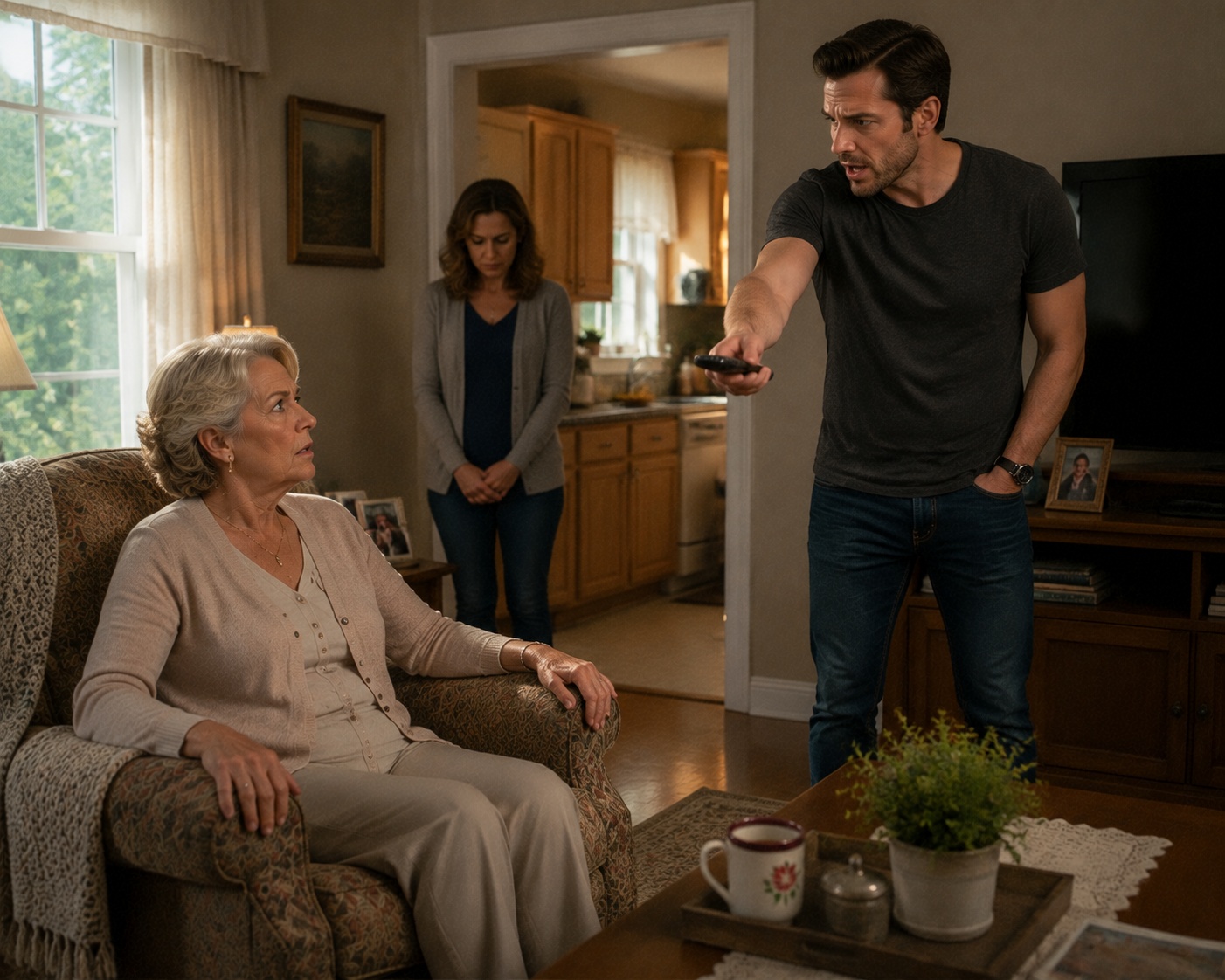
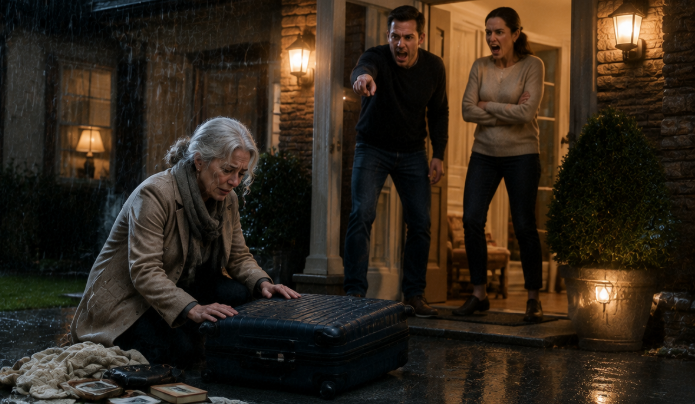
My stepmother’s voice sliced through the kitchen: “You’re not even in the will, sweetheart. So I wouldn’t get too comfortable at that table. ”
It was the 4th of July, and the whole Callaway family had gathered at my grandmother’s lake house on Seneca Lake. The air smelled like charcoal and citronella.

My grandmother, Ruth, sat at the head of the long wooden table, her white hair pinned up, her sharp eyes moving slowly across the family like she was reading a room full of evidence. She had just handed out four envelopes—one for me, one for my half-sister Brooke, one for my stepbrother Marcus, and one for my biological brother Connor, who hadn’t shown up because he was avoiding our father, same as every holiday since he turned 18. I opened mine. Inside was a cashier’s check for $15,000, my name printed in neat block letters: Elena Callaway.
Before I could say a word, Victoria plucked the check from my fingers. She held it up to the light like a counterfeit bill. “Oh, Ruth,” she said, her voice dripping with that particular sweetness that always made my skin crawl. “This is so generous, but these are from that old credit union account you closed last spring.
Remember? You can’t keep writing checks from dead accounts. It’s confusing for everyone. ”
My grandmother said nothing.
She picked up her glass of iced tea and took a long sip. Marcus didn’t even open his envelope. He tore it in half and dropped the pieces on his plate. “Nice thought, Grandma Ruth.
Maybe next year. Just do gift cards. ”
Brooke hesitated, looked at me, then at Victoria, then crumpled her envelope and tossed it into the trash. “Sorry, Grandma,” she whispered.
“I don’t want to cause trouble. ”
I looked at Ruth. She was watching me with those sharp brown eyes, the ones that never missed a misplaced decimal. And then, so quickly I almost thought I imagined it, she pressed her index finger to her lips.
I slipped the check back into the envelope and put it in my pocket. Nobody noticed. Nobody ever noticed me. I couldn’t sleep that night.
I lay in the narrow guest room, listening to the lake lapping against the dock, the check on the nightstand next to a dog-eared novel Ruth had left there. At 8:15 the next morning, I drove into town. The credit union was a small brick building on the main street. I walked in and handed the check to a teller named Darlene.
“I need to know if this is valid,” I said. My voice was steady, but my hands were shaking inside my jacket pockets. Darlene typed. She squinted.
She typed some more. “This is drawn on an active account,” she said. “Funds are available. Would you like to deposit it?
”
I nodded. She stamped the check. The receipt printer whirred. I looked at the number.
$15,412. 16. The 412 was mine, scraped together from months of freelance bookkeeping. The 15,000 was Ruth’s.
I sat in my car in the parking lot and pressed my forehead against the steering wheel. It was real. The check was real, which meant Victoria had lied, which meant she had been lying about a lot of things. You need to understand how the Callaway family works to understand why a $15,000 check made me cry in a parking lot.
My mother, Laura, died when I was 11. Ovarian cancer, fast, brutal, and final. She was a middle school math teacher who kept a budget spreadsheet she updated every Sunday night. She taught me that numbers don’t lie.
People lie. Numbers just sit there and wait for someone honest to read them. My father remarried 14 months later. Victoria Hale Callaway, formerly of the Greenwich Hales, a family whose wealth was three generations deep and whose compassion was approximately one generation shallow.
Victoria brought Marcus into the family. Marcus was two years older than me, loud, confident, and spectacularly average in every measurable way. But Victoria made sure the world treated him like a prodigy. Private lacrosse coaching, SAT tutors, a brand new Audi for his 16th birthday.
Me? I got a used graphing calculator and a reminder that college isn’t for everyone. I worked my way through a state school. I majored in accounting because I was good with numbers, like my mother, and because nobody in the Callaway household thought accounting was worth paying attention to.
“Elena does the taxes” was how they described me at dinner parties, the same way you’d say “Elena feeds the cat. ” It was a chore someone had to do, and I was the someone. Three years ago, I was living in a studio apartment in Syracuse that had a radiator with two settings: volcanic and broken. I was pulling in 38,000 a year before taxes.
I asked my father for help with a security deposit on a better apartment. Just $2,000. He leaned back in his leather chair in his study, the one Victoria had redecorated with oil paintings of horses nobody in this family had ever ridden, and shook his head. “Elena, we’d love to help, but money is tight right now, you understand?
You’re an accountant, right? Budget better. ”
Money was tight. I heard those words on a Tuesday.
On Thursday, Marcus posted an Instagram photo from a resort in Turks and Caicos. In the caption, he thanked Mom and Dad for the birthday trip. The room rate was $1,400 a night. I knew because I had done the family’s credit card reconciliation the month before.
They didn’t even bother to hide it from me because they didn’t think I was paying attention. But the thing about accountants is that paying attention is literally what we do. Two years ago, I learned about the trust. Not from my father, not from Victoria.
From a letter that arrived at Ruth’s house, forwarded to me by accident. It was a quarterly statement from a brokerage firm I’d never heard of. It showed a balance of $520,000 in a trust established by my maternal grandmother, Dorothy Weston, who had died when I was nine. The trust was supposed to be released to me when I turned 25.
I was 27 when I found that letter. I had never seen a dime. When I asked my father about it, he didn’t blink. “That trust was restructured years ago.
The principal was moved into a family investment account for tax efficiency. Victoria and I manage it on your behalf. When the time is right, we’ll release it. ”
“When the time is right.
” That phrase haunted me. I asked to see the statements. He said the financial advisor would send them. They never came.
I asked again. He said he’d look into it. He didn’t. I asked a third time, and Victoria pulled me aside, her manicured hand on my shoulder like a claw wrapped in silk.
“Elena, your father and I have protected that money for you because, frankly, you don’t have the financial sophistication to manage that kind of wealth. You’re a bookkeeper. You balance checkbooks. This is different.
This is real money. ”
“I’m a certified public accountant,” I said. She smiled. “Exactly.
You work for other people. Trust us. We know what we’re doing. ”
I stopped asking, but I didn’t stop counting.
Sitting in that credit union parking lot, I did the math one more time. Marcus’s Audi, Brooke’s private school tuition, the kitchen renovation, the boat, the trips, the investments in Marcus’s string of failed business ideas—a food truck that never left the driveway, a clothing brand that produced exactly zero garments, a cryptocurrency play that evaporated in six weeks. $520,000 doesn’t last long when five people are spending it and only one person earned it. I drove to Ruth’s real home, a gray colonial on a hill outside town surrounded by birch trees, absolutely silent except for the ticking of the grandfather clock in the hallway.
She was in her study, sitting at her roll-top desk. “You went to the credit union,” she said without turning around. “It cleared,” I said. “15,000.
It’s real. ”
“Of course it’s real. I’m old, Elena. I’m not incompetent, despite what your stepmother tells the family attorney every chance she gets.
”
“The trust,” I said. “They took it. ”
Ruth was quiet for a moment. “Your grandmother Dorothy set that money aside because she believed you were the only one in this family who understood the value of a dollar.
She was right. Dennis told me you signed a deferral. He showed me a letter with your signature. ”
“I never signed anything.
”
“I know that now,” Ruth said. “But I need more than suspicion. Victoria has been whispering to my lawyer about cognitive decline. If I accuse them without hard evidence, they’ll petition for conservatorship, and I’ll lose control of everything before I can protect it.
”
“How much is everything? ”
Ruth looked at me over her reading glasses. “The estate is valued at approximately $12 million. I was planning to divide it evenly.
But if they’ve committed fraud, the trust provision is clear. Fraud voids the bequest. ”
I sat down. My hands were steady now.
The shaking was gone. In its place was something cold and precise, the feeling I get when I open a spreadsheet and know that somewhere in column J, someone has been lying. “What do you need me to do? ”
Ruth picked up the phone.
“I’m going to call your father. I’m going to tell him I want to restructure the estate distribution. Accelerate it. Avoid probate.
But I’ll need a clean financial review first. The trust documents, the investment records, everything on the table. I’ll give them 72 hours. ”
“They’ll fabricate everything,” I said.
Ruth smiled. It was the smile of a woman who had survived a husband, two recessions, and 70 years of people underestimating her. “I’m counting on it. ”
She dialed.
I listened on speaker. “Dennis,” she said, her voice thin and wavering—a performance so convincing I almost believed it myself. “I’ve been thinking. I don’t want you kids fighting over the estate when I’m gone.
I want to restructure everything now. Move the major assets into a family trust with you and Victoria as co-trustees. ”
I could hear my father inhale sharply. “Mom, that’s—that’s incredibly generous.
We can come over tonight. ”
“Not yet,” Ruth said. “My attorney, Alan Whitfield, wants to see a full accounting first. Dorothy’s trust for Elena, the investment records, everything.
Just to confirm it’s all been managed properly. Bring it to his office Friday morning. Once Alan signs off, we move forward. ”
“Of course,” my father said, his voice vibrating with barely concealed greed.
“We have everything organized. No problem at all. ”
Ruth hung up and looked at me. “Now we watch.
”
Here’s the thing about being the family’s invisible accountant. For six years, I had done the Callaway family’s taxes. I had set up their QuickBooks. I had organized their cloud storage.
I had configured their shared family Google Drive because Victoria once called me in a panic at 11:00 at night because she couldn’t figure out how to upload a PDF. They never changed the passwords. They never restricted my access. They never even thought about it because I was just Elena, the girl who balanced the checkbooks.
You don’t lock the door when you think the person inside is too stupid to know what they’re looking at. I opened my laptop and logged into the family’s Google Drive. For the first 12 hours, nothing happened. Then, at 10:47 p.
m. on Wednesday, the uploads began. I watched the notifications cascade down my screen like a stock ticker printing bad news. “Trust fund summary draft” uploaded by Dennis.
“Brokerage statement template PDF” uploaded by Victoria. “Dorothy Weston trust final PDF” uploaded by Victoria. Then: “Delete notification. Trust fund summary draft removed by Victoria.
”
They were building the records from scratch because the records didn’t exist because the money was gone. They didn’t know that Google Drive keeps a version history of every file. They didn’t know that deleted files go to a trash folder that retains them for 30 days. They didn’t know because they never asked, and they never asked because they thought I was furniture.
At 2:13 a. m. Thursday, the final file appeared. “Dorothy Weston trust complete statement PDF.
”
I downloaded it. To a normal person, it looked flawless. It had the brokerage firm’s logo. It had the correct address and phone number.
It showed a current balance of $520,000 neatly allocated across three mutual funds. It had quarterly returns, transaction histories, and a management fee schedule. It was professional, detailed, and comprehensive. I’m not a normal person.
I’m a CPA who spent four years auditing financial statements for a living. A document isn’t just words and numbers on a page to me. It’s a system. And systems have rules.
I opened the spreadsheet in Excel and started pulling it apart. The first thing I checked was the math. In a legitimate brokerage statement, every number connects to every other number. Their numbers didn’t tie.
The Q3 dividends showed $4,215 reinvested into the growth fund, but the growth fund balance only increased by $3,800 from Q2 to Q3. There was a $415 gap. A real brokerage would never produce a statement with a $415 discrepancy because the software generates these numbers automatically. A human making it up wouldn’t notice because they don’t think in reconciliations.
I do. Then I checked the formatting. The brokerage firm they were impersonating uses a proprietary reporting template. Their statements use 11-point Garamond for body text and 9-point Helvetica Neue for footnotes.
The document Victoria created used 12-point Times New Roman throughout, which is the default font in Microsoft Word. That’s like showing up to a black-tie gala in cargo shorts. If you know what you’re looking at, it screams. Then I checked the fund performance data.
They had listed three mutual funds by ticker symbol. I pulled the actual historical returns from Morningstar’s public database and compared them line by line. Their fabricated quarterly returns were close, but not exact. In Q2, they listed the bond fund return as 1.
87%. The actual return was 1. 62%. They didn’t look it up.
They guessed, and they guessed wrong. Finally, I checked the metadata. The PDF properties showed it had been created on Wednesday at 11:58 p. m.
using Microsoft Word 2019. The author field read “Victoria’s Surface Pro. ” A legitimate brokerage statement would be generated by the firm’s reporting software, not built in Word on a personal laptop at midnight. I saved everything.
The file, the version history, the deletion logs, the metadata report, the Morningstar comparison, the reconciliation breakdown. I put it all on an encrypted thumb drive and locked it in the glove compartment of my car. Then I called Ruth. “They used Times New Roman,” I said.
There was a pause. Then Ruth laughed—a real laugh, full and sharp. The sound of a woman who had been waiting a very long time for someone in this family to do their homework. “Friday it is,” she said.
Alan Whitfield’s office was on the third floor of a brick building on the main street of Geneva, New York. It was the kind of law office that hadn’t been redecorated since 1994. All dark green carpet and framed diplomas and a conference table that could seat 12 but usually only sat three. On Friday morning it sat seven.
Alan at the head, Ruth to his left, me in the corner near the television mounted on the wall, my laptop bag on my knees. And at exactly 10:00 a. m. , the double doors opened, and in walked my father, Victoria, and Marcus.
Victoria was wearing a cream-colored blazer and diamond studs. Dennis had on his best navy suit. Marcus trailed behind them in a sport coat that still had the tag tucked inside the collar. They looked like a family arriving at a closing, ready to sign and collect.
They didn’t look at me. To them, I was part of the setup. A tech assistant. An extension cord with a pulse.
“Thank you all for coming,” Alan said. “Ruth has asked for a full review of the Dorothy Weston trust before proceeding with the estate restructuring. Dennis, I understand you’ve brought the documentation. ”
My father placed a leather portfolio on the table.
It landed with a satisfying thud. The sound of a man who thought he was about to inherit $12 million. “Everything’s here,” he said, flashing a smile so confident it bordered on indecent. “The trust has been managed conservatively.
The balance is strong. Elena’s money is safe and sound. ”
“My eyes aren’t what they used to be,” Ruth said softly. “Elena, would you put it on the screen?
Nice and big so I can follow along. ”
Dennis glanced at me. “Go ahead,” he said, the way you’d tell a dog to fetch. Victoria leaned toward me.
“Just the summary page,” she whispered. “Don’t overthink it. ”
“Sure,” I said. “I’m good with numbers.
”
I connected my laptop to the wall-mounted screen. I pulled up their PDF. The statement filled the display. $520,000.
Three funds. Twelve quarters of performance data. It looked clean. “Everything’s in order,” Dennis said.
“As you can see—”
“Actually,” I said, “I’d like to walk through a few things since this is a formal review. ”
Dennis shifted in his seat. Victoria’s jaw tightened, but they couldn’t object. Not in front of Alan.
Not without looking like they had something to hide. “Of course,” Victoria said through a smile that could have cut glass. I started with the math. “This statement shows $4,215 in Q3 dividends reinvested into the growth fund,” I said, highlighting the cell.
“But the growth fund balance only increased by $3,800 between Q2 and Q3. That leaves $415 unaccounted for. ”
“Rounding,” Dennis said quickly. “Rounding doesn’t create a $415 gap in a system-generated statement.
Brokerage software calculates these to the penny. They have to. It’s an SEC requirement. ”
The room was quiet.
I moved to the formatting. “The brokerage firm you’re impersonating uses Garamond 11-point for body copy and Helvetica Neue 9-point for footnotes. I pulled up a genuine statement from the firm’s website, which they publish as a sample on their investor relations page. I put it side by side with the fabricated one.
Your document uses 12-point Times New Roman. That’s the default font in Microsoft Word. ”
Victoria’s face went pale. Not white.
Gray. Like concrete in winter. I moved to the fund data. “These are the actual quarterly returns for each of these three funds pulled directly from Morningstar’s public database,” I said, putting the comparison on screen.
“In Q2, you listed the bond fund at 1. 87%. The real return was 1. 62%.
In Q4, you listed the international equity fund at 3. 41%. The real return was 2. 98%.
None of your numbers match the actual fund performance. ”
Marcus was staring at his hands. Dennis was gripping the edge of the table. Victoria was perfectly still, like a woman calculating how many exits are in the room.
“And finally,” I said, “I pulled up the metadata screen. This document was created on Wednesday at 11:58 p. m. The software used was Microsoft Word 2019.
The author field reads ‘Victoria’s Surface Pro. ’”
I let the words hang in the air. “A real brokerage statement would be generated by the firm’s reporting platform. It would not be authored on a personal laptop at midnight, two days before a legal review.
”
I turned to face my father. He wouldn’t look at me. “You didn’t manage the trust. You spent it.
And when you were asked to prove it still existed, you built a fake statement in Word, filled it with made-up numbers, and assumed nobody would check because the only person in this family who could check is the one you’ve been calling a glorified bookkeeper for the last 10 years. ”
Victoria erupted. “This is absurd. She’s manipulating.
”
“The data is on screen, Victoria,” Alan Whitfield interrupted, his voice steady and absolutely lethal. “The metadata is from your own device. The numbers don’t reconcile. And you submitted this document to a legal proceeding under a representation of accuracy.
Do you understand the implications of that? ”
Silence. Dennis cleared his throat. His voice came out in a whisper.
“We—we had some cash flow issues a few years back. We borrowed from the trust temporarily. We intended to replace it. ”
“How much did you replace?
” Alan asked. Dennis didn’t answer. “How much, Dennis? ” Ruth said.
Her voice was no longer trembling. It was iron. “None of it,” Dennis finally said. “We used it for living expenses, Marcus’s ventures, the house renovation.
We were going to pay it back. ”
Alan opened a folder. He read from a document I had never seen before—something Ruth and he had clearly prepared in advance. “Ruth’s estate plan includes a standard fraud and malfeasance clause.
Any beneficiary found to have committed financial fraud, forgery, or misrepresentation forfeits their share of the estate. The forfeited portion is redistributed to the remaining beneficiaries. ”
He closed the folder. “Dennis, Victoria, you have submitted a fabricated financial document to this office.
You have confessed to misappropriating $520,000 from a protected trust. Under the terms of the estate plan, your combined share of $12 million is now void. ”
Victoria’s chair scraped backward. “You can’t do this.
We’ll fight it. We’ll sue. ”
“You’re welcome to try,” Alan said. “But I should mention that the metadata report, the version history from Google Drive, and the Morningstar comparison have already been forwarded to a forensic accountant at the district attorney’s office.
Whether criminal charges follow is their decision, not mine. ”
Marcus stood up so fast his chair hit the wall. “This is insane. I didn’t have anything to do with the trust.
”
“You spent the money, Marcus,” I said quietly. “The food truck, the clothing line, the crypto. That was my inheritance. ”
“I didn’t know where it came from.
”
“Now you do. ”
Dennis turned to Ruth. His face was crumbling. For the first time in my life, I saw my father look like a man who understood he had lost something he could never buy back.
“Mom, please. We’re your family. ”
Ruth stood up slowly. She was 5 foot 2 and 81 years old, and in that moment, she was the tallest person in the room.
“Elena is my family. She has been cleaning up after this family for a decade. She did your taxes. She organized your files.
She built your spreadsheets. And you repaid her by stealing her inheritance and telling her she wasn’t smart enough to notice. ”
She looked at me. “She noticed.
”
Security walked them out. Victoria stopped at the door and grabbed my arm. Her nails dug into my skin. “You think you’ve won?
” she hissed. “You’re nothing. You’ll always be nothing. ”
I removed her hand gently, the way you’d close a ledger at the end of a long audit.
“I’m a CPA, Victoria. I don’t need to be something. I just need to be accurate. ”
The door closed behind them.
Later, Ruth and I sat on the porch of her gray colonial, watching the sun set over the birch trees. The air smelled like pine and lake water, and somewhere down the hill, a loon was calling across the lake. “You’re grieving,” Ruth said. “I am.
”
“That’s natural. You didn’t just lose a father today. You lost the idea of one. ”
She put her hand on mine.
“Your grandmother Dorothy would have been so proud of you. She always said you were the one who understood that love isn’t a feeling. It’s a ledger. And the people who love you are the ones whose numbers always add up.
”
Eight months later, the trust was replenished from the frozen assets of Dennis and Victoria’s accounts. The DA’s office filed charges. Dennis pleaded no contest to misappropriation and received three years of probation and full restitution. Victoria contested the charges and went to trial.
She was convicted of forgery and fraud. Marcus was not charged, but he lost his share of the estate under the malfeasance clause. I moved out of Syracuse. I opened my own forensic accounting practice in a small office above a bookstore in Ithaca.
My first client was a woman whose ex-husband had hidden assets during their divorce. I found $340,000 in a shell company registered to his mother’s address. The case settled in nine days. Ruth and I spent Thanksgiving in Key West.
She ordered a Manhattan at a waterfront bar and toasted my grandmother’s memory. I ordered the same. My father called last month. I looked at the screen for a long time.
Then I silenced the phone, opened my laptop, and went back to work. Numbers don’t lie. People lie. And if you’re patient enough, honest enough, and precise enough, the numbers will tell you exactly who’s been lying, and for how long.
Competence doesn’t need applause. It just needs a spreadsheet and enough time.