My brother’s truck was parked in my parents’ driveway when I pulled up. That should have been my first sign. He wasn’t supposed to be there. Nobody was supposed to be there.

I had planned this for eight months, every single detail. And his beat-up red Ford with the cracked left tail light was sitting in the spot where I had imagined my parents’ car would be when I surprised them. I turned off the engine, grabbed my bag, and walked to the front door. My father opened it before I could knock.
His face told me everything. He’s not a man who shows much. Thirty-two years of the same job, the same route, the same lunch, never complained once. But when he saw me, something moved across his face I hadn’t seen since I was nine and fell off my bike and he thought I was really hurt.
A look like he didn’t know what to do with his hands. “Riley,” he said. Just my name. “Dad, what’s going on?
”
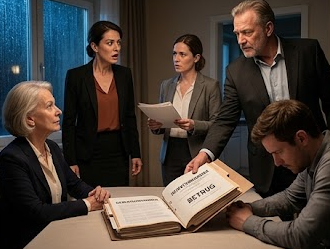
He stepped aside. My brother was standing in the living room. His wife was next to him, arms crossed, already wearing the expression she saves for conversations she’s decided she’s already won. My mother was on the couch, very still, holding a mug she wasn’t drinking from.
I had driven four hours to get here. I had the folder in my bag. I had planned to hand it to my parents over dinner, somewhere nice, somewhere they could cry without feeling embarrassed. I had planned to say: This is yours.
I love you. You don’t have to worry about anything anymore. Instead, I was standing in their living room, and I already knew something had gone wrong. Let me back up.
My parents have rented the same house for nineteen years. Same landlord, same creaking third step, same kitchen window that sticks in the summer. They moved in when I was in middle school, after the house they’d owned had to go in the bankruptcy that followed my dad’s accident at work. He hurt his back.
Couldn’t do heavy work for almost two years. They lost a lot. They rebuilt, slowly. They’re stable now, but they’ve rented for nineteen years, and my mother has never once said she didn’t mind, because she does mind, and we all know it.
I’m twenty-nine. I work in software. I got lucky — the right company, the right timing, a few years of grinding that nearly broke me, but eventually paid off. I’m not wealthy by any dramatic definition, but I have more than I need, and I’ve known for a while what I wanted to do with part of it.
I bought them a house. Not a rental, not help with a down payment. A house outright. Three bedrooms, a big backyard, a covered porch, in a neighborhood where people walk dogs in the evening and wave at each other.
About forty minutes from where they live now, which I knew my mother would love because her sister is nearby. I spent six months finding the right one. I paid $274,000 cash, handled the closing myself, and set up an account to cover property taxes and basic maintenance for the next twelve years, so they would never have to worry about it. I put the deed in a trust.
I named my parents as the life beneficiaries. After they’re gone, it comes back to me. I had an estate attorney set it up. I asked questions until I understood every single word of every document.
I was not going to let anyone, ever, use my love for my parents as a door they could walk through uninvited. I told no one. Not my best friend. Not my co-workers.
Not my brother. I want to say something about my brother here, because I think it matters. He is not a villain. He’s not someone who wakes up planning to take things that aren’t his.
He’s someone who learned early that loudness works — that if you push hard enough and long enough, people get tired and give in. He learned it in our house. Our parents are conflict-averse. When they’ve had hard years, they’d rather smooth things over than fight.
He and his wife have borrowed money from my parents three times in the last seven years. Once for a car, once for a deposit on an apartment, once for something to do with a business that never materialized. None of it was paid back. My parents never asked.
I knew all of this when I bought the house. I factored it in. It’s why I set the trust up the way I did. It’s why I said nothing to anyone.
What I didn’t factor in was that my brother would find out before I got there. He found out because of the neighbor. The house I bought is in a neighborhood where my mother’s sister lives. My aunt, who I love, who cannot keep a secret for longer than forty-eight hours.
I had specifically asked her not to say anything until I arrived. She had promised. She ran into my brother’s wife at the grocery store on Thursday. It was now Saturday.
I learned later that by Thursday evening, my brother already knew the address, the approximate price, and that the deed was in some kind of trust. I didn’t know any of this when I walked through my parents’ front door. What I walked into was this: my brother had spent approximately thirty-six hours convincing my parents that the house should be considered a family asset. That since it was bought with money I earned while being part of this family, and since family takes care of family, the right thing to do was to make sure everyone had access.
He had paperwork. Actual paperwork. I don’t know where he got it or who helped him with it, but there was a document on the coffee table suggesting that my parents add him as a joint tenant on the property. My mother looked like she hadn’t slept.
My father looked like he’d been having a conversation he didn’t know how to end for a day and a half. My brother looked at me when I came in and said, “Good, you’re here. We were just talking about the house. ”
“I can see that.
”
His wife said, “We think it’s wonderful what you’re doing for the family. ”
I noticed she said the family. Not your parents. The family.
I set my bag down on the chair by the door. I didn’t sit. I looked at my mother. “Mom, are you okay?
”
“I’m fine, honey. We were just —”
My brother cut in. “We were just talking about how something this big affects everyone. That’s all.
Nobody’s trying to make this into something. ”
“What is it affecting you? ” I asked. He did the thing he always does: took a breath and looked patient, like I’m the one being unreasonable.
“We’re family. We share things. That’s what family does. ”
“You share things,” I said.
“You borrowed four thousand dollars from Mom and Dad in 2019, and I don’t think that was shared back. ”
His wife uncrossed and recrossed her arms. My father said, “Riley. ”
“I’m sorry.
I’m not trying to start anything. I just want to understand what’s on that table. ”
My brother said, “It’s just an option. Just something to consider.
If something happens to Mom and Dad, we want to make sure the house doesn’t get tied up, that it can be handled smoothly. As a family. ”
“Handled smoothly,” I said. “It makes sense.
Legally, practically, it’s just smart. ”
I picked up the document from the coffee table. I read it. It was a quitclaim deed form, partially filled out, that would have added my brother and his wife as joint tenants with right of survivorship on the property.
Meaning if my parents passed, my brother would own half the house automatically and could potentially force a sale. I set it back down. I looked at my brother, and I thought about the nineteen years my parents spent in a house that wasn’t theirs. I thought about my mother never saying she didn’t mind.
I thought about my father’s face at the door. “I need to show you all something. ”
I opened my bag and took out the folder. A plain manila folder, nothing dramatic about it.
I had organized everything the same way the estate attorney had organized it for me, with tabs and labels, because I wanted to be able to explain it clearly. I put it on the coffee table next to my brother’s document. “The house is held in an irrevocable trust. Mom and Dad are the life beneficiaries.
That means the house is theirs for as long as they’re alive. They can live in it, they can make decisions about it. It’s their home in every sense. It cannot be sold, rented, transferred, or modified without their consent.
And because of the trust structure, it is not part of any estate that can be contested or divided. When they pass, it reverts to me as the remainder beneficiary. ”
I let that sit for a second. “There is nothing to add anyone to.
There is no joint tenancy to create. The trust does not allow for it, and even if someone tried to file paperwork to that effect, the title company and the trustee would reject it. The document on this table is not something my parents can sign, because they don’t own the property in the way that would make that signature meaningful. The trust owns it.
”
My brother stared at me. His wife said, “That seems overly complicated for a gift. ”
“It’s not complicated. It’s clear.
That was the point. ”
My brother said, “You’re saying we have no say. ”
“In my parents’ home? No, you don’t.
Neither do I. Actually, that’s the point of the trust. It protects them from everyone, including me. ”
My mother made a small sound.
I looked at her, and she was crying, very quietly, the way she does when she’s trying not to. I went and sat next to her. I found the page with her name on it, and my father’s name, and showed it to her. “This is yours.
This is just yours. Nobody can take it. ”
She put her hand on the page like it was something fragile. My father was still standing near the door.
He processed everything slowly — always has. He looked at my brother and said, “I think you should go home. ”
“Dad. ”
“I think you should go home.
We’ll talk later. ”
There was a long silence. My brother looked at me like I had done something to him. Maybe in his version, I had.
I don’t know. He and his wife left. He didn’t slam the door. He just closed it.
Then it was quiet. The three of us sat in the living room for a while. My mother kept her hand on that page. My father sat down in his old chair, the one he’s had for fifteen years that everyone has offered to replace and he never lets them.
“I’m sorry this isn’t how I planned to tell you,” I said. My mother shook her head like that was the silliest thing she’d heard. “How long have you been planning this? ”
“About eight months.
”
“By yourself? ”
“Yes. ”
She looked at me for a long time. Then she said, “Your father and I used to talk about having a porch when we were first married.
We had all these plans. ” She stopped, started again. “We stopped talking about it after a while. It felt foolish.
”
I told her the house had a covered porch, big enough for two chairs and a table, facing the backyard. She put her face in her hands — not in a bad way, just in the way people do when something is too big to hold upright. I drove them to see it that evening. We told no one.
The three of us, in my car, the way we used to drive to my grandmother’s on holidays when I was small and fell asleep in the backseat. We pulled up as the sun was getting low. The house is white with green shutters, which I had second-guessed for weeks. But when we pulled up, my mother said, “Oh,” very softly, and I stopped second-guessing.
I unlocked the door and we went in. I had left a lamp on in the living room so it wouldn’t feel empty. Hardwood floors. A window above the kitchen sink that looks into the backyard.
My mother walked directly to that window and stood there for a long time. My father walked through each room slowly. He opened closet doors. He tested the faucet.
He stood in the doorway of the smaller bedroom and looked in, and I don’t know what he was thinking, but I let him be. Then he went out to the back porch. I watched him through the kitchen window. He stood at the railing, the yard going dark, the light getting soft and orange at the edges of the trees.
He stood there with his hands on the railing and didn’t move. I went outside and stood next to him. He didn’t say anything for a while. Then, “You did all this yourself?
”
“Yeah. ”
“How? ”
“I worked hard for a few years, and I knew what I wanted to use it for. ”
He was quiet again.
A bird landed on the fence at the back of the yard, then flew off. “You know your brother is going to be angry for a while. ”
“I know. ”
“He’ll come around.
”
“Maybe. ”
He nodded. He wasn’t arguing with me. He wasn’t defending anyone.
He was just telling me what he thought would happen, calmly, the way he tells me the weather when I ask if I need a jacket. Then he said, “Thank you, Riley. ”
That was all. Just that.
They didn’t come out the way thank you usually comes out — a little reflexive, filling space. They came out like he’d been carrying them and finally found where to set them down. “You don’t have to thank me. ”
“I know I don’t have to.
That’s why I want to. ”
We stood there until it was fully dark. My mother came out and stood on my other side, and we were all three of us on that porch looking at nothing in particular — a dark yard, a few stars, the kind of quiet that doesn’t need to be filled. There are things I want to say about the weeks after, because I think they matter.
My brother and I didn’t talk for about two weeks. His wife sent me a message that started with, “I just think you should understand how this looked from our side. ” I read it once and didn’t respond. Not to be cold.
I’ve learned, slowly and with some difficulty, that not every message requires an answer, and not every person asking you to see their side is actually interested in seeing yours. My brother called eventually. He didn’t apologize exactly, but he said he had reacted badly and that he knew the house was something I had done for Mom and Dad, not against him. I said I appreciated him saying that.
We didn’t go further than that, which was probably the right distance for the time being. My mother’s sister called and apologized about fifteen times. I told her it was fine, which it mostly was. I understood.
She shares everything as an act of love, not malice. She didn’t know what she was setting in motion. My parents moved in six weeks after that evening. I helped them pack.
We rented a truck, and my father’s old co-worker came to help with the heavy furniture. My mother wrapped every dish herself, individually, even the ones that had chips. The day they moved in, I brought two rocking chairs for the porch. Not expensive ones — simple wooden ones painted white to match the shutters.
My mother rocked in hers and said it was the most comfortable chair she’d ever sat in, which I’m fairly sure wasn’t true, but I took it. I want to say one more thing, because it’s the thing I keep coming back to. People talk about boundaries like they’re a form of hardness. Like drawing a line means you’ve closed something off, pulled back, made yourself smaller or colder.
I used to half believe that, honestly. I used to think protecting something meant being defensive about it. But standing on that porch that first evening, in the dark, with my parents on either side of me, that didn’t feel like hardness. That felt like the opposite of hardness.
That felt like I had built something solid enough that we could all finally rest. The trust protects the house. The house protects my parents. The structure I put in place isn’t a wall between my family and the property.
It’s the thing that makes the property actually safe to give. If I hadn’t set it up that way, I would have handed my parents a gift wrapped in anxiety. Every holiday would have had that undercurrent. Every family event would have had the shadow of it.
Instead, my father watches the evening light from his own porch. My mother puts things on the kitchen windowsill — a plant, a little blue pitcher, a photograph — and they stay there. Nobody is coming to move them. I have a key.
I don’t use it without calling first. That’s another kind of line. The quiet kind. The kind that doesn’t need to be explained because it’s just the shape of respect.
A boundary isn’t a wall. It’s just the edge of where something good begins.