My mother was coughing in the guest room at 6:48 in the morning. Not an ordinary cough. It was tight and strained, the kind that makes you sit upright in bed without thinking. She’s 82, with heart failure and a medication list longer than a restaurant menu.
She’s lived with us since my father passed three years ago. That morning, she couldn’t catch her breath. Her hands were cold, her skin had that pale gray tone I’ve learned not to ignore. “Let’s not wait,” she whispered.
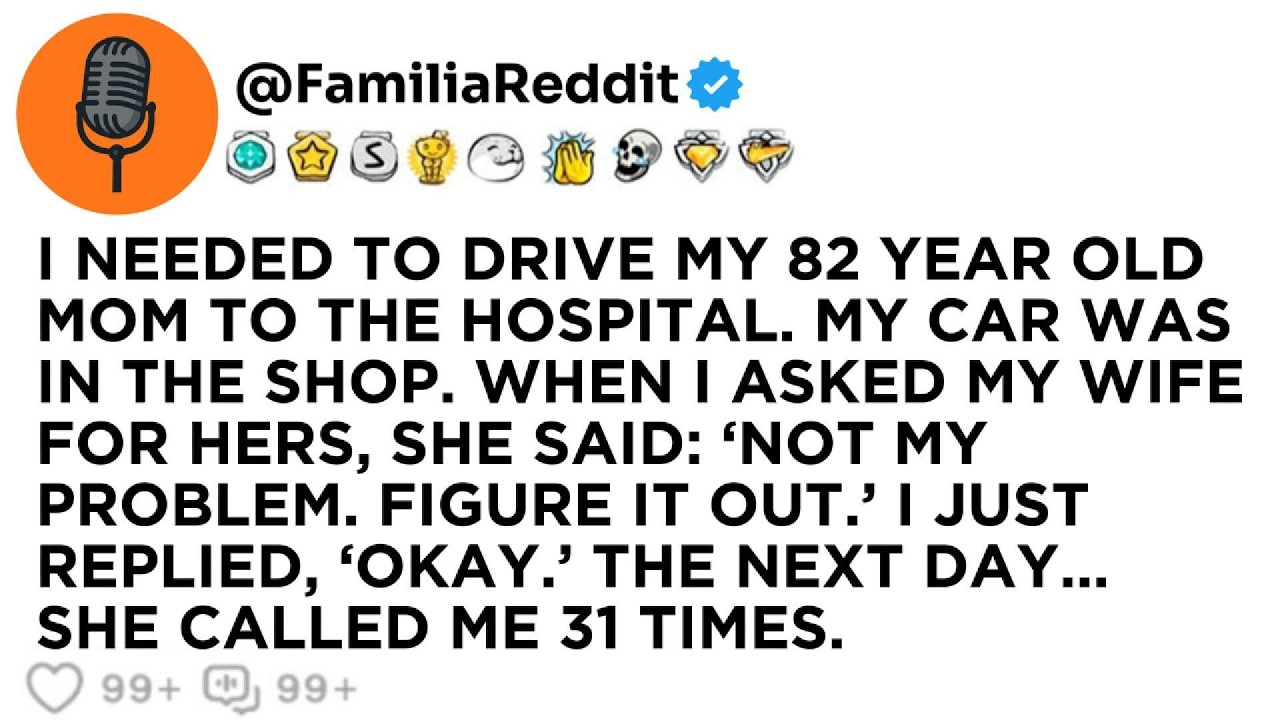
I called her cardiologist. They told me to bring her in immediately. And that’s when I remembered. My car was still in the shop.
Transmission failure. Fourth day waiting on parts. Laura’s SUV sat in the driveway, practically brand new, fully paid off. I walked into the kitchen where my wife was scrolling through her phone, coffee steaming beside her.
“Laura,” I said, trying to keep my voice even. “Mom needs to get to the hospital. My car is still in the shop. Can I take yours?
”
She didn’t look up right away. “I have Pilates at 9:00,” she said flatly. “I’ll have it back before then. ”
That’s when she finally looked at me.
Not anger. Not stress. Indifference. “Not my problem,” she said, lifting her mug.
“Figure it out. ”
I thought I’d misheard her. My mom couldn’t breathe. She shrugged.
“Then call an Uber. ”
I stood there longer than I care to admit, waiting for the punchline, waiting for softness to return to her eyes. It didn’t. So I nodded.
“Okay,” I said. No shouting. No arguing. Just that one word.
Okay. Our neighbor Frank drove us to the hospital. The whole ride, I stared out the window while Mom rested her head back against the seat. “Was that Laura?
” she asked quietly. I kept my eyes forward. “She has a busy morning,” I replied. Mom didn’t say anything else.
But I felt the weight of her silence. At the hospital, the tests began immediately. EKG, blood work, oxygen monitoring. I stayed by her side the entire time.
It wasn’t a heart attack, thankfully. Fluid buildup, medication adjustment, close call. But something else had shifted inside me that morning. Something quiet.
Something permanent. Laura texted once around noon. “Everything fine? ”
I stared at the message.
No apology. No concern. Just efficiency. “She’s stable,” I replied.
A thumbs-up emoji came back. That was it. That evening, when we returned home, Laura was sitting at the kitchen island. “How is she?
” she asked without turning around. “Stable,” I said. She nodded. “Good.
”
I stood there studying her. Twenty-eight years of marriage. We built this house together, raised two stepchildren from her first marriage, shared holidays, shared funerals, shared retirement plans. And yet that morning, when it mattered most, she had drawn a line I hadn’t known existed.
Not my problem. Figure it out. The words weren’t loud. They weren’t dramatic.
They were cold. And they told me something I hadn’t allowed myself to see. I wasn’t her partner anymore. I was her responsibility.
And responsibilities can be declined. That night after Laura went to bed, I sat alone in the living room. I opened my laptop. I don’t know what I expected to find.
Maybe I just needed something solid, something factual, something that didn’t depend on emotion. So I logged into our joint bank account. And that’s when I saw it. Transfers I didn’t recognize.
Large ones. Frequent ones. I leaned closer to the screen. My pulse slowed instead of quickened because suddenly the morning made sense.
And for the first time all day, I didn’t feel hurt. I felt clear. If you had asked me a year ago whether I trusted my wife, I would have said yes without hesitation. I’m 68 years old.
My trust was built through decades of routine—shared calendars, shared passwords, shared doctor appointments. The quiet confidence that comes from surviving things together. Laura and I married when I was 40. She had two children from her first marriage.
I had just made senior partner at the accounting firm where I worked for 35 years. She was warm then, charismatic. She stopped working 12 years ago. “It doesn’t make sense for both of us to kill ourselves,” she had said.
“You make more anyway. ”
I didn’t argue. I was proud to provide. Over time, I moved my paycheck into our joint account.
I added her as an authorized user on every credit card. When I retired at 65, I rolled my pension and 401K into accounts managed under both our names. It never crossed my mind that I should do otherwise. Looking back, I can see the subtle shifts.
Not dramatic enough to alarm me, just small adjustments in tone. When I hesitated over a large purchase, she’d say, “You worry too much. ” When I asked about a charge I didn’t recognize, she’d smile and say, “Relax. It’s handled.
”
Somewhere along the way, I stopped reviewing statements as carefully. Retirement changes you. You begin to value peace more than precision. After her words that morning, I couldn’t sleep.
So I did something I hadn’t done in months. I combed through the accounts. The first transfer was from four months ago. $8,500 wired to an unfamiliar account labeled “consulting.
” The next month, $12,000 “investment seed,” then $6,200 withdrawn in cash. I pulled up the credit card statements. Designer purchases totaling over $14,000 in the past year. Jewelry, weekend spa packages, a boutique travel agency.
That SUV in the driveway wasn’t fully paid off after all. It was financed through a separate line of credit tied to our home equity. A line of credit I hadn’t known existed. I leaned back in my chair and stared at the screen.
For 28 years, I believed we were making decisions together. Now I saw the pattern. The transfers weren’t random. They were escalating.
$8,500, $12,000, $15,000. Like someone building a parachute in secret. I scrolled further. Three inquiries on her credit report—business loan applications dated within the last 60 days.
The day she told me my mother’s emergency wasn’t her problem, she already had one foot outside our marriage. And I’d been the one funding the exit. I sat there until 2:00 in the morning. I didn’t cry.
I didn’t rage. I replayed the last few years. The way she’d started taking phone calls in another room. The new friends I’d never met.
The sudden insistence that she needed financial independence. I had interpreted it as healthy autonomy. Now it looked like preparation. The painful part wasn’t the money.
It was the realization that while I was thinking about cardiologist appointments for my 82-year-old mother, my wife was thinking about liquidity. I heard her footsteps and quickly closed the laptop. “Why are you up? ” she asked.
“Couldn’t sleep. ”
She paused. “You seem distant today. ”
“I was thinking,” I said.
“About what? ”
“Responsibility. ”
She frowned slightly but said nothing more and went back to bed. The next day, while she was at Pilates, I called Daniel, my former financial advisor.
“I need to review everything,” I said. He scheduled me for the following morning. When I walked into his office, he closed the door and said, “Start from the beginning. ”
So I did.
I told him about my mother, about the car, about Laura’s words. Then I slid a printed stack of statements across his desk. He flipped through them slowly, then faster. “How long since you’ve reviewed these line by line?
”
“Not in detail. Six months, maybe more. ”
Within ten minutes, he found what I had sensed but not fully understood. “She’s been moving liquidity,” he said calmly.
“Cash positions, short-term transfers, credit expansion. She’s increasing available funds while limiting traceable long-term commitments. ”
“In English? ”
“She’s preparing for financial separation.
”
The word hung in the air. Separation. Not divorce. Not yet.
Preparation. “Home equity line of credit opened eight months ago,” Daniel continued. “$42,000 drawn over the past seven months. That money didn’t go toward the house.
”
“Where did it go? ”
“Three deposits into a newly formed LLC registered solely under Laura’s name. ”
“What is this? ”
“Looks like she started a consulting business.
”
Laura had never run a business in her life. “She hasn’t touched your 401K,” Daniel added. “That’s good. It’s protected unless you authorize distribution.
”
“So what are my options? ”
“First, separate your income immediately. Open an individual account. Redirect your social security.
Freeze the home equity line. Remove her as an authorized user on any credit cards issued under your name. Then consult an attorney. ”
“Will that escalate things?
”
He gave me a look I recognized from years of negotiations. “It’s already escalated. You’re just late to the meeting. ”
I drove home with a strange calmness.
There’s something clarifying about numbers. They remove ambiguity. Laura wasn’t acting impulsively. She was executing a plan.
And I had funded it. The next afternoon, I opened a new checking account in my name only. I redirected my social security deposits effective immediately. I called the bank and froze the home equity line pending review.
I removed her authorization from two credit cards tied to my retirement account. Each action felt methodical. Controlled. Not revenge.
Protection. By evening, the bank notified me that pending transactions linked to the equity line were suspended. At 9:12 p. m.
, Laura’s phone buzzed. I watched her face change as she read the notification. “What is this? ” she asked sharply.
“What is what? ”
“It says the equity line is frozen. ”
“Yes. ”
“Why?
”
“Risk management. ”
She stood up. “You can’t just freeze it without talking to me. ”
“I can,” I said calmly.
“It’s in my name. ”
“It’s in our name. ”
“It was,” I corrected. Her jaw tightened.
“You’re overreacting. ”
“Am I? ”
“This is about yesterday. ”
“No,” I said quietly.
“Yesterday was about something else. ”
She stared at me, searching for anger. But there wasn’t anger anymore. Only calculation.
She picked up her phone and walked into the bedroom, closing the door behind her. The next morning at exactly 7:18, my phone buzzed. Call one. Laura.
I let it ring. Call two. Call three. By the time I reached the bank parking lot at 8:05, I had seven missed calls.
Inside, I requested a meeting with the senior account manager. I told her I needed to review asset ownership and freeze any outgoing transfers above $5,000 without dual authorization. “Are you anticipating litigation? ” she asked.
“Possibly. ”
Within 30 minutes, the equity line was officially suspended. Alerts were placed on all accounts. Large transfers required in-person authorization.
My individual account was fully activated. When I walked back to my car, my phone showed 15 missed calls and one voicemail. At 9:30, I met with an attorney, Susan Myers, a family law specialist with 20 years of practice. She listened without interrupting.
When I finished, she leaned back. “Your wife has been repositioning assets. Quietly. You’ve frozen liquidity before she completed the transition.
”
“What are my risks? ”
“If she files first, she’ll argue financial abuse. ”
“I’ve transferred nothing to myself beyond my earned income. ”
“Good documentation is your shield.
”
She tapped her pen. “Let me ask you something. Why now? ”
I thought about it.
“It wasn’t just about money. It wasn’t the transfers,” I said finally. “It was the sentence. ”
“What sentence?
”
“Not my problem. Figure it out. ”
Susan’s expression shifted. “That tends to be the moment,” she said quietly.
“The moment when one spouse stops seeing the other as a partner. ”
When I got home, Laura was sitting at the kitchen island. Waiting. Her eyes were sharp.
“What did you do? ” she asked without greeting. “I adjusted risk exposure. ”
“Stop talking like that.
This isn’t a boardroom. ”
“No,” I agreed calmly. “It’s our house. ”
“You froze the equity line.
”
“Yes. ”
“You removed me from the cards. ”
“Yes. ”
“You redirected your social security.
”
“Yes. ”
She blinked, surprised I wasn’t denying it. “You don’t trust me. ”
“I trusted you,” I said evenly.
“That’s how the equity line got open. ”
“You’re punishing me because I had a class scheduled. ”
“This isn’t about Pilates. ”
“Then what is it about?
”
I held her gaze. “It’s about partnership. ”
Silence stretched between us. “You’re trying to control me,” she said finally.
“No,” I replied. “I’m removing the ability to control me. ”
“You can’t just rewrite the rules after 28 years. ”
“I didn’t,” I said quietly.
“You did. ”
That afternoon, I filed for legal separation. Not divorce. Protection.
Temporary financial boundaries pending mediation. When the process server delivered the notice two days later, I wasn’t home. But I heard about it. Because that was the day she called me 31 times.
The first few calls were controlled. “David, we need to talk. This is ridiculous. ”
By call 15, the tone shifted.
“You can’t file separation without discussing it. You’re embarrassing both of us. ”
And then around call 22, something new entered her voice. Uncertainty.
I sat at my desk and let the phone vibrate against the wood. I didn’t feel triumphant. I felt steady. By late afternoon, I finally answered.
Call number 31. Her breathing was uneven. “David, what is happening? ”
“You were served,” I replied evenly.
“Legal separation. ”
“Are you serious? ”
“Yes. ”
“You’re blowing up our life.
”
“No,” I said quietly. “I’m stabilizing mine. ”
“This is about your mother. ”
“It started there.
”
“So because I told you to handle something yourself, you’re dismantling 28 years? ”
“No,” I said. “Because I realized I’ve been handling everything myself. ”
Silence.
“You think I was stealing from you? ” she asked finally. “I think you were preparing for something without telling me. ”
“That’s called independence.
”
“Not when it’s funded by joint equity without transparency. ”
She exhaled sharply. “You’re acting like I committed a crime. ”
“You opened a $42,000 credit line against our home.
”
“It’s our home, and you didn’t discuss it. ”
“You signed me electronically,” I said calmly. The pause that followed was heavy. “You trusted me,” she said.
“I did. ”
“And now you don’t. ”
“Now I verify. ”
Over the next two weeks, mediation was scheduled.
Assets were outlined. Retirement accounts separate and protected. Home jointly held subject to evaluation. Equity line suspended pending court review.
Her LLC entirely hers with no further funding from marital assets. The SUV solely her responsibility for the first time. The structure was visible. No ambiguity.
No quiet transfers. No blurred lines. The strangest part wasn’t the tension. It was the calm.
I drove my mother to her follow-up appointment in a rental car I paid for myself. When we got home, she studied my face. “You look lighter,” she said. “I feel clearer,” I replied.
Three days before mediation, Laura stood in the doorway of the den. “You didn’t have to humiliate me,” she said. “I didn’t. ”
“You served me at home.
”
“That’s how the process works. ”
“You could have warned me. ”
“I did,” I replied. “When?
”
“When I said okay. ”
Mediation was scheduled for 9:00 a. m. on a gray Thursday.
Laura arrived ten minutes late. Controlled. She wore the navy blazer she used to wear to charity events. The mediator, a man in his early 60s named Richard, reviewed the financial summary.
When he reached the section detailing the credit line withdrawals, he paused. “Mrs. Thompson, these funds were accessed without prior documented discussion. ”
Laura crossed her legs.
“We have shared finances. We don’t ask permission for every expense. ”
“$42,000 isn’t an expense,” I said calmly. “It’s a position.
”
When we moved to the equity line freeze, she leaned forward. “He froze it without consulting me. ”
“Yes,” Richard said, “but he did so legally. ”
She turned to me.
“You embarrassed me at the bank. ”
“You embarrassed me at the kitchen table,” I replied evenly. The room went quiet. Mediation lasted four hours.
By the end, the temporary structure was outlined. No shouting. No dramatic ultimatums. Just terms.
When we stepped outside into the parking lot, the air felt cold and sharp. “So that’s it? ” she asked. “For now.
”
“You’ve turned us into a contract. ”
“No,” I said quietly. “We were always a contract. I just finally read it.
”
“You don’t even seem angry. ”
“I’m not. ”
“Then what are you? ”
“Done pretending.
”
That evening, she stood in the hallway as I walked toward the den. “You could still undo this,” she said. “How? ”
“Lift the separation.
Reinstate the line. Trust me again. ”
“What would be different? ”
She hesitated.
“I wouldn’t say something like that again. ”
“That wasn’t the issue. ”
“Then what is? ”
“I asked for help,” I said quietly.
“And you decided it wasn’t your concern. ”
“It was one morning. ”
“It was a pattern. ”
She stepped closer.
“You think you’re the only one who felt alone in this marriage? ”
That caught me off guard. “What does that mean? ”
“You buried yourself in numbers for decades.
Retirement plans. Risk management. Always calculating. I learned to build something of my own.
”
“Then you should have said that. ”
“I tried. ”
She hesitated. And in that hesitation, I saw something real.
Not manipulation. Distance. Maybe she had felt invisible, too. But invisibility doesn’t justify secrecy.
“You didn’t build something with me,” I said calmly. “You built it behind me. ”
She looked tired suddenly. “Maybe I didn’t think you’d understand.
”
“That’s the part that hurts,” I said quietly. “Not the money. ”
We stood there in silence. “Is this over?
” she asked, softer this time. “It’s not what it was. ”
“And what is it now? ”
“It’s honest.
”
She exhaled slowly. “And if honesty leads to divorce? ”
“Then at least it’s real. ”
Six months passed.
Not dramatically. Not in flames. Just steadily. The house was appraised in early spring.
Mediation continued twice a month. We moved through spreadsheets instead of arguments. In the end, I bought out her share of the house using a structured rollover from a portion of our joint brokerage account. Clean.
Documented. Signed in ink. She kept the SUV, the LLC, and the funds she had already transferred. The court formalized the legal separation with clear financial boundaries.
She moved into a downtown condo in July. I helped carry the last box to her car. That surprised her. “You don’t have to,” she said quietly.
“I know,” I replied. We stood in the driveway. Two people who had once promised forever, now dividing furniture. “Was it worth it?
” she asked. “Yes,” I said honestly. “For what? ”
“For clarity.
”
She nodded slowly. “I never meant to hurt you. ”
“I believe that,” I said. “But you did.
”
She looked away first. Then she drove off. The house felt larger without her. Not emptier.
Just quieter. My mother sat at the kitchen table that evening, folding a dish towel. “She gone? ” she asked.
“Yes. ”
She nodded as if she’d known this ending long before I did. “Are you lonely? ” she asked gently.
I considered the question. “No,” I said finally. “I’m settled. ”
My social security now deposits into my individual account every month.
The mortgage is paid down aggressively. The equity line remains closed. My retirement projections are modest but stable. For the first time in years, I review statements without anxiety.
We speak occasionally. Quarterly. Briefly. No accusations.
No nostalgia. Just updates. I drove my mother to her cardiology appointment last week in my own car, transmission replaced, fully paid. On the way home, she reached over and squeezed my hand.
“You look peaceful,” she said. “I am. ”
“You forgive her? ”
“Yes.
”
“And yourself? ”
That question lingered. It took me a moment to answer. “I’m working on that.
”
One evening in late August, Laura called. Not 31 times. Just once. I answered.
“Hi,” she said. “Hi. ”
“I got the mediation finalization notice. ”
“So did I.
”
Silence. “I was scared,” she admitted. “Of what? ”
“Of being dependent again.
”
I thought about that. “You were never dependent,” I said. “You just didn’t trust that I’d stand beside you if you asked. ”
“And now?
”
“Now I stand beside myself first. ”
She exhaled softly. “That sounds different. ”
“It is.
”
We didn’t say much else. When the call ended, I didn’t feel regret. I felt resolution. This story doesn’t end with reconciliation.
It doesn’t end with dramatic apologies or renewed vows. It ends with structure. With boundaries. With a man who finally understood that love without respect becomes obligation, and obligation without clarity becomes erosion.
When she said, “Not my problem. Figure it out,” she didn’t realize she was handing me something powerful. Permission. Permission to stop absorbing.
Permission to stop smoothing. Permission to stop assuming partnership where it no longer existed. And when she called me 31 times the next day, it wasn’t because she loved me more. It was because the structure had shifted.
Because for the first time in 28 years, she couldn’t rely on my silence.