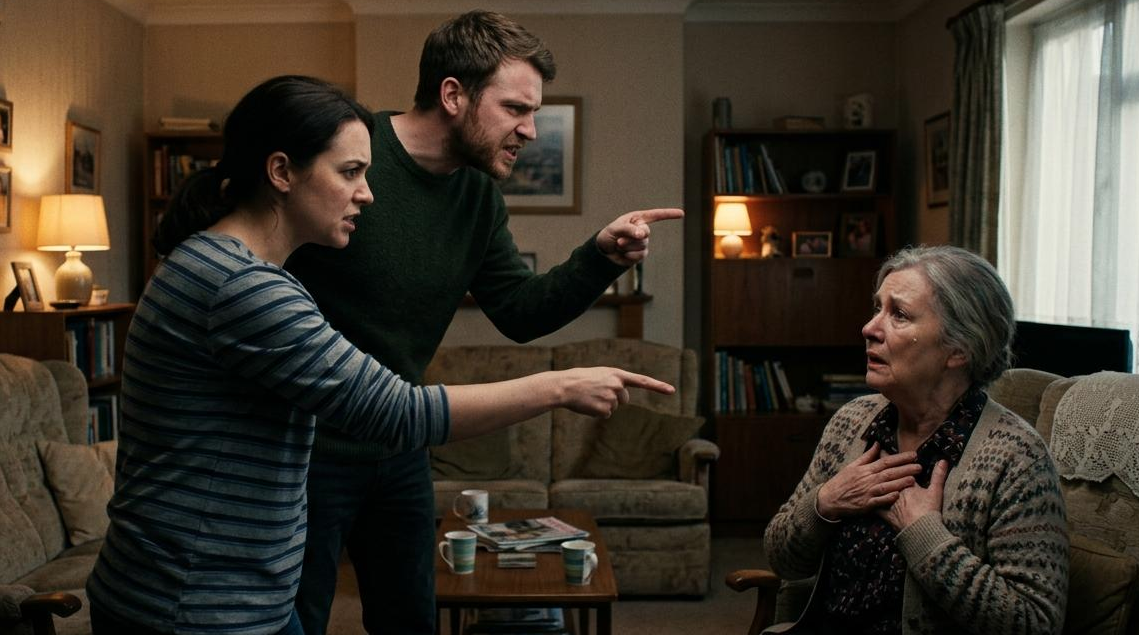
At seventeen, my parents looked at me like I was a criminal. Not disappointed, not angry, just cold—like a stranger had broken into their home. All it took was one lie from my sister to flip the switch. We lived in a quiet suburban house.
My dad was a factory foreman, my mom worked part-time at the library. And then there was Rachel, the golden child, nineteen, in community college, praised for her ambition. Me? I was just Daniel.
Quiet, studious, always compared to her. We used to be close. She walked me home from school, ruffed my hair when I was sad. But something shifted as we got older.
The first crack appeared on a rainy Tuesday in September. I came home drenched, dropped my backpack by the door. My parents were in the kitchen, silent. Rachel sat at the table, arms crossed, looking smug.
“Daniel,” Mom said. “We need to talk. ”
Dad held up a torn envelope. “Found this hidden in the laundry hamper.
It’s from my desk drawer. It had three hundred dollars in it. ”
“I’ve never seen that before. ”
“I saw him sneaking around the office last night,” Rachel said, calm as a practiced witness.
“I wasn’t in your office. Why would I take your money? ”
“Just admit it,” Rachel interrupted. “You’ve always been jealous of me.
”
That word hit me like a slap. I realized in that moment it didn’t matter what I said. The decision had already been made. That night, no one sat with me at dinner.
Within a week, Dad changed his office locks. Mom took my laptop. I wasn’t grounded, exactly, but the message was clear. I was no longer their son.
I was a liability. Rachel was showered with praise for her honesty. A month passed, then two. The money incident faded, but the tension never did.
I started noticing things—missing jewelry, checks taking longer to clear. Rachel suddenly buying new clothes despite claiming she was broke. But I knew better than to say anything. Until the night it happened again.
I heard raised voices downstairs and crept to the top of the stairs. “The emergency envelope. It had nearly two grand,” Dad shouted. “Why would I take it then?
” Rachel’s voice was muffled. I leaned over the railing. “Everything okay? ”
Three heads turned toward me.
Dad took a step forward. “Don’t play dumb, Daniel. You’re not going to gaslight us again. ”
Something in me snapped.
“I didn’t even know you had two grand stashed in the house. And if I was going to steal, don’t you think I’d use a different method than last time? ”
Rachel shot me a glare sharp enough to cut steel. “Go to your room, Daniel,” Mom said.
That night, I cried for the first time in years. Not from fear or anger, but because I realized I would always be the villain in their eyes. The scapegoat. The disappointment.
I started mentally counting down the days until I turned eighteen. I had money saved from tutoring jobs, enough for a shared apartment and a used car. I didn’t speak to Rachel unless I had to. Then, one week before my birthday, something shifted.
I came home late to find Rachel sitting in her car, frantically texting. “Hey,” she said, her voice different. Desperate. “Can you lend me fifty bucks?
Just until Friday. ”
“You want me to give you money? After everything? ”
“Oh, come on.
Don’t be dramatic. You seriously need to grow up, Daniel. ”
I leaned in. “Did you take the money from Dad’s drawer and the emergency envelope?
”
She paused. Her eyes flicked away. Then she scoffed. “Please.
You think I’d be dumb enough to leave a trail? ”
She didn’t even deny it. Not really. That was the moment I decided I was done being quiet.
I didn’t know how or when, but I knew one day the truth would come out. And when it did, I wouldn’t just get an apology. I’d get justice. My birthday came and went with almost no acknowledgment.
No cake, no card, just silence, like I’d already stopped existing in their eyes. Fine by me. That afternoon, I grabbed my things and walked out the front door without a word. The moment I stepped off the porch, I felt lighter.
Like I could breathe for the first time in years. Life on my own was rough. My room was barely big enough for a mattress and a fold-up desk. But it was mine.
No judgment. No accusations. Just blessed freedom. I didn’t speak to my family for nearly three years.
I worked my way up from repairing cracked screens to building custom systems. I took IT courses at night, picked up freelance work. My boss liked me, my clients trusted me. And for the first time in my life, I trusted me.
Then came the message that dragged me back into their orbit. Hi Daniel, it’s mom. We really need to talk. I ignored it.
A few days later, Rachel texted. Hey, I think mom and dad want to apologize. They’re going through some stuff. I ignored that too.
But the messages kept coming—from Mom, from Dad, even from family friends I hadn’t spoken to in years. I agreed to meet them for coffee. When I walked in, they were already at a corner table. Mom’s hands clasped tightly.
Dad staring into his untouched coffee. Rachel nowhere in sight. “Daniel,” Mom said, standing quickly. “You look good.
”
“We owe you an apology,” Dad said. “That’s new. ”
“Rachel… she’s not the person we thought she was.
”
It all came spilling out. She’d been stealing from them for years. Credit cards, heirlooms, lied about tuition, spent the money on trips with her boyfriend. It all came to light when they got a foreclosure warning they’d never seen coming.
“She told us you did it,” Mom said quietly, tears in her eyes. “And we believed her. ”
I sat there listening. Part of me wanted to scream.
Most of me just felt empty. “What do you want from me? ” I asked finally. They exchanged a glance.
“We need help,” Mom said. “Financially. ”
And there it was. The real reason they reached out.
Not because they missed me, but because they were broke, desperate. And I, the son they cast out, was now their best chance. I told them I needed time to think. Then I walked out.
That night, I dug through my cloud backups and found an old voice memo from my cracked iPod touch. A recording from my room. Rachel’s voice, clear as day:
“You seriously think I’d be dumb enough to leave a trail? Please.
If they want to keep handing me money and blaming you, that’s their problem. ”
I stared at the screen, heart pounding. I had proof I wasn’t crazy. That the years of exile weren’t a misunderstanding.
It was all real, and I had survived it. But I wasn’t interested in revenge. Not yet. After our reunion, I ignored their follow-up texts.
Long, desperate paragraphs about their financial situation, how they were at risk of losing the house, how Rachel had run off. No more apologies—just guilt trips laced between pleas for help. I had my own life to worry about. I was still in that tiny room, still juggling work and classes.
Proud of how far I’d come, but it wasn’t enough. Not for what I deserved. So I made a decision. No more just surviving.
It was time to build. I pitched my boss, Brian, an idea. Let me take on mobile clients. Small businesses, home calls, on-site support.
A new branch under his brand. Low risk for him, and I do the leg work. He was skeptical, but I put together a full proposal. Pricing tiers, marketing strategies, a basic website.
Within a month, I was taking calls directly, walking into offices wearing a navy blue polo with our logo. The work was exhausting, but it was mine. And slowly, the money started coming in. I moved into a small studio apartment with a real kitchen and a balcony.
I bought a secondhand couch and a tiny espresso machine. Small luxuries that felt like monuments. I finished my certifications and started bidding on larger contracts—network setups, server management, cybersecurity audits. I was honest about being a solo operator, and people respected the hustle.
Then one day, I got a message from Rachel. I know you hate me. I don’t blame you, but I need your help. I left her on read.
More messages came from unfamiliar numbers, all variations of the same theme. Please talk to me. I’m sorry. I’m in a bad place.
One finally stood out. Mom and dad told me you have money now. You don’t have to shut me out forever. It wasn’t an apology.
It was entitlement. As if she deserved forgiveness simply because she existed in my past. I blocked her number. I changed my email.
I added call filters. Not out of spite. For peace. Months passed.
Brian made me a partner. We opened a second location. I hired my first employee—a kid named Felix who reminded me of myself at seventeen. Then one afternoon, I came home to an envelope taped to my apartment door.
A letter from my mother. She wrote about how they’d sold the house, how they were living in a rental barely able to afford groceries, how Dad lost his job, how Rachel disappeared again. And then the kicker: We’re sorry, Daniel. We know we failed you.
But please, if there’s any way you can help us, we’d be forever grateful. It wasn’t manipulation. It was pure raw desperation. And for a moment, I felt something stir.
Not pity, but an old ache. The part of me that used to crave their approval. But I couldn’t go home. Because there was never really a home to begin with.
So I did something I hadn’t done in ten years. I printed the email I’d sent Mom all those years ago, warning her about Rachel. I printed the screenshots. I transcribed the audio file.
I stapled everything together with a short note:
I tried. You just didn’t want to hear it. And I mailed it to their address. No return label.
Just silence. A week later, I got one last text before changing my number entirely:
I didn’t know. We should have believed you. I didn’t reply.
Things were quiet after that. No more letters on my door. No more desperate voicemails. But quiet doesn’t mean peaceful.
I’d hear whispers through old connections. They say Daniel abandoned them when they needed him most. They treated him like royalty growing up. I didn’t care about gossip.
It lingered, though. Like smoke after a fire. Then one afternoon, Felix came into my office holding a clipboard, looking pale. “I think this is a joke or something, but this came through our contact page.
”
It was a service request form. Name: Rachel Hawthorne. Company: Hawthorne Digital Solutions. Requested services: network installation, security upgrade, cloud backup configuration.
Estimated budget: twelve thousand dollars. I spent the rest of the day looking into it. Public registry showed the company filed two months ago. She had a website—glossy, polished, painting her as a digital strategist with ten years of experience.
I almost choked laughing. But the part that got my attention was her client list. And one name I recognized: Midstate Logistics. A regional shipping company I’d been pursuing for nearly a year.
We’d had meetings, sample quotes, then radio silence. Now I knew why they’d chosen her. I reached out to an old classmate who worked in procurement at Midstate. “Hey, I saw Hawthorne Digital landed your IT contract.
I thought we were still in talks. ”
Her reply came fifteen minutes later. “Honestly, I was surprised when your name didn’t come up in the final quote. Rachel mentioned you two were still professionally linked and that she’d be representing your branch.
Thought it was a weird setup, but her quote came in lower. ”
She used my name. My work. My reputation.
The switch flipped. Because this wasn’t just Rachel being Rachel. This was Rachel stepping into my world. My turf.
I started building a dossier. Every fabricated credential on her website, documented. Every lie about her experience, pulled from LinkedIn screenshots. I hired a virtual assistant to pose as a potential client.
She recorded the entire Zoom consultation. In it, Rachel mentioned me by name at least twice. “Oh, yes. I modeled our packages after some work I did with my associate Daniel.
We’ve handled several high-end clients together. ”
The kicker? She sent over my sample contract. Word for word.
I waited exactly three weeks. Not because I needed more time—I had everything. I waited because revenge is best served cold. And slow.
Then I sent a package to Midstate Logistics. No branding, no note. Just proof. Proof that her resume was fabricated, that her quote was plagiarized, that she’d never worked with me.
Transcripts of old voicemails where she admitted to lying and stealing. And a signed affidavit from me stating I had no affiliation with her company. I sent similar folders to two other companies on her website. One emailed me the same day.
“We will be conducting an internal review immediately. ”
I sent the final package to a small business watchdog group with a section called “Spotlight on Fraud. ” I included a USB with side-by-side screenshots of her website and mine. One week later, everything unraveled.
Her new clients pulled out. One requested a refund and reported her to the Better Business Bureau. Midstate didn’t just cancel the contract—they blacklisted her publicly. They issued a warning to vendors about a consultant who misrepresented credentials and engaged in deceptive practices.
Two days later, her website went down. Her LinkedIn vanished. Her business email started bouncing. She was disappearing.
But I wasn’t done yet. Because while Rachel’s crash was satisfying, there were still two people who had spent nearly a decade believing her lies. I hadn’t spoken to my parents since mailing that envelope. Then I received an email from my dad.
Subject: We understand now. Daniel, we’ve seen the news about Rachel. We received a letter from one of her clients with links to everything you sent. We failed you.
Not just once—over and over. I don’t even know how to ask for forgiveness. I didn’t reply. They didn’t deserve closure.
But what they did deserve was a mirror. So I submitted an article to a small community newsletter in our hometown. Not a rant—just a story. The story of a young man falsely accused, cast out by his family, who started with nothing and built something meaningful.
Only to find that the same people who betrayed him were now reaching for his hand as they fell. I didn’t use names. But the details were unmistakable. The story went viral locally.
Commenters speculated. Some recognized the timeline. I heard through the grapevine that my parents were mortified—they stopped going to church, deleted their Facebook accounts. All I did was tell the truth.
And the truth does what it always does. It burns away the lies. Rachel resurfaced under a different name, trying to start over in another city. But her reputation had holes in it now.
Holes that didn’t patch easily. As for me, I kept building. I hired two more employees. Expanded to another city.
Built a mentorship program for young IT students who didn’t have a support system. One day, Felix asked me why I never talked about my family. I smiled. “They thought I stole from them,” I said.
“Turns out I was the one they couldn’t afford to lose. ”
He laughed, not realizing how true it was. And I realized in that moment that I was free. Not just from them, but from who I used to be.
They had tried to bury me in lies. I used every ounce of their dirt as the foundation for something better. They cut me off when I had nothing. They came crawling back when I had everything.
So I gave them the one thing they never gave me. Silence.