The Old West was far stranger, harsher, and more unpredictable than the version seen in classic movies. Behind the famous cowboys, outlaws, and lawmen lay peculiar rules, brutal working conditions, odd inventions, and events that history books often skip over. The reality of the frontier included everything from strict gun control laws to a legendary gunfight that didn’t happen where its name suggests. Many frontier towns actually required visitors to surrender their firearms before entering busy areas.
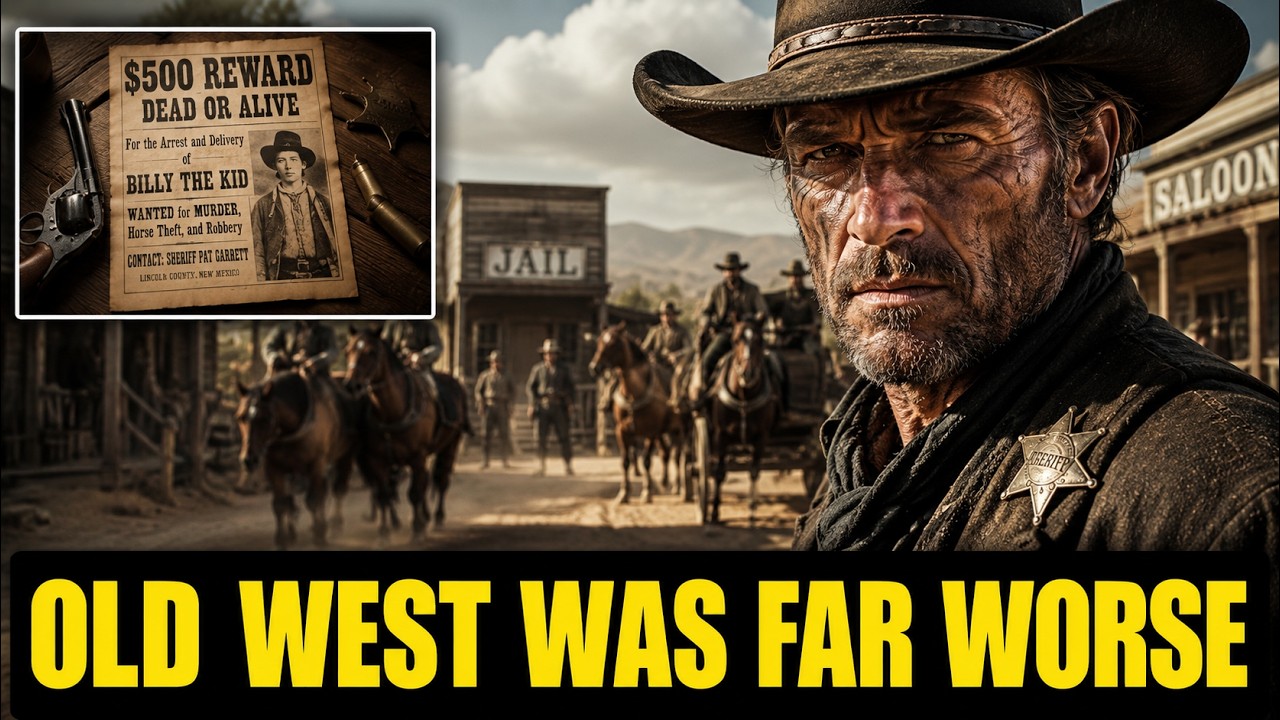
Dodge City posted a sign explicitly banning the carrying of weapons, and Tombstone had similar laws. The effort to enforce those rules in Tombstone led to the conflict that became the most famous shootout in Old West history. The Gunfight at the O. K.
Corral actually took place in a narrow empty lot behind the corral, near a photography studio on Fremont Street. The confrontation lasted only about thirty seconds. Tombstone residents were not pleased with the notoriety, as they wanted their city to be seen as a growing business hub rather than a den of gunfighters. The formal quick-draw duel seen in Westerns was largely a Hollywood invention.
Historians often cite the 1865 clash between Wild Bill Hickok and Davis Tutt as one of the few events that even approximated this pattern. Real frontier violence usually happened through arrests, robberies, personal disputes, or sudden attacks, with no formal countdown or fair starting positions. A federal lawman’s job involved far more paperwork and prisoner handling than chasing criminals. U.
S. Marshals delivered summonses and warrants, transported prisoners, located witnesses, ensured jurors appeared, paid court expenses, rented space for courtrooms and jails, and hired bailiffs. A deputy might ride for days to catch a fugitive, then spend the next stretch organizing food, lodging, legal documents, and court schedules. Bass Reeves amassed one of the most remarkable records among Old West lawmen.
Born into slavery, he served as a Deputy U. S. Marshal in Indian Territory for nearly 32 years and said in an 1901 interview that he had arrested more than 3,000 people. Unable to read, he reportedly memorized warrant details and matched them against descriptions of those he was ordered to arrest.
His record came not from one famous gunfight but from decades of steady court work, long horseback journeys, careful identification, and bringing prisoners back alive for trial. Reeves once had to enforce the law against his own son. Bennie Reeves was accused of murdering his wife, and Bass insisted on taking the arrest himself. He delivered his son to court, where Bennie was convicted and sent to prison.
The incident demonstrated how seriously Reeves took his duties, even in the most personal of cases. Judge Isaac Parker became known as the “Hanging Judge,” but the nickname hid a significant contradiction. Parker personally opposed the death penalty and believed in reforming criminals when the law allowed. Over 21 years, he handled more than 13,000 criminal cases and sentenced 160 people to death, though only 79 executions were ultimately carried out.
His court sat beside a federal prison so unsanitary that inmates called it “Hell on the Border,” and media reports eventually forced changes. The Dalton Gang had deep roots in law enforcement before becoming one of the West’s most notorious outlaw groups. Several Dalton brothers worked as lawmen, including as Deputy U. S.
Marshals and police chiefs. In 1892, the gang attempted to rob two banks simultaneously in Coffeyville, Kansas. The plan failed, and only Emmet Dalton survived among the brothers who took part. Frank Canton built a respected reputation as a lawman and detective in Wyoming, but he arrived there under a false identity.
His real name was Josiah or Joe Horner, and before coming to Wyoming around 1880, he had lived as a criminal in Texas. He adopted the name Frank Canton and built an entirely new public life, serving as sheriff and later holding government positions in Oklahoma. He received a pardon from Texas in 1894 for his earlier crimes. Belle Starr earned the title “Bandit Queen,” yet the documented record of her crimes is far smaller than the legend suggests.
The only clearly documented crime was horse theft, for which she was convicted in federal court in 1882. Her national fame came only after her death in 1889, when a publisher rushed out a cheap novel calling her the “female Jesse James. ” The legendary character was largely created from rumor, clothing, association, and the publishing industry. Wyatt Earp’s image was shaped not only by his actions but also by what those close to him wanted removed from the record.
In the 1920s, Earp worked with John Flood on his biography. Josephine Earp insisted that gambling, drinking, and other behavior she found embarrassing be removed from the manuscript. Editors rejected the manuscript for poor writing quality, but the project showed that Earp’s legend was being curated long before Hollywood took control. Doc Holliday was actually a trained dentist.
John Henry Holliday enrolled in the Pennsylvania College of Dental Surgery in 1870, graduated in 1872, and practiced dentistry in Georgia. He contracted tuberculosis—the disease that killed his mother—and moved west in 1873 seeking a drier climate. He died of tuberculosis in Colorado at age 36. His illness influenced nearly every major decision of his adult life, including the move west where his legend grew.
Buffalo Bill Cody turned the West into a traveling entertainment business. Starting in 1883, Buffalo Bill’s Wild West staged horse races, stagecoach scenes, shooting exhibitions, and reenactments for huge audiences across the U. S. and Europe.
For many people who never traveled west, this show became the primary visual reference for frontier history, turning complex events into short action scenes with clear heroes, villains, and dramatic endings. Dime novels were already turning Old West characters into stars while the frontier era was still happening. Publishers used bright covers packed with violence and adventure, and a large portion of readers were teenagers. Publishers reused famous names like Buffalo Bill and Jesse James, mixing real events with fiction, and these cheap publications created character and story patterns that Hollywood later inherited.
The American cowboy was not suddenly invented by English-speaking settlers. The profession grew directly from the older Spanish and Mexican vaquero tradition. Vaqueros maintained vast herds, trained horses, and developed practical methods for working on dry, open land. The Library of Congress notes the first cowboys were Spanish vaqueros and warns that the familiar image of the heroic white cowboy is historically incorrect.
Real cattle drive crews were highly mixed. Teams typically included Mexican vaqueros, African Americans who had been enslaved, Anglo-Texans, newcomers from the eastern U. S. and Europe, and sometimes Native Americans.
Some early cowboy songs were in Spanish. Black cowboys like Nat Love later wrote about their experiences, but popular entertainment presented cowboys as almost exclusively white for decades. Cowboy work was generally exhausting, uncomfortable, and poorly paid. One warning to would-be cowboys described riding 12 to 18 hours a day, wet bedding, plain food, cold nights, heavy rain, dust, and intense heat.
Much of the job involved preventing problems rather than creating adventure, and for many young workers, being a cowboy was temporary seasonal labor. The famed era of long cattle drives was surprisingly brief. The main push of moving Texas herds to northern rail markets lasted roughly from 1866 to 1890—about 24 years, less than a generation. Railroads pushing further south, quarantine laws, and barbed wire fencing brought the system to an end.
The long drive was a short economic opportunity created by geography, price differences, and incomplete rail networks. A force invisible to cowboys helped end the cattle drive era. Texas fever was a cattle disease spread by ticks. Texas longhorns often appeared healthy because they had developed immunity, but they remained carriers.
Northern cattle that mixed with them or grazed where they had passed became sick. By 1885, Kansas banned Texas cattle from crossing the state entirely. A tiny parasite carried by a tiny tick helped close the trails where thousands of cattle once moved. Barbed wire did more than divide ranches in Texas—it helped spark the Fence Cutting War of 1883.
Severe drought made grass and water critically important. Some ranchers enclosed land they owned or leased, while others seized public land, blocked roads, and cut off access to schools, churches, mail, and water. Armed groups cut fences at night, leaving warnings not to rebuild. The destruction spread across more than half of Texas counties, killed at least three people, and caused around $20 million in property damage.
The legislature eventually made fence cutting a crime and also punished those who knowingly enclosed others’ land. The winter of 1886 and 1887 brought the end of the open-range cattle boom on parts of the northern plains. Rapid expansion, overgrazing, falling cattle prices, and severe drought set the stage. Then early snow fell, temperatures dropped fast, and a hard crust formed over remaining grass.
Historians consider the popular claim that almost all cattle died to be exaggerated; one careful estimate put statewide losses in Wyoming at about 15 percent. But even that number was a massive financial blow, and the cattle business never returned to its former glory. Charles Goodnight is credited with inventing the chuck wagon, a mobile kitchen that made long cattle drives more organized. The wagon served as a traveling kitchen, storage area, and camp center, carrying cooking supplies, tools, water containers, bedding, and repair materials.
The cook managed supplies and camp routine, often arriving at the next stop before the others. The wagon was the support system that kept crews fed and moving across hundreds of miles. Cowboys sang to reassure cattle during night duty. A steady human voice helped the herd stay accustomed to riders moving in the dark.
A sudden noise could make a frightened herd difficult to control, so familiar songs and calls served a practical purpose. Perfect words or fine voices were not required—what mattered was a calm, regular tune. This practice helped build a vast tradition of cowboy songs that were later collected, printed, and performed on stage. On the treeless plains, dried manure was fuel.
Settlers and travelers called these dried pieces buffalo or cow chips, burning them for cooking and heat when wood was scarce. Children were often assigned to collect them. The practice showed how people adapted to an environment where familiar resources were absent. What travelers would normally have stepped over became a practical alternative to wood.
The first famous Stetson cowboy hat was far more plain than the sharply creased hats of later Western films. John B. Stetson introduced the “Boss of the Plains” hat in 1865 with a smooth, rounded crown, a flat brim, and very little ornamentation. Its main selling point was durability.
Owners later shaped and creased their hats, and regional styles developed over time. Blue jeans were not originally marketed as stylish cowboy clothing. In 1873, tailor Jacob Davis and businessman Levi Strauss patented metal rivets to reinforce work pants at points prone to tearing. Their product was marketed as riveted “waist overalls” for workers who needed durable clothing for mining, construction, ranch work, and other physical labor.
The famous cowboy connection to denim came later; the original innovation was the small metal rivet that prevented tears. The Pony Express became one of the most powerful symbols of the Old West, yet it operated for only 18 months. It began in April 1860, carrying mail across more than 1,800 miles between Missouri and California. A letter could make the entire trip in about 10 days, an astonishing speed before electronic communication.
The service was expensive and financially troubled. In October 1861, the transcontinental telegraph connected San Francisco and New York, instantly making the Pony Express obsolete. In the 1850s and 1860s, the U. S.
Army experimented with camels as transport animals in the Southwest. The imported camels performed well in official trials: they carried more weight than most mules, needed less water and food, handled rough terrain, and required no shoes. One unexpected problem was that horses and mules often reacted badly to their presence. The experiment was disrupted by the Civil War, leadership changes, and a military system built around horses, mules, wagons, railroads, and river transport.
The remaining camels were eventually sold off, though some escaped or were abandoned, and reports of wild camels persisted for decades. Chinese workers made up about 90 percent of Central Pacific Railroad’s workforce at its peak and were essential to building the western half of the first transcontinental railroad. More than 11,000 Chinese immigrants worked for the company, cutting roadbeds, building retaining walls and bridges, and carving tunnels through the Sierra Nevada. They were generally paid less than white workers and often had to cover more of their own living costs.
In 1867, thousands went on strike demanding better pay and conditions—one of the largest labor actions in the country at that time. The strike ended when the company cut off supplies to isolated camps, but the famous photos and old textbooks often pushed these workers to the margins of history, even though Central Pacific could not have crossed the mountains without them. The term “snake oil” now refers to useless products sold with dishonest promises, but the story began with a real remedy. Chinese railroad workers brought knowledge of making oil from Chinese water snakes, which had anti-inflammatory properties and was historically used for muscle pain after hard work.
American patent medicine sellers noticed its reputation and began using the phrase, but many of their products contained little to no actual snake oil. A famous product marketed as rattlesnake oil was later tested by federal investigators and found to contain mineral oil, animal fat, and other ingredients—but no snake oil. The fraud became better known than the real treatment, and the term “snake oil salesman” entered the language as a name for a clever swindler. Plains Native American nations used a sophisticated sign language to communicate between different spoken languages.
Called American Indian Sign Language, Plains Indian Sign Language, or hand talk, it was far more than basic gestures for trading. Skilled users could express names, actions, directions, stories, and a wide range of complex ideas. In 1930, a major film council was organized out of fear the language was being lost. Eighteen official delegates from twelve tribes and language groups gathered to demonstrate and preserve it, with Congress funding the project.
Westerns often show Native people and newcomers struggling to communicate with immediate gestures, but in reality, plains peoples already had an established visual language used across vast cultural and geographic distances. Popular Western stories often present attacks as the greatest danger for emigrants, but disease killed far more people on overland journeys. The National Park Service estimates that roughly 6 to 10 percent of emigrants died from illness. Of about 350,000 people who started the journey, perhaps 30,000 died from disease.
Cholera was the most feared cause because a person could become fatally ill very quickly. Travelers camped repeatedly near the same rivers and stops, so waste from earlier groups contaminated water used by later ones. The covered wagon is usually imagined as a moving family room with everyone riding comfortably inside. In reality, most emigrants walked much of their 2,000-mile journey.
Wagons carried food, supplies, bedding, clothing, spare parts, and other necessities, and extra passengers added more weight for the oxen or mules. Travelers often walked alongside loaded wagons, sometimes pushing or helping with stock on difficult stretches. Daily progress averaged only 10 to 15 miles. On the Great Plains, many settlers built homes from sod because wood was scarce or too expensive.
They cut thick blocks of prairie soil held together by grass roots to build walls. Sod provided good insulation, but weather damaged roofs and walls, requiring constant repairs. The Library of Congress notes that very few of these buildings lasted more than 50 years. Building a home directly from the prairie was a practical solution for living in a region with severe shortages of trees and construction materials.
Before the great commercial slaughter, the North American bison population was estimated at 30 to 60 million. By the 1890s, fewer than 1,000 bison survived. Railroads opened the plains to large-scale hunters, and hides, meat, and bones were shipped to distant markets. The slaughter devastated Plains Native nations, for whom bison had provided food, clothing, shelter, tools, trade goods, and religious materials.
The National Park Service describes this destruction as a major part of the broader devastation of Indigenous communities in the 19th century. The collapse from tens of millions to under 1,000 happened within the lifetimes of people who had seen the old great herds.