The real Al Swearingen was far more ruthless, cunning, and dangerous than his foul-mouthed television counterpart. As the mastermind behind Deadwood’s infamous Gem Theater, he ruled the frontier town not with a badge or a gun, but with blackmail, intimidation, and manipulation. Ellis Alfred Swearingen was a key figure in the early development of Deadwood, South Dakota, during the late 1800s. He operated the Gem Theater, which advertised itself as a performance venue but functioned primarily as a saloon and entertainment hall offering alcohol, music, and companionship to the miners and fortune seekers who poured into town during the Black Hills gold rush.
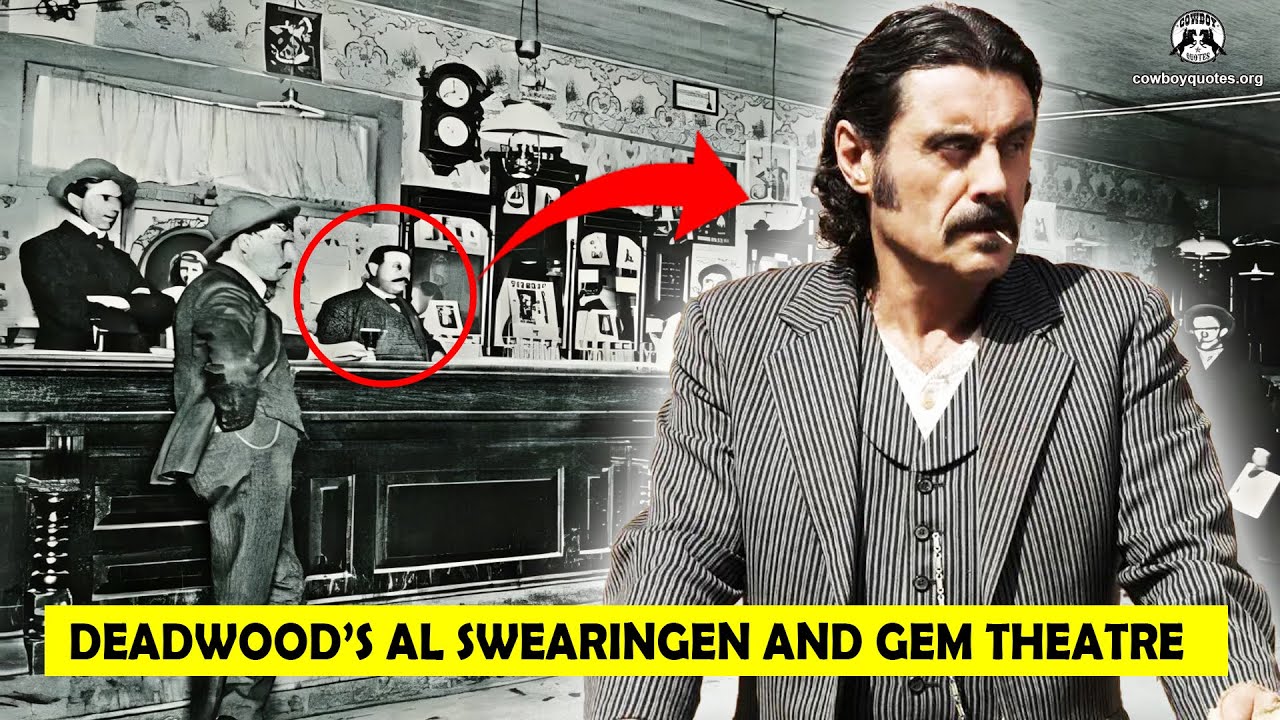
The Gem quickly earned a reputation as one of the most prominent and lucrative businesses in town. Swearingen ran it for over two decades, an impressive feat given the lawlessness and economic instability that defined frontier towns at the time. His success came from a keen understanding of human desire in frontier economics. By blending showmanship with strategic relationships with local officials and lawmen, he maintained the Gem’s dominance in Deadwood’s social and commercial life.
Swearingen was born in Oskaloosa, Iowa, alongside his twin brother Lemuel. The two were the oldest of eight children born to Daniel J. Swearingen, a farmer of Dutch American descent, and Kaziah “Katie” Montgomery. Unlike many ambitious young men who headed west in their early twenties, Swearingen remained in Iowa well into his thirties.
It wasn’t until May 1876 that he made his way to Deadwood with his wife Nettie, arriving as the town was transitioning from a chaotic mining camp to a more established settlement. His first marriage did not last. Historical accounts suggest Nettie eventually filed for divorce, citing mistreatment within the marriage. Swearingen would go on to marry two more times, and both subsequent unions also ended in divorce.
Before establishing his business in Deadwood, Swearingen had already built a reputation as a savvy entrepreneur in Custer, South Dakota. During the early boom years, he operated a dance house there that became one of the liveliest spots in town. According to the Black Hills Pioneer’s 1882 New Year Edition, Swearingen’s Dance House was a large structure measuring approximately 30 by 150 feet. It was reportedly so popular that crowds gathered day and night, and patrons often had to push through the busy entry just to get inside.
But Custer’s heyday was soon eclipsed by rumors of richer prospects nearby. In January 1876, reports circulated that gold had been discovered in Deadwood Gulch. By March, a major migration was underway, and Custer’s population dwindled so dramatically that only about a hundred residents remained. Property values collapsed.
Lots that had sold for as much as $800 two months earlier were now being offered for as little as $50, with few takers. Recognizing the shift, Swearingen made a calculated decision to follow the crowd and set up shop in Deadwood. His initial venture in Deadwood was a modest saloon known as the Cricket, built from canvas and lumber, offering gambling and stage prize fights. But Swearingen had larger ambitions.
He soon closed the Cricket and used its early profits to open the far more expansive Gem Theater. The Gem became a cornerstone of Deadwood’s nightlife, serving as a saloon, dance hall, and social club. It gained a reputation as one of the most profitable and notorious businesses in the Black Hills. Historical reports and personal accounts suggest Swearingen actively recruited women to work at the Gem, often targeting those who were financially vulnerable or seeking a fresh start in the West.
While some may have arrived voluntarily, others were said to have been pressured into remaining through manipulative practices in a lawless town. One colorful figure from this period, Calamity Jane, is reported to have been among the Gem’s first dancers. According to some sources, she once traveled to Sidney, Nebraska, and returned with ten women for Swearingen’s business. Financially, the Gem was an enormous success.
Records suggest that on an average night, the establishment brought in around $5,000, and on particularly busy nights as much as $10,000—a staggering figure for the time, equivalent to nearly $300,000 in today’s money. Disaster struck on September 26, 1879, when a fire swept through much of Deadwood and reduced the original Gem Theater to ashes. Swearingen rebuilt, this time creating a larger, more lavish version of the venue. His success wasn’t due to business instincts alone.
He demonstrated a strong talent for political navigation, forming key alliances and offering financial support to select town officials. Figures like Sheriff Seth Bullock sought to bring law and order to the town, but Swearingen’s influence shielded him from much of that effort. Eventually, the Gem’s reign came to an end. In 1899, another fire destroyed the rebuilt structure, and this time it was not reconstructed.
That same year, Swearingen left Deadwood behind and entered a new phase of his life, marrying Odellia Turjan. For many years, it was believed that Swearingen died alone and destitute, supposedly while attempting to board a moving freight train. However, more recent research suggests a very different and far more mysterious ending. According to his obituary and newspaper reports published at the time, his body was discovered in the early morning hours of November 15, 1904, lying in a street in suburban Denver, Colorado.
The cause of death was listed as severe trauma to the head, though few details were offered. There were no witnesses, no reported altercation, and no evidence of robbery. The unusual nature of his injuries and the public silence that followed led some historians to suspect foul play. Adding to the intrigue, just weeks earlier, Swearingen’s twin brother Lemuel had also been the victim of an apparent attack.
He was shot by unknown individuals but managed to survive. Notably, like his brother, Lemuel was not robbed, leading some to believe the two incidents might have been connected. Theories have emerged over the years, ranging from business rivalries to long-standing personal grudges. No one was ever charged in either case, and the story of his final moments remains clouded in uncertainty.
Between 2004 and 2006, the HBO television series Deadwood brought renewed attention to the historical figure, portraying him as one of the town’s most influential and commanding characters. The show depicted Swearingen as a complex, often harsh leader deeply entangled in the evolving political and economic future of Deadwood. The series took creative liberties with his background, re-imagining him as English-born with his first name changed from Ellis to Albert. Swearingen was portrayed by Ian McShane, whose performance was widely acclaimed for its intensity and nuance.
In 2005, McShane received a Golden Globe Award for Best Actor in a Television Drama for the role. That same year, he was also nominated for both Emmy and Screen Actors Guild Awards. TV Guide later included McShane’s Swearingen in its 2013 list of the 60 nastiest villains of all time, placing him at number six. Ian McShane later reprised his role in Deadwood: The Movie, released in 2019.
Set in 1889, the film revisits the town and its aging residents a full decade after the events of the series. While the show took liberties with names, dates, and personalities, it succeeded in bringing renewed attention to the real Swearingen, a man whose historical reputation is as tangled and controversial as the fictional version made famous on screen.