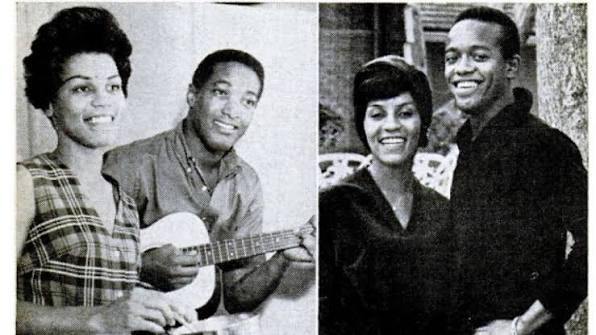
Bobby Womack walked into Sam Cooke’s funeral wearing one of Sam’s suits.
But that wasn’t the part that made people stare.
On his arm was Barbara Cooke—Sam’s grieving widow.
And only three months later, Bobby would marry her.
To understand why that single decision caused outrage, threats, family violence, and a scandal that would follow Bobby for decades, you have to understand who Sam Cooke was to him.
Sam wasn’t simply another singer Bobby knew.
He was his mentor.
His friend.
The man who had helped change his life.
Years earlier, Bobby Womack and his brothers had been trying to make their way in music when Sam Cooke recognized their talent. Sam helped them secure a recording contract, encouraged their careers, and eventually became someone Bobby deeply admired.

Their relationship went far beyond business.
That was why what happened after Sam’s death felt, to many people around them, like an unforgivable betrayal.
Sam Cooke died in Los Angeles in December 1964 after being shot by motel manager Bertha Franklin. The official circumstances surrounding his death became the subject of controversy and speculation that would continue for decades.
But before anyone could even begin processing how suddenly he was gone, his family faced another horrifying experience.
Sam’s body was prepared in Los Angeles and flown to Chicago.
According to accounts later repeated by family members, they were deeply disturbed by his appearance. They believed his body had been badly handled and asked the mortician to work on him again before the public viewing. His brother reportedly helped fix his hair.
Then the doors opened.
Thousands upon thousands of people came to say goodbye.
The viewing at Chicago’s Tabernacle Baptist Church drew an enormous crowd of grieving fans, friends, musicians, and family members. Reverend Clay Evans conducted the service. The Staple Singers performed. Mavis Staples reportedly struggled through tears.
Among those who came to mourn were major figures from entertainment and public life, including Smokey Robinson, Dick Gregory, and Muhammad Ali.
But another service would take place in Los Angeles.
And that was where Bobby Womack made an entrance people would remember.
He arrived beside Barbara Cooke.
Sam’s widow.
And according to Bobby’s own later account, he was wearing one of Sam’s suits.
Imagine the room.
People were grieving a man whose death had stunned the music world, and suddenly his young protégé appeared dressed in his dead mentor’s clothes while escorting the mentor’s widow.
At that moment, however, Bobby and Barbara were not yet married.
Bobby later explained that after Sam died, he became someone Barbara could lean on. She was grieving. He tried to comfort her.
But sympathy turned into something else.
Bobby was only twenty-one.
And approximately three months after Sam Cooke’s death, Bobby Womack married Barbara Cooke.
The reaction was explosive.
To many people, this wasn’t simply a widow moving forward with her life.
This was Sam Cooke’s friend marrying Sam Cooke’s wife almost immediately after his death.
Black radio stations reportedly stopped playing Bobby’s music.
People who had supported him turned away.
Even his own family wanted little to do with the marriage.
Bobby later remembered feeling completely isolated.
His parents had opposed the relationship. His brothers knew threats were being made against him and were afraid of becoming involved.
And the most dangerous anger came from Sam Cooke’s own family.
According to Bobby’s autobiography, Sam’s brother Charlie confronted him with words Bobby never forgot.
Anybody else could have married Sam’s wife.
But not you.
Because Sam loved you.
The warning ended with a threat about what would happen if Bobby ever came to Chicago.
Bobby understood exactly what Charlie meant.
Yet instead of staying away, he decided to confront the situation.
He and Barbara flew to Chicago and checked into the Roberts Motel.
Then Bobby called Charlie.
“I’m here.”
He gave him the room number.
And waited.
Inside the motel room, the tension became almost unbearable.
According to Bobby, Barbara began loading a pistol.
She expected trouble.
Bobby did too.
But without telling her, he removed the bullets before Charlie arrived.
Then came the knock.
Bobby opened the door.
Charlie was there with two of his brothers.
There was almost no conversation.
Charlie hit him.
Bobby later described a vicious beating that left his face badly swollen, his lip torn by his own teeth, and his jaw broken.
Eventually, he lost consciousness.
Barbara rushed from the bathroom.
She reached for the pistol.
She aimed.
She pulled the trigger.
Click.
Nothing happened.
Bobby had already removed the ammunition.
Charlie and his brothers eventually left.
Police arrived and saw Bobby’s injuries. According to Bobby, officers told him Charlie could face serious consequences.
But Bobby refused to press charges.
Charlie was released.
And Bobby returned to Barbara.
It seemed the worst of the scandal might finally be behind them.
It wasn’t.
Because inside Bobby and Barbara’s marriage, another secret was developing—one that would eventually destroy the relationship completely.
Barbara had a daughter with Sam Cooke named Linda.
She was still a teenager.
And Bobby later admitted in his autobiography that he began having a sexual relationship with his teenage stepdaughter.
The betrayal was staggering.
Bobby described going to bed beside Barbara, waiting until his wife fell asleep, and then secretly entering Linda’s room.

For a time, they managed to hide it.
Until one night.
Bobby was with Linda when suddenly—
the light came on.
Barbara was standing there.
She had caught her husband with her daughter.
Everything exploded.
According to Bobby’s account, Barbara confronted him and later fired a .32-caliber pistol as he fled the house. The bullet grazed his scalp while he escaped toward the garage.
The marriage was effectively finished.
Bobby and Barbara eventually divorced in 1970.
But the consequences extended far beyond their marriage.
The relationship reportedly shattered Barbara and Linda’s bond as well. Mother and daughter became estranged.
And then the story took another extraordinary turn.
Bobby may have wanted Linda.
But Linda ultimately did not build her life with Bobby Womack.
She eventually married Bobby’s younger brother, Cecil Womack.
Cecil already had his own remarkable musical history. He had previously been married to Motown star Mary Wells.
After that marriage ended, Cecil and Linda became a couple and married in 1979.
Together, they would later become the successful songwriting and performing duo Womack & Womack.
Linda remained married to Cecil until his death in 2013.
Looking back, Bobby admitted that his mother had tried to warn him before he married Barbara.
To her, Barbara wasn’t simply another woman.
She was Mrs. Cooke.
Sam’s wife.
But Bobby refused to listen.
He married her anyway.
And for people who already believed Bobby had crossed a sacred line, everything that happened afterward seemed almost like punishment.
There was another layer to this belief.
Both Sam Cooke and Bobby Womack had roots in gospel music before crossing into secular soul and R&B. In deeply religious circles, some interpreted the tragedies surrounding their lives through a spiritual lens, believing they had been punished for leaving gospel behind.
Whether anyone accepts that interpretation is another matter entirely.
What cannot be disputed is that Bobby Womack survived an extraordinary amount of turmoil.
And somehow, through all of it, his music endured.
After the scandal surrounding Barbara, Bobby rebuilt his career.
He became a respected solo artist, guitarist, session musician, and songwriter. His work touched recordings associated with some of the biggest names of his era, and his own songs became soul classics.
“If You Think You’re Lonely Now.”
“Woman’s Gotta Have It.”
“Across 110th Street.”
And later, one title would sound almost painfully ironic when viewed against his personal history:
“I Wish He Didn’t Trust Me So Much.”
Because trust had been at the center of the entire tragedy.
Sam Cooke had trusted Bobby.
Barbara had trusted Bobby.
And Bobby’s decisions created wounds that spread through two families.
Yet his personal life never erased his musical talent.
That contradiction followed him for the rest of his life.
The gifted musician.
The loyal protégé who became the controversial husband.
The celebrated songwriter whose private decisions repeatedly threatened to overshadow his art.
In his later years, Bobby faced serious health problems. He battled illnesses including prostate cancer and signs of Alzheimer’s disease. In June 2014, at the age of seventy, Bobby Womack died.
Even after his death, reports emerged about financial problems surrounding his estate.
Court filings reported by TMZ described substantial debts, including unpaid child support and loans, while his listed personal assets were comparatively modest.
For a man whose music had traveled around the world, the ending seemed painfully small.
And inevitably, people asked the question that had followed Bobby for decades.
Was it karma?
Was the difficult ending somehow connected to what happened after Sam Cooke died?
Or was Bobby Womack simply another brilliant musician whose enormous talent could not protect him from bad decisions, broken relationships, illness, and financial trouble?
There is no way to answer that with certainty.
But there is one image that captures the entire story.
December 1964.
A church filled with people mourning Sam Cooke.
His family grieving.
His friends stunned.
His fans saying goodbye.
And through those doors walks Bobby Womack—the young singer Sam had once helped, encouraged, and trusted.
He is wearing Sam Cooke’s suit.
Beside him is Sam Cooke’s widow.
At that moment, almost nobody in the church could have known what would happen next.
Three months later, Bobby would marry her.
Years later, he would admit to an affair with her teenage daughter.
That daughter would eventually marry his brother.
And what began in the shadow of Sam Cooke’s funeral would become one of the most controversial stories in soul music history.
Bobby Womack left behind extraordinary music.
But behind those records was a story of loyalty, desire, betrayal, family, fame, and consequences.
And perhaps the most haunting question isn’t whether Bobby Womack eventually paid for what he did.
It is this:
When he walked into his mentor’s funeral wearing Sam Cooke’s clothes and escorting Sam’s widow…
had the betrayal already begun?