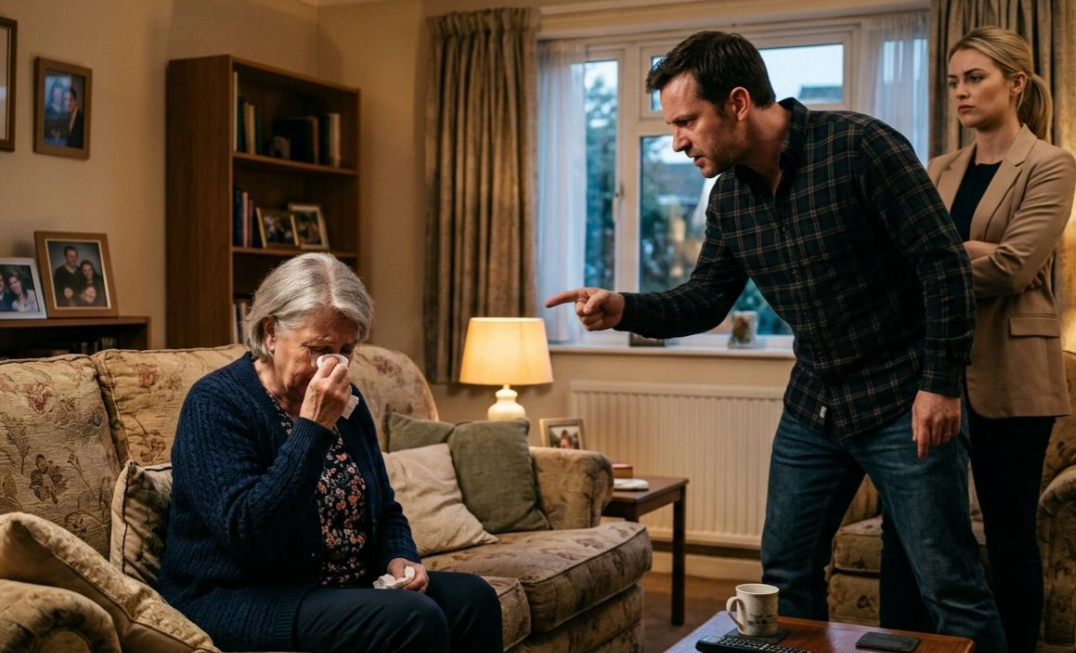
The title of “son with potential” belonged to my older brother, Jake. I was the one who worked every weekend hauling lumber, getting mocked by my dad’s friends for not being out partying like a normal guy my age. Jake had never worked a single day in his life, and everyone thought that was something to celebrate. When I asked why he got praised for doing nothing while I got criticized for working hard, my dad just said I should be happy for him.
That moment cracked something inside me. Not all at once, just a hairline fracture. And once it started, it only spread. It all came to a head two weeks before Jake was set to move into his dorm at the big state school.
I had come home from a shift, and there he was, sprawled on the couch with his friends, bragging about all the new gear he was getting. Microwave, mini fridge, monitor—all new, all expensive, all bought for the golden boy who had never worked a day in his life. Over $2,000 in move-in expenses alone. Later that night, I went to grab a sandwich from the fridge and found an envelope on the kitchen counter with Jake’s name on it.
I peeked inside. A check for $5,000. The same people who told me there wasn’t enough money to help with my rent or books or even a basic laptop had just handed Jake five grand after buying him every gadget in the store. I worked two jobs.
He flunked two classes by the end of his first semester and blamed the professors. The day my dad finally admitted they had been covering Jake’s expenses all along, saying, “We’ve been covering you both,” I realized the truth. There was no “both. ” There was only him.
I walked out that night. I didn’t yell or slam doors. I just left and started building something they wouldn’t understand, something mine. Even as things started looking up for me, I kept glancing over my shoulder, wondering if someone was going to take it all away, tell me it was a mistake, remind me where I really belonged.
I showed up early every single day at my internship, stayed quiet, did my work, took notes, listened more than I talked. I offered to stay late, took on side projects, asked smart questions. There was no slow-motion montage or everything-falls-into-place moment. Just a steady grind.
Then the story started changing. By sophomore year, Jake dropped two courses and moved into an off-campus apartment. By junior year, he was on academic probation. But when he came to me asking for help with his resume because he wanted to apply for a marketing role, he didn’t even acknowledge how I got into the industry.
I spent two hours rewriting his resume, tightening the language, formatting it perfectly. He never even said thanks. Still waiting on that potential, I thought. Instead of calling him out, I went back to work.
I learned how to build websites, run ads, write copy that actually converted. I put my head down and built a reputation for myself. Not out of bitterness, but because for the first time in my life, I didn’t have space for him in my world. Then came the day my dad called, asking me to look at Jake’s resume again since he had a big interview.
I said yes, but I felt a strange calm. Dad actually said he was proud of me. For a second, I saw something I’d never seen on his face before. Then the lease ran out, and my resolve faltered again when I heard Jake had been kicked out of school.
My parents called, saying he was just under pressure. I told them I couldn’t help anymore. A month later, I got an email from a strategist I’d helped with a late-night presentation years ago. She had a client with funding and a scalable model, but no brand identity whatsoever.
They were desperate for a brand strategist who could take raw chaos and turn it into something clean, trustworthy, and viral. Between the consulting gig, wrapping up classes, and keeping up with my other duties, I ran on four hours of sleep and enough coffee to stun a horse. And I loved every minute of it. That’s when my mom called.
Jake was back in our hometown, still bouncing between couches, still making excuses, still waiting for someone to hand him another opportunity he hadn’t earned. I told her I had a new client and I’d see what I could do. I hung up and got to work. I pitched a full-scale digital campaign complete with branded pop-ups and influencer tie-ins.
I worked until three in the morning, not out of revenge, but because I wanted to show exactly what I could do when I wasn’t being held back. The launch event was a small industry mixer in the city. My parents drove up, looking dazed like they’d accidentally wandered into someone else’s success story. I gave a short speech about how the company was built by people who were told they weren’t enough, who were mocked for working weekends, who were told to be happy for someone else’s potential while they scraped together a future.
I said that the thing about potential is that it only matters if you use it. When I was done, my mom was crying, and my dad couldn’t even look at me. Because this wasn’t revenge. It was just me, finally taking up the space I’d earned.
The party ended the way most of them do, with laughter and handshakes. Then Jake showed up. He looked off, his blazer sleeves too short, his smile too wide. He asked if I had any openings at my agency.
He said he had been looking for a while and needed to get back on his feet. I told him to send me his resume and I’d take a look. The final piece of my plan was already in motion. I introduced him to my client—a fake client I had invented months ago.
The brand had a full identity: logo, colors, fake product renders, a website, a newsletter with 12 pre-written entries, even a dead-end Shopify page. It looked real. Jake took the bait. He started emailing the fake contact, pitching concepts, redoing branding materials.
I watched him through a glass wall as he worked. He was so desperate to prove himself that he didn’t notice the red flags. After weeks of back-and-forth, after he spent hours on mockups and concepts, the fake client sent him a rejection email saying he was rambling and unfocused, that the work was amateurish. The stats didn’t add up, the target demo didn’t make sense, and the retention rates were based on fictional projections.
He never even got a chance to explain. I never replied to his calls. Instead, I sent one final email from my own account. Subject line: “Still waiting on that potential.
” The body said: “You should have read the fine print. ” That was it. Then I sent a final text to my dad, telling him I was done. Done covering.
Done helping. Done being the safety net for someone who never even tried. A few days later, my mom sent me a long message asking if I could meet her for coffee and talk about family. She said they were proud of me and that dad struggled to say it.
I wanted to tell her it wasn’t now, that after years of being told I wasn’t enough, they wanted to act like everything had changed. But I didn’t. I just said I had a meeting and walked away. Now I think about it sometimes.
Jake was the result of constant praise without performance. I was the result of constant criticism without acknowledgment. He’s probably still chasing shortcuts, still waiting for the next handout, still blaming the world for not bowing to his greatness. And I’m still carrying the weight of always being the one who had to fight for everything.
But here’s the thing I’ve learned: that weight isn’t a burden anymore. It’s a foundation. It’s what built me. And when people ask about potential, I don’t think about Jake or my dad or any of the people who doubted me.
I think about the late nights and the early mornings and the quiet satisfaction of knowing I did it all without a single handout. No apologies. No explanations.
Just results.