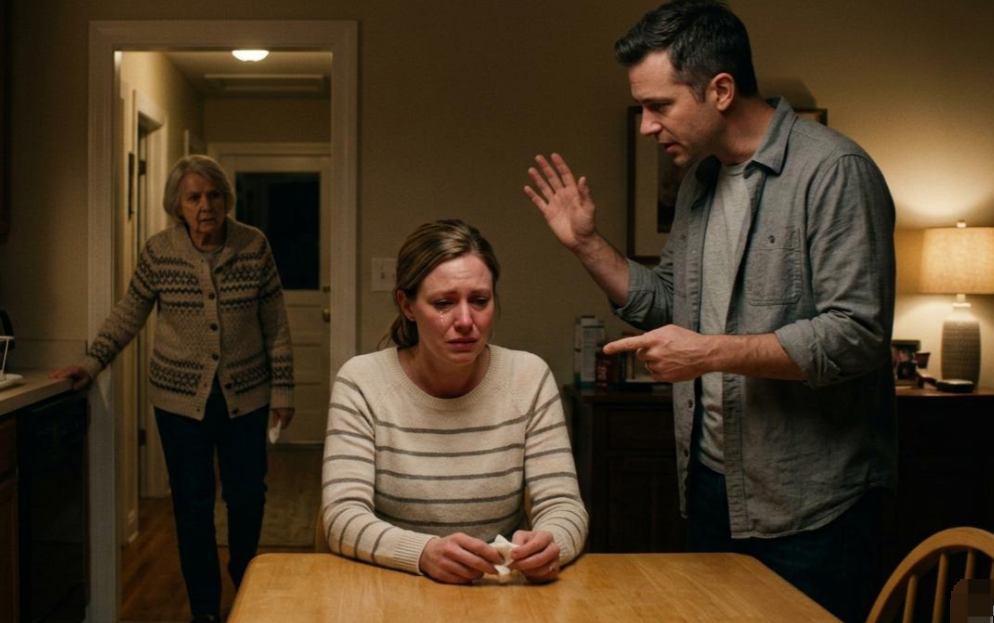
Two kids. That was what everyone said when they found out. Two kids and fifteen years, and then one Tuesday night in October when I saw a text message glow on Daniel’s phone. *Miss you already* at 10:00 PM.

Not all at once. It never happens all at once. There were other things first, the way he lingered over his phone at dinner, the sudden work trips, the new cologne he never wore for me. But that text was the stone that cracked the foundation.
I didn’t confront him, not then. I carried that weight inside me, quiet and heavy, because I wasn’t ready for my whole life to shatter yet. I met her at a work event two weeks later. She smiled at me with warm, practiced ease, as if we were strangers who had never intersected, as if she hadn’t been texting my husband at 10:00 on a Tuesday night.
Her name was Christine Harrow. She was polished and professional, and she looked at Daniel like he was a colleague. But I saw the flicker, the tiny pause when she shook my hand. I also felt clarity.
There is no recovering a dinner table from a sentence like that, not with polite conversation and dessert. We went home that night, and I said nothing while the kids slept. Then he came into the kitchen, where I was loading the dishwasher with slow, deliberate movements, and said, “That was unnecessary. ” I didn’t ask what he meant.
I just kept stacking plates. I had spent 15 years doing exactly that for other people’s buildings and other people’s money as an architect. I knew how to plan, how to see the whole structure before laying a single brick. I needed to understand the financial picture completely, not my half of it, all of it.
Joint accounts, his personal accounts if possible, any assets I wasn’t aware of. I needed to understand my legal position before I did anything visible. So I did my research the night before under the covers with the screen brightness turned all the way down. I didn’t move any money, not yet, not without legal guidance.
But I started building a map. I called my sister Dana first. She lived in Portland, Oregon, far enough away that she’d had no part in our social life, close enough in every other sense that she was the first person I trusted with any of this. I told her everything, the text, the event, the quiet cracks.
Dana was silent for a long moment. Then she said very quietly, “Tell me what you need. ” I told her I needed a place to stay, a place that was only mine, for later. She said yes without hesitation.
We agreed I would not act yet. There were things to gather first. No anger, no coldness, no tears. I made dinner the next night like it was any other Wednesday.
I handed Daniel a bowl of pasta and talked about Connor’s baseball schedule. The plan was simple in its first form. I would not tip my hand. I would let him believe the cracks were invisible.
I met with Patricia, a divorce attorney Dana recommended, on a Thursday afternoon in a small office across town. I told her everything, the timeline, the text, the patterns. The most difficult kind of patience I had ever practiced was waiting for her to speak. When I finished, she said, “First thing, don’t move any money, don’t change any accounts, don’t do anything financially visible yet.
We need a complete picture. And if there is any opportunity to obtain communication records, texts, emails, through legitimate means, that’s worth pursuing. ” I told her about the shared phone plan, the old family account where Daniel forgot I had access to the billing portal. Two photographs from a parking garage arrived in my inbox a week later.
Christine Harrow’s car parked next to Daniel’s at a hotel near the airport. I stared at them for a long time, then I put my phone face down on the counter and cried for exactly four minutes. Then I wiped my face, walked into the store, bought milk and bread and apples, and drove home. Daniel asked me that night if I was okay.
I said I was tired. He didn’t push. Patricia called me on a Friday with the first draft of the financial inventory. She said, “This is more than enough.
” I met Dana halfway in Iowa the following weekend. We sat in a diner and I told her I was going to file. She asked if I was sure. I said, “There are financial things I need to understand first.
” She nodded and said, “Then we use this time well. ” I filed on a Monday in December. I had, for the first time in 14 years, acted entirely on my own behalf. I told Daniel on a Thursday after the kids were in bed.
I kept my voice even. I said, “I’ve filed for divorce. The papers will be served tomorrow. ” He stared at me for a long moment without speaking.
Then he asked if I was serious. I said I was. He asked if there was someone else. I laughed, a short, dry sound.
I said, “No, Daniel. There isn’t. ” He left that night, booked a hotel room. The kids didn’t see it.
I didn’t want the children anywhere near the moment it landed. We told them together on Saturday, which was the hardest thing I have done in my life. Connor didn’t fully understand and asked if they were still going to baseball in the spring. I told him yes, they would always have baseball.
Mira held my hand and looked at her father with a question in her eyes. I held them both for a long time. After that, the divorce moved through the machinery of law. Daniel’s attorney, Sandra Harrow, was Christine’s sister.
Of course she was. The discovery requests went out. The financial records came in. I learned things about our marriage I had not known, accounts, investments, a business interest he had never mentioned.
I listened to all of it. When I told Daniel that communication regarding the children should go through the attorneys, he said, “This isn’t how I wanted our life to go. ” I didn’t answer. The house was very still after that.
A few weeks later, I found his personal banking records in the discovery material. There were transfers to an account in Portland, Oregon. My sister’s city. I looked at the amounts, the dates, the pattern.
And then I realized, for the first time, I wasn’t sure if I knew my husband at all. Daniel’s deposition was scheduled for January. I prepared with Patricia for days. When I walked into the room, he was already there with Sandra.
He looked tired. He looked at me once, briefly, then looked away. I sat down across from him. The court reporter was ready.
The questions were methodical. Patricia asked about the Oregon account. Daniel said it was for a business venture. When she asked for the name of the business partner, he hesitated.
Then he said, “Christine Harrow. ” The room felt very still. I watched his face as he said it. There was no anger in me, only a kind of confirmation.
I waited for more, but he offered nothing else. After the deposition, I drove home alone. I felt the weight of what I had heard, but I also felt something else, something like freedom. I would not let them frighten me into a smaller version of this.
In early February, Sandra Harrow called Patricia to propose a settlement negotiation. I agreed because it was reasonable and because I had no grounds not to. But I continued to gather information. The Oregon property was in both their names.
I had proof. And then, in the third week of January, Daniel texted me directly, not through the attorneys, with a single message. “Can we talk? Just the two of us.
” It was a door left ajar, an invitation to step back into negotiation on his terms, in his emotional space. I typed back through the attorney channel where it belonged. “All communication should go through counsel. ” He did not reply.
I could feel the process shifting, like weather changing before you see it. I told my two closest friends, Claire and Miriam, the truth. Both of them listened, asked the right questions, and said variations of the same thing, “What do you need from me? ” These relationships held me in the ordinary world while the legal process moved on its separate slower track.
In March, Sandra Harrow requested a private meeting with me. Just the two of us. She met me at a coffee shop in a neutral part of town. She ordered tea and then she looked at me with what I took to be genuine concern and said, “I want you to think about what divorce will do to these children before you go any further.
” I watched her perform it. I felt something I hadn’t expected, a strange pity for her, for the role she was playing. I said, “So do I. That’s exactly why I’m sure this process is handled correctly.
So that they have stability and both of their parents fully present in a healthy way. ” She looked at me for a long moment. Then she said, “I want you to understand that Daniel has resources. If you push this, if you go after everything, this will not go the way you think it will.
” I said, “I understand. ” And I did. In late March, we had a second deposition. This time, Sandra Harrow brought a set of photographs.
They were of me, at a diner with Dana in Iowa, at a park with the kids. She placed them on the table. She asked what I had discussed with my sister. I looked at him steadily and answered every question in factual, complete sentences.
No defensiveness, no elaboration, no visible anger. She asked about each photograph. She tried to suggest I was planning to hide assets. I said, “The only planning I have done is to secure a legal and fair outcome for my children.
” With each photograph, the control required slightly more effort. But I held. Then Patricia produced our own exhibit, the billing records from the shared family phone plan. Not the content of messages, those had not been obtainable through proper discovery, but the metadata.
Timestamps, durations, frequencies. She simply placed it on the table and read several entries aloud, quietly in her professional voice. “October 15. October 22.
November 3. ” The pattern was clear. Daniel’s calls and texts to a number registered to Christine Harrow. And the number she used most often from the Oregon property line.
The room felt very still. Sandra Harrow asked for a brief recess. When we resumed, she said nothing about the photographs of me. In April, I learned something else.
Through Carla Fuentes, who was still at my instruction monitoring the situation, I found out that Daniel had signed a quitclaim deed on the Oregon property to Christine Harrow two weeks after the first deposition. He had lied under oath. Patricia incorporated this into our proceedings immediately. The settlement we reached in early May gave me the house.
It gave me primary custody of the children with a standard visitation schedule for Daniel. It gave me a financial agreement that allowed us to maintain our home and their school and their activities without disruption. This arrangement allowed both parents to remain fully present. When I signed the final papers, the signature I had written 10,000 times on checks and school forms and birthday cards was now on the decree that ended my marriage.
Daniel was at the other end of the same conference table. For a moment, we were simply two people who had shared 14 years and two children and a porch that needed repainting every spring. He said, “I’m sorry it came to this. ” I said, “I know you are.
” Then he asked, “How do you feel? ” I said, “I feel like I built something I didn’t know I was building. ” He did not ask me to explain. We walked out of the building separately.
I laughed in my car on the interstate in the April rain, the first real laugh in a long time. There was no dramatic reversal, no apology from Daniel, not a real one, not the kind that costs something, no moment of spectacular public reckoning. There was just a quiet, legal end to a marriage that had already ended long before the papers were signed. And that was enough.
Summer came in slowly that year, tentative at first, then suddenly enormous. The kids adjusted with a resilience that made me proud and broke my heart at the same time. Connor still played baseball. Mira still drew pictures of our house with all of us in front of it.
I dated no one for the first year. I had decided consciously that I needed the full experience of being alone and whole before I invited anyone else into my life. I learned to be alone in my own house, the same house with the same porch I repainted every spring. It felt different from the inside.
The walls held different conversations now. The silence wasn’t empty anymore. It was mine. In October, I started seeing a man named Paul who taught history at a local community college.
He was quiet and patient and he never asked me to perform anything for him. Connor liked him almost immediately. Mira took a little longer. The way people move when they understand that children’s stability is not negotiable.
After the divorce, Daniel’s business reputation took a quiet hit. The details were not made public, but the professional community is smaller than it appears. People noticed when his business partner changed and when a promising contract quietly disappeared. I will not claim no satisfaction in that because I am human.
Sandra Harrow stopped calling me entirely. She sent Christmas cards to the children and nothing else, which was appropriate, and I made sure the children could receive them without commentary from me. On the first anniversary of the divorce finalization, I took the day off work. I drove to the lake that Dana and I had sat by the year before, when everything was still uncertain.
I stood at the water’s edge for a long time. I thought about the woman who had sat under the covers reading texts on a glowing screen. I thought about the woman who had handed Daniel a bowl of pasta and talked about baseball schedules while her marriage died at the dinner table. I thought about the woman who had signed her name at the bottom of the final decree.
She had built something. And it was solid. I turned from the water and walked back to my car. My phone buzzed.
It was Paul, asking if I wanted to meet for dinner. I smiled. I texted him back. Yes.
I drove home to a house with a porch and two kids and a life that was entirely my own. It was enough. More than enough.
It was just beginning.