The clock on the wall of the Huntsville death house read 6:37 p. m. when the chemicals began to flow into the veins of Christopher Anthony Young.
The 34-year-old man, once a gifted violinist and chess prodigy, now strapped to a gurney, turned his head toward the witnesses behind the thick glass. His voice, steady but strained, cut through the sterile silence of the chamber. I’ve changed, he said.
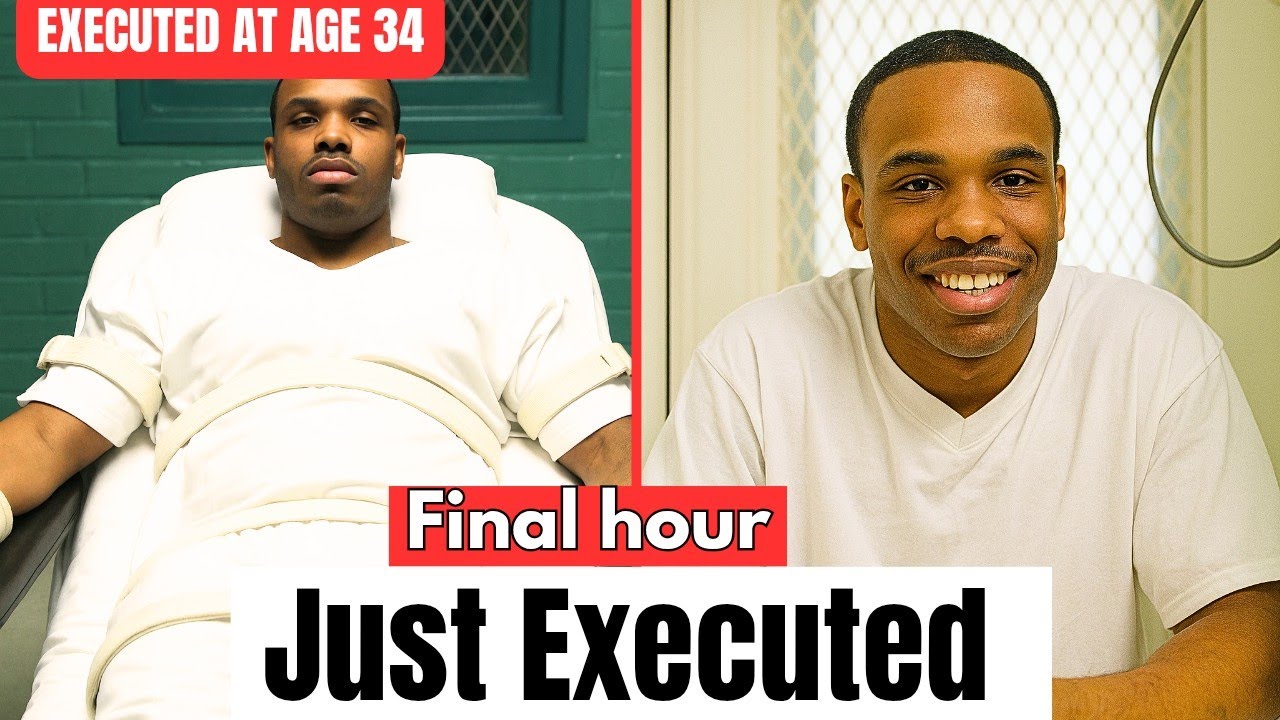 I’m sorry for what I did. I hope my death can serve some purpose. Those were his final words before the lethal injection took hold, and at 6:39 p.
m. , the state of Texas declared the sentence carried out. The man who had spent nearly thirteen years on death row, who had transformed from a violent gang member into a mentor and peacemaker, was gone.
But the questions he raised in his final hours, about racial bias, about redemption, about whether justice is truly blind, do not die with him.
The final twenty-four hours of Christopher Young’s life were a study in contradiction, a man at peace with his fate but at war with the system that delivered it. He had spent the previous night, July 16th, 2018, lying awake in his cell at the Palinsky unit, staring at the ceiling, replaying every mistake he had ever made. He was not the angry twenty-one-year-old who had taken Hazmuk Patel’s life in a San Antonio convenience store back in 2004.
He was not the Bloods gang member, not the addict, not the man consumed by rage and grief. For the last decade, he had been a model prisoner, mentoring younger inmates, rejecting violence, finding religion, and finding a peace that had eluded him his entire life. But none of that mattered to the state of Texas.
The countdown had begun, and there was no appeal left, no motion to file, no governor willing to intervene.
Just hours earlier, Christopher had stood before the Texas Board of Pardons and Paroles, not to beg for mercy but to challenge the very foundation of the system that had condemned him. He told them that the process was not fair, that racial bias, not justice, had sealed his fate. He pointed to others with similar or worse crimes who had been granted clemency.
Just seven months prior, a white man named Thomas Bart Whitaker had his death sentence commuted to life in prison. Whitaker had orchestrated the murder of his entire family, his mother and brother killed, his father surviving the attack. Yet the board had shown him mercy, commuting his sentence despite the premeditated slaughter of his own blood.
Christopher argued that he too had earned that right, that his transformation behind bars was not a performance but a genuine rebirth. He had become a born-again Christian, a mentor to young men facing the same gang pressures that had consumed him, and a father who desperately wanted to guide his three daughters through life, even if from behind bars. The board did not listen.
They never do. The decision was unanimous, and the words from the chairwoman were cold and final. We are unanimous.
No commutation.
The afternoon of July 16th brought Christopher’s most precious visitors, his three daughters, now aged seventeen and thirteen-year-old twins, along with their mother. The visiting room was too bright, almost cruel in its harsh fluorescent lighting, but there was no glass between them this time, a rare privilege granted for the final visit. He held their hands, feeling how much they had grown, how much they had inherited his intelligence and his resilience.
His voice was low but firm as he imparted his final wisdom. Be better than me, he told them. Stay out of the streets.
Use your gifts. Don’t let the world tell you who you are. The girls did not break down.
Their love came in the quiet squeeze of his fingers and the way they memorized his face, knowing they would never see him alive again. It was a moment of profound tenderness in a place designed for punishment, a father trying to give his children the tools he never had
As night fell on July 16th, his final meal was offered. It was not a special request, not a last indulgence of steak or lobster, but the standard prison fare, meatloaf, mashed potatoes, corn, and a slice of bread. He chewed slowly, each mouthful heavy with the knowledge that he would never taste anything again, that this simple, bland food was his last communion with the physical world.
After the meal, he wrote letters into the night, unfinished ones to his daughters, to the family of his victim, to anyone who might remember him as more than the crime he committed. His cell stayed lit long after lights out, the scratch of his pen against paper the only sound in the corridor. Somewhere in the silence, he prayed, not for deliverance but for forgiveness, for peace, for the strength to face what was coming with dignity
To understand Christopher Young’s final hours, one must understand the path that led him there, a journey marked by trauma, brilliance, and a system that failed him at every turn. He was born into pressure, into a family already cracking at the seams. From the beginning, he carried two things, a quiet brilliance and a lineage scarred by violence.
He was just eight years old when his father was shot and killed, a murder that shattered what little order existed in his world. That loss did not just grieve the family, it detonated it. The man who might have taught him discipline, who might have set boundaries, who might have pulled him back from the edge, was gone.
And in that absence, chaos moved in. The neighborhood did not wait for him to grieve. Streets filled the silence.
The trauma deepened. And with no therapy, no guidance, no healing, Young searched for meaning the only way a child in pain knows how, by looking for power, identity, and safety outside his home
The gang culture welcomed him before the schools could. But underneath the trauma, there was something else, a spark that teachers remembered vividly. Christopher was curious, even gifted.
He played chess with ease, seeing patterns and moves that adults missed. He could hear a musical note once and reproduce it on the violin, cello, or bass. That kind of brain does not come along often.
He could have been an artist, a composer, maybe even a scholar. But talent needs air to breathe, and Christopher was suffocating. By the time he was twelve, the Bloods had already claimed him.
 Red bandanas, street rules, a brotherhood built on fear and reputation. It was not just a gang, it was survival. His identity shifted.
No longer the violinist. No longer the quiet boy who moved bishops and rooks with precision. Now he was a soldier for the set.
The block became his classroom. The rules were brutal. Show no fear.
Never back down. Defend your crew and make money fast. Petty crime turned into full-blown hustling.
Fights, weapons, arrests, juvenile lockups, and with each scrape with the law, the system tightened around him. They were not trying to rehabilitate Christopher. They were preparing to contain him
By ninth grade, the tension between promise and pressure snapped. He dropped out, not because he lacked the ability, his mentors would later insist he was one of the sharpest minds they had ever met, but because school did not feel relevant anymore. What was algebra compared to a loaded pistol.
What was Shakespeare when you were dodging rival gangs and planning your next move on the corner. Christopher stopped chasing possibility. He started chasing survival.
From the outside, it was easy to write him off as another statistic, another black boy who chose the streets over school. But that view ignores everything he had no control over, the death of a father, the lure of protection, the sheer gravity of a world built on trauma and poverty. Christopher did not choose the gang life because it was glamorous.
He chose it because to him, it was the only thing that made sense. And by the time he realized it was not, by the time he began to understand what it had cost him, the damage was already done. His brilliance forgotten, his music silent, his childhood swallowed by the streets
On November 21st, 2004, that collision course reached its devastating endpoint. San Antonio, Texas, was quiet on that Sunday morning, the air cool and sunlight filtering gently through the dusty windows of a small convenience store on the city’s east side. Behind the counter stood Hazmuk Patel, a fifty-five-year-old husband, father, and local shopkeeper.
He had opened the store early, as he always did, just as the city began to stir awake. Mr. Patel was no stranger to hard work.
He was an immigrant who came to America seeking safety, stability, and a better life for his family. He believed in peace, in karma, in the quiet dignity of serving his community through honest work. That store was more than a business, it was his dream in motion, a place where he knew the faces, the names, the habits of every customer who came through his door.
But at 9:30 a. m. , a stranger walked in.
Christopher Young, just twenty-one years old, stepped through the door with bloodshot eyes and a gun tucked under his jacket. He had spent the weekend in a blur, alcohol, cocaine, and adrenaline coursing through his system. His thoughts were scattered, his emotions volatile.
He had not eaten. He had not slept. His life was unraveling, and deep down, he knew it
Christopher was not there to rob the place. Not really. There was no demand for money, no plan.
What he carried into that store was not just a weapon, it was years of unresolved trauma, grief, rage, and self-destruction, a storm he could not control. Hazmuk Patel sensed it immediately. He raised his hands, his voice calm, asking the young man to put the gun down.
No threats, no resistance, just a man trying to diffuse a situation he did not deserve to be in. Then it happened. A single deafening shot.
The bullet struck Mr. Patel in the chest, sending him crumpling behind the counter. Blood spread quickly across the tile floor.
His breath was shallow, his eyes wide, and within minutes, his heart stopped. Christopher did not take a single dollar. He did not speak another word.
He turned and fled, stumbling into the street, disoriented and trembling. The sound of that shot still echoed in his ears. Police caught up with him that same day, just blocks away.
He was sitting on a curb, drenched in sweat, crying, shaking his head over and over. Witnesses had already identified him. Surveillance footage confirmed it.
In the interrogation room, he confessed, told detectives he did not even remember firing the gun, told them he was drunk, high, lost. Told them he was sorry, but it was too late
 The Patel family was shattered. A wife widowed, children left fatherless, a community enraged, and the state of Texas made one thing very clear. This was not just a murder, it was capital murder.
Prosecutors would later say the case was open and shut. The facts were undeniable. The suspect confessed.
The video was clear. But what they never talked about, what the courtroom would never fully acknowledge, was the story behind the bullet, the life behind the trigger, and the possibility that this young man was broken long before he ever walked into that store. To them, Christopher Young was not a son or a father or a man unraveling from years of pain.
He was a killer. And in Texas, killers die. The death penalty was on the table from day one.
And for Christopher Young, that day in the store became the moment everything ended and the slow, agonizing countdown to execution began
The Bexar County District Attorney wasted no time. They charged Christopher Young with capital murder, a charge that carried one clear goal, the death penalty. In Texas, that path is swift and direct, especially when a cold video, a confession, and a grieving family are all in plain view.
In 2006, Christopher stood before a jury. The prosecution painted him as a violent gang member. They listed his juvenile offenses, framed him as a hardened criminal.
The defense tried to show his addiction, his youth, the trauma of losing his father. They spoke of the violin, the chess games, the intelligence, but the jury did not see potential. They saw a killer.
It took them just two hours to decide. Christopher Anthony Young was sentenced to death. No second chance, no life in prison.
The courtroom was silent as the judge handed down the punishment. Christopher stared ahead, not angry, not shocked, just resigned. From there, he was shackled, loaded into a van, and driven to the Palinsky unit, Texas’s notorious death row facility, a place where men wait years, even decades, for the end, a place where the lights never fully go out.
For Christopher, that ride marked the start of a slow death, not just of his body, but of everything he could have been
When Christopher Young first stepped into Palinsky unit in early 2006, he expected war. He braced for gang fights, stabbings, tension between sets. After all, that is what prison had always meant in his world, a jungle with walls.
That was what he had prepared for. But death row was not like that. Instead, it was twenty-three hours a day in a solitary cell, locked behind a steel door, surrounded by silence so heavy it almost hummed.
There were no loud arguments, no visible turf wars, no gang politics playing out in the open. Just time, time, and concrete. And his own thoughts chasing him in circles.
At first, Christopher tried to fight the silence. He shouted, punched walls, did push-ups until his muscles gave out. He was angry at the system, at himself, at life.
He thought his street identity as a Blood would mean something here. It did not. On death row, nobody cared about the colors you wore.
The only colors that mattered were the dull gray of the walls and the deep brown of the tray food sliding under your door
Then he met Reginald Blandon. Reg was different, calm, centered, soft-spoken, but not soft. Like Christopher, he came from San Antonio.
Same kind of neighborhood, same kind of pain. Reg had grown up in a violent environment. Chris was a Blood.
In the free world, they might have been enemies, but in this concrete purgatory, they became brothers. Christopher admired how Reg carried himself. He was not bitter.
He was not trying to prove anything. One day, Christopher asked him for a book, expecting maybe a street novel, something like The Coldest Winter Ever or a gritty prison thriller. But Reg handed him something else entirely.
The book was As a Man Thinketh by James Allen. At first, Christopher did not get it. It was thin, filled with poetic language and old sounding phrases.
But the message cut deep. Your thoughts shape your life. That book made him look inward.
 It forced him to confront the trauma, the rage, and the patterns that had defined him for years. The way he acted was not just about now. It was a cycle rooted in slavery, poverty, and broken legacies.
That was the beginning. Reg gave him more books, more lessons. He taught Christopher how to breathe through anger, how to speak without violence, how to think before responding.
The two would pass books under their cell doors, writing notes, debating chapters. Reg pushed him to grow, not for the courts, not for public image, but for himself
In 2009, Reginald Blandon was executed by the state of Texas. His death shook Christopher. It was like losing a brother, a teacher, a mirror.
But Christopher refused to let that be the end of the journey. He kept going. He started mentoring other inmates.
He broke up fights before they began, talking guys down through vents. He helped guards deescalate tense moments. He wrote letters to youth programs, proposed a curriculum called Reaching Our Young from the Inside Out, meant to steer kids away from the path he took.
He spoke about accountability, about healing, about being a man even in a cage. He became a father again through letters and phone calls. He had three daughters on the outside.
He wanted them to know the version of him that had grown, not just the one who had fallen. But Texas did not care. Over the years, Christopher Young filed appeal after appeal.
His lawyers argued that his death sentence was racially biased, that white defendants who committed equal or worse crimes had received life sentences. They emphasized his age, just twenty-one at the time of the crime, and his model behavior since. They pointed to evidence of remorse, change, growth.
But the courts turned away
The case of Thomas Bart Whitaker became Christopher’s most powerful argument, and his most bitter wound. Whitaker, a white man from Texas, had been convicted of orchestrating the murders of his mother and brother in 2003, shooting them execution-style in their sleep. His father, Kent Whitaker, survived the attack despite being shot, and later became a vocal advocate for his son’s clemency, forgiving him publicly and pleading for his life.
In December 2017, the Texas Board of Pardons and Paroles voted unanimously to commute Whitaker’s death sentence to life in prison without parole, citing his model behavior, his remorse, and his father’s forgiveness. Christopher Young, whose crime was a single impulsive shot during a botched robbery, whose victim’s son, Shaun Owen, had publicly forgiven him and advocated for his life, received no such mercy. The contrast was stark, and Christopher did not hesitate to point it out.
In his final plea to the board, he argued that justice was not even handed, that his life mattered too, that the system was infected with racial bias that determined who lived and who died. The board did not agree. They never do
The execution itself was swift, clinical, and devoid of 𝒹𝓇𝒶𝓂𝒶. Christopher Young was led from his holding cell to the death chamber at Huntsville, the short walk made endless by the sound of his chains echoing off the concrete walls. Witnesses gathered behind the glass, officials, journalists, family members of the victim, spiritual supporters.
He was strapped to the gurney, his arms extended, needles inserted into his veins. He turned his head as far as the restraints allowed, his eyes finding the faces of those who had come to witness his final moment. He spoke his last words, a simple apology and a hope that his death could mean something.
The first 𝒹𝓇𝓊𝑔, sodium thiopental, began its work, rendering him unconscious. The second, pancuronium bromide, paralyzed his muscles. The third, potassium chloride, stopped his heart.
It burns, he whispered, tears sliding from the corners of his eyes, a rare human moment in a procedure designed to be sterile and efficient. Within moments, his chest stilled. At 6:39 p.
m. , the warden’s voice was flat. The sentence has been carried out
Christopher Young’s story is a ledger of contrasts that defies easy moralizing. He was a boy with a brilliant mind, capable hands, and an ear for music that could have led him anywhere. Yet the trauma of losing his father and the seduction of gang belonging consumed him before adulthood, steering him toward a collision course with violence.
His crime took a life and left a family fatherless, a wound that can never fully heal. His own execution left three daughters without a father as well, perpetuating a cycle of loss that his own childhood had begun. The tragedy is not just in what he did but in what he might have been and in how late redemption came.
Potential is fragile when childhood is shaped by violence, when the systems designed to protect children fail them at every turn. Redemption has no place to land in a system that closes its doors long before change can prove itself, that values finality over growth, punishment over transformation. Punishment ripples outward, claiming the innocent along with the guilty, leaving behind a trail of grief that extends far beyond the condemned man on the gurney.
Christopher Anthony Young’s life began with promise, descended into chaos, and ended on a gurney in Huntsville, Texas. In the final measure, his last breath carried both the weight of his crime and the quiet hope that someone else might choose differently, that a child with a violin and a chessboard might find a path that does not lead to this sterile room, this final, unforgiving silence


