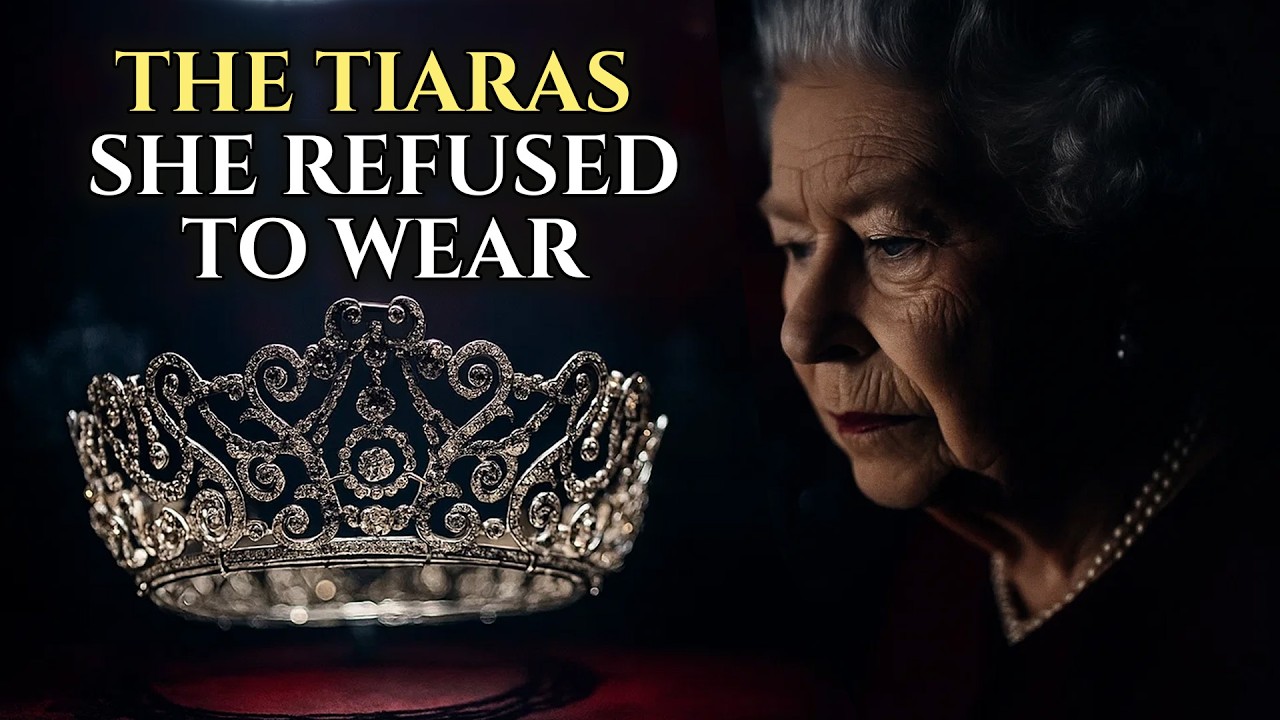
LONDON — For seventy years, Elizabeth II presided over the most dazzling jewelry collection on earth, commanding access to diamonds, sapphires, and pearls beyond compare. Yet a remarkable new examination of the royal vaults reveals a startling truth: a significant portion of her inherited, gifted, and acquired tiaras never once touched her head. Instead of adorning the monarch, these glittering masterpieces were hidden, sheathed in velvet, and left to gather darkness for decades—only to emerge on the heads of princesses, duchesses, and brides who were not their rightful owner.
The most telling example begins not with the Queen herself, but with her mother. In 1936, the Duke of York, later King George VI, purchased the delicate Cartier Halo Tiara for his wife, Elizabeth. The band, crafted that very summer, was intended to enhance the modest jewelry collection of the Duchess of York.
 Yet, the unexpected ascent to the throne in 1937 rendered the piece too modest for a Queen Consort. In 1944, as Princess Elizabeth turned eighteen amid the austerity of war, the Queen Mother gifted the halo to her heir. It was a birthday present that would become a legend of neglect.
Princess Elizabeth, the future Queen Elizabeth II, was never photographed wearing it—not once.
The pattern is unmistakable. The Cartier Halo, gifted to the young princess, became a go-to loan for other royals. Princess Margaret wore it for the 1953 coronation.
Princess Anne used it as a signature piece in the late 1960s. The world rose to a climax in April 2011 when Catherine Middleton, lacking a tiara, received the piece from the Queen at the moment of her wedding. She walked down Westminster Abbey in the halo, and yet, Elizabeth II never glimmered beneath it herself.
It was not an anomaly but a strategy.
Consider the case of the Meander Tiara, a diamond piece of Greek heritage woven with a central laurel wreath. Presented to Elizabeth as a wedding gift in 1947 by her mother-in-law, Princess Alice of Battenburg, it was a meaningful heirloom for the future Queen. Yet again, the pattern of Elizabeth II apex at the center.
She never wore the meander in public. By 1972, she officially passed it to her daughter, Princess Anne, who used it for state functions. The tiaras last most memorable appearance came in 2011, when Anne’s daughter, Zara Tindall, wore it at her own wedding.
Three generations found a relationship with it, but Elizabeth II preferred to see it sparkle elsewhere.
One of the most dramatic examples of purchase, storage, and resurfacing involves the Queen Mary’s Diamond Bandeau. Created by Cartier in 1932, this special piece was designed to display a 1919 diamond brooch from the people of Lincolnshire. Queen Mary wore it occasionally, but she left it to Elizabeth II upon her death in 1953.
The piece then vanished into the royal vaults for 65 years, an absence of absolute silence. In May 2018, at length, Meghan Markle emerged from a chauffeur-driven car at St. George’s Chapel wearing it.
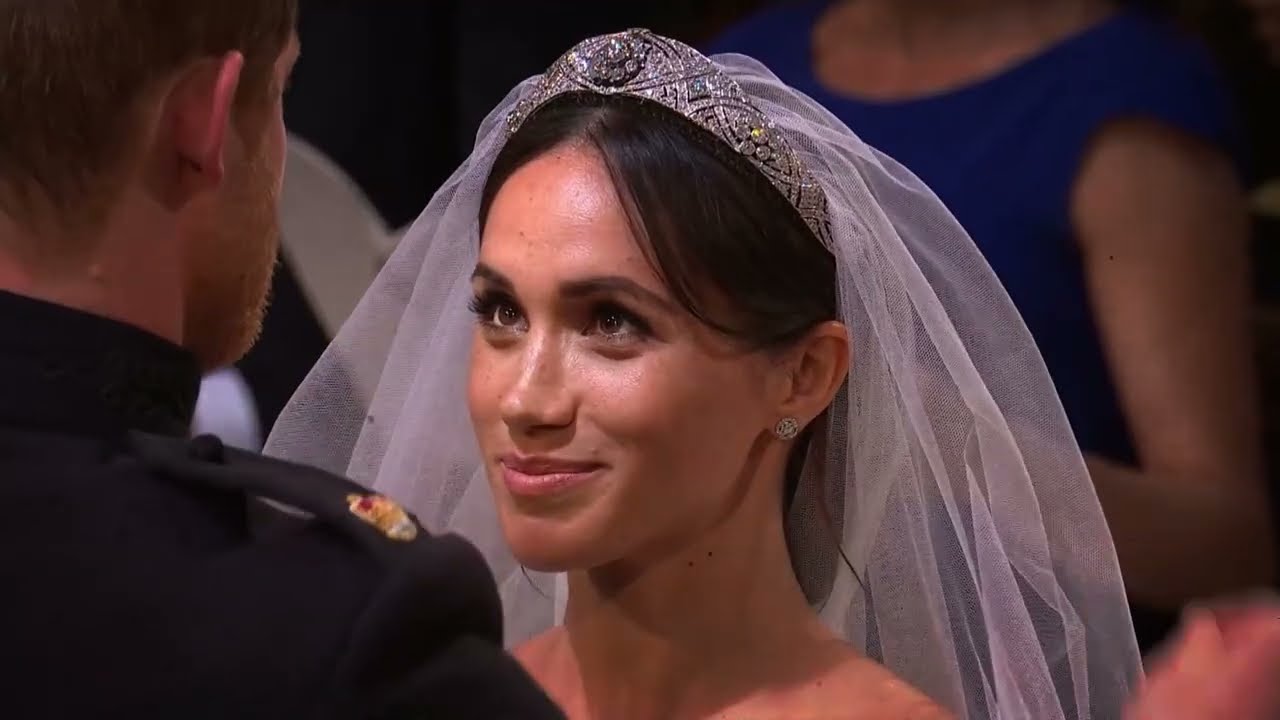 The world saw the diamond bandeau for the first time in generations, but it had never been on the head of the very woman who owned it for six decades. The queen had hidden it away, waiting for the footage of the modern era.
The Queen was not merely hoarding. She was curating a silent strategy. The Strathmore Rose Tiara, commissioned by the Earl of Strathmore for his daughter in 1923, is a touching tale.
The tiara came with five removable diamond roses that could be worn as brooches and two separate frames, for placement either low across the forehead or atop the head, an ingenious design for the roaring twenties. The Duchess of York wore it enthusiastically in early portraits. But she abandoned it upon becoming Queen in 1937.
For decades, rumors swirled of its existence until it reappeared in exhibitions. When Elizabeth II inherited it after 2002, she never wore it. But in November 2023, Catherine, the Princess of Wales, chose this exact tiara for the South Korean state banquet at Buckingham Palace, a full century after its creation, the first time it had been used on this scale since its birth.
The lotus flower tiara tells its own transformation tale, one of royal resourcefulness. What started as an 800 pearl and diamond necklace from Garrard in 1923 was dismantled six months later to be remade into a tiara of lotus motifs by the then Duchess of York. It became a favorite for portraits.
In 920, the Queen passed it to Princess Margaret, who wore it for decades and loaned it to her daughter-in-law for a 1993 wedding. After Margaret died in 2002, it was widely assumed to be lost to the family. But in 2013, the Duchess of Cambridge appeared at the diplomatic reception in it, a find that stunned royal watchers.
Once again, Elizabeth II had inherited it, hidden it, and then let a younger royal, her granddaughter-in-law, reveal it to the public, herself never wearing it.
Perhaps even more revealing are the pieces created from raw materials that could be transformed. Between 1923 and 1925, the Duke of York gave his wife five art deco bracelets, each set with sapphires, emeralds, rubies, or diamonds. In 1925, she acquired a special bandeau frame that allowed three bracelets to be assembled into a single tiara.
This Cartier image became a fashion icon in the late twenties. But the Queen mother never used it as a tiara after her ascent. At the moment of the Queen’s reign, she passed the bracelets to Elizabeth II, but the Queen wore them only as bracelets.
 She never reassembled them into the crown. The frame itself remains in the royal vaults, waiting for anyone with the imagination to restore the fading magic.
There is a moving consistency to this pattern: the ancients of the Delhi Durbar Crown, created in 1911, which King George V called, “May’s best tiara.” Queen Mary gave it to the Queen Mother for a South African tour in 1947. The Queen Mother wore it once, at the opening of Parliament in Cape Town, and never again for the rest of her 80 years.
The independent inheritance of Elizabeth II took it to the vault. It then was loaned to the Duchess of Cornwall, who wore it exactly one time for a Norwegian state banquet in 2005, then back to the darkness. (This piece is deemed “too precious to wear,” a contradiction of a monarch’s duty.)
Perhaps the most extraordinary element is how this strategic act of hoarding has become the engine of the royal spotlight. When the Queen Mother, Charles, and the Duke of Gloucestersceded between her and the public, the absolute originals of several historic jewels. The Strathmore, the lotus, the Grarevel.
In 1920, a family call from the Queens of the era.
The pattern extends to the world’s remaining gaps. Queen Elizabeth II inherited a full invention of jewelry from the Quesnelley, and used to be present. She nearly entangled in a pair of earrings that make for an intricate rule.
But explore further, or the true bulk of the collection reversals. Queen Mary’s Delmar Tiara, grand formal statement, was inherited from May, from her own authority, as a crown jewel. It was loaned to the Duchess of Cornwall for a banquet 2009.
Queen Marie’s agenda of the great, gifted personal so royal that it produces.
On the night May 24, “The Doubt Meander Tiara,” born to the Quesnel via Margaret Greville’s 1943 bequest. It appeared in a 1961 exhibition and then vanished for a decade. It was believed to be worn by Princess Anne at a 2004 state banquet, in a single photograph, but palace confusion links.
 Are we not even certain if these are real thread?
The question remains: why? Why would. a sovereign with whole vaults of jewelry play curator for the she never saw?
On the one hand, the answer is simple comprehensibility. The Queen set her own standard. She wore a tiny set of beloved tiaras: the Grand Duchess Vladimiri, the Girls of Great Britain, the Burmese, the Alexander II of Russia, and the others.
But she considered pieces like the Delhi Durbar and anything associated with her mother’s magic to be too precious to fasten to her own head. They had meaning, even more emotional than the diamond ring.
Perhaps the most recent has a simple answer: She was the steward of the monarchy, not merely the owner. The she said it that she was not just a person who collected jewels, but a crown that governed them, distributing them as vehicles for the future. All that marring, Caroline, Zara, Maya and Serag.
They were links to the past, given and then censures. A sharp, frozen frame of the newest, brightest royal of the moment.
The vault was silent. But every few years, when a young woman walks down the aisle, or a false state delegate lifts a head, and the newfound tiara catches the light for the first time in decades. It is Elizabeth II herself, already a memory (she dead in 2022), who scripts that dazzling shining.
She spent her reign mastering the art of the delayed appearance. She knew, better than anyone, that stealth subjects to the royal pubic: obscurity is power. And with 9,000 title of J’Adore the male Times, the remnants of her passing are being already called gold.
The true legacy of the Queen’s invisible tiaras is not their absence but their memories. It has been a fashion in the royal family that attire, gleaming in the vault. Yet the Grunlevel Emerald Kokoshnik, thought completely lost for 96 years, emerged in 2018 on princess Eugenie.
It has been decades of delay, and when it did, everyone saw it, but never the monarch. The question now: Whose head will celebrate? The next generation wants to open this new era.