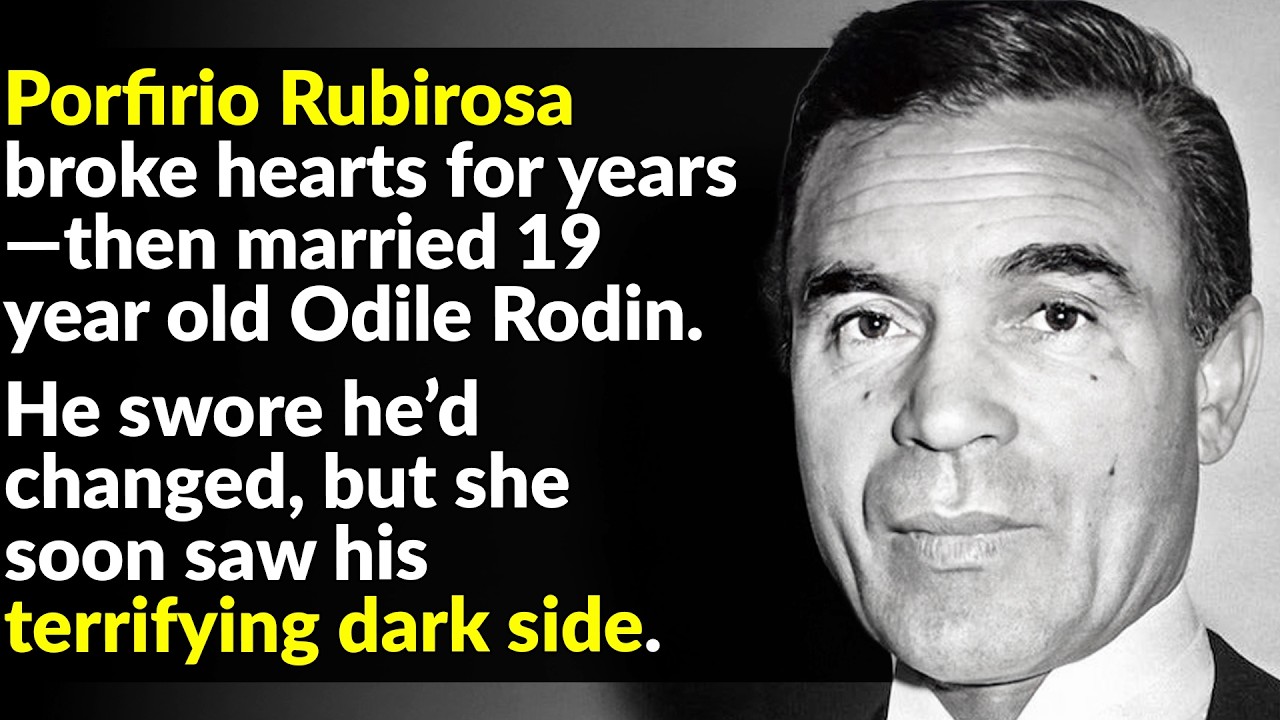
Porfirio Rubirosa, a Dominican playboy who became one of the mid-20th century’s most notorious international fixtures, finally met his match in 19-year-old French actress Odile Rodin. He married her quickly, swept away by her youth and charm. But the young bride soon discovered the darker, controlling side of a man whose name was synonymous with fast cars, faster women, and a life of unrestrained indulgence. Born in the Dominican Republic in 1909, Rubirosa was the youngest of three brothers.
When he was just six, his family moved to Paris after his father, Pedro Rubirosa, secured a diplomatic post in France. Pedro was a respected figure with a brilliant career, a vibrant social life, and an impeccable reputation—but, most notably, he was also a dedicated womanizer. Young Porfirio absorbed his father’s tastes, though he skipped the work ethic. By seventeen, he had returned to his homeland and joined the military, climbing quickly through the ranks.
By twenty, he was a captain in the army and a member of the national polo team. It was through polo that Rubirosa first caught the attention of the Dominican dictator Rafael Trujillo. Impressed by the young man’s charm, Trujillo offered him a position as a lieutenant in his personal presidential guard. One of his first assignments was simple: greet the dictator’s seventeen-year-old daughter, Flor de Oro, at the airport.
She had just returned from school in France. Rubirosa was immediately smitten, and his charm worked. He was soon invited to a dance at the presidential palace. At the ball, Rubirosa broke protocol by dancing with the dictator’s daughter for every set.
The bold move enraged Trujillo, and Rubirosa was promptly dismissed from the guard. He went into hiding on the family coffee plantation. After eight days, Flor de Oro sent a secret message arranging a rendezvous in a photo booth, away from prying eyes. The secret meeting changed his life—Flor de Oro proposed to him, and the two married in 1932.
The hasty marriage was not a happy one, but it did restore Rubirosa to Trujillo’s favor. He began a diplomatic career that took him to Berlin and then Paris. Despite being married, he could not resist the city’s temptations, becoming known for all-night parties and returning home covered in lipstick marks. Ironically, he would beat his wife when she questioned his whereabouts.
The marriage ended in divorce in 1937. Fearful of returning home and facing the wrath of his former father-in-law, Rubirosa’s financial situation collapsed when Trujillo’s family cut off their support. He found an unexpected solution: as political tensions rose in Europe and World War II approached, many Jews sought to flee to safer countries. Rubirosa began selling them visas to the Dominican Republic.
His motives may have been personal, but there is little doubt his actions saved lives. The war brought new challenges. Because of his views on the Germans, Rubirosa was detained for five months by the Vichy French government in a hotel. His then-girlfriend, French actress Danielle Darrieux, managed to secure his release in exchange for promotional work in Berlin.
The couple married quickly amid the chaos of war. In 1944, they were ambushed in Paris while returning home from a nightclub. Caught in an open car, Rubirosa shielded his wife with his own body, taking three bullets near his kidneys. They hid out for the remaining months of the German occupation on her farm, once spending several days in a friend’s barn to stay safe.
The couple had survived a great deal together, but the marriage would not last. Darrieux’s glamorous film world introduced Rubirosa to many beautiful, wealthy women. One of them was journalist Doris Duke, heiress to a $100 million fortune. After an interview with Darrieux in Rubirosa’s presence, the two felt an instant mutual attraction.
Duke was determined to have him and allegedly offered Darrieux $1 million to divorce him. The divorce went through in 1947, and Rubirosa soon married Duke. Just before the ceremony, Duke’s lawyers surprised Rubirosa with a prenuptial agreement. Despite hesitation, he signed.
The benefits of marrying one of the world’s richest women were immediate: Rubirosa was showered with luxury gifts, including sports cars, horses, and even a World War II-era B-25 bomber. But the marriage quickly soured. Duke expected her husband to be constantly available; Rubirosa expected his freedom. He began secret affairs, one of which was with his ex-wife, Flor de Oro.
When Duke caught them together, the marriage collapsed after just one year. Due to the prenuptial agreement, he received only a 17th-century house in Paris and a modest annual allowance of $25,000 until he remarried. A pattern had emerged: a wealthy wife, extravagance, infidelity, and a short-lived union. Asked once about work, Rubirosa famously replied, “Work?
It’s impossible for me to work. I have no time for it. ” His trade, it seemed, was charming women and living well. Rubirosa’s social circles eventually drew him into car racing, which provided yet more opportunities for romance.
He pursued women indiscriminately, including the wives and girlfriends of his peers. One such married woman was the famous Hungarian-American actress Zsa Zsa Gabor. After a brief encounter at the Plaza Hotel in New York in 1953, she returned from a nap to find her room filled with flowers and a note reading, “To the most beautiful woman in the world. ” Rubirosa pursued her relentlessly with flowers and phone calls, and Gabor grew increasingly attached.
But his possessiveness soon showed. When Gabor’s husband filed for divorce, Rubirosa gave her an ultimatum: marry him or leave him. Gabor was torn. In one alarming incident, Rubirosa attacked and beat her.
Gabor defended him in a surprising way, saying, “His beating me is proof of his love. A woman who has never been beaten has never been loved. ”
Meanwhile, Rubirosa’s bank account was dwindling. When another extremely wealthy woman entered his life, he was drawn to heiress Barbara Hutton.
She was past forty and not the youthful beauty he usually preferred, but she was enormously rich. She also had a long-standing feud with Doris Duke, making a marriage to Rubirosa a sweet form of revenge for her. For perhaps all the wrong reasons, they agreed to marry in a lavish New York ceremony in 1953. The marriage was no better than his previous ones.
Hutton was in poor health, and Rubirosa lacked empathy. His former lover Zsa Zsa Gabor mocked the union, betting he would come back to her within six months. Hutton tried hard to make it work, showering him with gifts: a huge coffee plantation, forty suits, eight polo ponies, a plane, and at one point $2. 5 million in cash.
Reports claimed she was spending $66,000 a day on him. Despite it all, Rubirosa was bored and unhappy. After just two weeks, Hutton left him and moved in with her aunt. The marriage ended after a mere 53 days.
Rubirosa complained, “She stays in bed and reads all day. It’s a very boring life. ” Though the marriage was brief, it was highly profitable—he was no longer broke. Free again, Rubirosa returned to Zsa Zsa Gabor, exactly as she had predicted.
But by 1956, at age 47 and back in Paris, things with Gabor fizzled out. Soon after, he met a young, ambitious French actress named Odile Rodin. He fell in love at first sight, saying, “I fell in love with her the first moment I saw her. She was young, fresh, very beautiful, and had a mysterious charm.
” Rodin’s mother knew of Rubirosa’s reputation and initially forbade her daughter from responding to his advances. She eventually relented after seeing the harmony between them during a quiet dance. Rubirosa was captivated by Odile’s vitality, and she loved staying up into the early morning hours with him. Five months after meeting, they married in October 1956.
But Odile soon discovered his dark side: his extreme controlling behavior. He dictated how she should behave, from how much hairspray she used to how modest her clothing should be. At social gatherings, he watched her jealously, monitoring all her interactions. He moved her to the suburbs of Paris, far from the film industry, to tighten his control.
Their marriage was outwardly more stable than his earlier ones, with no violence or obvious problems. Then, in 1961, Trujillo was assassinated in the Dominican Republic. His son, Ramfis Trujillo, took over but proved even more unstable, leading to a disastrous rule that included a failed plot against Venezuela’s president, a U. S.
embargo, and the embezzlement of $200 million before he fled the country. Eventually, Joaquín Balaguer was elected president and promptly removed Rubirosa from his diplomatic post. This plunged the playboy into immediate financial distress. Many of his wealthy friends had drifted away, and the weight of his money problems bore down on him.
Living without money was difficult for a man accustomed to a life of leisure. Rubirosa fell into a depression. In 1965, Rubirosa died after crashing his Ferrari into a tree. It was never determined whether the crash was caused by excessive drinking or by his depression.
Odile Rodin later moved to Rio de Janeiro and married a Brazilian businessman.