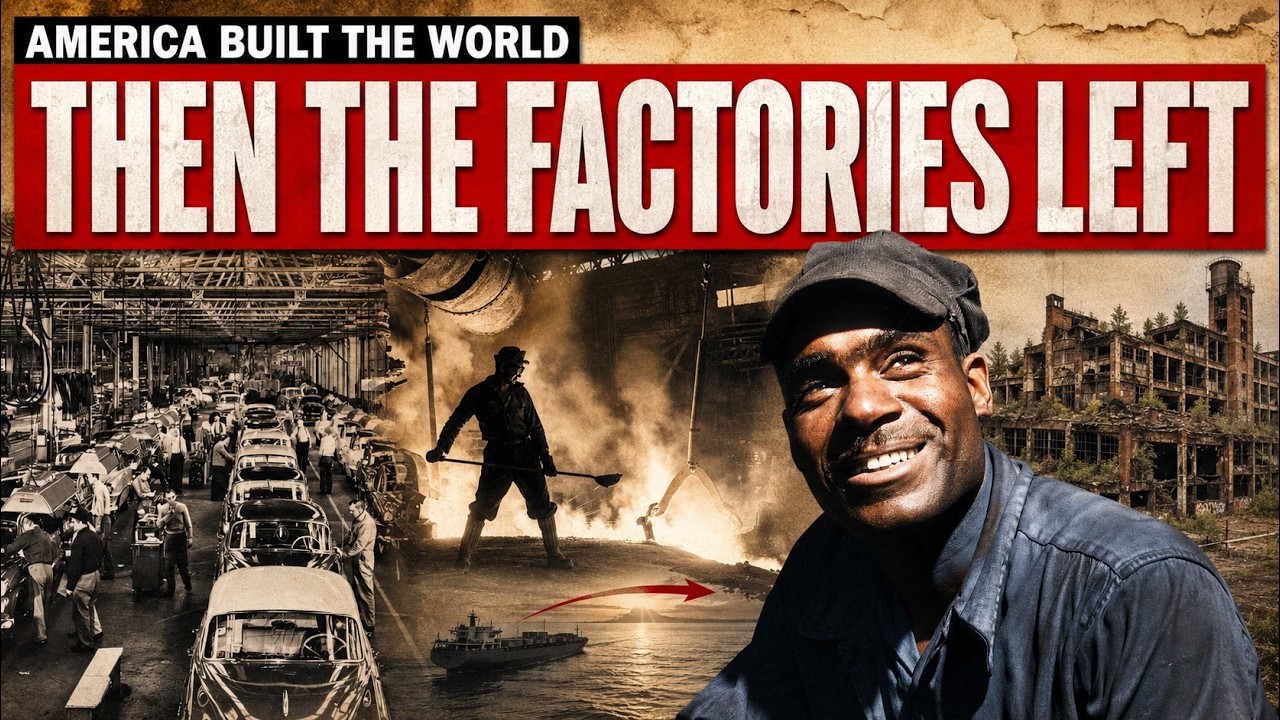
The announcement took less than ten minutes.
The factory had been there longer than some of the workers had been alive.
Their fathers had worked there.
Some of their grandfathers had worked there.
The parking lot filled before sunrise every morning.
The local diner opened early because of the shift change.
The high school depended on the taxes.
The hardware store depended on the paychecks.
So did the barber.
The grocery store.
The car dealership.
Hundreds of families had built their lives around one assumption:
That factory would always be there.
Then management called the workers together.
The plant was closing.
Production was moving somewhere else.
A man who had spent twenty-seven years on the line raised his hand.
“What happens to us?”
There was no answer that mattered.
Within months, the machines were gone.
Then the workers.
Then the customers.
Storefronts went dark.
Property values fell.
Families moved away.
The school lost students.
The city lost tax revenue.
And eventually the enormous factory that had once sounded like thunder twenty-four hours a day became silent.
This happened again.
And again.
And again.
Across Pennsylvania.
Ohio.
Michigan.
Indiana.
New York.
New Jersey.
Entire communities discovered that when a factory disappears—
it doesn’t take only the jobs with it.
It can take the town.
And that raises one of the strangest questions in modern American history.
How did this happen to the country that once built a bomber every hour?
Because forty years earlier, American factories were not dying.
They were doing something the world had never seen.
Michigan.
Willow Run.
Walk onto the factory floor and the building seems to have no end.
Bombers stretch into the distance beneath thousands of lights.
Aluminum flashes.
Riveting guns hammer.
Engines hang from chains.
Women in work clothes crawl through unfinished fuselages.
Parts move from station to station.
And at the end of that enormous production line—
a B-24 Liberator emerges.
Then another.
Then another.
At peak production, roughly one finished bomber was rolling out about every hour.
Think about that.
An aircraft containing hundreds of thousands of parts.
Four engines.
Miles of wiring.
Hydraulic systems.
Weapons.
Instruments.
Fuel tanks.
Landing gear.
Built with enough precision to fly thousands of feet above the earth carrying a combat crew—
approximately once every sixty minutes.
And Willow Run was only one factory.
Across America, automobile plants stopped building civilian cars.
Typewriter companies made weapons.
Appliance factories produced military equipment.
Companies that had never imagined themselves as defense contractors suddenly became part of an industrial war machine.
Over four years, the United States produced more than 300,000 military aircraft.
Tens of thousands of tanks.
Millions of trucks.
Billions of rounds of ammunition.
Cargo ships emerged from American shipyards at astonishing speed.
Factories ran day and night.
Millions of women entered industrial jobs.
Workers migrated across the country toward production centers.
Detroit became known as the Arsenal of Democracy.
And by the end of the war, the United States possessed an industrial capacity without precedent.
This was not simply a country with factories.
It was a country capable of reorganizing civilian industry into a continental production machine.
Then the war ended.
And something even more extraordinary happened.
Instead of collapsing—
the machine changed products.
Bombers became automobiles.
Military electronics became consumer electronics.
Factories that had fed armies began feeding suburbia.
Refrigerators.
Televisions.
Washing machines.
Cars.
Construction materials.
Millions of returning servicemen wanted homes and families.
Pent-up savings flooded into the consumer economy.
Europe and Japan were rebuilding from devastation.
American factories faced relatively limited foreign competition.
For a brief historical moment—
the United States stood at the center of the industrial world.
And the American factory worker stood near the center of American economic life.
A worker without a university degree could enter a plant, earn a wage capable of supporting a family, buy a house, own a car, take a vacation and eventually retire with a pension.
Not everyone received that promise equally.
Racial discrimination remained deeply embedded in American life.
Women who had filled wartime factories were often pushed aside when men returned.
Labor conflicts could be bitter.
But for millions of households, industrial work provided something enormously powerful:
A route from working-class wages into middle-class security.
And that system had taken more than a century to build.
Its origins began with a man leaving Britain with stolen industrial knowledge stored entirely inside his head.
Samuel Slater boarded a ship for America.
Britain was the world’s leading industrial power.
And Britain understood that machinery was power.
Industrial technology was guarded.
The export of textile machinery was restricted.
Skilled workers with valuable technical knowledge faced restrictions on leaving.
Slater knew how British textile machinery worked.
So he didn’t carry blueprints.
He carried memory.
After reaching the United States, he helped construct a successful water-powered cotton spinning operation in Pawtucket, Rhode Island.
Britain would remember him as “Slater the Traitor.”
America would remember him very differently.
The machinery spread.
Textile mills multiplied across New England.
Then other industries accelerated.
Iron.
Coal.
Machinery.
Railroads.
Meatpacking.
Steel.
Oil.
By the middle of the nineteenth century, the United States was transforming from an overwhelmingly agricultural society into an industrial power.
Then the Civil War revealed exactly what industrial power meant.
The Union could manufacture.
Weapons.
Uniforms.
Rail equipment.
Ammunition.
Supplies.
The Confederacy possessed enormous agricultural resources and fought with extraordinary determination.
But the North possessed something the South could never fully match.
Industrial scale.
The lesson was brutal:
Wars are fought by soldiers.
But they are sustained by factories.
After 1865, those factories did not disappear.
They multiplied.
Railroads tied national markets together.
Pittsburgh became synonymous with steel.
Chicago became a center of meatpacking and machinery.
New England dominated textiles.
Detroit would eventually dominate automobiles.
Men such as Andrew Carnegie and John D. Rockefeller accumulated fortunes almost unimaginable in earlier generations.
By the end of the nineteenth century, the United States had surpassed Britain as the world’s leading manufacturing power.
Then Henry Ford changed the speed of production itself.
Highland Park, Michigan.
A Model T moved past workers instead of workers moving around the Model T.
That sounds simple.
It changed industrial history.
Break automobile production into repeated tasks.
Place workers at specific stations.
Move the product continuously.
One person installs the same component.
Again.
Again.
Again.
The car advances.
Another worker performs the next operation.
The result was extraordinary.
The time required to assemble a Model T collapsed.
Costs fell.
Production soared.
And eventually the price fell far enough that the automobile moved from luxury object toward mass-market product.
But Ford understood another equation.
Factories could produce enormous quantities of goods.
Someone had to buy them.
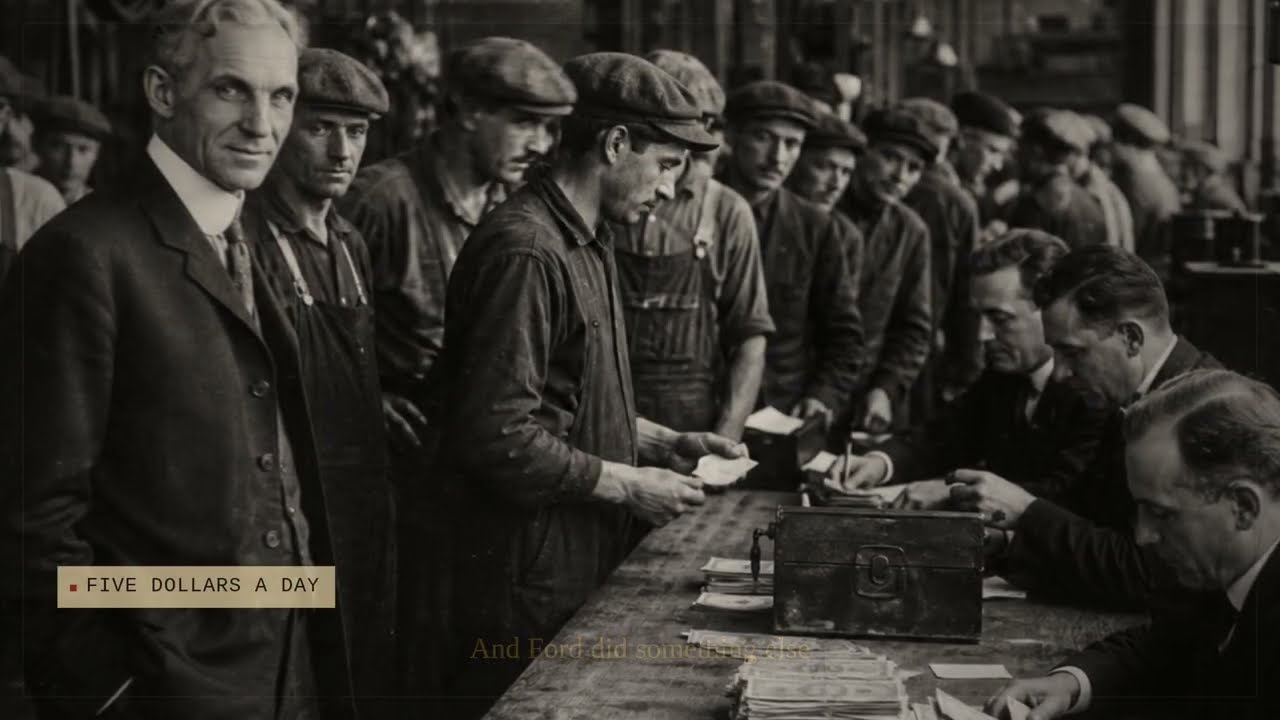
In 1914, Ford announced the famous five-dollar workday for qualifying workers, dramatically above prevailing rates for many industrial jobs.
The decision also helped reduce turnover and came with controversial conditions and paternalistic oversight.
But the economic logic was powerful.
Higher industrial wages could help create mass consumers.
The person tightening bolts inside the factory could eventually become the person buying what factories produced.
That relationship—
mass production plus mass consumption—
became one of the foundations of twentieth-century American prosperity.
Then World War II pushed the system beyond anything Ford could have imagined.
And after victory—
America inherited the industrial world.
But dominance creates its own danger.
When your competitors are shattered—
you can begin believing they will remain shattered forever.
They didn’t.
Germany rebuilt.
Japan rebuilt.
And because much of their industrial infrastructure had been destroyed, they had an opportunity American companies often did not.
Build new.
New factories.
New equipment.
New processes.
New management systems.
Japanese manufacturers became especially aggressive about quality control, efficiency and continuous improvement.
American industry was still enormously powerful.
But some companies had grown comfortable inside a domestic market they had dominated for decades.
Then came a warning American automakers could no longer ignore.
Oil crisis.
Gasoline prices surged.
Suddenly the enormous American automobile became a liability.
Consumers wanted efficiency.
Japanese manufacturers were ready.
Toyota.
Honda.
Datsun.
Smaller cars.
Better fuel economy.
Increasing reputations for reliability.
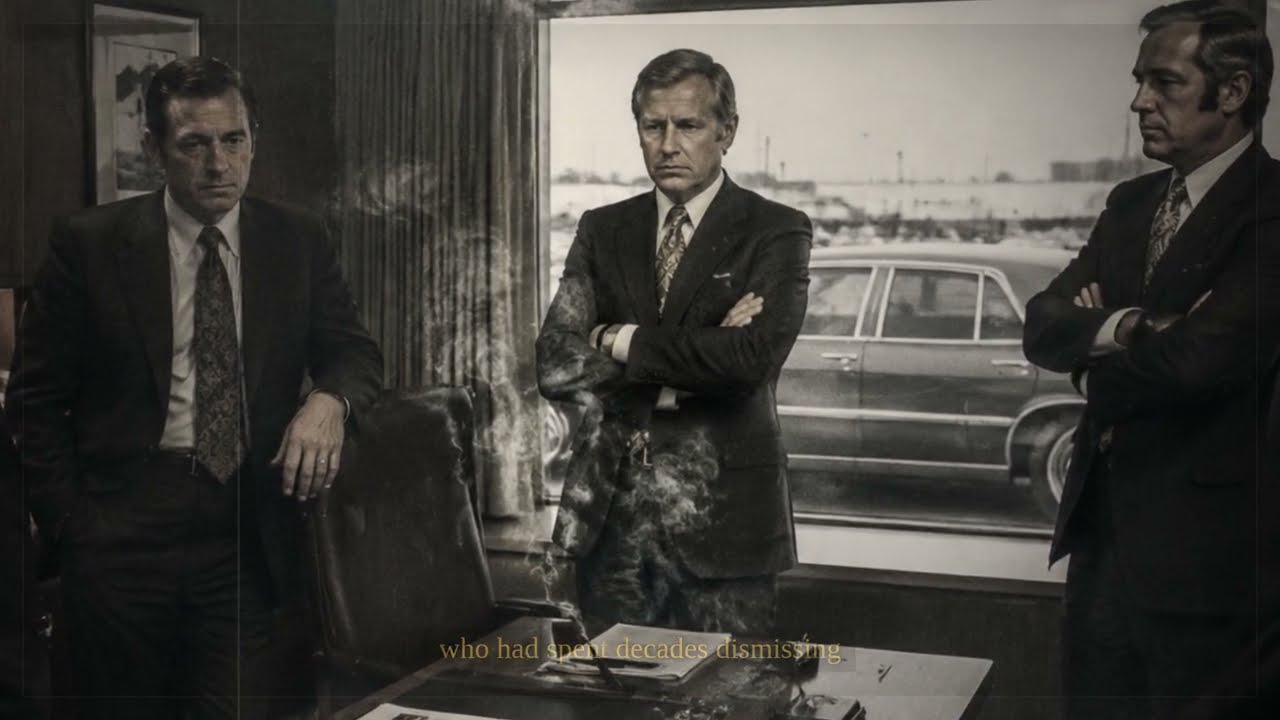
Detroit had spent years assuming foreign competitors could never seriously threaten its dominance.
Now Americans were buying their cars.
But foreign competition was only one force.
Something else was happening inside American factories.
The workers were disappearing—
even when production wasn’t.
Walk through a modern factory and compare it with Willow Run.
Willow Run required tens of thousands of human beings.
Modern production can use robots.
Computer-controlled machines.
Automated material handling.
Precision systems that work faster and more consistently than human labor for many repetitive tasks.
The result created one of the great misunderstandings about American manufacturing.
America could produce more—
while employing fewer factory workers.
Output and employment no longer had to rise together.
A plant that once required thousands might eventually produce comparable or greater value with hundreds.
Automation was not the same thing as offshoring.
But to the worker receiving a termination notice—
the distinction did not necessarily make the loss easier.
And automation was only beginning.
Because American companies were also discovering another way to cut labor costs.
Move.
At first—
not overseas.
South.
For decades, America’s industrial heartland had been concentrated heavily in the Northeast and Midwest.
Strong unions.
Higher wages.
Older factories.
Higher costs.
Then manufacturers began looking toward Southern and Southwestern states.
Land was cheaper.
Unions were weaker.
Right-to-work laws changed labor bargaining environments.
State governments offered incentives.
Factories moved.
For Charlotte or Atlanta or parts of Texas—
new industry could mean opportunity.
For Detroit, Cleveland, Buffalo, Pittsburgh, Youngstown and other older industrial centers—
losing factories meant something else.
At first, one plant closes.
Then another.
The workers disappear.
The restaurants lose customers.
The stores lose customers.
The city collects less tax.
Services deteriorate.
Young families leave.
Property values weaken.
Empty houses appear.
Another employer looks at the declining city and decides not to invest there.
Decline begins feeding itself.
Eventually a new phrase enters the American vocabulary.
The Rust Belt.
But the most consequential movement had not happened yet.
Because soon the factories would not simply cross state lines.
They would cross oceans.
Executives discovered a number on the spreadsheet that was almost impossible to ignore.
Labor cost.
An American worker might receive a comparatively high hourly wage plus health benefits, retirement costs and other compensation.
A worker in a lower-income country could cost a fraction of that amount.
For a product requiring thousands of hours of labor—
the savings could be enormous.

Container shipping made global logistics cheaper.
Telecommunications made overseas coordination easier.
Trade barriers declined.
Multinational supply chains expanded.
Suddenly a corporation headquartered in America did not necessarily need to manufacture in America.
Design here.
Finance here.
Market here.
Sell here.
Manufacture somewhere else.
That distinction would change the country.
Because international trade and offshoring were not identical.
America had traded internationally since its founding.
Now companies could reorganize the production process itself across borders.
And beginning in the late twentieth century—
the incentives became stronger.
Mexico.
Taiwan.
South Korea.
Southeast Asia.
Eventually—
China.
But before China transformed global manufacturing, North America underwent its own major experiment.
NAFTA.
The North American Free Trade Agreement connected the United States, Canada and Mexico through dramatically reduced trade barriers.
Supporters promised larger markets.
More exports.
Greater efficiency.
Lower prices.
Opponents warned that American companies would discover something obvious.
If the same product could be assembled in Mexico at much lower labor cost—
why keep the plant in Ohio?
Both sides captured parts of what followed.
Trade across North America expanded dramatically.
Supply chains became deeply integrated.
Some American industries benefited.
Consumers gained access to lower-cost goods.
But certain workers and communities faced severe disruption as production shifted.
And employers gained a powerful bargaining weapon.
A factory manager no longer needed actually to move a plant to change negotiations with workers.
Sometimes the possibility was enough.
Accept lower costs.
Accept concessions.
Or production might leave.
Then, just as America was adjusting to continental integration—
a much larger labor market entered the global system.
China.
And this time—
the scale was enormous.
China entered the World Trade Organization.
The United States had already granted China permanent normal trade relations the previous year.
Political leaders from both major parties supported deeper economic integration.
The argument extended beyond cheap goods.
Trade, many believed, might pull China toward greater political and economic liberalization.
American corporations saw something more immediate.
A gigantic manufacturing base.
Low labor costs.
Rapidly improving infrastructure.
An enormous workforce.
Factories expanded at astonishing speed.
American companies moved sourcing.
Then assembly.
Then increasingly entire production ecosystems.
Furniture.
Textiles.
Toys.
Electronics.
Consumer goods.
Machinery components.
Containers filled Chinese ports and crossed the Pacific toward American shelves.
Consumers saw prices fall.
Corporate margins improved.
But in many American factory towns—
another number was falling.
Employment.
Between 2000 and 2010, U.S. manufacturing employment dropped by roughly five million jobs.
Not all of those jobs disappeared because of China.
Automation mattered enormously.
Recessions mattered.
Domestic restructuring mattered.
Productivity mattered.
But economists studying what became known as the “China shock” found that rapidly rising import competition produced severe and geographically concentrated employment losses.
That word—
concentrated—
is essential.
Because the benefits of cheap imports could be distributed across hundreds of millions of consumers.
Save five dollars here.
Twenty dollars there.
Cheaper television.
Cheaper furniture.
Cheaper clothing.
But the cost of a factory closure did not spread evenly across America.
It landed on one town.
One street.
One family.
One worker.
The letter arrives.
Plant closing.
Maybe the worker receives severance.
Maybe retraining.
Maybe unemployment insurance.
Then he searches for another job.
But there is no other factory paying the same wage.
So he finds work in retail.
Or a warehouse.
Or food service.
Maybe healthcare support.
The paycheck is smaller.
The pension is gone.
The health benefits are worse.
His wife starts working more hours.
They stop eating out.
The local restaurant loses revenue.
His neighbor is laid off too.
Now the car dealership sells fewer cars.
The city receives less tax.
School funding tightens.
The young people who can leave—
leave.
The people who remain become older and poorer.
This is how deindustrialization moves through a community.
Not as one explosion.
As a chain reaction.
And few American cities illustrate that chain more painfully than Flint.
At its industrial peak, General Motors employed tens of thousands of workers in Flint, Michigan.
GM was not simply an employer.
It was the economic skeleton of the city.
Factories supported neighborhoods.
Neighborhoods supported businesses.
Businesses supported taxes.
Taxes supported public services.
Then GM employment collapsed over the following decades.
Plants closed.
Automation reduced labor requirements.
Production shifted.
The population shrank dramatically.
Poverty increased.
The city lost financial capacity.
Then, in 2014, Flint entered another American nightmare.
The city’s water source was switched in an effort to reduce costs while under state-appointed emergency management.
Inadequate corrosion control contributed to lead contamination entering drinking water.
Children were exposed.
A manufacturing story had somehow become a public-health disaster.
Not because a closed factory directly poisoned the water—
but because economic decline had helped leave the city extraordinarily vulnerable.
Flint became a symbol.
But it was not alone.
Youngstown.
Gary.
Erie.
Camden.
Detroit.
Different industries.
Different histories.
Similar scars.
An enormous abandoned plant standing beside a struggling neighborhood tells you something statistics cannot.
The building isn’t empty.
It is full of ghosts.
Shift whistles.
Lunch boxes.
Overtime.
Paychecks.
Christmas bonuses.
Retirement parties.
Parents telling children:
“You can build a life here.”
Then one day—
you couldn’t.
But if offshoring were the entire explanation, the story would be simple.
It isn’t.
Because while factories were moving geographically—
American corporations themselves were changing philosophically.
For much of the twentieth century, large American corporations balanced multiple constituencies.
Shareholders mattered.
But so did employees.
Customers.
Communities.
Long-term growth.
Then, particularly from the late twentieth century onward, shareholder-value ideology became increasingly influential in corporate governance.
Executives were judged intensely by financial performance.
Quarterly earnings.
Return on capital.
Stock price.
Labor increasingly appeared on spreadsheets as something to reduce.
Move production overseas—
costs fall.
Automate—
costs fall.
Cut headcount—
costs fall.
Outsource support functions—
costs fall.
Wall Street could reward the decision.
For the executive, the mathematics could be compelling.
For the community losing the plant—
the mathematics were catastrophic.
And this is where the question “Who killed American manufacturing?” becomes dangerous.
Because there is no single killer.
Not China.
Not robots.
Not unions.
Not corporations.
Not trade agreements.
Not Washington.
Not Wall Street.
Each explanation alone is too simple.
The transformation came from several forces reinforcing one another.
Foreign competitors became stronger.
American firms sometimes underinvested.
Automation reduced labor requirements.
Industry migrated within the United States.
Trade barriers declined.
Global logistics improved.
Corporations offshored labor-intensive production.
China entered the global trading system.
Financial incentives rewarded cost cutting.
Consumers demanded low prices.
And policy often failed to protect communities from the speed and concentration of the disruption.
No one pulled a single lever and turned Detroit into the Rust Belt.
Thousands of decisions did.
But there is one question that becomes much harder to avoid.
Why did some other advanced economies retain a larger manufacturing role?
Germany never froze itself in 1955.
It automated.
Globalized.
Traded.
Competed.
But manufacturing remained a larger share of its economy than in the United States.
Its vocational education system created structured pathways into skilled industrial work.
Networks of specialized manufacturers retained deep technical knowledge.
Labor-management institutions operated differently.
Industrial policy followed different assumptions.
Japan evolved differently again.
South Korea differently again.
None escaped disruption.
None preserved every old factory.
But their experience shows that deindustrialization was never simply a law of nature.
Countries made choices about training.
Infrastructure.
Trade.
Currency.
Corporate governance.
Research.
Energy.
Supply chains.
Regional development.
America made choices too.
And those choices produced extraordinary benefits.
Cheaper consumer goods.
Higher corporate profits.
More efficient supply chains.
Access to global markets.
Enormous productivity.
But the costs were real.
And they were often imposed on people who had the least influence over the decisions.
That is why this story still burns politically.
Because the economy as a whole could grow—
while a town died.
Both could be true simultaneously.
And yet there is one final twist.
American manufacturing never actually disappeared.
Walk into an aerospace plant.
A semiconductor fab.
A pharmaceutical facility.
A chemical complex.
An advanced machinery factory.
America still makes enormous quantities of goods.
Manufacturing output remains immense.
The country still possesses some of the most sophisticated industrial capabilities on Earth.
What disappeared was something different.
The factory as a mass employer.
The old industrial bargain.
The idea that millions of Americans without university degrees could walk through a factory gate—
and find a reliable path into the middle class.
Modern factories can produce astonishing value with far fewer workers.
A semiconductor fabrication facility may cost billions of dollars and employ highly skilled technicians and engineers—
but it will not necessarily recreate the employment ecosystem of a 1950s automobile complex.
That is the paradox.
America did not simply stop making things.
America learned to make many things—
without nearly as many people.
And now the country is trying to rebuild strategic manufacturing capacity in sectors such as semiconductors, batteries, advanced electronics and defense.
New plants are being announced.
Supply chains are being reconsidered.
Reshoring has become a political goal.
Tariffs have returned to the center of economic debate.
Industrial policy—once treated by many American policymakers as something other countries did—has returned too.
But even if manufacturing returns—
the 1955 factory worker may not.
Because the new factory has robots.
Sensors.
Software.
Computer-controlled machines.
Automated warehouses.
AI-assisted systems.
The building may come back.
The old job may not.
And that may be the hardest truth in this entire story.
Now go back to Willow Run.
The doors are open.
Tens of thousands of workers pour inside.
Riveting guns echo beneath the roof.
Bombers move down the line.
One leaves.
Then another.
Then another.
America is producing at a scale its enemies cannot match.
For generations afterward, that image became part of the country’s identity.
We build.
We make.
We produce.
But decades later, Willow Run fell silent.
Most of the enormous bomber complex was eventually demolished.
And across the industrial heartland, countless smaller factories followed it into memory.
Not because Americans suddenly forgot how to manufacture.
Not because one president signed one agreement.
Not because one corporation made one decision.
And not because one foreign country stole everything.
Something more complicated happened.
America built the most powerful manufacturing economy the world had ever seen.
Then technology made its workers more productive.
Globalization made its labor compete with the entire planet.
Corporate incentives made cost reduction increasingly valuable.
Policy made capital and goods easier to move.
Consumers rewarded lower prices.
And communities built around factories discovered something nobody had prepared them for:
Capital can leave.
A town cannot.
That’s the part hidden inside every abandoned factory.
The machines can be sold.
Production can move.
Shareholders can invest somewhere else.
Executives can relocate.
Young workers can sometimes leave.
But the streets remain.
The houses remain.
The schools remain.
The people who cannot leave remain.
And eventually the rusting building becomes a monument to a bargain that America once made with millions of workers:
Give us your labor—
and there will be a place for you in the prosperity you create.
For decades, that bargain helped build the largest middle class the world had seen.
Then the factory doors closed.
And millions of Americans were left standing outside—
still waiting to hear what was supposed to replace it.