The screaming started somewhere in the dark.
Then it stopped.
No one inside the house moved.
The father grabbed the only candle they had left and walked toward the door.
His wife whispered,
“Don’t open it.”
Another sound came from outside.
Closer this time.
A branch snapped.
Then footsteps.
The candle flame shook in his hand.
Beyond that tiny circle of light was nothing.
No streetlamp.
No porch light.
No flashlight.
No neighbor he could call.
No police.
No way to see what was standing ten feet from the door.
Then—
someone knocked.
Once.
Twice.
The children began crying.
And this was not a horror story.
This was nighttime in America before electricity.
When the sun went down, the world did not simply become darker.
It became more dangerous.
Roads disappeared.
Bridges vanished into blackness.
Strangers became threats.
Criminals owned the shadows.
A single overturned candle could burn a family alive.
And for poor households, even staying awake after sunset could cost more money than they could afford.
For most of American history, darkness controlled when people worked—
when they traveled—
when they slept—
when they prayed—
when they locked the door—
and when they simply stopped living until morning.
Today, we think night is just daytime with the lights off.
Back then—
night was a different world.
And if you stepped into it unprepared—
you might not come back.
To understand how completely darkness ruled American life, forget the electricity for a moment.
Forget the glowing city.
Forget the headlights.
Forget your phone.
Go back to a cloudy night in 1770.
Step outside.
Close the door behind you.
Now look around.
Nothing.
Not “dim.”
Nothing.
You cannot see the road.
You cannot see the ditch beside it.
You cannot see the river twenty yards away.
You may not even see your own hand clearly.
People became lost walking across property they knew.
They fell into wells.
Walked off bridges.
Drowned in rivers.
Wagons overturned.
Travelers disappeared because they missed a turn that was obvious in daylight and invisible at night.
Darkness itself could kill you.
But people were even more afraid of what might be hiding inside it.
In colonial cities, respectable people tried to be home before full dark.
Shops closed.
Markets emptied.
Churches locked their doors.
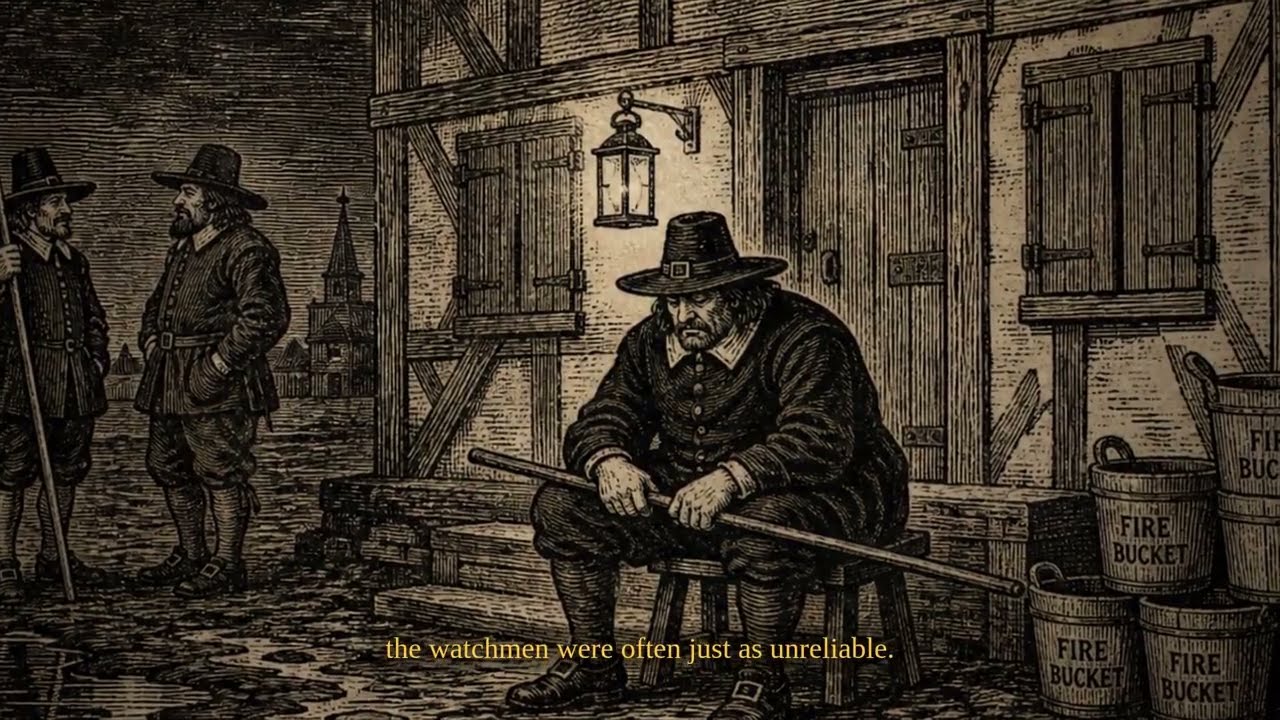
The streets belonged to watchmen—
and whoever the watchmen failed to catch.
Boston organized night patrols early.
Men walked the streets carrying rattles and lanterns.
If they saw someone moving after dark, the question was immediate:
“Who are you?”
“Where are you going?”
“Why are you outside?”
Because simply being on the street at night could make you suspicious.
Nightwalker laws gave authorities broad power to question or detain people whose presence after dark could not be explained.
Think about what that says about the culture.
Today, taking a walk at 11 p.m. is ordinary.
Then—
it could look criminal.
Because nighttime activity had a reputation.
Theft.
Robbery.
Violence.
Arson.
Drunkenness.
Smuggling.
Prostitution.
Gambling.
The night created anonymity.
And anonymity created opportunity.
A thief did not need to hide from a security camera.
There were no cameras.
No headlights.
No illuminated storefronts.
He only needed the sun to disappear.
Then the city became cover.
And inside the home, another danger was already burning.
Fire.
Every light source involved flame.
Every room was full of things that could burn.
Wood floors.
Wood walls.
Curtains.
Blankets.
Clothing.
Furniture.
A candle tipped over—
and the darkness problem became a fire problem.
One mistake could destroy the house.
In a dense city, one house could take several others with it.
That is why fire discipline mattered so much at night.
Even the old idea behind “curfew” is tied historically to covering or controlling household fires before sleep.
Because people were not only afraid of being robbed at night.
They were afraid of waking inside an inferno.
And yet they still needed light.
The cheapest answer was tallow.
Animal fat.
Rendered down.
Wrapped around a wick.
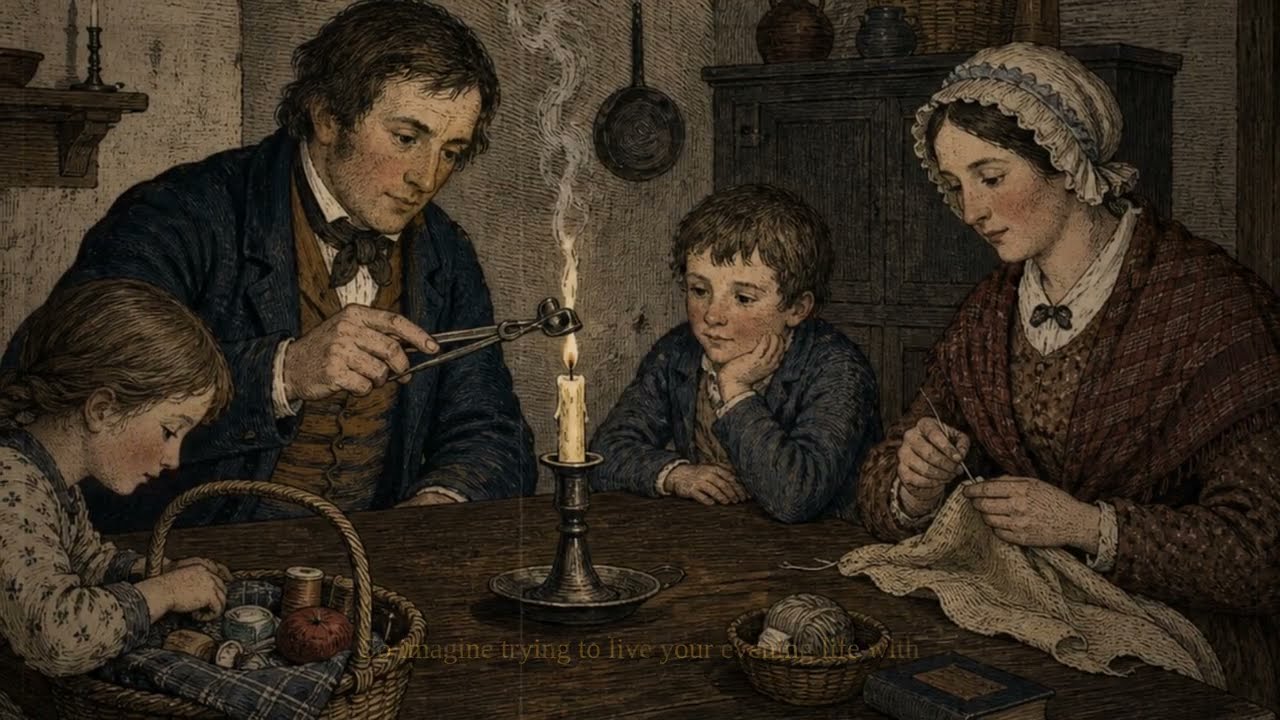
A tallow candle gave weak, smoky, yellow light.
It smelled.
It dripped.
It needed trimming.
And compared with a modern bulb, it illuminated almost nothing.
Put one candle in the middle of a room.
That was your world.
Faces near the flame.
Shadows at the wall.
Everything else fading into black.
For poor families, even that tiny flame was an expense.
Burn the candle—
you are literally burning money.
So sometimes the choice was simple.
Do we stay awake—
or save the candle?
Many families went to bed early because darkness was cheaper than light.
That is how powerful nighttime was.
It could decide when your day ended simply because you could not afford to see.
The rich could buy more darkness back.
Beeswax candles burned cleaner.
Spermaceti candles burned brighter.
Whale-oil lamps offered more usable illumination.
The Argand lamp improved the efficiency of oil lighting dramatically.
Now a wealthy household could read after dinner.
Write letters.
Entertain guests.
Conduct business.
A poor household might already be asleep.
Artificial light created something almost nobody thinks about today:
A class divide in usable time.
The wealthy could purchase additional hours of life.
The poor lost them to darkness.
And that may have affected even the way people slept.
Before abundant artificial light, many people appear to have practiced what historians call segmented sleep.
First sleep.
Wake.
Then second sleep.
You might go to bed soon after nightfall.
Sleep several hours.
Wake around midnight.
Stay awake for a period.
Feed the fire.
Pray.
Talk.
Check animals.
Do chores.
Spend time with your spouse.
Then sleep again until dawn.
Nobody necessarily thought this was insomnia.
It was just night.
Then light became cheaper.
People stayed up later.
The midnight waking period shrank.
Within generations, the old pattern largely disappeared.
Electricity did not simply illuminate the room.
It helped rewrite the clock inside human life.
But before electricity, the evening itself was intensely communal.
Families gathered in one room.
Why one room?
Because that was where the fireplace was.
And where the candle was.
Parents.
Children.
Grandparents.
Everybody close.
The rest of the house might as well not exist.
Too dark.
Too cold.
Too expensive to illuminate.
So people talked.
Stories.
News.
Family history.
Religion.
Songs.
Gossip.
Children heard the same stories again and again.
That is how memory survived.
A grandfather did not upload photographs.
He spoke.
A mother did not send her child a link.
She told the story.
Night forced families together because light was too scarce to let everyone disappear into separate rooms.
Women often used those hours to sew and mend clothing.
Work that could partly be guided by touch.
A shirt was repaired until there was almost nothing original left.
Fabric was too valuable to throw away.
Reading was possible—
but painful.
One moving flame.
Tiny print.
Long shadows.
Your eyes worked constantly trying to hold the words in focus.
Now imagine theaters.
Hundreds of people.
Wooden building.
Long dresses.
Heavy clothing.
And hundreds, sometimes thousands, of open flames trying to make the stage visible.
Candles hanging overhead.
Candles at the edge of the stage.
Candles in the wings.
Heat.
Smoke.
Wax.
Then one flame touches the wrong fabric.
Theater fires were not theoretical.
They were deadly.
Nighttime entertainment literally required surrounding crowds with fire.
Taverns were different.
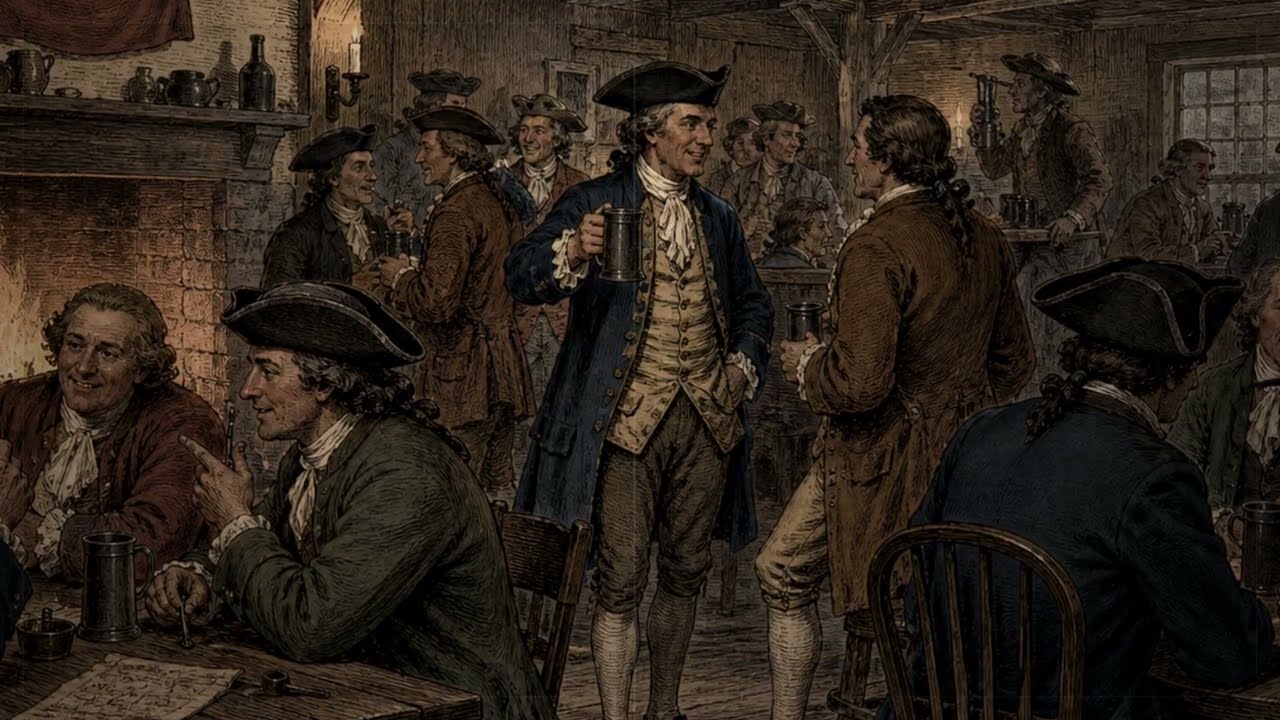
Fireplaces.
Candles.
Alcohol.
News.
Politics.
Deals.
Arguments.
Travelers.
For many communities, the tavern was one of the few places that remained alive after sunset.
But walk beyond its door—
and the darkness returned immediately.
On the frontier, the night could feel even more absolute.
A farm miles from the nearest neighbor.
No road lighting.
No town glow.
No communication.
A wolf howls.
Something brushes against the barn.
The horse becomes nervous.
You hear a branch break.
You do not know what made the sound.
And if something happens—
there is no one coming.
No ambulance.
No sheriff arriving in five minutes.
No telephone.
No emergency light.
You wait for morning.
That phrase mattered enormously:
Wait for morning.
Morning meant visibility.
Movement.
Help.
Night meant isolation.
Cities had the opposite problem.
More people.
More danger hidden among them.
As New York and other cities grew, nighttime districts developed their own society.
Basement taverns.
Gambling rooms.
Sex work.
Stolen goods.
Con artists.
Journalists described a city that seemed to transform after sunset.
One city by day.
Another by night.
Then something appeared that began to tear that division apart.
Gaslight.
Baltimore introduced gas street lighting in 1816.
Suddenly a street could glow continuously.
Not brightly by modern standards—
but enough to change behavior.
People stayed outside longer.
Businesses remained open.
Restaurants expanded their hours.
Theaters became easier to operate.
Respectable middle-class people began walking after dark for pleasure.
Nightlife was born.
Not the criminal underworld.
Actual social nightlife.
And the economic impact was enormous.
Light created more business hours.
More customers.
More entertainment.
More work.
The sun was losing its monopoly over commerce.
But gas was dangerous too.
Leaks.
Explosions.
Fumes.
Soot.
Heat.
A gaslit room could become suffocating.
The technology pushed back darkness—
but still filled the room with combustion.
Then came Manhattan.
And for the first time, people watched light appear without flame.
Pearl Street.
Thomas Edison’s electric system.
Generators.
Wires.
Distribution.
Customers.
Then the switch was thrown.
Lamps glowed.
No wick.
No smoke.
No oil.
No candle.
Light simply existed.
That was the revolution.
Not the bulb alone.
The system.
Electricity could be produced somewhere else—
sent through wires—
and summoned instantly inside your room.
The night had never faced anything like it.
Factories could run beyond sunset.
Stores could remain open.
People could read comfortably.
Streets could become safer.
The theater could illuminate itself without thousands of flames.
The economic day expanded.
Then expanded again.
Second shift.
Third shift.
Twenty-four-hour production.
For thousands of years, the human working day had been limited by one enormous fact:
Eventually the sun disappears.
Electricity broke that limit.
But it did not happen everywhere at once.
Cities lit up.
Rural America remained dark for decades.
Imagine being alive in the 1930s.
You visit a city.
Electric signs.
Streetlights.
Radio.
Bright shops.
Then return to your farm.
Kerosene lamp.
Dark barn.
Black road.
Same country.
Different century.
Private utilities often found rural customers unprofitable.
Too many miles of wire.
Too few customers.
So millions waited.
Then New Deal-era rural electrification pushed power lines into the countryside.
Poles rose beside roads.
Wires crossed fields.
Then one night—
a farmer stood inside his own house and touched a wall switch.
Click.
Light.
The entire room appeared.
His children could read without smoke.
His wife no longer had to clean lamp chimneys.
The barn could be illuminated.
Machines followed.
Radios followed.
Appliances followed.
And perhaps most importantly—
the night stopped controlling the family.
For the first time, they could decide when the day ended.
That freedom became so ordinary that their grandchildren would barely understand why it mattered.
And now we’ve gone almost too far in the opposite direction.
Our cities never truly become dark.
Streetlights.
Cars.
Billboards.
Windows.
Screens.
Phones.
Electronic clocks.
Artificial light reaches the sky itself.
For many Americans, the Milky Way has almost vanished.
Our ancestors had too much darkness.
We have so much light that we pay to escape it.
Blackout curtains.
Sleep masks.
Dark-sky vacations.
Night mode.
We now manufacture darkness inside bedrooms because the world outside refuses to provide enough of it.
That is the reversal.
A colonial family feared the candle dying.
A modern family worries the phone screen is too bright.
The old problem was:
How do we defeat the night?
The modern problem is sometimes:
How do we make the night come back?
And that brings us back to the knock at the door.
One candle.
A frightened family.
Something moving outside.
For them, darkness meant danger because it hid the world.
For us, darkness has become rare enough that we sometimes romanticize it.
But before electricity, nobody needed to romanticize night.
They respected it.
Because when the sun disappeared—
your ability to see disappeared with it.
Your ability to travel shrank.
Your ability to get help shrank.
Your ability to work shrank.
Your world became smaller.
Then humans built candles.
Oil lamps.
Gas networks.
Power stations.
Wires.
Bulbs.
And slowly—
the world stopped ending at sunset.
So tonight, when you walk into a dark room and touch the switch—
remember what that motion really means.
For thousands of years, night told human beings:
Stop.
Stay inside.
Wait.
And with one finger—
you tell the night:
No.