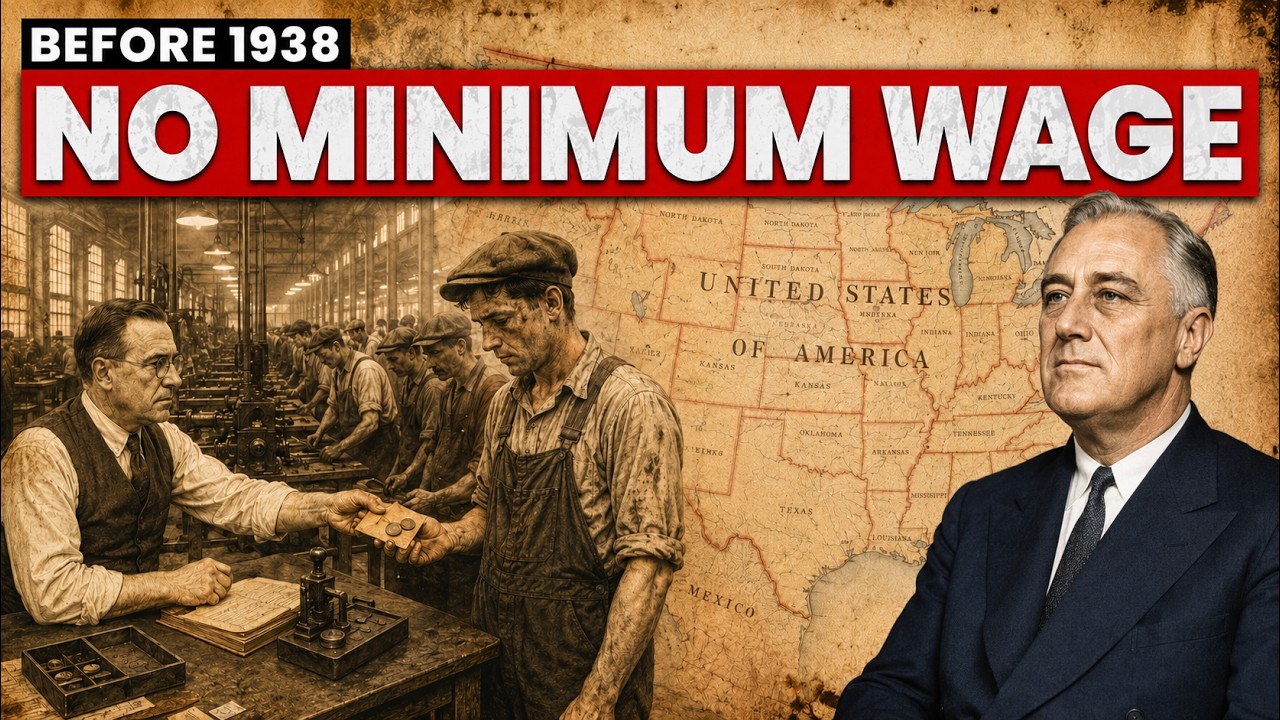
He worked all day underground—
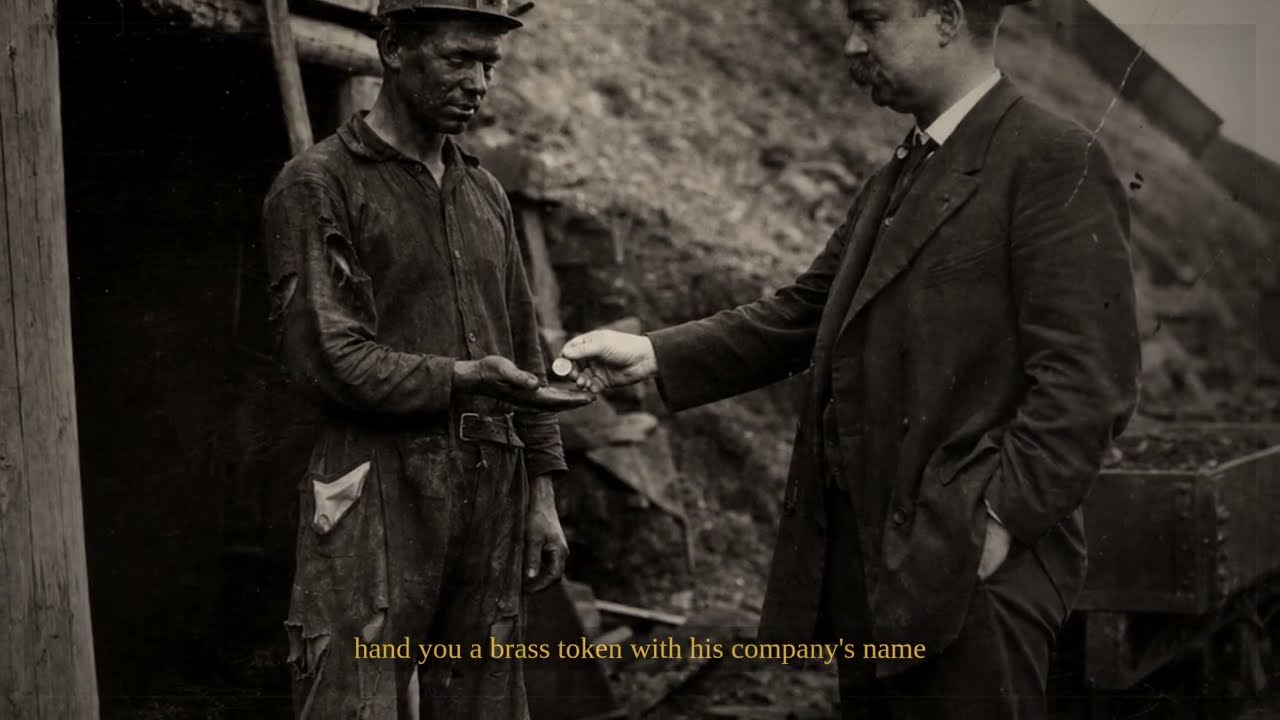
and when payday came, his boss handed him money he couldn’t spend anywhere else.
Not dollars.
Not coins issued by the United States.
Company scrip.
A token stamped with the name of the company that owned the mine.
The same company owned his house.
The same company owned the store where his family bought food.
The same company could extend him credit when his wages weren’t enough.
And the same company could fire him—and force his family out of the town.
He could work ten hours.
Twelve.
Sixteen.
Crawl back to the surface covered in coal dust—
open his hand—
and discover that his “pay” was useful almost nowhere except inside the economic world controlled by his employer.
Want cheaper flour in another town?
You needed real money.
Want to save enough to leave?
Real money.
Want to buy a train ticket and take your family somewhere else?
Real money.
But the company had given you scrip.
And if the company store charged more than your wages covered—
you didn’t leave payday richer.
You left owing your employer money.
That is the part of American labor history that sounds almost fictional today.
Before the federal minimum wage—
there was no nationwide floor saying how little a covered employer could pay.
No federal forty-hour workweek.
No modern federal overtime system.
And for generations, children could be sent into mines, mills and factories under conditions that would later become illegal.
The people who built industrial America did not begin with the protections modern workers recognize.
Those protections came afterward.
And the price of getting them was enormous.
Because before Washington finally drew a line in 1938, Americans had already watched children disappear into factories, miners become trapped in company economies, soldiers confront striking railroad workers—
and 146 people die inside one New York garment factory.
So the real question is not:
Why did America create a minimum wage?
The harder question is:
What had to happen before the country finally decided there should be a limit to how cheaply human labor could be bought?
To answer that—
we have to go back to an America where the paycheck itself was still becoming normal.
In the early nineteenth century, much of the country was agricultural.
Millions of Americans lived on farms.
Families produced a large share of what they consumed.
Cash could be scarce.
Neighbors exchanged labor.
Goods could be bartered.
A man might help harvest another farmer’s field and receive help repairing a barn in return.
For many Americans, there was no Friday paycheck because there was no factory employer.
Among skilled trades, the relationship between worker and employer could also be highly personal.
An apprentice might live with a master craftsman for years.
He received food, lodging and training while learning carpentry, printing, blacksmithing or another trade.
Eventually he became a journeyman and sold his labor more independently.
Wages existed.
But the industrial labor market that would later dominate American life did not yet exist at anything like its later scale.
Then factories changed the equation.
Water power.
Steam.
Textile mills.
Ironworks.
Railroads.
Steel.
Meatpacking.
Large employers no longer needed a handful of craftsmen who knew an entire trade.
They could divide production into repetitive tasks and hire enormous numbers of people to perform them.
The relationship changed.
The worker might not know the owner.
The owner might never see the worker.
One person left—
another could take the place.
And as industrial cities expanded, millions of immigrants arrived looking for work.
Irish.
Germans.
Italians.
Poles.
Russians.
Chinese immigrants in the West.
People fleeing famine, persecution and poverty entered an economy hungry for labor.
That abundance of desperate workers gave employers enormous bargaining power.
If one worker refused the wage—
someone else might accept it.
And there was no federal minimum telling the employer:
You cannot go lower than this.
By the Gilded Age, industrial workers could spend ten or twelve hours a day inside factories and still struggle to support a family.
The source describes typical factory wages around twenty cents an hour in parts of this period, with weekly earnings often painfully small once rent, food, clothing and medicine were paid.
For many working-class households, one wage was not enough.
So another source of labor entered the factory.
The children.
By around 1900, child labor was widespread enough to become one of the defining scandals of industrial America.
And the reason employers wanted children was brutally simple.
They were cheap.
In textile mills, small bodies could move around machinery adults could not.
Small fingers could reach into tight spaces.
In coal regions, boys worked as breaker boys, separating slate and rock from coal.
Hour after hour—
bent over moving material—
breathing dust—
hands close to machinery—
for a fraction of an adult wage.
A child earning fifty cents could mean the difference between a family buying food—
and not buying it.
That is what makes child labor difficult to understand through the simple language of evil employers.
Employers exploited it.
But poverty supplied it.
Parents often did not send children to work because they believed mines were good for them.
They sent them because the household arithmetic did not work without another wage.
Rent.
Food.
Fuel.
Clothing.
Father’s wage.
Then the gap.
The child filled the gap.
Industrial America had created a system where the labor of a ten-year-old could become part of a family’s survival calculation.
And in isolated mining communities, even earning money did not necessarily mean receiving money.
That brings us back to company scrip.
A mining corporation could build an entire settlement around the mine.
Housing.
Store.
School.
Sometimes other community institutions.
The worker entered not merely a workplace—
but an economic ecosystem dominated by the employer.
He paid rent back to the company.
Bought food from the company.
Bought boots from the company.
And in some places received compensation through company-issued scrip or credit systems closely tied to the company store.
The company store mattered because competition might be miles away.
If a sack of flour was more expensive there—
what was the miner going to do?
Walk twenty miles?
If his account exceeded his earnings—
credit could be extended.
Then deducted later.
Work.
Buy.
Owe.
Work again.
The cycle could become extraordinarily difficult to escape.
This is where the famous image of owing one’s soul to the company store came from.
Not because the company literally owned the worker.
But because employment, housing, purchasing power and debt could become concentrated in the hands of the same institution.
And if miners attempted to challenge that institution—
another problem appeared.
Organizing.
Employers could fire union supporters.
Blacklists could make finding another job difficult.
Private security, local authorities, state militia and sometimes federal power entered major labor disputes.
American labor history became increasingly violent because the argument was no longer simply about wages.
It was about who controlled industrial life.
Then urban factories produced their own version of the nightmare.
New York.
Garment industry.
Young immigrant women and girls sat at sewing machines for brutally long days.
Low wages.
Crowded rooms.
Fabric everywhere.
Fire risk everywhere.
And on March 25, 1911—
the argument over workplace regulation stopped being abstract.
Fire broke out at the Triangle Shirtwaist Factory.
It spread rapidly.
Workers on the upper floors tried to escape.
Some routes failed them.
The fire escape collapsed.
Fire department ladders could not reach high enough.
And people began appearing at the windows.
Then they began falling.
One after another.
The crowd below could see them.
In less than an hour—
146 workers were dead.
Many were young immigrant women.
Some were teenagers.
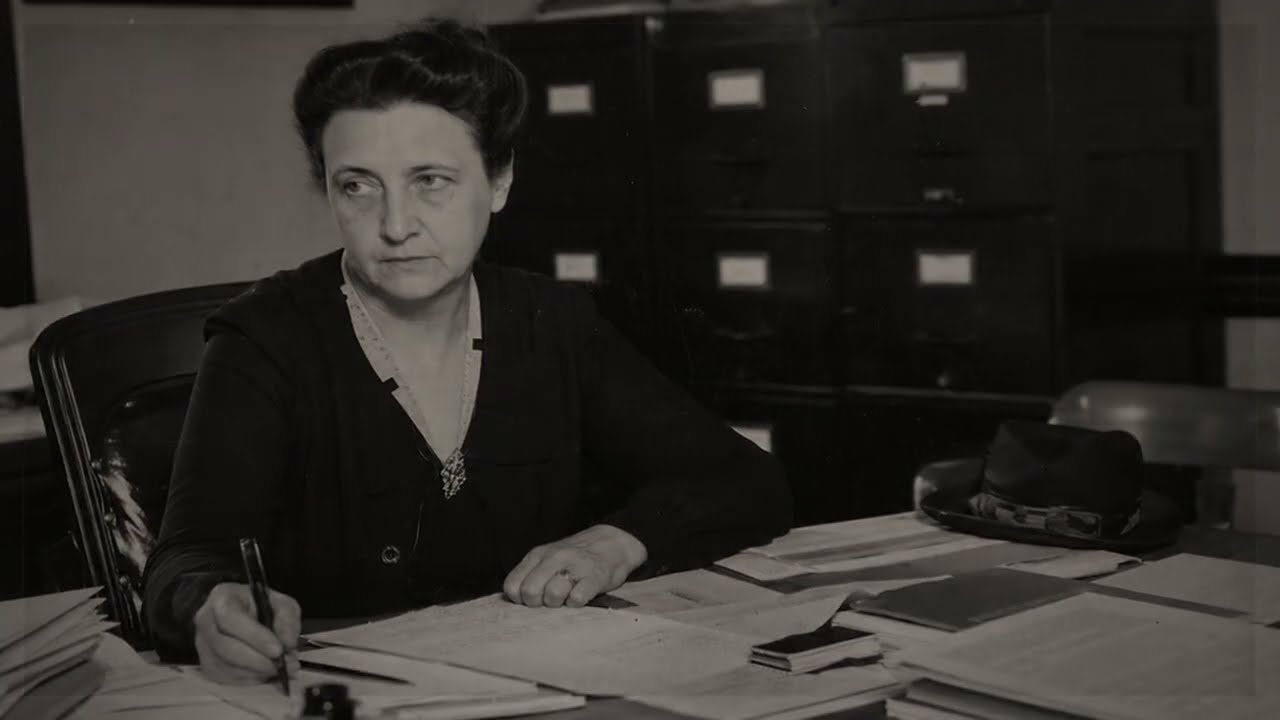
And among the people who witnessed the horror from the streets was a woman whose name would become inseparable from the labor protections that followed.
Frances Perkins.
She later described the Triangle disaster as a transformative moment in the history of labor reform.
But Triangle was not the beginning.
Workers had already been fighting for decades.
One of the central demands was time.
Eight hours.
That was the radical idea.
Eight hours for work.
Eight hours for rest.
Eight hours for everything else a human life contained.
Today, an eight-hour workday sounds ordinary.
In the nineteenth century, employers could regard legally limiting hours as an attack on freedom of contract.
Why should government tell an employer and worker what agreement they were allowed to make?
The answer from workers was equally simple:
Because a starving person negotiating with a corporation is not negotiating from equal power.
That conflict exploded in Chicago in 1886.
Hundreds of thousands of workers participated in the broader eight-hour movement.
After violence involving workers and police near the McCormick plant, a protest meeting was held at Haymarket Square.
The gathering was winding down when police moved toward the remaining crowd.
Then someone threw a bomb.
The explosion shattered the square.
Gunfire followed.
Police officers died.
Workers died.
Dozens were wounded.
And the political consequences were enormous.
Anarchists and labor radicals were blamed.
Eight defendants were prosecuted.
Four were ultimately executed.
The Haymarket affair became a symbol that different sides interpreted in completely different ways.
To employers and conservative newspapers, it proved labor radicalism could threaten public order.
To labor activists, it became evidence that demands for basic rights could be answered with repression.
Either way—
the movement did not disappear.
Because the conditions producing it remained.
Then came Pullman.
George Pullman’s company manufactured railroad sleeping cars near Chicago.
When economic depression hit, wages were cut.
But workers complained that costs associated with living in the company town did not fall proportionately.
That combination was explosive.
Less money coming in.
Major expenses still going out.
Workers struck.
The American Railway Union under Eugene V. Debs supported them.
The conflict spread across the rail network.
Rail traffic was disrupted.
The federal government intervened, citing interference with the mails and interstate commerce.
Federal troops entered Chicago.
Violence followed.
People died.
Debs went to jail.
The union was badly damaged.
And only days after the strike began, Congress made Labor Day a federal holiday.
Think about the contradiction.
Workers were receiving a national holiday honoring labor—
while federal troops were helping break one of the largest labor confrontations in the country.
Symbolic recognition was becoming politically acceptable.
Structural power was not.
Then workers in Lawrence, Massachusetts, forced the issue again.
Textile mills.
Immigrant workers.
Women.
Children.
A reduction in weekly pay helped trigger a strike involving tens of thousands.
The phrase later associated with the struggle was unforgettable:
Bread—
and roses.
Not merely survival.
Dignity.
The strike eventually produced wage gains.
But workers trying to use state law to secure protections repeatedly encountered another barrier.
The courts.
During the era associated with Lochner v. New York, courts often treated economic regulation with deep constitutional suspicion.
In 1905, the Supreme Court invalidated New York’s limit on bakery working hours.
The majority framed the law as an unconstitutional interference with liberty of contract.
Then in Adkins v. Children’s Hospital in 1923, the Court struck down a minimum-wage law for women in Washington, D.C.
Again—
freedom of contract.
Employer and employee should negotiate.
Government should not dictate the wage.
But that theory contained a problem visible on every factory floor.
How free is the negotiation when one side can survive without hiring you—
and the other side cannot survive without a job?
For decades, America struggled with that question.
Then the economy collapsed.
Factories closed.
Banks failed.
Unemployment spread.
By 1933, roughly one-quarter of the labor force was unemployed.
Now the bargaining imbalance became almost grotesque.
If an employer cut your wage—
what were you going to do?
Quit?
Millions of people were looking for your job.
Someone would take it.
Ten cents an hour.
Fifteen.
Whatever kept food on the table.
The Depression demonstrated something the old theory of individual bargaining struggled to explain.
A labor market could move downward collectively.
Each worker could technically be “free” to reject a wage—
while millions simultaneously became too desperate to reject anything.
Franklin Roosevelt entered the presidency in that environment.
His administration began trying to place floors beneath wages and limits on working hours.
The National Industrial Recovery Act attempted to use industry codes.
Then the Supreme Court struck the law down in 1935.
The fight was not over.
And inside Roosevelt’s administration was Frances Perkins.
The woman who had watched Triangle burn.
By 1933, she had become Secretary of Labor—
the first woman to serve in a U.S. presidential cabinet.
She had spent years working on labor reform.
Hours.
Safety.
Child labor.
Minimum standards.
Now she had access to federal power.
But there was still one enormous obstacle.
The Supreme Court.
Earlier wage legislation had failed constitutional review.
Any new federal law had to be designed carefully enough to survive.
Then constitutional doctrine began shifting in 1937.
The political opening widened.
And the battle over federal wage-and-hour legislation accelerated.
But opposition was fierce.
Business groups warned that federal wage floors would increase costs and destroy jobs.
Regional political interests feared the effects of national wage standards on low-wage economies.
Southern lawmakers held enormous power in Congress.
And race was inseparable from the negotiations.
Agricultural and domestic work employed huge numbers of Black workers in the South.
The final Fair Labor Standards Act excluded major categories of workers, including many agricultural and domestic employees.
Those exclusions meant the celebrated national labor floor was never truly universal.
Millions remained outside it.
That contradiction belongs inside the story.
Because June 25, 1938 was both a breakthrough—
and an unfinished victory.
Roosevelt signed the Fair Labor Standards Act.
Federal minimum wage:
Twenty-five cents an hour for covered workers.
Maximum standard workweek initially:
Forty-four hours before overtime requirements applied.
Restrictions on oppressive child labor.
For the first time, the federal government had established a nationwide wage floor across covered interstate industries.
Twenty-five cents sounds almost insulting now.
But the number was not the revolution.
The principle was.
For generations, the dominant assumption had been:
If someone is desperate enough to accept the wage—
the wage is legitimate.
Now Washington was saying:
No.
There is a point below which the bargain itself is unacceptable.
That was the break.
The employer’s power to offer terms was no longer unlimited.
The worker’s desperation could no longer legalize every arrangement.
Government had entered the contract.
And it had entered because more than a century of industrial conflict had demonstrated what could happen when the contract was treated as though both parties possessed equal power.
But 1938 did not erase the old world overnight.
Coverage was incomplete.
Enforcement varied.
Excluded workers remained vulnerable.
Labor conflict continued.
Wage debates continued.
The minimum wage changed repeatedly.
Later amendments expanded coverage and moved the standard workweek toward the forty-hour framework Americans recognize today.
The law evolved.
But the line had been crossed.
And perhaps the best way to understand what changed is to return to that miner.
Imagine two paydays separated by generations.
In the first—
he climbs from the mine.
His employer determines the wage.
The company may dominate the housing.
The store.
The local economy.
His bargaining power is almost nonexistent.
He opens his hand.
Company scrip.
Take it—
or someone else will take the job.
There is no federal wage floor beneath him.
Now move forward.
The modern worker can still be underpaid.
Still be exploited.
Still face an employer with more bargaining power.
Labor law did not eliminate any of those things.
But a legal boundary now exists.
Minimum wage.
Overtime rules for covered workers.
Child-labor restrictions.
Safety regulation developed through other laws.
Workers’ compensation systems developed.
Collective-bargaining protections emerged and changed.
The modern workplace was not created because industrial capitalism naturally became kinder.
It was constructed through political conflict.
Law by law.
Disaster by disaster.
Strike by strike.
And that is why Triangle matters.
Haymarket matters.
Pullman matters.
Lawrence matters.
Frances Perkins matters.
They are not isolated episodes.
They are pieces of the answer to one question:
How bad did conditions have to become before Americans decided the employment contract could no longer be treated as completely private?
The answer took generations.
Children had to work in mills.
Miners had to become indebted to company stores.
Workers had to strike for an eight-hour day.
Courts had to strike down reform laws.
A factory had to burn with 146 people inside.
A depression had to leave roughly one worker in four unemployed.
And even then—
the final law almost did not happen.
That is the part worth remembering when we look backward from a world where the paycheck feels normal.
The forty-hour week feels normal.
Overtime feels normal.
A legal minimum wage feels normal.
Children attending school instead of working full shifts in factories feels normal.
None of it was normal to the people who first demanded it.
To employers opposing regulation, some of those demands sounded radical.
Economically dangerous.
Even unconstitutional.
Then generations changed.
And yesterday’s radical demand became today’s ordinary expectation.
Which brings us back to the small object in the miner’s hand.
The token.
Company name stamped into metal.
Worth something inside the company store.
Worth almost nothing once he stepped outside the company’s world.
That object tells the entire story.
Because industrial America did not merely control how much some workers earned.
In its most extreme company-town systems—
the employer could influence where they lived—
where they shopped—
what they owed—
and even the form in which they were compensated.
Then workers spent generations fighting to separate employment from that kind of total economic control.
The minimum wage was only one part of that separation.
But in 1938, something fundamental changed.
For the first time at the federal level, the country told covered employers:
You may bargain.
You may hire.
You may fire within the law.
You may make a profit.
But there is now a floor.
And beneath that floor—
the worker’s desperation is no longer enough to make the bargain legal.
That is what twenty-five cents an hour meant.
Not wealth.
Not comfort.
A boundary.
A line that had not existed before.
And America needed more than 160 years after independence—
and generations of workers paying the price—
before it finally drew it.