The banks were failing.
Depositors were running through the streets.
Trust companies were locking their doors.
Thousands of people were trying to pull out their savings before the money disappeared.
And the United States government had no central bank to stop it.
No Federal Reserve.
No national lender of last resort.
No institution with enough authority to flood the system with emergency cash.
So in October 1907, the fate of the American financial system came down to one man.
J.P. Morgan.
Seventy years old.
Private citizen.
Private banker.
No elected office.
No constitutional authority.
And yet bank presidents came to his library because there was nobody else powerful enough to save them.
Morgan examined balance sheets.
Decided which institutions were worth rescuing.
Organized emergency pools of money.
Pressured wealthy financiers to contribute.
And on one extraordinary night, he reportedly locked a group of trust-company presidents inside his library and refused to let them leave until they agreed to put up millions.
Imagine that.
The largest industrial economy on Earth—
steel mills running—
railroads crossing the continent—
factories producing at unprecedented scale—
and when the financial system began collapsing, there was no public institution standing behind it.
There was one elderly banker.
If Morgan failed—
banks could fail.
If banks failed—
businesses could lose credit.
If businesses lost credit—
workers could lose jobs.
America had spent more than a century fighting the idea of centralized banking power.
Then one panic forced the country to confront an uncomfortable question:
Was it really safer to have no central bank—
if the alternative was letting one unelected billionaire act like one?
That question would eventually lead to a secret meeting on a private island—
six men using first names—
a borrowed shotgun as cover—
and a banking plan they refused to publicly admit they had written for years.
And three years after that meeting—
President Woodrow Wilson signed the Federal Reserve into law.
But the Federal Reserve was not America’s first attempt at a central bank.
It was the third.
And the first fight began almost immediately after the Revolution.
America declared independence.
Politically, it had broken from Britain.
Financially—
it was barely a country.
The Continental Congress needed money to fight a war.
It had no reliable national taxing power.
No deep bond market.
No central bank.
No large gold reserve.
So Congress printed paper money.
Continentals.
At first, people accepted them.
Then more were printed.
Then more.
The war dragged on.
Confidence collapsed.
The currency depreciated violently.
Eventually the phrase “not worth a Continental” became shorthand for something nearly worthless.
That experience scarred the new republic.
Americans had seen what uncontrolled paper issuance could do.
So when Alexander Hamilton became the first Secretary of the Treasury, he faced two problems at once.
The country needed a stronger financial system.
And much of the country was terrified of giving anyone enough power to build one.
Hamilton’s solution was bold.
Assume state debts.
Consolidate national obligations.
Create a national bank.
Make federal credit credible.
Tie powerful investors to the survival of the new government.
To Hamilton, this was not corruption.
It was state-building.
A nation with weak credit could not survive.
A nation unable to borrow could not defend itself.
A nation with chaotic currencies could not grow.
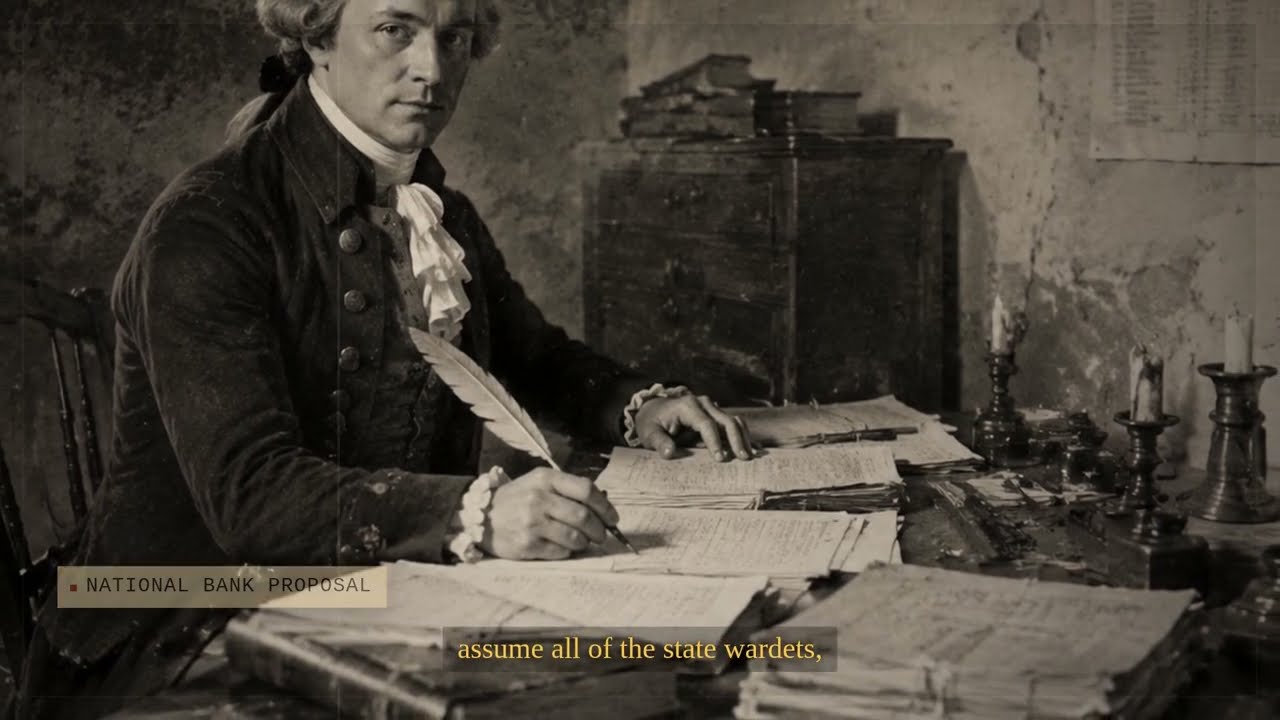
So Hamilton proposed the First Bank of the United States.
Thomas Jefferson hated the idea.
James Madison opposed it.
Their fear was not irrational.
A national bank could concentrate enormous economic power in the hands of financiers.
It could favor merchants over farmers.
Creditors over debtors.
The Northeast over the South and West.
And Jefferson argued that the Constitution did not expressly authorize Congress to create such an institution.
Hamilton answered with implied powers.
Necessary and proper.
Washington ultimately sided with Hamilton.
February 25, 1791.
The First Bank received its charter.
And for twenty years—
it helped bring order.
It held government deposits.
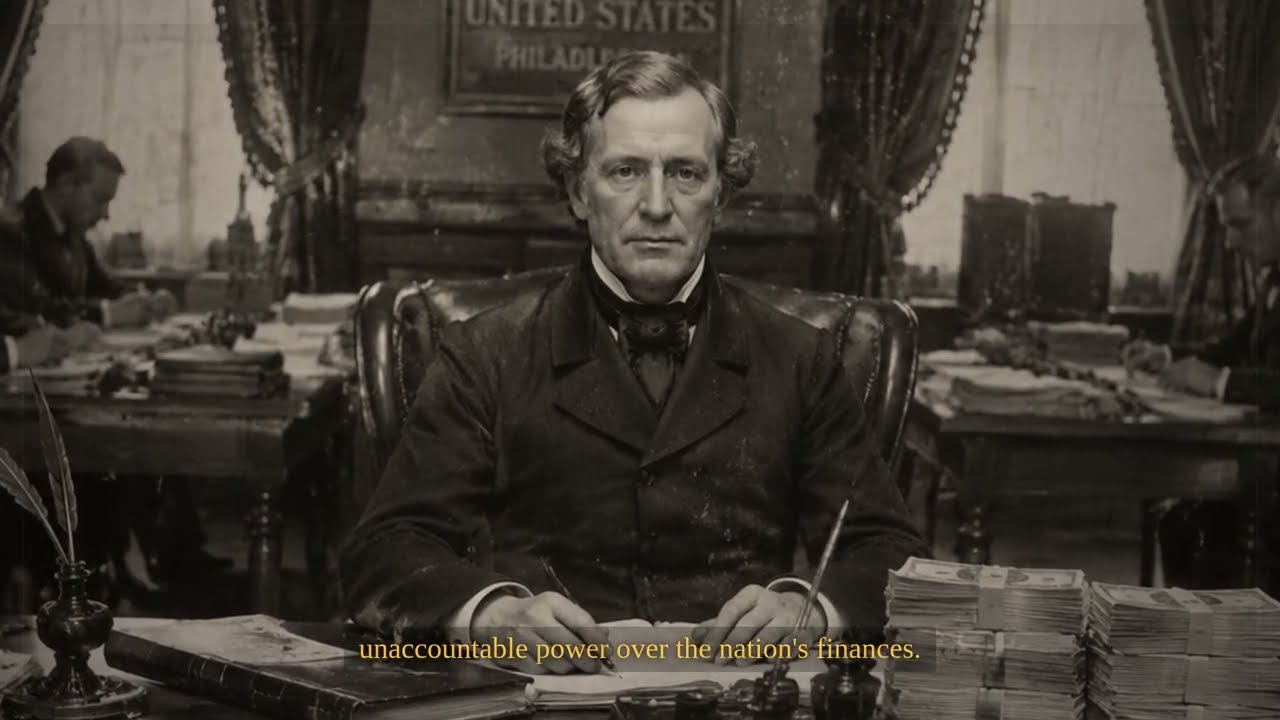
Facilitated payments.
Supported credit.
And pressured state banks to redeem their notes in specie when they issued too much paper.
In effect, it imposed discipline.
That made it useful.
It also made it hated.
State banks disliked the competition.
Agrarian politicians distrusted concentrated finance.
Foreign ownership of bank shares became politically explosive.
Then 1811 arrived.
The charter came up for renewal.
Hamilton was dead.
Jeffersonian Republicans dominated politics.
And the recharter failed by the narrowest margin.
The First Bank closed.
Now America would discover what happened when the national brake disappeared.
The number of state banks surged.
Each could issue its own notes.
Different banks.
Different currencies.
Different discounts.
Different levels of trust.
A note worth one dollar near the issuing bank might trade for less somewhere else.
Counterfeiting was widespread.
Merchants needed banknote reporters just to know what unfamiliar bills were actually worth.
Then the War of 1812 exposed the weakness brutally.
The federal government needed money.
Banks suspended specie payments.
Treasury borrowing became difficult and expensive.
The system fractured.
Only five years after killing the First Bank—
Congress decided it needed another one.
The Second Bank of the United States.
Larger.
More powerful.
And initially—
badly managed.
Its early leadership made reckless loans.
Speculation surged.
Then came the Panic of 1819.
Banks failed.
Farmers lost land.
Credit collapsed.
The public blamed the bank.
Again.
Then Nicholas Biddle took control.
And under Biddle, the institution became far more disciplined.
It regulated credit.
Pressured state banks.
Helped create a more uniform currency.
Managed federal finances.
By the late 1820s, the Second Bank was functioning in many ways like a central bank.
And this is where the story becomes almost perfectly symbolic.
The bank was working.
Then Andrew Jackson declared war on it anyway.
Jackson did not trust paper money.
He did not trust financiers.
And he especially did not trust a powerful institution that could expand or contract credit across the entire country while being controlled largely by unelected directors.
To Jackson, the Bank was not stability.
It was a threat.
A financial aristocracy.
A “monster.”
Nicholas Biddle, to Jackson, was exactly the kind of man republican government was supposed to prevent from becoming too powerful.
Then in 1832, the Bank’s supporters made a political gamble.
They pushed for early recharter.
They believed Jackson would not dare veto it during an election year.
He did.
And his veto message turned banking into a war between ordinary Americans—
and concentrated money power.
Jackson won reelection overwhelmingly.
Then he went further.
Federal deposits were removed from the Second Bank and redirected to state institutions.
Biddle retaliated.
He restricted credit.
The goal was simple:
Make the economy hurt.
Let businessmen and borrowers panic.
Force Congress and the public to realize they needed the Bank.
It was one of the most extraordinary moments in the history of American finance.
A private banker deliberately tightened credit to prove how indispensable his institution was.
But politically—
it was a disaster.
To Jackson, Biddle had just proved the accusation.
One unelected financier really did possess enough power to inflict pain on the national economy.
The charter expired in 1836.
The Second Bank died.
And America would now spend seventy-seven years without another permanent central bank.
What followed was not economic collapse.
That is important.
America expanded enormously.
Factories multiplied.
Railroads spread.
Cities grew.
Industrial production exploded.
But the financial system remained unstable.
The period associated with free banking produced hundreds of institutions issuing their own notes.
Some were sound.
Others were disasters.
The most notorious were the so-called wildcat banks.
Open in remote locations.
Issue notes.
Make redemption difficult.
Maintain inadequate reserves.
Sometimes fail.
Sometimes vanish.
Stories spread of banks moving the same specie from place to place ahead of inspectors.
Some of those stories were exaggerated.
Modern scholarship has shown free banking was not universally fraudulent or chaotic.
But the larger problem remained.
No one institution stood above the system.
When confidence vanished—
liquidity could vanish with it.
And nineteenth-century America experienced financial panics again and again.
The pattern became familiar.
Credit expands.
Speculation rises.
Something breaks.
Depositors panic.
Banks call loans.
Businesses fail.
Workers lose jobs.
Then eventually the economy recovers.
Until the next panic.
During the Civil War, Washington improved the structure dramatically.
Greenbacks gave the Union a national paper currency.
The National Banking Acts created federally chartered banks.
National banknotes became more uniform.
State-bank note issuance was effectively pushed aside through taxation.
This solved part of the currency problem.
But not the crisis problem.
There was still no central lender of last resort.
No institution whose job was to say:
The banks are solvent.
The panic is psychological.
Here is emergency liquidity.
Stop running.
Instead, private clearinghouses sometimes coordinated rescues.
Major banks issued clearinghouse loan certificates.
Treasury officials occasionally moved government funds.
Private financiers intervened.
The system improvised.
Until 1907.
And in 1907—
improvisation nearly failed.
The panic began with speculation.
A failed attempt to corner United Copper stock.
Connections to banks and trust companies.
Rumors.
Then withdrawals.
Depositors ran toward institutions associated with the speculators.
Fear spread faster than facts.
That is how a financial panic works.
You do not need your bank to be insolvent.
You only need to believe everyone else will withdraw before you.
If you think the bank is healthy—
you leave your money.
If you think twenty people ahead of you will empty it—
you run.
Enough healthy depositors doing the rational thing individually can destroy a healthy institution collectively.
Trust companies were particularly vulnerable.
They held fewer reserves than national banks and sat outside some of the support mechanisms of the New York Clearing House.
Then Knickerbocker Trust came under pressure.
One of the largest trust companies in New York.
Depositors lined up.
Money poured out.
October 22.
Knickerbocker suspended operations.
Now the panic became systemic.
And there was no Federal Reserve.
So J.P. Morgan came home.
His private library became the emergency room of American capitalism.
Bank presidents entered.
Numbers were examined.
Solvent?
Insolvent?
Rescue?
Let fail?
Morgan had to make decisions normally associated with a central monetary authority.
Except the authority came from wealth and reputation—
not law.
He organized rescue pools.
The U.S. Treasury injected government deposits into New York banks.
Other financiers contributed.
Then another crisis emerged.
A major brokerage faced collapse.
The New York Stock Exchange itself was in danger because brokers could not obtain the short-term loans needed to operate.
Money was gathered.
Another failure prevented.
Then trust companies needed support.
Morgan summoned their presidents.
They resisted.
He needed millions immediately.
And according to the famous account—
the doors were locked.
They were not leaving until they agreed.
Near dawn—
the commitment came.
The system survived.
But the victory was humiliating.
The United States had just learned that its financial stability depended on whether one private man possessed enough influence to force other private men to cooperate.
Morgan had saved the system.
Which made the problem obvious.
What happens after Morgan dies?
America needed a mechanism.
Not a hero.
Congress reacted.
National Monetary Commission.
Senator Nelson Aldrich became central to the effort.
He studied European banking systems.
And came back convinced America needed an elastic currency and some kind of reserve institution capable of responding to crisis.
But he also understood the political trap.
Call it a central bank—
and populists would attack.
Let Wall Street visibly design it—
and the plan would be dead before debate began.
So in November 1910—
a small group of men disappeared.
Hoboken.
Private railroad car.
Separate arrivals.
First names only.
Cover story:
Duck hunting.
Destination:
Jekyll Island, Georgia.
A private club used by some of the richest men in America.
Among the participants were Aldrich—
Frank Vanderlip of National City Bank—
Henry P. Davison of J.P. Morgan & Co.—
Paul Warburg—
A. Piatt Andrew—
and Arthur Shelton.
They worked for roughly ten days.
No reporters.
No public hearings.
No transparency.
And their goal was to design a banking structure capable of solving the weaknesses exposed in 1907.
Reserve pooling.
Elastic currency.
Discounting commercial paper.
Emergency liquidity.
Regional branches.
A central coordinating institution.
The resulting Aldrich Plan was not exactly the Federal Reserve that would later become law.
But it contained important structural ideas that would carry forward.
The secrecy is not a myth.
The participants themselves later acknowledged it.
Frank Vanderlip later wrote openly about how furtive the trip had been.
Why hide?
Because they knew what Americans would think.
For more than a century, the country had fought against concentrated financial power.
Now several of the most powerful banking figures in the country were privately helping design a new national reserve system.
Even if the plan were economically sensible—
the optics were catastrophic.
And the Aldrich Plan eventually stalled.
Then politics shifted.
Woodrow Wilson won the presidency.
Democrats took control.
Banking reform was still necessary.
But politically—
the final legislation had to look different from Aldrich’s Wall Street plan.
Wilson wanted more public control.
Carter Glass and H. Parker Willis became central to drafting the new legislation.
The system would be decentralized into regional Reserve Banks.
Washington would have a central governing board.
Private member banks would participate.
Government would exercise oversight.
Neither pure public central bank—
nor pure bankers’ institution.
A hybrid.
That hybrid structure is one of the reasons debates over what the Federal Reserve “really is” continue even now.
December 22, 1913.
The House passed the bill.
December 23.
The Senate passed it.
Wilson signed it that same day.
Federal Reserve Act.
The institution began operations the following year.
And after 137 years of argument—
America finally had a permanent central banking system.
But the argument did not end.
It simply moved inside the institution.
How much power should the central bank have?
Who should control it?
Should it rescue failing banks?
If institutions know they will be rescued—
do they take more risk?
Should elected officials influence monetary policy?
Should bankers?
Should regional interests have more power than Washington?
How much inflation is acceptable?
How much unemployment?
Every one of those questions contains an older argument.
Hamilton versus Jefferson.
Biddle versus Jackson.
Wall Street versus farmers.
Central authority versus local control.
Stability versus independence.
That is why the history before 1913 matters.
Because it destroys two simple myths at once.
Myth one:
America could not possibly function without a central bank.
It did.
For long periods.
And it became an industrial giant.
Myth two:
Therefore a central bank was unnecessary.
The repeated panics show why that conclusion is too easy.
The country grew—
but growth did not protect ordinary people from financial collapse.
Factories could be productive while banks failed.
Railroads could expand while depositors lost savings.
GDP could rise over decades while families were destroyed during recurring panics.
Economic dynamism and financial stability are not the same thing.
America had enormous amounts of the first—
and repeatedly struggled with the second.
The system survived partly because Americans invented substitutes.
Clearinghouse associations.
Mutual support between banks.
Private credit networks.
Emergency Treasury action.
And occasionally—
a J.P. Morgan.
Those bottom-up mechanisms were real.
Some worked remarkably well.
But they had limits.
And 1907 exposed the most dangerous one.
The emergency system depended on cooperation that no law guaranteed.
Morgan could force the bankers into his library.
Another man might not.
That is the moment the entire 137-year argument becomes visible in one room.
Imagine the scene.
Midnight.
Madison Avenue.
America is panicking outside.
Inside—
the most powerful financiers in the country are trapped in a private library.
Morgan sits there.
Silent.
Waiting.
No Federal Reserve chairman.
No emergency lending facility.
No public backstop.
Just private men deciding whether they will contribute enough money to keep the system alive.
Hours pass.
Finally—
they agree.
The crisis eases.
And America survives.
But the story should not make Morgan the hero.
Or the villain.
The more important fact is that the system required him at all.
Because when one private citizen becomes indispensable to the survival of national finance—
the country no longer has a financial system.
It has a dependency.
That is what 1907 exposed.
Jekyll Island was the response.
The Federal Reserve was the compromise.
And more than a century later—
the original question remains unresolved.
Not:
Should anyone manage the money?
Someone always will.
A bank.
A clearinghouse.
A market.
A Treasury.
A central bank.
A private financier.
The real question is the same one Americans have been fighting over since Hamilton and Jefferson:
Who gets that power—
and who pays when they get it wrong?