Prague, Czechoslovakia — The woman who stood beside one of the most feared architects of Nazi terror, sharing in the spoils of conquest while her husband ordered thousands to their deaths, remains one of the most unrepentant figures of the Second World War, and her name is Lina Heydrich.
Born Lina Mathilde von Osten on June 14, 1911, on the Baltic island of Fehmarn, she grew up in an impoverished aristocratic household shaped by German defeat in the First World War and a bitter resentment of the Weimar Republic. Her father, Jürgen von Osten, was a village school teacher; her mother, Mathilde, managed the home. From an early age, Lina absorbed the nationalist and anti-Semitic currents that swept through post-war Germany, and by her teenage years she had become a passionate anti-Semite.
 After graduating from school in Oldenburg in 1927, she began training as a trade teacher in the port city of Kiel in 1928. It was there, at a rowing club ball on December 6, 1930, that her life took a decisive turn. She met Reinhard Heydrich, a naval officer described as ambitious, intelligent, and socially confident.
Within less than two weeks, on December 18, 1930, they announced their engagement.
At the time, Heydrich had already promised marriage to another woman, the daughter of a senior naval officer. He broke that promise to be with Lina, triggering a 𝒔𝒄𝒂𝓃𝒹𝒶𝓁 that led a military court of honor in April 1931 to force his resignation from the German Navy for dishonoring the officer corps. The dismissal devastated Heydrich, who believed his career was ruined.
Lina saw something else entirely: opportunity.
She already supported the Nazi Party and urged Heydrich to join the party and its elite paramilitary formation, the SS. In June and July 1931, he did. Heinrich Himmler, head of the SS, was searching for capable men to build an internal intelligence service, and Heydrich was introduced to him in August 1931.
The recommendation rested on the mistaken assessment that Heydrich possessed intelligence experience from his naval service. Himmler was impressed and hired him.
On December 26, 1931, Heydrich married Lina. Together they had four children: Klaus, Heider, Silke, and Marte. Heydrich quickly proved his value to Himmler, creating and expanding the Sicherheitsdienst, the SD, the intelligence organ of the Nazi Party.
By January 1933, when Adolf Hitler became Chancellor, the SD was already a powerful tool of repression.
Lina followed her husband’s rise with pride. In letters to her parents, she described the arrests of political opponents and Jews with enthusiasm and portrayed violence by the SA and SS as justified revenge. After Hitler consolidated power in 1933, repression intensified, and Heydrich became a central figure in the Nazi movement.
In 1936, he was placed in charge of the Sipo, the Security Police, uniting the Gestapo, the secret state police, and the criminal police into one centralized structure, making him one of the most powerful men in Nazi Germany.
 Lina embraced the expensive lifestyle and social status that came with this power, a status her parents could never have imagined. While she enjoyed luxury, her husband participated in the crimes of the regime. One of them was the Kristallnacht pogrom of November 9 to 10, 1938, when orchestrated violence against Jews erupted across Germany and annexed Austria.
In this planned pogrom, known as the Night of Broken Glass, Heydrich played a crucial role, and Lina actively supported him and encouraged him to act even more brutally.
Both Reinhard and Lina had several affairs. His duties required long working hours and frequent absences from home. Lina would later recall, “I was married to Reinhard Heydrich for 10 years.
He was not home for seven of those years.”
The turning point came on September 1, 1939, when Nazi Germany invaded Poland and the Second World War began. Occupied territories became laboratories of racial policy, and German security services expanded their reach and power. Reinhard Heydrich played a leading role in coordinating measures against Jews, resistance fighters, and political opponents across occupied Europe.
He organized and chaired the infamous Wannsee Conference in January 1942, where leading German officials coordinated the implementation of the so-called final solution of the Jewish question, meaning the systematic and physical murder of European Jews.
Before the Wannsee Conference, in September 1941, after Adolf Hitler dismissed Reich Protector Konstantin von Neurath, Reinhard Heydrich was appointed Deputy Reich Protector of Bohemia and Moravia. The position placed him at the top of the power hierarchy in the Protectorate. For Lina, it was a social triumph.
The family first resided in Prague Castle, the ancient seat of Czech kings, and then moved to the confiscated castle of Panenské Břežany near Prague. The estate had belonged to the Jewish industrialist Ferdinand Bloch-Bauer and had been seized after the German occupation. At Panenské Břežany, Lina felt she had reached her rightful status.
She later wrote that she was a princess living in a fairy tale land.
 The castle became a symbol of both privilege and repression. While she enjoyed receptions, gardens, and luxury, her husband ordered executions and mass arrests. Special courts sentenced hundreds to death in the first months of his rule.
Thousands were handed over to the Gestapo, and Heydrich earned the nickname the Butcher of Prague.
Heydrich believed his repression had pacified the country and destroyed the Czechoslovak resistance. He was wrong. On May 27, 1942, he was gravely wounded during an attack by two Czechoslovak soldiers sent from Great Britain, Jozef Gabčík and Jan Kubiš.
Heydrich died of infection on June 4, 1942, and his death triggered another round of brutal reprisals in the Protectorate.
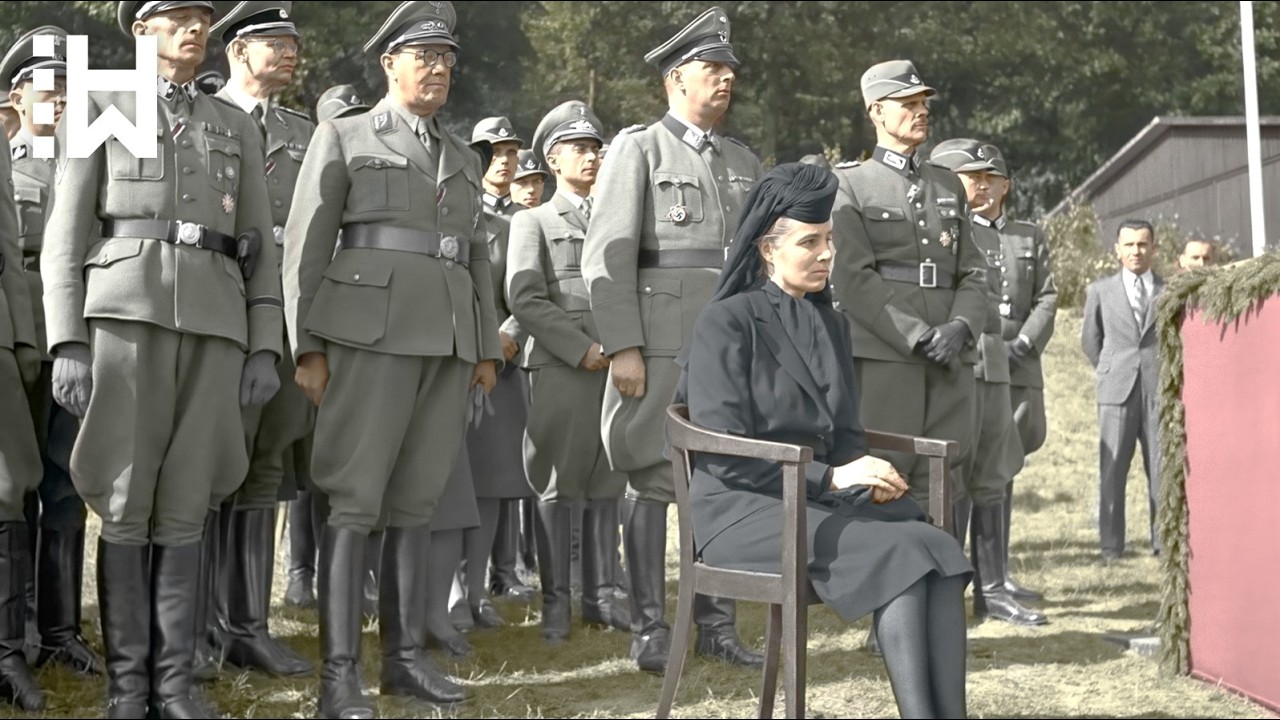
A great deal changed after the death of Lina’s husband. Lina, pregnant at the time, did not attend his funeral. In July 1942, she gave birth to their fourth child, Marte.
Adolf Hitler granted her ownership of Panenské Břežany and secured a generous lifetime pension. She became a wealthy widow of a man considered a hero within the Nazi regime, in reality a mass murderer.
She soon transformed the estate according to her wishes. A playground and swimming pool were built, and Lina decided to destroy the English park with its rare trees. She sold the wood and planted potatoes and other vegetables there, which she then sold to German troops in Prague.
In order to run her business, she needed workers. In the castle grounds, she set up a miniature labor and concentration camp where around 150 prisoners from the Terezín ghetto lived in former stables and worked for Lina Heydrich under miserable conditions. Witnesses later testified that Lina insulted, spat on, and physically abused Jewish forced laborers.
She reportedly observed them through binoculars and ordered punishments for those who worked too slowly.
 When this labor force was withdrawn in February 1944, she obtained 15 Jehovah’s Witnesses from the Flossenbürg concentration camp. Even payment for these prisoners to the administration of the concentration camp became a dispute, and eventually Himmler himself covered the costs from his own account.
The death of her husband was not the only loss Lina suffered during her stay in the Protectorate of Bohemia and Moravia. In an ironic twist of fate, Heydrich’s son, Klaus, died on October 24, 1943. This was exactly one year after the Germans murdered the supporters of the Anthropoid group, which had killed Heydrich, along with their families in the Mauthausen concentration camp in Austria.
The 10-year-old Klaus rode out onto the street, where he was struck by a truck coming down the road and was almost immediately dead. Jewish prisoners initially dug his grave, but Lina decided that her Aryan child should not be buried in a grave prepared by Jews. German soldiers dug a new grave.
She even demanded that Karel Kašpar, the driver involved in the accident, be shot, but an investigation found him not guilty, so he was not executed.
In April 1945, as Soviet forces approached, Lina fled with her children. Before leaving, she shook hands with staff and promised pensions, convinced she would return to the castle. She never did.
She also had rabbits, geese, and chickens slaughtered and took jars of preserved meat with her.
After the war, a Czechoslovak court sentenced her in absentia to life imprisonment in 1948. In Germany, she hid for a few years, fearing extradition, but in the end, despite her crimes, she was never handed over to Czechoslovakia. Later, she repeatedly applied for a general’s pension, although her husband was considered a war criminal rather than a soldier.
Eventually, she received a widow’s pension.
In 1965, she married Finnish theater director Mauno Manninen, partly to change her surname. She operated her former summer house on the German island of Fehmarn as a restaurant and inn. Many visitors were former supporters of the Nazi regime who remembered the past with nostalgia.
When Lina Heydrich died on August 14, 1985, in Fehmarn, she was 74 years old. She showed no remorse for the victims of Nazism. In 1979, six years before her death, she said, “National Socialism was a faith and I can never renounce this faith.”
Her life stands as a stark reminder that the machinery of terror was sustained not only by those who carried out orders but by those who cheered them on, profited from them, and remained loyal to the very end.