We were all crammed into my parents’ dining room, pretending we were a perfect family while mom served her overcooked roast. My brother Graham, 38 and jobless for over a decade, was there. So were my parents, their eyes flickering with the kind of nervous excitement that made my stomach turn. The first red flag came before dessert: Graham was never early, but he’d shown up on time, showered, wearing a collared shirt.
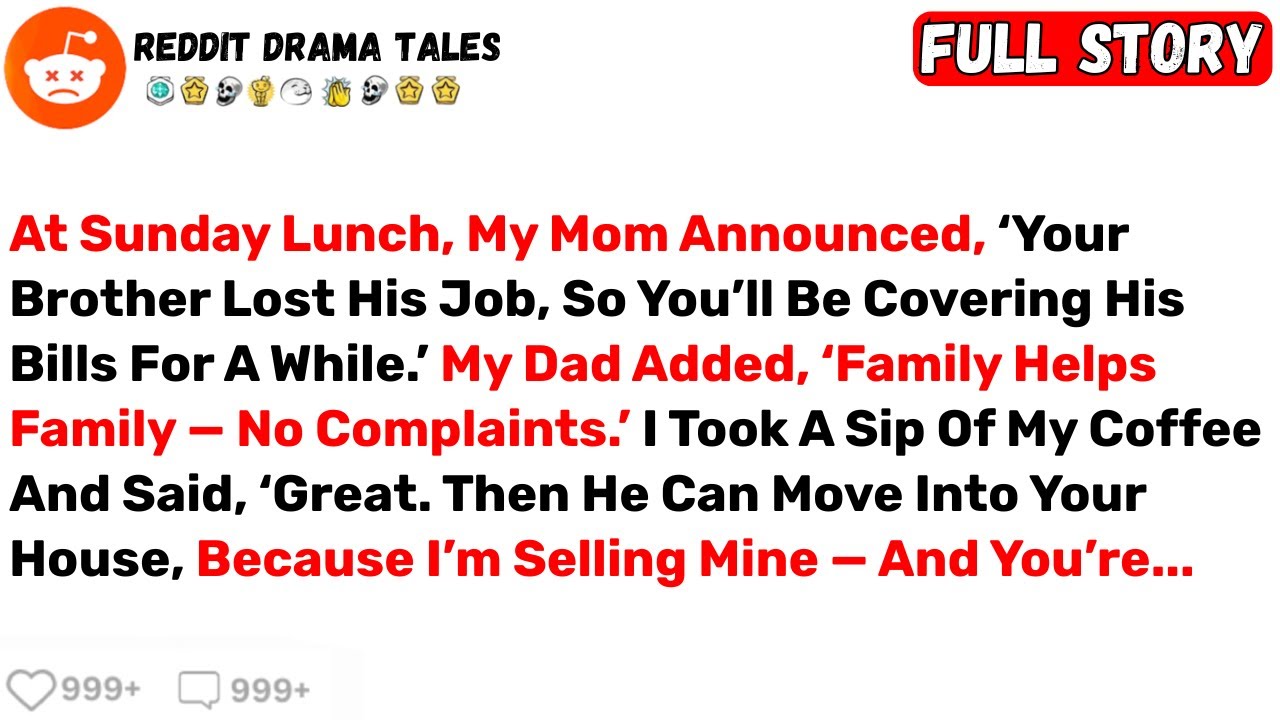
That meant something was coming. Mom forged ahead, clearly on script. “We’ve been thinking, and we want to help Graham get back on his feet. We thought it would make the most sense if you helped cover his bills for a while, just until he’s stable.
”
I set down my fork. “You’ve said that before. Every time you say ‘a while,’ it turns into a year, and I end up paying for his bad decisions while he plays Xbox in his underwear. ”
“Enough,” Dad said.
“Family supports each other. ”
“You mean like when you told me I had to take out loans for college because there wasn’t enough saved? While Graham got a new car? ”
The room went silent.
Mom’s cheeks flushed. Graham stared at his plate. I looked at my father, waiting for him to defend me, to finally take my side. Instead, he studied the grain of the table.
“We’re not asking for a loan,” Mom said. “Just some help. He’s your brother. ”
“He’s the only reason I haven’t cut all ties with you,” I said.
“But this isn’t happening. ”
I left early, heart pounding, and didn’t return their calls for three weeks. Graham sent a few half-hearted texts asking if I was still mad. I ignored them.
Then came a call from my mom, her voice tight. “You’re not going to like what I’m about to tell you. ”
“What now? ”
“Your parents technically still have a lean on the house.
You remember when you bought the place? They co-signed the mortgage. ”
I remembered. I’d paid every single payment myself—worked two jobs, skipped vacations, never missed a due date.
“And? ”
“Well,” she said, “they’re thinking it’s time they got their names off the title. But they want something for it. ”
“Something like what?
”
“$72,000. ”
I laughed, but it came out hollow. “For what? They never paid a cent.
”
“They co-signed. They took the risk. ”
“They’ve never touched a bill. They’ve never even walked through that house without criticizing the décor.
”
“That’s what they’re asking. ”
That call ended with me saying no, but the next one came from a lawyer’s office. A letter arrived, formal and threatening. Inside was a demand for $72,000 as compensation for shared equity, with a warning that if I didn’t pay, they’d take me to court and block the sale of my house.
I didn’t touch it after the first read. I sat with it for a long time, wondering if I was the crazy one, if maybe I was selfish, cold, ungrateful. But then I thought about the years of supporting them, about how my parents had always treated me like an ATM with a pulse. I thought about Graham and all the money he’d burned through.
No. I was done. I called my lawyer, a friend from law school named Joel. He listened, then said, “Here’s what we’re going to do.
”
Step one was the legal response. We filed a motion for declaratory judgment, stating that Graham had attempted to remove my parents from a note he had no authority over and that the claim was factually and legally baseless. But before we filed, we did our homework. We gathered every document imaginable: the original mortgage with my name as primary borrower and my folks as co-signers only, bank statements showing I funded the mortgage, property tax records, insurance payments, receipts for plumbing upgrades and a new HVAC system.
We even pulled the landscaping invoices. Step two was reputation. I didn’t blast anything online. Instead, I reached out to a few trusted contacts—people who knew our family history.
My mom, who had always loved to play the victim, had already started talking. She didn’t name names, but everyone in our town could connect the dots. So I let the paper trail speak for itself. I shared records showing I’d been the sole financial support for that house, and I made it clear I’d never asked my parents for a single dollar.
Step three was the hardest. I had to emotionally separate from them. Joel reminded me week after week, “You are not the villain in their story. ” But every time I looked at old family photos, I felt the distance growing.
Not hate—just absence. For the first time, I wanted to live somewhere I owned fully, with no strings attached. So I listed the house. That’s when things really exploded.
One night, my phone buzzed with hundreds of notifications. Graham had sent a mass Facebook post claiming he’d been betrayed by the one person he ever trusted. Within hours, people were commenting—some with sympathy, some with questions like, “Wasn’t your name on that fraud claim? ”
Then came the email.
A friend of mine, a paralegal, forwarded me a message that had been sent to the listing agent. It read, “We’d like our names removed from the title once Elliot’s cleared the 5-year payment threshold. This was always meant to be his house, but they never followed through. ” It was signed by both my parents.
I read it twice. Then I printed it out and added it to the file. A few days later, a process server handed me a summons. My parents had filed a motion for an injunction to block the sale.
They also claimed I’d forged their signatures on a refinance document. My lawyer, calm and professional, submitted a motion to dismiss, along with evidence that the signatures on the refinance were indeed forged—but not by me. The handwriting expert confirmed it: my dad’s signature was traced from a 2010 mortgage doc, and my mom’s was a clumsy imitation by someone who’d clearly never seen her write. That someone turned out to be Graham.
A clerk at my bank, who had processed a refinance application weeks earlier, recognized his face in the security footage. He’d come in wearing a hat and sunglasses, using my birth certificate and a copy of the deed. The judge ruled in my favor, dismissing the injunction. But my parents, not satisfied, pursued their original claim for $72,000.
We went to court. My dad was called to testify. He walked to the stand, but he’d been in such a rage that morning that he’d gotten into it with security at the metal detector, and the judge ordered him to remain outside until called. He never made it back in.
When his name was called, the bailiff returned alone and said, “He’s been removed from the building. ”
My mom testified next. She claimed they’d never received a deed transfer and that I’d promised them equity. But my lawyer pulled up the bank records, the mortgage statements, the tax bills.
Then he asked her one question: “Did you contribute financially in any way after the third year of the mortgage? ”
She stared at him, then at the judge, then at the ceiling. “Objection,” her own lawyer said, but it was over. The records didn’t lie.
The judge ruled in my favor on all counts. He ordered my parents to pay my legal fees. He also issued a cease-and-desist, forbidding them from contacting me for any reason other than through legal counsel. After the hearing, I walked out of the courthouse and felt something loosen in my chest.
The house sold the next week. I moved into a small apartment downtown, twenty minutes away, and felt peace for the first time in years. Then, two weeks later, a letter arrived at my new address. No stamp, no return address.
Inside was a single check, made out to me for $72,000. A sticky note was attached, the handwriting smudged but recognizable. “This isn’t a payment. It’s a peace offering.
We made a terrible mistake. We see that now. We miss you. ”
I stared at the check for a long time.
My first instinct was to frame it, like a trophy. Instead, I sat down at my desk. I thought about the years of manipulation, the pressure to be the responsible child while they fed my brother. I thought about the look on my dad’s face when the truth came out.
I folded the check neatly and dropped it into the trash. Then I picked up the phone and called my sister—the one who never once took sides—and told her I was coming for dinner that Sunday. She paused, then said, “Good. I’ll make the roast.
”
I laughed for the first time in weeks. Life would never be the same. But that was okay.
For the first time, I was the one holding the pen.