On the night of July 9, 1943, Allied forces landed in Sicily, opening a new front in Europe and bringing the war directly to Italian soil. Within weeks, the fascist regime began to collapse. Benito Mussolini, who had ruled Italy for more than 20 years, was removed from power by order of King Victor Emmanuel III and placed under arrest. While Mussolini was dragged away, his wife was nowhere to be seen.
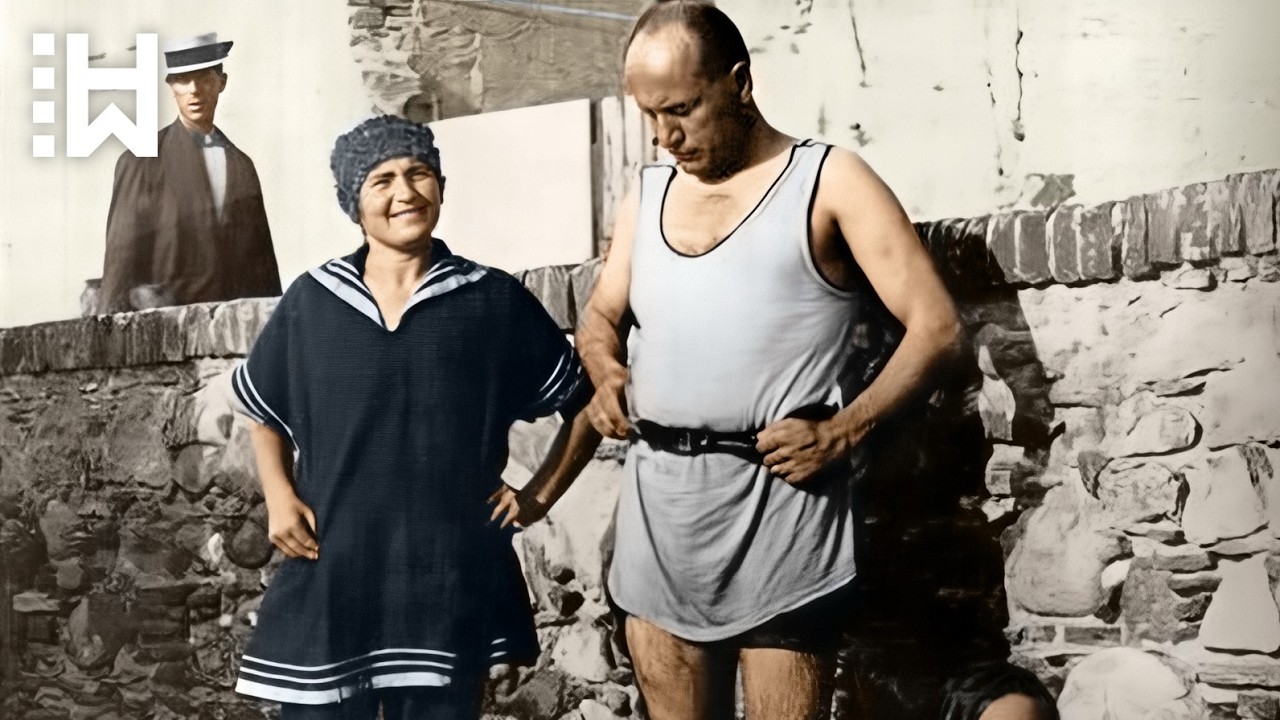
She did not share his imprisonment, his humiliation, or his fall. But her story is inseparable from his. For three decades, she stood by him through his rise to power, his countless infidelities, and his ultimate collapse. She endured his affairs in silence, kept their home running with the same peasant hands that once worked the fields, and never shed a tear for public display.
Behind the scenes, she was called the real dictator in Il Duce’s house. Her name was Rachele Mussolini. Rachele Mussolini was born as Rachele Guidi on April 11, 1890, in the town of Predappio, then part of the Kingdom of Italy. She was the youngest of seven children and grew up in a humble peasant family.
Rachele began to work as soon as she could walk, helping to feed the animals and clean the little stone hut where she lived with her parents and siblings. At the age of five, she carried water from the fountain balanced on her head. Her neighbors remembered Rachele as a hardworking, likable, wholesome girl with no qualities that would have led them to expect a future for her. In 1902, her life grew even harder when her father Agostino died, plunging the family into extreme poverty.
Rachele and her mother Anna moved to the city of Forlì, where Rachele went to work as a maid for several wealthy families. In 1905, following the death of Benito Mussolini’s mother, his father Alessandro began a relationship with Rachele’s mother Anna. Some believe Anna had been Alessandro Mussolini’s mistress even before her husband died. This has led some to suspect that Rachele may have been Benito Mussolini’s half-sister.
By this time, Mussolini had returned from Switzerland and moved to Forlì to live with his father. There, he met Rachele and began a relationship with her, but their parents disapproved. In 1909, Mussolini confronted his father and Rachele’s mother brandishing a revolver. He declared that if they did not consent to the marriage, he would kill Rachele and then himself.
In 1910, Rachele moved in with Benito Mussolini and gave birth to their first child, a daughter named Edda, in September of that year. The child was considered illegitimate because they had not yet married. Before Mussolini came to power, the couple had two more children together, Vittorio and Bruno. Mussolini eventually married Rachele in December 1915, although as it turned out, he had already been married to another woman, Ida Dalser, with whom he had a son.
The records of that earlier marriage were later destroyed by Mussolini’s own government. On October 30, 1922, Benito Mussolini came to power in Italy after the March on Rome, when fascist supporters forced the government to hand him authority. He soon established a dictatorship, suppressing political opposition, controlling the press, and promoting aggressive nationalism. His regime emphasized loyalty to the state, militarization of society, and expansionist ambitions aimed at restoring Italy’s power and influence in Europe and beyond.
After Mussolini seized power in Italy, he stayed in Rome, but Rachele lived in Milan with their children. The new dictator lived first in two modest rooms in the Palazzo Tittoni, while Rachele stayed behind as she wanted to keep the children’s lives stable and had no desire to be thrust into the political circles of the capital. In Milan, Rachele raised Edda, Vittorio, Bruno, and the younger children Romano and Anna Maria, managing the household with just one servant. She walked them to and from school every day and handled all the usual domestic chores herself.
Rachele did not join Mussolini in Rome until 1929, when the family finally moved into the grand Villa Torlonia. Even then, she refused to live in the grand mansion and instead settled in the modest entrance lodge at the villa’s gates. People referred to her as Donna Rachele Mussolini, a title of honor, but she remained a simple woman at heart. In Rome, Donna Rachele’s daily life was remarkably ordinary.
She fed the chickens in the early morning, slipped a basket over her arm, and walked through the back streets to the markets, where stall holders knew her as an experienced bargainer. She never attended the official banquets held in hotels or restaurants. Rachele spoke no foreign language and still spoke to her husband in the thick rural dialect of their youth. She felt that a woman’s place was by the fireside and in the kitchen, and her joys were simple and elementary, centering on her husband and family.
Yet her husband lived by very different rules. Benito Mussolini had a well-documented weakness for women. A notorious womanizer, he regularly abandoned his marital bed and pursued countless affairs, including one period where he claimed to have had 14 lovers at once, taking three or four women every evening. His long-time driver, Ercole Boratto, kept a diary that revealed the dictator’s relentless womanizing in vivid detail.
Mussolini would often order Boratto to stop the car in the middle of a drive simply to chase after a beautiful woman he had spotted. He would regularly retreat to his beach resort, Castel Porziano, in order to properly concentrate on his extramarital affairs. Rachele seemed to deal with her husband’s nature as best she could. Once, she said, “My husband had a fascination for women.
They all wanted him. Sometimes he showed me their letters, from women who wanted to sleep with him or have a baby with him. It always made me laugh. ”
But Boratto’s diary suggests a different reality.
One night, Mussolini came home to find Rachele waiting for him. She made a jealous scene, hysterically shouting at him about his cheating and his many mistresses. His most famous mistress was Clara Petacci, a young woman half his age who remained devoted to him until the very end. But Mussolini was not the only one who was unfaithful.
In 1923, while he was in Rome building his dictatorship, Rachele took a lover of her own. The man was the cousin of a station master near Forlì, where the family had a country home. Their affair lasted for several years. In 1995, shortly before her death, their daughter Edda revealed the secret in a recorded interview.
Edda said that by the age of 15, she already knew about her father’s countless affairs, but discovering her mother’s infidelity made her furious. In her mind, her father could do whatever he wanted, but her mother had no such permission. Edda eventually confronted her mother, who admitted to the affair. Rachele then told Benito Mussolini about her lover, reportedly saying that she had found someone who truly cared for her.
Mussolini was said to be astonished but did not forbid the relationship. Edda could not bear the situation and threatened to ask to be sent to boarding school. Only then did Rachele end the affair. Inside their home, Rachele had a terrible temper, and Mussolini always indulged his wife as if he feared her.
He lost his temper with her only once. On one occasion, Rachele gathered together all the recognition trinkets her husband had received over the years: plaques, cups, medals, gold and silver objects. With the practicality of a peasant woman, she saw them as nothing more than useless decorations taking up space. So, she had them melted down to get the money for something she considered far more useful: an economical stove.
When Mussolini found out, he exploded and shouted at her, “You have stolen from the state. That gold and silver were not given to me. They were given to the head of government. ”
Because of Rachele’s temperament, Edda called her mother the real dictator of the house.
One of the reasons for this nickname was her unforgiving stance during the Verona trial. In 1943, Edda’s husband, Galeazzo Ciano, had served as Mussolini’s foreign minister. But when the fascist Grand Council voted to strip Mussolini of power, Ciano cast his vote against his father-in-law. After the Germans rescued Mussolini, Adolf Hitler demanded revenge.
Ciano was arrested, put on trial for treason in the northern Italian city of Verona, and sentenced to death. Rachele showed no mercy and opposed any act of clemency toward her son-in-law, even as her daughter, Edda, begged for his life. She was not at all intimidated by the circumstances. In the final months of 1943, she went every evening for two-hour meetings with Guido Buffarini-Guidi, the minister of the interior of the German-backed puppet state in northern Italy, known as the Italian Social Republic.
Rachele asked him for greater severity in order to restore internal order. Her son-in-law was executed by firing squad on January 11, 1944. After this, Edda never spoke to her father again. On April 28, 1945, Italian partisans captured and executed Benito Mussolini and his mistress, Clara Petacci.
Just over one week later, on May 8, 1945, the Second World War in Europe ended. After the end of the war, Rachele was sent into exile to the small island of Ischia off the coast of Naples, where she remained until 1958. She then returned and spent the rest of her life in her hometown of Predappio, located in the district where she and Mussolini were born and where they first met. She ran a small farm there and also opened a restaurant, which became popular with tourists, curiosity seekers, and neo-fascists.
Despite the ruin spawned by Mussolini’s public career and the infidelities that marked his private life, Rachele honored his memory to the end of her days. She insisted that his body be returned to her by the Italian government, and in the end it was. She saw that it received a Christian burial in the cemetery in Predappio. She insisted that part of his brain that had been taken to the United States be returned, and it was.
She fought for the return of his personal belongings, all of which had been confiscated after the war, and many of them were given back. It is said that the only one of her husband’s belongings that she refused to accept was a large walnut bed. When the government offered it to her together with other furniture, she turned it down and reportedly said, “Clara Petacci used it. ”
Rachele Mussolini was 89 years old when she died on October 30, 1979, in Forlì, in Italy.
In the end, the long-standing rumors about Rachele Mussolini’s origins were never proven. There is no conclusive evidence that she was her husband’s half-sister, only suspicion born of circumstance. What is clear, however, is her character: tough and pragmatic. She accepted her husband’s countless infidelities, yet could show fierce jealousy and bitterness, particularly toward Clara Petacci, the woman who shared Mussolini’s final moments.
After the war, a reporter asked Rachele about Petacci. Her eyes flashed and she replied, “They did well to shoot her. “


