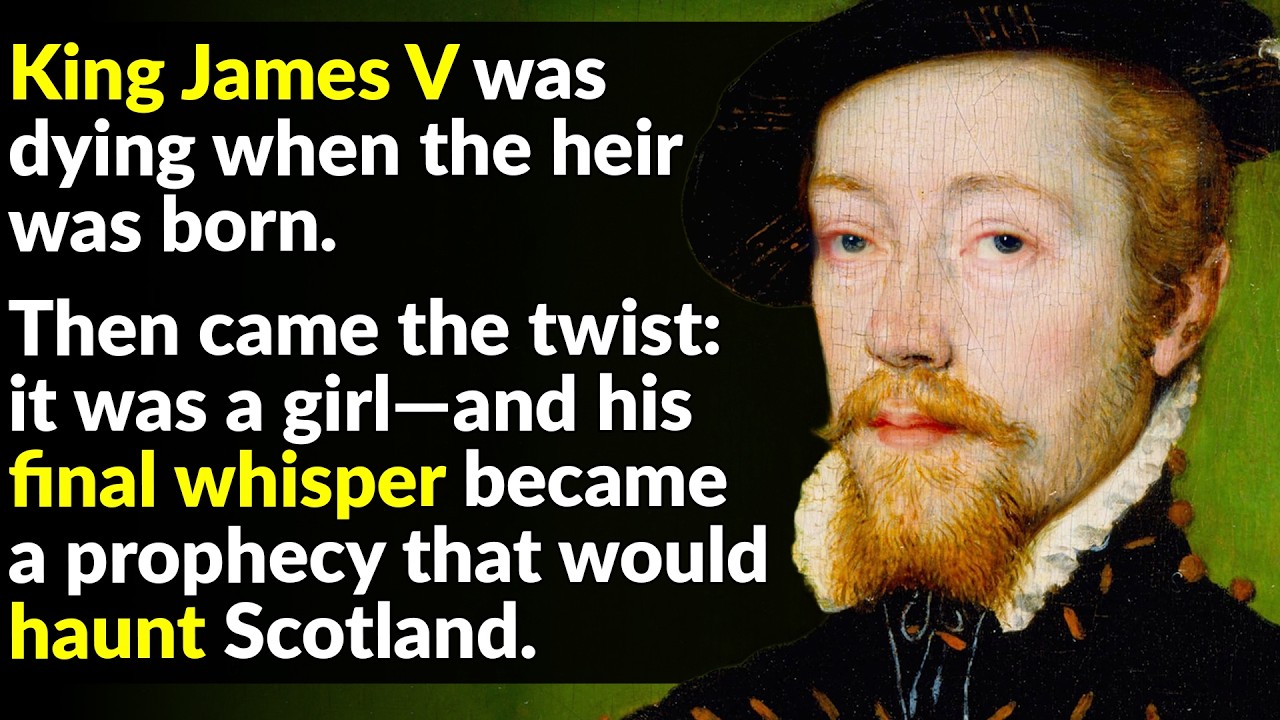
King James V of Scotland received the final news of his life while lying on his deathbed in December 1542: his wife had given birth to an heir. When he learned the child was a girl, he reportedly uttered a grim prophecy, saying, “It came with a lass, and it will gang with a lass,” a reference to the belief that the Stewart dynasty, which began with Marjorie Bruce, daughter of Robert the Bruce, would end with his newborn daughter. Born in April 1512 at Linlithgow Palace, James was the only surviving legitimate child of King James IV of Scotland and Margaret Tudor, sister of England’s King Henry VIII. His life changed dramatically when he was just 17 months old.
His father was killed at the Battle of Flodden in September 1513, making the infant James king of Scotland. His mother, Margaret Tudor, became regent, but only on the condition that she not remarry. Less than a year after her husband’s death, in August 1514, Margaret broke that promise. She married Archibald Douglas, 6th Earl of Angus, a man whose own uncle described him as a “young witless fool.
” The marriage scandalized the court, and the nobility used Margaret’s remarriage to strip her of the regency, replacing her with John, Duke of Albany. For years, James lived under the Duke of Albany’s control, watched closely by the regent and his men. That changed in 1524, when Margaret successfully removed Albany and raised her 12-year-old son to full royal powers, positioning herself as his chief counselor. The peace did not last.
James’ stepfather, the Earl of Angus, arrived at Edinburgh Castle with armed men, and Margaret famously fired cannons at her estranged husband. The family feud escalated into a political crisis that divided Scotland. To calm the infighting, the government devised a shared custody arrangement for the young king. Each faction would hold him for part of the year.
But Angus proved untrustworthy. When he gained custody of James, he refused to give the boy up, making the king a prisoner once more. Angus attempted to keep the teenage king distracted. He showered James with gifts, but the young monarch grew restless and increasingly aware of his situation.
In another effort to control him, Angus introduced James to paid women, and the teenager eagerly embraced the distraction. Over the following years, James developed a reputation for his mistresses and illegitimate children, a pattern that would mark both his personal and political life. In May 1528, James finally escaped. He slipped away from Angus and rode to Stirling Castle to join his mother.
One of his first acts as the true king was to ban Angus and his family from coming within seven miles of his person. He then purged his court of Angus’ followers, charged his stepfather with treason, and ultimately drove him out of Scotland. James’ hatred for the Earl of Angus lasted for decades and extended to Angus’ sister, Lady Janet Douglas. In 1528, he had her charged with abetting her brother in holding him captive.
Though that charge was dropped, James did not forget. In 1537, after new allegations of conspiracy surfaced against her, Lady Douglas was burned at the stake for treason. The years of captivity left a lasting mark on James. He was reportedly intelligent but highly anxious, swinging between deep depression and bursts of energy.
In foreign policy, Scotland was bound by the Treaty of Rouen, signed in 1517, to marry James to a daughter of the French king. There were complications. King Francis I’s youngest daughter, Margaret, was too young, and his eldest, Madeleine of Valois, was in poor health. Francis feared Scotland’s harsh climate would kill her.
James and his advisers pursued other options, including Catherine de’ Medici and his own cousin, Mary Tudor, daughter of Henry VIII. In March 1536, a contract was drawn up for James to marry Mary of Bourbon, daughter of a French duke. But James was unimpressed. In September 1536, he traveled to France in disguise to meet Mary before she knew he was a king, and he came away dissatisfied.
He then traveled south to meet Madeleine of Valois. Despite her frail health, James found her exactly what he wanted in a bride. Madeleine, for her part, fell for him as well. The couple begged King Francis to allow the marriage.
Francis reluctantly agreed. They married in January 1537 in Paris and celebrated across several French cities. The joy did not last. Madeleine fell ill even before leaving France.
In May 1537, she braved the journey to Scotland, and by July, she had died of tuberculosis before turning 17. Widowed, James audaciously asked Francis for permission to marry his youngest daughter, Margaret. This time, Francis refused. Instead, Francis offered Mary of Guise, a recent widow of a French duke.
James accepted the deal, and Mary had qualities that appealed to him. One of his men described her as “stark, well-complexioned, and fit to travel. ”
There was, however, competition for Mary’s hand. Henry VIII, James’ maternal uncle, had just lost his third wife, Jane Seymour.
Henry stepped in and asked for Mary of Guise himself, more to frustrate his nephew than out of genuine interest. Mary, wary of marrying a king known for executing wives, turned Henry down. Francis then pressed her to accept James. Though Mary was reluctant to leave France and her young son from her first marriage, a carefully worded letter from James helped convince her.
She married James in person in June 1538. Within a few years, Mary gave James two sons: James, Duke of Rothesay, born in May 1540, and Robert, Duke of Albany, born in April 1541. But Robert died within hours of his birth, and his older brother died the very next day. The double loss plunged the royal couple into grief.
That same year, James’ strained relationship with Henry VIII showed a brief glimmer of hope. The two monarchs had discussed a diplomatic meeting since 1536. In 1541, Henry traveled to northern England and waited for ten days for James to join him. James never showed.
Henry was outraged by the snub, interpreting it as a firm declaration of James’ alliance with Catholic France and rejection of the English Reformation. Shortly after the failed meeting, James’ mother, Margaret Tudor, died at age 51, likely from complications of a stroke. In her final wishes, she asked James to reconcile with the Earl of Angus and to give her possessions to her daughter, Margaret Douglas, who was Angus’ child. James ignored his mother’s requests, unable to forgive his former captor.
With Margaret’s death, Scotland lost its last true diplomatic tie to England. Open conflict soon broke out between the two kingdoms. In August 1542, Scottish forces won a decisive victory at the Battle of Haddon Rig. Believing an heir was on the way, since Mary of Guise was pregnant again, James grew increasingly aggressive.
The Scots delayed peace talks with Henry until Mary delivered the child, which further enraged the English king. That autumn, Henry ordered his army to march toward Scotland. On November 24, 1542, the two sides clashed at the Battle of Solway Moss. Though the Scots had numerical superiority, their command structure collapsed.
As English forces captured Scottish artillery and the royal standard, the Scottish soldiers fled. It was a humiliating rout. Days later, on December 6, 1542, James traveled to Falkland Palace to regroup. He had been complaining of illness for weeks in letters to his pregnant wife, and he soon took ill again.
Within days, he was on his deathbed. It was there that he received word of his child’s birth. Mary of Guise had given birth to a daughter, the future Mary, Queen of Scots. Upon hearing the news, James reportedly made his famous remark about the dynasty beginning and ending with a girl.
Though his claim proved inaccurate for the Stewart line as a whole, it did come full circle for him personally. James V died on December 14, 1542. History repeated itself: just as he had become king at 17 months old when his father died, his newborn daughter Mary became Queen of Scotland at just six days old, the youngest monarch ever in Great Britain. In his three decades of life, James V moved from boy king to captive ruler to vindictive monarch.
His personal and political lives were perpetually entangled, marked by illegitimate children, lost heirs, family feuds, and international conflict.