Wyatt Earp claimed he killed the outlaw known as Curly Bill Brocius at Iron Springs on March 24, 1882, a moment that has been debated by historians ever since. Brocius, a gunslinger and cattle rustler active in Arizona Territory during the late 1870s and early 1880s, was a prominent figure in the Cowboys gang, a loosely organized band of outlaws operating in Cochise County. Details about Brocius’s identity remain uncertain, and his name may have been an alias. Some historians believe he may have been the same person as William “Curly Bill” Breham, a man convicted in Texas in 1878 for attempted robbery and assault.
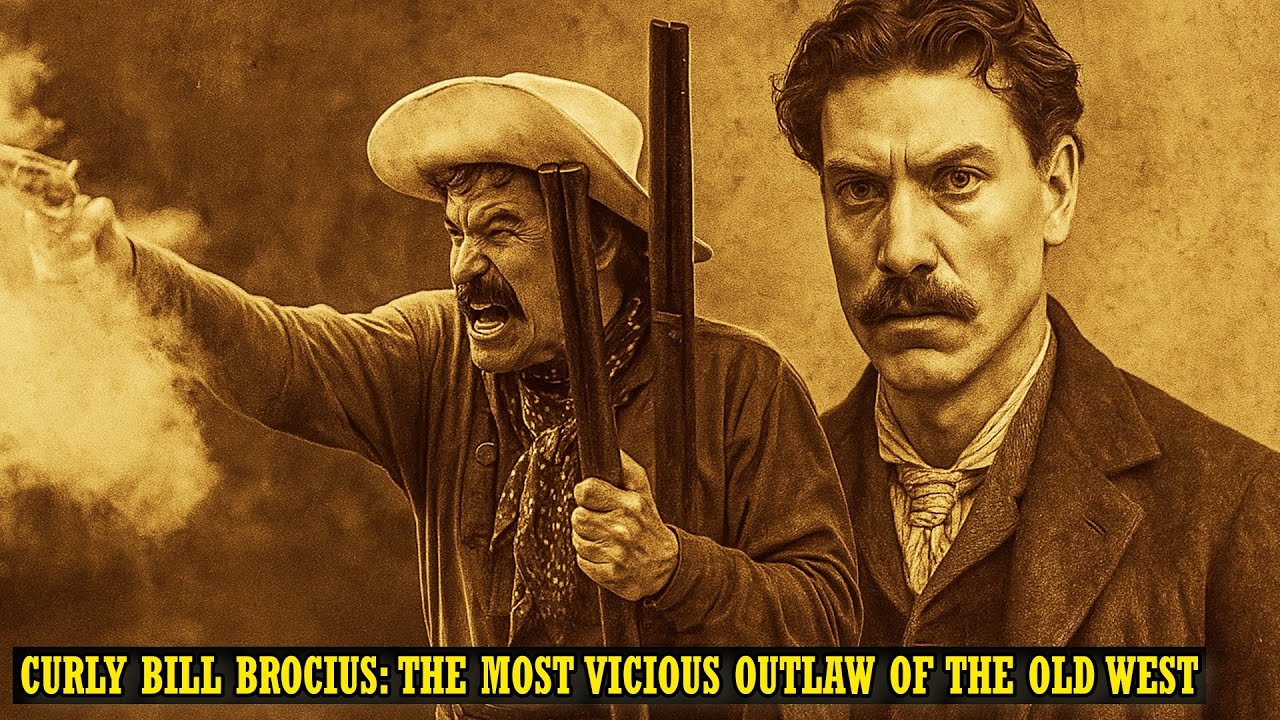
That conviction, followed by an escape from custody, fits the timeline of Brocius’s arrival in Arizona Territory around the same period. Brocius landed in Arizona Territory around 1878, reportedly after briefly visiting the San Carlos Indian Reservation. He became tied to the Cowboys, a group of rustlers active in southeastern Arizona. Despite his criminal ties, he held an official position for a time as a tax collector under Cochise County Sheriff Johnny Behan, gathering fees from other rustlers for their stolen livestock in exchange for protection.
Witnesses described a volatile and often cruel man. Fred Dodge, a Wells Fargo agent, wrote in his memoirs that Brocius once interrupted a church service by pressuring the preacher into performing exaggerated movements. In another incident, he reportedly humiliated guests at a Mexican community dance. These stories also appeared in contemporary newspapers, suggesting his behavior was widely known and criticized.
One of the most documented events involving Brocius occurred on the night of October 28, 1880, when several of his associates were firing guns into the air in a vacant lot in Tombstone. Town Marshal Fred White approached the group to restore order. White tried to disarm Brocius by taking hold of his pistol by the barrel, when the weapon unexpectedly discharged, striking White in the lower abdomen. Wyatt Earp, who had borrowed a pistol from Fred Dodge, subdued Brocius and took him into custody.
Earp testified that White had identified himself as an officer and reached for the gun as Brocius began to draw it. White later gave a statement clearing Brocius of deliberate wrongdoing, but he died two days after the shooting. Brocius waived his right to a preliminary hearing, reportedly out of fear for his safety, and was transported to Tucson by Deputy Sheriff Wyatt Earp and Officer George Collins. During legal proceedings, White’s testimony and a demonstration showing the pistol could discharge from the half-cock position helped secure the outcome.
The court ruled White’s death accidental, and Brocius was formally acquitted. Years later, Earp told biographer John H. Flood Jr. that he had not initially seen Brocius’s weapon fall to the ground and believed the outlaw might still be armed.
Brocius, despite his violent reputation, reportedly held Marshal White in high regard and consistently claimed the shooting was a tragic mistake. Brocius was also remembered as one of the most skilled marksmen among the Cowboys. Former lawman Billy Breakenridge wrote that Brocius could hit fast-moving jackrabbits, extinguish candle flames without damaging the holders, and shoot coins held between volunteers’ fingers. The same memoir also noted his unpredictable behavior when drunk.
On March 8, 1881, Brocius and fellow cowboy Johnny Ringo were at a settlement near Camp Thomas, Arizona, when another member of the Cowboys, Dick Lloyd, rode his horse into a saloon after injuring a man during a poker game. Lloyd was fatally shot by multiple people frustrated with the disruption. The saloon’s proprietor, Mr. O’Neal, took legal responsibility but was later acquitted.
On May 25, 1881, in Galleyville, Brocius was socializing with cowboys including Jim Wallace, a veteran of the Lincoln County War. Wallace insulted Deputy Marshal Billy Breakenridge, and Brocius insisted he offer a direct apology. After Wallace complied, Brocius continued to confront him, making threatening remarks. Wallace left the saloon, but when Brocius followed, Wallace shot him in self-defense, wounding him in the cheek and neck.
The court later determined Wallace had acted in self-defense. In July 1881, outlaws Bill Leonard and Harry Head were killed while attempting to rob a store in Hatcha, New Mexico. Some modern researchers have suggested Brocius and Johnny Ringo traveled there to retaliate, killing store owners William and Isaac Hasslet. However, there were no eyewitnesses and no direct evidence connecting Brocius to the event.
Brocius was also rumored to have participated in the ambush of a Mexican cattle drive during the so-called Skeleton Canyon massacre in July 1881. Reports claimed six Mexican vaqueros were killed and others taken captive. The cattle were allegedly sold to Newman Haynes Clanton, who was himself ambushed shortly after in the Guadalupe Canyon incident, believed to be retaliation by Mexicans. No official documentation ever confirmed Brocius’s role in the raid.
Historians have expressed doubt about both claims because Brocius was still recovering from the gunshot wound he received in the altercation with Wallace. A diary entry by George Parsons, dated October 6, 1881, noted seeing Brocius at the McClure Ranch in Sulphur Springs Valley, where he was able to ride but had not fully recovered. Tensions between the Earps and the Cowboys escalated after the gunfight at the O. K.
Corral on October 26, 1881. In January 1882, Brocius was believed to have been involved in two stagecoach robberies, one between Tombstone and Bisbee and another between Tombstone and Benson. Deputy U. S.
Marshal Wyatt Earp organized a posse to pursue those responsible but failed to locate them. Brocius returned to Tombstone on March 17, 1882. Not long after, he was implicated in the killing of Morgan Earp based on the account of Marietta Dwarte, the wife of Pete Spence. She identified Brocius as a participant, but Judge Wells Spicer dismissed her testimony as hearsay because she could not legally testify against her husband.
With insufficient evidence, charges were dropped. On March 20, 1882, Wyatt Earp, while escorting his injured brother Virgil to California, encountered and shot cowboy associate Frank Stilwell in Tucson, marking the beginning of the Earp Vendetta Ride. On March 24, 1882, Wyatt Earp and his posse were en route to Iron Springs, later renamed Mescal Springs, in the Whetstone Mountains. They were planning to meet a man named Charlie Smith who was bringing funds from Tombstone to cover the posse’s expenses.
As the group approached a dry wash near the springs, they unexpectedly encountered a group of cowboys. Among those gathered at the campsite were Curly Bill Brocius, Pony Diehl, Johnny Barnes, Frank Patterson, Milt and Bill Hicks, Bill Johnson, Ed Lyle, and Johnny Lyle. The men appeared to be preparing a meal beside the water source. According to Wyatt Earp’s account and an anonymous letter sent to the Tombstone Epitaph, the posse came within roughly 30 feet of the camp before either side realized the other was present.
Earp, riding at the front, dismounted just as shots rang out from the cowboys’ position. He initially thought he had been struck, but only his saddle horn had been hit. The confrontation was especially personal: 18 months earlier, Earp had defended Brocius from a potential lynching after the accidental shooting of Marshal Fred White and had testified in court to help ensure he was not convicted of murder. During the skirmish, Brocius reportedly fired a shotgun in Earp’s direction from about 50 feet but did not strike him.
Earp responded by firing a 10-gauge shotgun loaned to him by Fred Dodge, fatally wounding Brocius, who collapsed near the water’s edge at the spring. The return fire from the lawmen was so overwhelming that several cowboys chose to withdraw. Earp was nearly struck multiple times: his long coat was pierced on both sides, a bullet struck the heel of his boot, and another hit his saddle horn. He returned fire, striking Johnny Barnes in the chest and Milt Hicks in the arm.
Posse member Sherman McMaster was slightly injured when a bullet grazed the strap of his field glasses. According to John H. Flood, Earp’s biographer, the cowboys later interred Brocius’s body on Frank Patterson’s ranch along the Babocomari River. Despite these reports, no confirmed burial site has ever been found.
Fred Dodge, the Wells Fargo undercover agent, took a personal interest in confirming Brocius’s fate. He questioned J. B. Ayers, a saloon keeper in Charleston, a known gathering place for outlaws.
Ayers told him that men present at the Iron Springs encounter confirmed Earp had ended Brocius’s life and that the body was taken away that night and buried on Patterson’s ranch. Two local newspapers challenged the claims. The Tombstone Nugget offered a $1,000 reward for proof of Brocius’s death, and the Tombstone Epitaph raised the stakes with a $2,000 reward. No one ever came forward to claim the money, and no definitive proof was presented.
At the time, Brocius was not facing any active charges in Arizona, which led some to question why he would disappear if he had survived. However, Earp later recalled that Brocius may still have been wanted in Texas on earlier charges. The absence of any confirmed sightings after Iron Springs has led most historians to accept that Brocius likely died that day, though his burial site remains unverified. Brocius has sometimes been mistaken for another outlaw of the same era, Curly Bill Graham.
Historical records clarify that Graham was a different individual, killed in an encounter with Deputy Sheriff James D. Houck on October 17, 1887, and buried in Young, Arizona. Much about Brocius’s early life remains uncertain. His exact birth date, original name, and place of birth have never been verified.
Historian Dennis McLelland, writing in the Encyclopedia of the Old West, suggested Brocius may have been originally named William B. Graham and born in Missouri, working for cattle outfits in Texas and Kansas. Another theory links Brocius to a past life in Texas. According to a report in the Tombstone Epitaph, while being escorted to Tucson in 1880, Brocius asked Earp to recommend a lawyer.
Earp suggested the firm of Hereford and Zabriskie. Brocius objected, saying Zabriskie had once prosecuted him in Texas. Earp investigated and found Brocius may have been involved in a robbery in El Paso during which someone lost their life. He was reportedly convicted and sentenced to prison but escaped custody not long after.
Modern researchers have proposed that Brocius may have actually been William “Curly Bill” Breham, convicted in Texas in 1878 along with Robert Martin, another well-known Tombstone cowboy. Both received five-year prison terms but escaped, believed to have headed west to Arizona Territory. Historian Robert M. Utley noted that Martin had previously been part of the Jesse Evans gang in New Mexico during the 1870s, raising the possibility that Brocius was also affiliated with that group.
Even his final resting place remains one of the lingering mysteries of the Old West. Wyatt Earp claimed he killed Brocius at Iron Springs, eyewitness accounts from the opposing side confirmed the death, and the outlaw was never seen again. Yet no grave has ever been found, and the reward money offered by skeptical newspapers was never claimed.