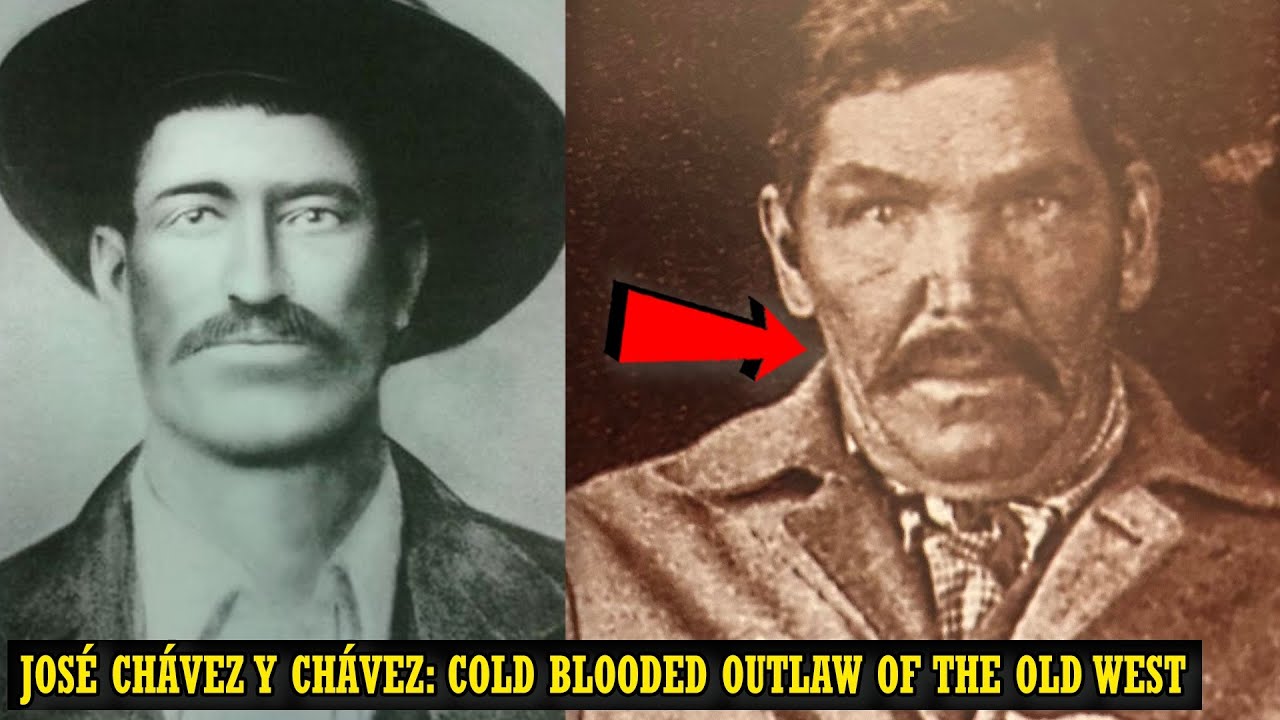
Jose Chavez y Chavez rode alongside Billy the Kid, claimed involvement in the killing of a sheriff, and later became entangled in a secretive crime network that ended in treachery. Born in 1851 in the small settlement of Cebolla in the New Mexico Territory, he came from a mixed heritage, the son of a Spanish-descended father and an Apache mother. That background placed him between two worlds during a period of deep cultural upheaval following the region’s transition from Mexican to American governance after the Treaty of Guadalupe Hidalgo. Chavez grew up in poverty and worked as a laborer before drifting into small-scale theft and cattle rustling.
In the American frontier economy of the era, such activities were often seen less as outright criminality and more as survival strategies for marginalized Hispanic and indigenous communities. His path into lawlessness reflected broader social and economic struggles rather than simple criminal intent. In his twenties, Chavez joined the Tunstall-McSween faction during the Lincoln County War, a violent economic and political feud that erupted in Lincoln County, New Mexico, between 1878 and 1879. He became one of the roughly 45 men known as the Lincoln County Regulators, riding alongside figures who would become legends of the Old West, including Billy the Kid, Doc Scurlock, and Charlie Bowdre.
He developed close friendships with Billy the Kid and fellow Regulator Jim French during this volatile period. The conflict escalated sharply following the murder of English rancher John Tunstall on February 18, 1878. The Regulators responded by confronting their rivals, and Chavez later claimed to have been personally involved in the killing of Sheriff William J. Brady, a supporter of the opposing Dolan faction.
The war reached its bloody climax on July 19, 1878, during the Five-Day Battle, when Alexander McSween’s home was besieged and burned. Six people perished in the flames, but Chavez and all of Billy the Kid’s associates escaped. By March 1879, territorial Governor Lew Wallace authorized the creation of the Lincoln County Mounted Rifles in an attempt to restore order. Chavez joined the unit as a private, but the force disbanded after just a few months, unable to heal the region’s deep divisions.
During this period, Chavez and Billy the Kid reportedly appeared in court to testify about the burning of the McSween residence, attempting to implicate members of the U. S. military in the tragedy. After the Lincoln County War ended and Billy the Kid was killed in 1881, Chavez’s life became increasingly unsettled.
He wandered through the Southwest and eventually arrived in Las Vegas, New Mexico, a rough railroad town. Local lore claims he once participated in a shooting contest with Bob Ford, the man who killed Jesse James, and that Ford withdrew after witnessing Chavez’s skill. The story may be embellished, but it contributed to his growing reputation. Chavez briefly served as a deputy sheriff, but old associations pulled him back toward the shadows.
He became affiliated with Vicente Silva, a saloon owner and underground leader who controlled several clandestine organizations in northern New Mexico. Among them were Las Gorras Blancas, the White Caps, a vigilante group that Anglo settlers deemed lawless but many Hispanic residents regarded as defenders of traditional land rights against encroaching railroads and speculators. Silva also led a more secretive organization often called the Society of Bandits, which enforced its will through intimidation. On October 22, 1892, Chavez and two associates, Eugenio Alarid and Julian Trujillo, allegedly carried out Silva’s order to kill Patricia Maes, who had become a liability to the group.
In early 1893, Silva grew paranoid that his own brother-in-law, Gabriel Sandoval, might expose the Maes case and ordered the same three men to eliminate him. When Sandoval disappeared, Silva’s wife grew alarmed, and Silva allegedly decided to have her killed as well. But by then, Chavez, Alarid, and Trujillo had begun to question Silva’s judgment. According to later testimony and legend, while preparing a burial site for Silva’s wife, the three men concluded that Silva himself had become a liability.
When he arrived at the site, they turned on him and buried him in the same grave. Silva’s network collapsed after his disappearance. In 1894, an arrest in connection with the Maes case led investigators to Chavez, Alarid, and Trujillo. Alarid and Trujillo were captured in April, stood trial, and received life sentences.
Chavez went into hiding, and a $500 reward was offered for his capture. He was arrested on May 26, 1894, in Socorro, New Mexico. Chavez was convicted and sentenced to death by hanging. The territorial Supreme Court granted him a retrial, but the second trial produced the same result.
Public interest in the case grew, and newspapers covered the proceedings closely. Under pressure from public appeals for leniency, territorial Governor Miguel Otero commuted Chavez’s sentence to life imprisonment. On November 23, 1897, Chavez entered the New Mexico Territorial Penitentiary in Santa Fe as inmate number 1089. He remained there for about eleven years.
On January 11, 1909, Governor George Curry granted him a full pardon, reportedly in recognition of his cooperation with prison officials during a period of unrest. After his release, Chavez returned to Las Vegas, New Mexico, and lived quietly for the remaining years of his life. He stayed out of the public eye and showed no evidence of returning to his former ways. In 1924, at the age of 72, he passed away peacefully in his bed, with his longtime companion Liberato Baca at his side.
Local legend claims Baca was one of the few men to have faced Chavez in an armed standoff and survived, though whether that story is fact or folklore remains uncertain. Chavez was buried in a modest cemetery near Magro in Guadalupe County, New Mexico. His grave stands far from both the battlegrounds of Lincoln County and the prison walls of Santa Fe.
His life reflected the contradictions of the Old West: he was a lawman and an outlaw, a fighter and a peacemaker, a man shaped by turbulent times who managed to outlive the violence and find a measure of peace.