
The cyanide capsule crunched between Hermann Göring’s teeth in the early hours of October 15, 1946, a final act of defiance that cheated the hangman’s noose by mere hours. The Reichsmarschall, once the second most powerful man in Nazi Germany, lay dead in his Nuremberg cell, his body already cooling as the dawn prepared for his scheduled execution. Yet while his chapter in the annals of history slammed shut with that bitter taste of poison, a far more complex and agonizing narrative was just beginning to unfold for the women he left behind.
Emmy Göring, the former actress who had ascended to the dizzying heights of Third Reich royalty, and Edda Göring, the seven-year-old “little princess” who had known nothing but opulence and adoration, were about to be plunged from the gilded halls of Carinhall into the brutal, unforgiving machinery of Allied justice and denazification. Their story is not merely a footnote to the Nuremberg trials; it is a harrowing saga of societal collapse, legal persecution, financial ruin, and a lifelong battle with the suffocating weight of a poisoned surname.
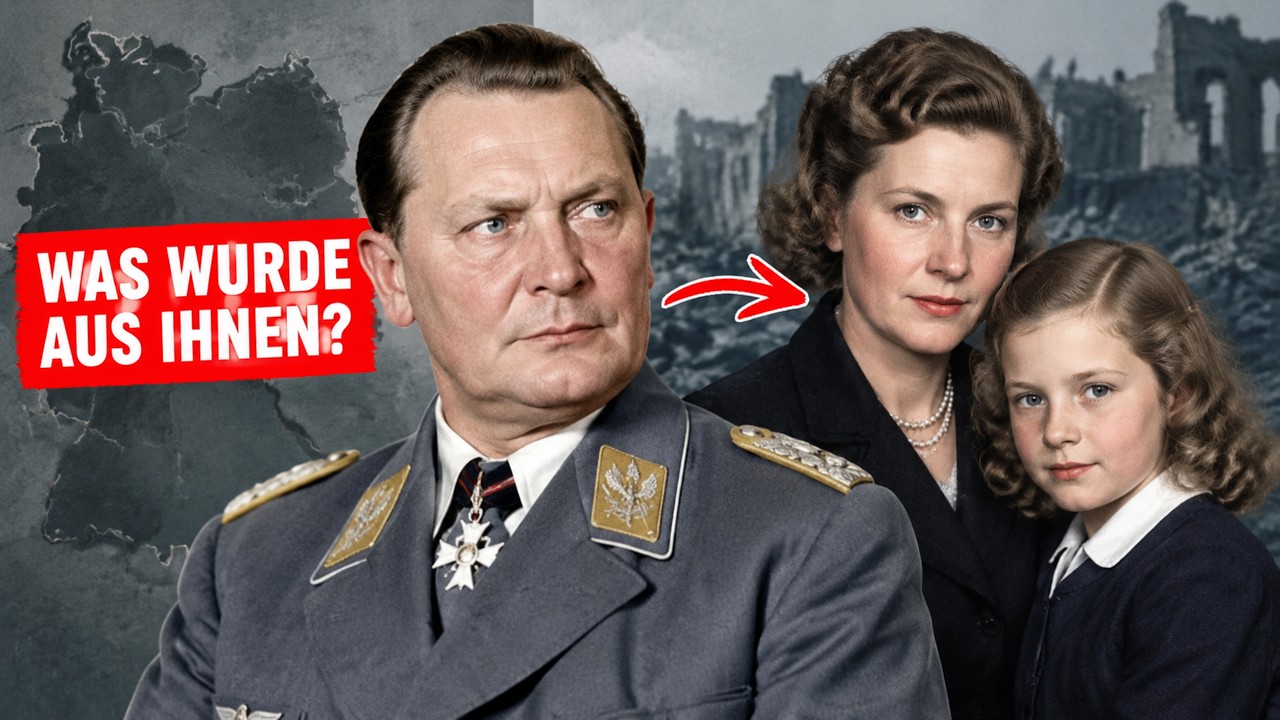 As the Red Army’s relentless advance turned the final weeks of April 1945 into a cacophony of thunderous artillery and desperate flight, the Göring family’s fairy-tale existence imploded with terrifying speed. Hermann, ever the sycophant and power-broker, had fallen out of favor with Hitler in the final days, branded a traitor for his ill-timed attempt to assume leadership. Stripped of his commands and under threat of arrest from his own Führer, he issued the order that would erase the physical manifestation of his ego from the map.
The demolition of Carinhall, the sprawling estate in the Schorfheide forest named after his first wife, was a spectacle of self-immolation. The Luftwaffe engineers tasked with the destruction laid charges that ripped through the grand halls, the private cinema, the indoor swimming pool, and the vast galleries stuffed with plundered art. The explosion was heard for miles, a final, thunderous roar of a regime in its death throes.
As the smoke cleared over the smoldering ruins, Emmy and Edda were hurried south, their lives reduced to a frantic scramble through the alpine retreats of a collapsing Reich.
The flight was a chaotic descent into the unknown. Initially directed towards Berchtesgaden, Hitler’s mountain retreat, the pair were shuffled between scattered safe houses, their movements controlled by the remnants of the Reich leadership who were themselves dissolving into paranoia and betrayal. For Emmy, the transition was a waking nightmare.
She had been the undisputed First Lady of the Reich, a woman whose social calendar was dictated by state functions, whose wardrobe was a testament to the wealth extracted from a continent, and whose proximity to Hitler’s inner circle had granted her a terrifying degree of influence. Now, she was a fugitive, her jewels hastily packed, her furs smelling of mothballs, her status evaporating with every mile the Soviet tanks advanced. For Edda, the world became a blur of unfamiliar faces and tense whispers.
The “Edda-Schlösschen,” the miniature palace built for her in 1940 complete with its own theater, was gone. The servants who had catered to her every whim were gone. All that remained was the constant, unsettling motion and the fear in her mother’s eyes.
The end of the road came on May 6, 1945, in the Austrian town of Radstadt. US Army troops, part of the 36th Infantry Division, apprehended Hermann Göring, who had been traveling with his wife and daughter in a desperate attempt to negotiate a surrender to the Americans rather than the Soviets. The capture was almost anticlimactic.
The once-mighty Reichsmarschall, weighed down by his gold braid and medals, surrendered to a lieutenant. Within hours, the news flashed across the Allied command. But the capture of the man was only the first step.
The Allies were acutely aware that the families of the Nazi elite were not merely bystanders; they were witnesses, beneficiaries, and potential sources of intelligence. Emmy and Edda were located in the same region shortly thereafter, and the machinery of occupation swallowed them whole. They were designated as “family members of high-ranking functionaries,” a bureaucratic category that stripped them of any pretense of civilian status and placed them under immediate military custody.
Their new reality was a stark departure from the marble floors and silk curtains of Carinhall. The Allies shuttled them between a series of provisional internment camps and requisitioned hotels, each move designed to prevent escape and to facilitate interrogation. The accommodations were a far cry from their former lives—cold, spartan rooms with iron beds, shared facilities, and the constant, watchful gaze of armed guards.
For Emmy, the psychological shock was immense. She was subjected to repeated interrogations by Allied intelligence specialists who were less interested in her feelings than in the operational details of the regime she had so publicly embraced. They pressed her on her knowledge of Hermann’s activities, his relationships with other Nazi leaders, the financial structures of the Reich, and the provenance of the art and valuables that had filled their homes.
They showed her photographs, confronted her with testimonies, and demanded she account for her own role as a prominent figure in state-sponsored cultural organizations. She was no longer the hostess of grand receptions; she was a prisoner, stripped of her staff, her status, and her protection.
The impact on Edda was even more profound. At just seven years old, she was too young to understand the geopolitical cataclysm that had befallen her family. She only knew that her father was gone, her home was destroyed, and her mother was constantly crying or being taken away for questioning.
Allied personnel noted her demeanor with a mixture of pity and clinical observation. She was described as quiet and polite, a child who clung to a small suitcase containing the few possessions she had been allowed to keep. She would ask repeatedly when she would see her father again, a question that no one had the heart—or the authorization—to answer truthfully.
The transition from a household of servants and adoring adults to a series of unfamiliar rooms under military guard was a brutal awakening, a childhood shattered by the consequences of a war she had no part in starting.
 While Hermann Göring awaited his trial before the International Military Tribunal, the Allied legal apparatus began a meticulous and unforgiving dissection of the family’s financial empire. The name Göring was synonymous with corruption and plunder. Emmy’s attempts to retain personal items—jewelry, furs, silverware—were met with immediate confiscation.
Allied officers conducted detailed inventories, cataloging every asset they could find, linking them to the broader restitution investigations that were sweeping across occupied Europe. The sheer scale of the Göring fortune was staggering. Beyond the destroyed Carinhall, there were properties in Berlin, Nuremberg, and the Alps.
There were bank accounts in Switzerland, stocks in German industries, and, most notoriously, the art collection. Hermann Göring had been one of the most voracious art looters in history, amassing over 1,500 paintings, sculptures, and tapestries, many of them stolen from Jewish families and museums across the continent. The hunt for this collection became a major Allied priority, with investigators tracking down caches hidden in salt mines, castles, and remote alpine villas.
The dissolution of this collection was not just a legal process; it was a symbolic dismantling of the Göring legacy, piece by piece.
As the Nuremberg trial opened in November 1945, Hermann Göring seized the spotlight with a performance that stunned the world. He was the most prominent defendant, and he used the courtroom as a stage, dominating the proceedings with his sharp intellect and defiant demeanor. He denied all criminal responsibility, claiming ignorance of the Holocaust and portraying himself as a moderate who had tried to restrain Hitler’s more radical impulses.
He cross-examined witnesses with brutal efficiency and attempted to paint the trial as a victor’s justice. For Emmy and Edda, still under Allied supervision, the trial was a torturous limbo. They were allowed no direct contact with Hermann.
Emmy, desperate for news, would press the guards and officials for any information, but was met with silence or terse, official updates. The months dragged on, filled with anxiety and the gnawing fear of the inevitable verdict. The world watched as Göring’s defense crumbled under the weight of documentary evidence and eyewitness testimony.
The verdict, delivered on October 1, 1946, was a foregone conclusion: guilty on all four counts—conspiracy, crimes against peace, war crimes, and crimes against humanity. The sentence was death by hanging.
The sentence set in motion a final, desperate countdown. Göring was given ten days to appeal, which he did, but the appeal was rejected. The execution was scheduled for October 16.
In the meantime, he was allowed a final visit from his wife and daughter. The meeting, which took place in the prison, was a devastating tableau of a family torn apart by history. Emmy and Edda were escorted into a room where Hermann, still defiant, awaited them.
The conversation was brief, monitored, and heavy with unspoken grief. Hermann reportedly told Emmy that he would not allow himself to be hanged, that he would take his own life. He gave her a kiss and told her to be strong.
For Edda, it was the last time she would see her father alive. The image of that meeting, the small girl looking up at the man who had once been the most powerful in the Reich, is a haunting reminder of the human cost of totalitarian ambition. In the dead of night on October 15, 1946, Göring made good on his promise.
He bit down on a cyanide capsule he had managed to conceal, dying in his cell just hours before the guards came to lead him to the gallows. His suicide was a final act of control, a refusal to submit to the justice of his captors.
The news of his death hit Emmy and Edda like a physical blow. Witnesses described a silent, profound shock. Emmy initially refused to believe the reports, clinging to the hope that it was a rumor.
 Edda, now eight years old, asked where her father had gone, a question that would haunt her for the rest of her life. The suicide also triggered a legal firestorm. The Allies, furious that Göring had cheated the hangman, immediately began investigating how he had obtained the poison.
But more importantly for the family, the death finalized the legal liquidation of the Göring estate. The confiscation procedures that had been in motion now accelerated. All properties, bank accounts, and remaining assets were formally seized.
The art collection, which had been meticulously cataloged, was broken up and distributed for restitution to its rightful owners or held as evidence. The Göring family, once among the wealthiest in Germany, was rendered effectively penniless.
With the war criminal dead, the focus shifted to the living. Emmy Göring’s case became a cause célèbre in the denazification process that gripped Germany in the late 1940s. She was not a minor figure; she had been a prominent public personality.
The Allies and the newly reconstituted German authorities viewed her as a symbol of the regime’s social elite. In 1947, she was summoned before a Munich Spruchkammer, a denazification tribunal. The proceedings were intense.
Prosecutors presented photographs of her at state functions, testimonies from former staff, and documents linking her to Nazi cultural organizations. They argued that her public presence had lent an air of legitimacy and glamour to the regime, helping to normalize its brutality in the eyes of the German public. They painted her as a willing and active participant in the Nazi social scene, not a passive wife.
Emmy’s defense was that she was a private individual, an actress who had married a powerful man and had been forced into a public role she never sought. She claimed ignorance of the regime’s crimes, insisting that her husband had shielded her from the darker aspects of his work.
The tribunal was not swayed. In March 1948, they delivered their verdict: Emmy Göring was classified as a “Belastete” (Incriminated), the second-highest category in the denazification system. The penalties were severe.
She was stripped of all remaining property rights, including claims on household goods still held by the Allies. She was banned from public employment, restricted in her travel, and prohibited from participating in cultural institutions. She was also denied any pension claims tied to her husband’s former state positions.
The judgment was a public humiliation, a formal declaration that she was complicit in the crimes of the Third Reich. Emmy immediately launched an appeal, arguing that her classification was excessive. Her lawyers emphasized her lack of formal political power, her duties as a mother, and her withdrawal from public life after 1939.
Over time, the appeals process did soften some of the restrictions, particularly those concerning her freedom of movement and personal employment. However, the core stigma of the classification remained with her for the rest of her life.
Financially, Emmy was left in a precarious position. The confiscations had stripped her of her wealth, and the legal battles had drained her of resources. She settled in Munich, living in modest apartments, often relying on the charity of old friends from the theater world.
Some reports depicted her as living in near-poverty, while others suggested she maintained a quiet, stable existence, albeit without the luxury she had once known. She was a ghost of her former self, a woman who had once dined with kings and dictators now reduced to a life of frugality and social ostracism. In 1967, she attempted to control her own narrative by publishing her memoirs, “An der Seite meines Mannes” (At My Husband’s Side).
The book was a staunch defense of Hermann, portraying him as a kind, loving, and compassionate man who had been misunderstood by history. She painted their life together as one of devotion and loyalty, conveniently omitting the plunder, the war, and the genocide. The book was a commercial success in some circles, appealing to those who harbored nostalgia for the Nazi era, but it was widely condemned by historians as a whitewash.
 She never wavered from this portrayal, maintaining her loyalty to her husband’s memory until her death on June 8, 1973, in Munich, at the age of 80. Edda was at her side until the end.
Edda Göring’s life was a different kind of tragedy. Born on June 2, 1938, her birth had been treated as a national event. Hitler himself served as her godfather, and the baptism at Carinhall was a lavish 𝒶𝒻𝒻𝒶𝒾𝓇 covered by international media.
She was showered with gifts, including paintings attributed to Lucas Cranach the Elder, a symbol of the immense wealth and power that surrounded her. She was the “little princess” of the Reich, living in a world of unimaginable privilege. The collapse of 1945 shattered that world irreparably.
After the denazification proceedings against her mother concluded, Edda returned to Munich with Emmy. She tried to build a normal life, attending local schools, but the name Göring was an inescapable burden. She was stigmatized, ostracized, and constantly reminded of her father’s crimes.
She reached adulthood in the 1950s, studying law at the University of Munich before eventually working as a medical-technical assistant in a hospital laboratory. She never married and had no children, living a quiet, reclusive life.
In the 1970s, Edda briefly re-entered the public eye through her association with journalist Gerd Heidemann. Heidemann had purchased the “Karin II,” the yacht that had once belonged to her father. Edda became a regular guest on the yacht, which became a gathering place for former Nazis and sympathizers.
This association would later have disastrous consequences, as Heidemann became embroiled in the infamous Hitler Diaries 𝒔𝒄𝒂𝓃𝒹𝒶𝓁, forging documents that he claimed were Hitler’s personal journals. Edda’s connection to this circle highlighted her refusal to distance herself from the past. Unlike many descendants of Nazi leaders who expressed shame or sought to atone, Edda remained fiercely loyal to her father.
In interviews throughout the 1990s and 2000s, she defended him, insisting that he was a kind, protective man who had tried to moderate the regime’s excesses. When confronted with the reality of the Holocaust, she would deflect, stating simply that she remembered a loving father. This unwavering loyalty set her apart and made her a figure of fascination and revulsion in equal measure.
She lived out her final years in seclusion, spending time in Schwarz, Austria, before returning to Munich. When she died on December 19, 2018, her obituary in the New York Times highlighted her steadfast loyalty, a loyalty that isolated her not only from German society but also from members of her own extended family. The contrast with her great-niece, Bettina Göring, could not be more stark.
Bettina, born after the war, grew up outside the immediate family structure but was acutely aware of the weight of the Göring name. She rejected the family narrative completely. As an adult, she moved to the United States, settling in New Mexico, and became an outspoken critic of her family’s legacy.
In interviews, she spoke openly about the psychological burden of being related to one of history’s greatest monsters. Her most 𝓈𝒽𝓸𝒸𝓀𝒾𝓃𝑔 revelation came in the 2000s when she disclosed that she and her brother had voluntarily undergone sterilization. Their stated reason was to end the Göring bloodline, to ensure that no future generation would have to bear what she called “the shadow of Göring.”
Bettina’s choice was a radical act of personal atonement, a stark contrast to Edda’s lifelong defense. While Edda clung to the memory of a loving father, Bettina sought to erase the very possibility of a future Göring.
The story of Emmy and Edda Göring is a chilling reminder that the consequences of history extend far beyond the lives of the primary actors. It is a story of women caught in the wreckage of a regime they had benefited from and, in Emmy’s case, actively supported. Their descent from the pinnacle of power to the depths of internment and poverty was swift and merciless.
They were subjected to the full force of Allied justice, stripped of their wealth, their status, and their freedom. Yet, their story also reveals the limits of that justice. While Emmy was legally classified as an incriminated Nazi, she never truly grappled with the moral implications of her husband’s crimes.
She retreated into a comfortable narrative of personal loyalty, a narrative that Edda would adopt and maintain until her dying day. The Göring women serve as a case study in denial, a testament to the human capacity to rationalize even the most horrific evil when it is intertwined with personal love and familial bonds. Their lives, marked by loss and stigma, are a somber epilogue to the Nuremberg trials, a reminder that the pursuit of justice often leaves behind a trail of human wreckage that takes generations to clear.


