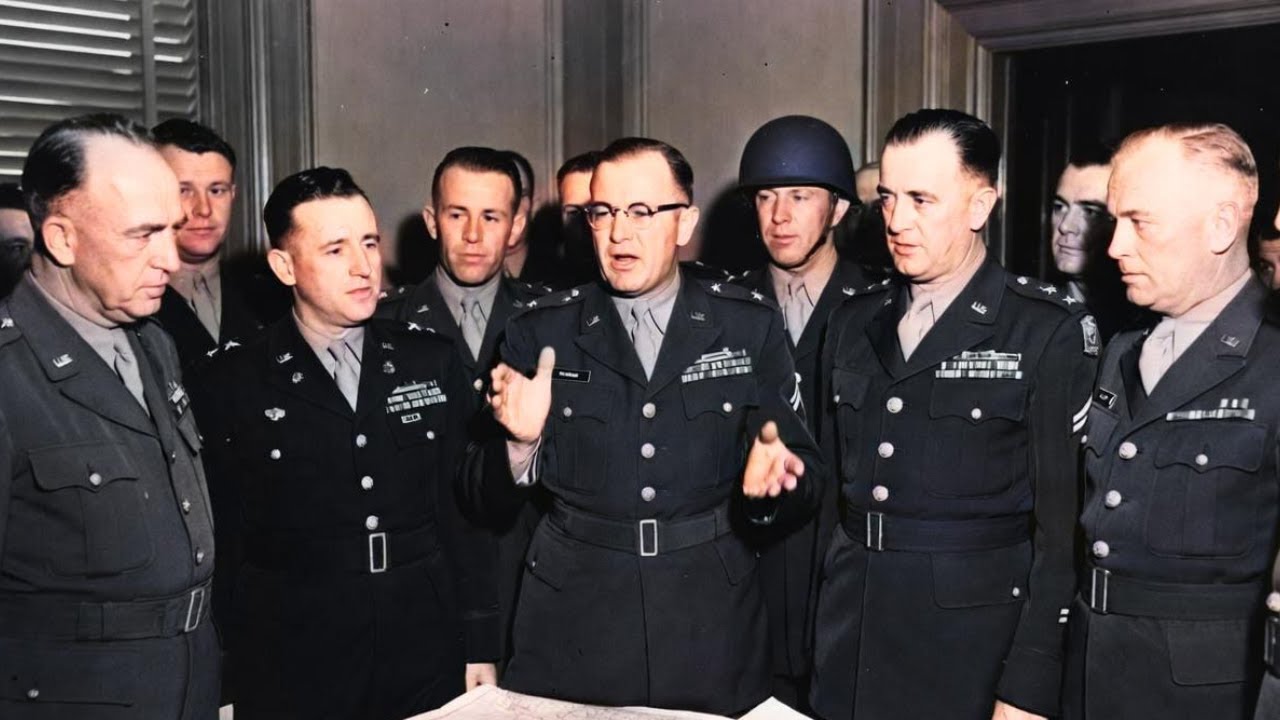
The snow outside the command trailer in Zonhoven, Belgium, had turned to a filthy grey slush, a fitting mirror for the state of the Allied high command in the first week of January 1945. The Battle of the Bulge was grinding to a bloody halt, but a new, far more insidious war was being waged in the telegraph wires between the front and London. It was a war of ego, empire, and raw political power, and at its center was a secret telegram that threatened to shatter the Grand Alliance into a thousand pieces.
Field Marshal Bernard Law Montgomery, the victor of El Alamein and the most decorated British soldier of his generation, had committed the ultimate act of coalition treason. In a series of encrypted messages intended only for the Chief of the Imperial General Staff, Field Marshal Alan Brooke, Montgomery had not merely criticized the American strategy in the Ardennes; he had launched a devastating, character-assassinating attack on the fighting men of the United States Army. He called them “brave but useless,” describing their command structure as a “complete shambles” and their leadership as lacking any grip whatsoever.
 The telegram was a political grenade with the pin pulled, and Montgomery was convinced he was holding it safely. He believed these private missives would be his ticket to supreme command, the final proof that the Americans were unfit to lead the war in Europe. He saw himself as the only man capable of snatching victory from the jaws of American incompetence.
He was wrong. The fuse was lit, and the resulting explosion would nearly consume the alliance that was fighting for the very survival of Western Europe.
To understand the venom in Montgomery’s words, one must strip away the propaganda reels of smiling generals shaking hands at victory parades. The “Special Relationship” between the United Kingdom and the United States in late 1944 was a toxic, codependent marriage of convenience, held together solely by the common enemy of Nazi Germany. On one side stood Supreme Allied Commander Dwight D.
Eisenhower, a man who was less a tactical genius and more a masterful manager of gargantuan egos. Ike, as he was universally known, was the chairman of the board, a chain-smoking mediator who spent his days navigating the treacherous waters of inter-allied rivalry.
Eisenhower represented the new American superpower, a nation of industrial might, democratic ideals, and overwhelming numerical superiority. His strategy was one of a broad, grinding advance, a war of attrition that favored the side with more men, more tanks, and more supplies. On the other side was Montgomery, the meticulous, brilliant, and insufferably arrogant hero of the desert war.
Monty represented the fading British Empire, a nation bleeding financially and demographically, desperate to maintain its prestige in a war it could no longer afford to fight on its own terms.
Montgomery did not view Eisenhower as his superior. He viewed him as a well-meaning logistics officer, a “nice chap” who should handle the paperwork while the real professionals, the British, directed the fighting. For months, this resentment had been building like pressure in a steam boiler.
Monty believed the war was dragging on because the Americans were too aggressive, too sloppy, and too spread out. He wanted a single, concentrated thrust into the heart of Germany, an operation that would, of course, be led by him. Eisenhower, ever the coalition manager, refused, preferring a broad-front strategy to keep the Germans off balance and to satisfy the political needs of all his allies.
The crack in the boiler finally opened in the frozen forests of the Ardennes when Hitler launched his massive surprise offensive on December 16, 1944. The Allied front line shattered under the weight of the German Panzer divisions. American units were overrun, communications were severed, and panic began to ripple through the rear echelons.
For Montgomery, this catastrophe was not a tragedy; it was a vindication. From his headquarters in the north, he looked at the map with a smug sense of “I told you so.” In his mind, the chaos in the American sector was definitive proof of everything he had been saying.
The Americans were amateurs, undisciplined cowboys who had overextended themselves and were now paying the price.
He genuinely believed the US Army was on the verge of total collapse, and that only a steady, professional British hand could save them from annihilation. This was the savior complex in full effect. Montgomery saw himself not as a partner coming to the aid of a friend, but as a stern headmaster arriving to discipline unruly schoolboys.
He assumed that once he stepped in and tidied up the mess, the Americans would be grateful. He expected them to bow to his superior intellect and gladly hand over the reins of the entire war effort. Blinded by his own ego, he failed to see the one thing that mattered most: the raw, desperate resilience of the American GI.
And that blindness was about to lead him into the biggest political minefield of the war.
The crisis began with a necessary but dangerous decision. On December 19, the German Panzer armies had punched a hole forty-five miles deep into the Allied lines. The “Bulge” had physically severed General Omar Bradley’s communications with his northern forces.
Eisenhower, looking at the logistics, made a purely tactical call. At 10:30 a. m.
on December 20, he temporarily transferred command of the US First Army under Courtney Hodges and the US Ninth Army under William Simpson to Montgomery’s 21st Army Group. Overnight, Montgomery gained control of 200,000 American soldiers and thousands of tanks. It was a massive transfer of power, but it was intended as a temporary measure to stabilize the front.
Montgomery did not treat this as a temporary loan. He treated it as a hostile takeover. He immediately halted the American counterattacks, reorganizing the lines with agonizing slowness, refusing to move until every unit was perfectly positioned.
 While the American 101st Airborne Division was surrounded at Bastogne, fighting off seven German divisions and screaming for relief, Montgomery held the northern flank stationary. He brought in his own liaison officers, young, arrogant British majors who lectured veteran American commanders on basic tactics. He vetoed Bradley’s plans to pinch off the bulge at its base.
By December 26, General George S. Patton had broken the siege of Bastogne from the south, moving three divisions over a hundred miles in 48 hours in a blizzard. Yet in the north, Montgomery sat still, tidying up his lines, treating the American armies like new toys he refused to share.
His silence on the battlefield, however, was matched by his noise on the telegraph wires. Between Christmas Day and New Year’s Day, the lines between Belgium and London burned with toxicity. Montgomery bypassed the chain of command entirely.
He didn’t write to Eisenhower. He wrote secret letters to Field Marshal Brooke. In a telegram dated December 27, he wrote, “The Americans are in a complete shambles.
There is no grip anywhere.” He claimed that without him, the entire front would have collapsed. He explicitly demanded that he be given full operational control of all ground forces, effectively demoting Eisenhower to a figurehead.
He didn’t stop at military criticism. He attacked the character of the US Army itself, stating that American troops were brave but useless because they lacked proper training and leadership.
He ignored the fact that by this point, the US Army had suffered 75,000 casualties in the Ardennes alone, including 19,000 killed in action, holding the line against the SS Panzer divisions. These telegrams were not just complaints; they were political dynamite. Montgomery was effectively lobbying the British government to stage a coup against the American High Command.
He was so confident in his assessment that he didn’t even bother to encrypt some of his sentiments, effectively assuming his prestige protected him. He was playing a game of poker with the highest stakes imaginable, betting his career against the patience of the United States. He was about to go all-in with a hand that was much weaker than he realized.
The explosion didn’t happen in a secret bunker. It happened in front of the world press. On January 7, 1945, Montgomery called a press conference at his headquarters.
He stood before dozens of reporters for exactly 30 minutes. What followed was one of the most tone-deaf public relations disasters in military history. In his speech, Montgomery used the word “I” 57 times.
He described the Battle of the Bulge not as a desperate defensive stand by American troops, but as a masterpiece of his own generalship. He claimed he had employed “the whole available power of the British group of armies” to save the Americans. The data proves this was a lie.
In reality, the British XXX Corps had engaged mainly in the final stages of the battle. The casualty statistics tell the true story: the Americans suffered 89,000 casualties in the Bulge; the British suffered 1,400.
Yet, listening to Montgomery, one would think he had single-handedly stopped Hitler’s panzers while the Americans cowered in the snow. He barely mentioned General Bradley. He didn’t mention Patton’s heroic relief of Bastogne.
He painted a picture of a frantic, disorganized American rabble being rescued by the cool, calm British professional. When the transcript of this press conference reached General Bradley’s headquarters, the usually mild-mannered general turned purple. He walked to his map board, slammed his fist against it, and told his staff that he would never take an order from Montgomery again.
The secret was out. The insult was public, and the alliance was effectively dead.
The news reached Eisenhower’s headquarters at Versailles like a physical blow. Ike was a man of infinite compromise, a man who had swallowed his pride a thousand times to keep the peace. But reading the transcript of Montgomery’s press conference and seeing the intelligence reports of the secret telegrams to London, something inside him finally snapped.
He sat at his desk, the cigarette smoke swirling around him in the cold light. He didn’t shout. He didn’t throw things.
 He simply pulled a piece of paper from his drawer and began to draft a cable to General George Marshall in Washington. It was an ultimatum. The text was polite, bureaucratic, and absolutely lethal.
Eisenhower wrote that he and Montgomery could no longer work together. He stated clearly, “It is him or me.” He asked to be relieved of his command if Montgomery was not removed.
This was the nuclear option. Eisenhower knew that Washington supplied 70% of the troops and 80% of the supplies in Europe. He knew who Marshall would choose.
He was effectively putting a gun to the head of the British Empire and pulling the trigger. The cable was prepared for encryption. But before it could be sent, a terrifying realization hit the British liaison officer, Major General Francis de Guingand.
He saw the draft. He saw the end of the war effort. He rushed to the phone to call the one man who could stop the madness.
When Winston Churchill received word of Eisenhower’s ultimatum, the blood drained from his face. Churchill was a romantic, but he was also a realist. He looked at the numbers.
The British Empire was bankrupt. Its manpower reserves were exhausted. They were relying on American Lend-Lease for everything from tanks to spam.
If Eisenhower resigned, or if he forced the firing of Montgomery, the American public would turn against Britain. The alliance would fracture. Stalin would be the only winner.
Churchill realized that his spoiled child, Monty, had finally pushed the Americans too far. Churchill summoned his staff. The adoration he usually held for Montgomery evaporated instantly.
This wasn’t about military strategy anymore. It was about survival. He knew he couldn’t just smooth this over with a speech.
He needed to crush Montgomery’s ego, and he needed to do it immediately. He dispatched de Guingand back to Montgomery’s HQ with a simple message: “Ike has the gun to your head and he is going to pull the trigger. You have 24 hours to apologize or you are finished.”
Why did it come to this? How could a brilliant general like Montgomery be so politically blind? The root cause lay in the fundamental difference between the British and American ways of war.
Montgomery viewed war as a set piece, a chessboard where the Grandmaster moves the pieces. He believed that rank and experience entitled him to respect. He failed to understand that the American center of gravity wasn’t strategy.
It was logistics and production. The Americans didn’t need a master. They needed a coordinator.
Churchill understood this. He knew that the era of British dominance was over. In his message to Montgomery, he didn’t appeal to their friendship.
He appealed to the cold, hard facts of geopolitical power. He effectively told Montgomery, “We are the junior partner now. You cannot insult the man who pays your bills and supplies your tanks.”
It was a brutal lesson in humility.
 Montgomery had spent his life believing he was indispensable. Churchill forced him to realize that in the face of American industrial might, no single British general mattered. The “useless” Americans were actually the owners of the company, and Monty was just an employee who had forgotten his place.
The scene in Montgomery’s caravan that night was pitiful. The arrogant warlord was gone. In his place sat a shaken small man.
De Guingand stood over him, practically dictating the terms of his surrender. Montgomery took his pen and wrote a letter to Eisenhower. It was the most difficult document of his life.
“Dear Ike,” it began, “I am distressed that my press conference has caused you trouble. I would never do anything to hurt you.” But then came the line that Churchill and de Guingand had forced out of him, the full retraction: “Your American soldiers are brave and fighting magnificently.
It is an honor to serve beside them.”
He signed it, “Your very devoted subordinate, Monty.” Subordinate. He had finally admitted it.
He sent the letter. Eisenhower, reading it the next morning, didn’t gloat. He simply took his resignation draft, crumpled it up, and threw it in the trash.
He replied with a short note: “Thanks, Monty. Let’s get on with the war.” The crisis was diffused, but the relationship was permanently altered.
The apology saved Montgomery’s job, but it killed his influence. From that day forward, Eisenhower stopped listening to London. The strategy shifted decisively.
When the time came to cross the Rhine into Germany, Montgomery demanded a grand, deliberate operation in the north. Eisenhower allowed it, but he also unleashed Patton and Bradley in the south. While Montgomery spent weeks preparing a massive artillery barrage, Patton slipped his tanks across the river quietly, stealing the glory of being the first across the Rhine.
The broad-front strategy that Monty hated became the law of the land. The American armies raced across Germany, leaving the British 21st Army Group to clean up the flanks. By May 1945, the US Army in Europe numbered over three million men.
The British contribution was dwarfed. The secret telegrams and the insults of January had ensured that when the victory photos were taken, the Americans would be standing in the center and the British would be standing to the side. History remembers the Battle of the Bulge for the snow, the shrapnel, and the courage of the 101st Airborne.
But the most dangerous moment of that winter didn’t happen in a foxhole. It happened in a telegraph office. Winston Churchill’s intervention did more than just soothe a bruised ego.
It saved the Western Alliance from self-destruction. He recognized what Montgomery could not: that in coalition warfare, words are as lethal as bullets. Montgomery called the Americans useless.
History proved him wrong. But it took the threat of being fired and a harsh lesson from his own prime minister to force him to see the truth. In the end, the alliance survived not because the generals liked each other, but because one man had the power to say “enough,” and the other had the wisdom to listen.
The telegrams were buried in the archives. The war moved on, but the scar remained.