The frozen earth of the Ardennes Forest had become a tombstone for thousands of young men, and inside the shrinking American perimeter around the Belgian town of Bastogne, the temperature was not the only thing dropping to lethal levels. As the last hours of December 16th, 1944, bled into the longest night of the war, the 101st Airborne Division was surrounded, outgunned, and running out of everything that mattered. Ammunition was being rationed to a handful of rounds per gun.
Medical supplies had evaporated, leaving wounded soldiers to freeze in makeshift aid stations with no morphine to dull their agony. The fog was so thick that soldiers described it as walking through wet wool, and the Luftwaffe, though battered, still ruled a sky that had become a gray, impenetrable ceiling. In a cold stone barracks 150 kilometers to the south, a general who had been humiliated, mocked, and nearly stripped of his command was about to make a promise that defied all military logic.
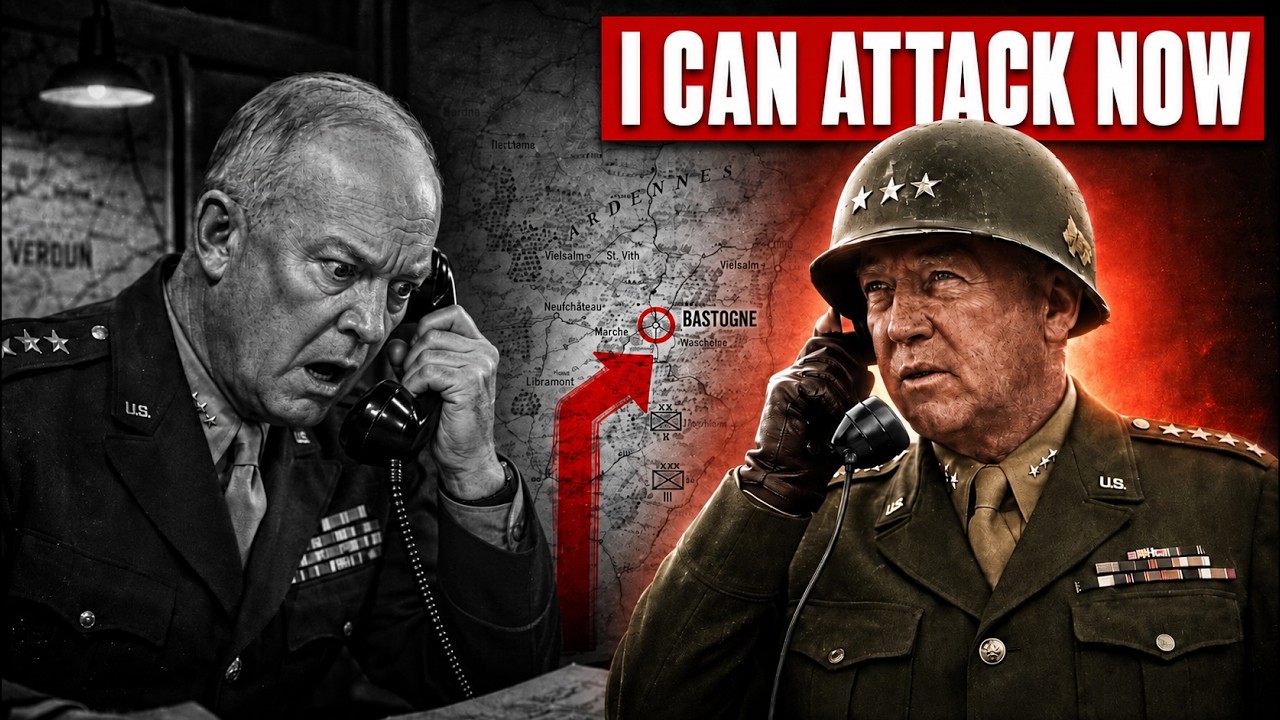 George S. Patton, the man they called too reckless to trust, picked up a telephone and spoke four words that would alter the trajectory of the entire Western Front: “I can attack now.” That call, and the impossible maneuver that followed, would decide whether 20,000 American soldiers lived to see another dawn or marched into German captivity in the dead of winter.
The crisis had erupted with terrifying suddenness. For months, Allied commanders had allowed themselves to believe the war in Europe was nearly finished. German forces had been pushed back across France, Paris had been liberated, and optimism was so high that some officers spoke openly of celebrating Christmas in Berlin.
But Adolf Hitler had been planning a desperate, audacious counterstroke in total secrecy. Under the cover of the Ardennes’ dense pine forests, the German High Command had assembled over 200,000 soldiers, hundreds of tanks, and thousands of artillery pieces. Radio silence was enforced under threat of execution.
Tanks moved only at night, their headlights taped down to thin slits, their engines muffled by low-flying aircraft sent up specifically to mask the rumble of armor gathering below. The goal was as bold as it was reckless: punch through the thinly held American lines, cross the Meuse River, and drive all the way to the port city of Antwerp, splitting the American and British armies in two. If the plan succeeded, it could buy Hitler the time he desperately needed and potentially force a negotiated peace on the Western Front.
When the offensive erupted on the morning of December 16th, it overwhelmed the exhausted and green American units in its path within hours. Communication lines were severed. Entire companies were surrounded before their officers understood what was happening.
At the center of this chaos sat Bastogne, a small, unremarkable town that held no intrinsic value except for one critical feature: seven highways converged there like spokes on a wheel. In a region choked with forests, ridges, and narrow valleys, whoever controlled those roads controlled the speed of the entire German advance. If Bastogne fell, the road network would open wide for German armor to race toward the Meuse and beyond.
The 101st Airborne, rushed to the town in open trucks without winter coats, arrived just in time to dig in around the edges. By December 20th, the trap closed. German armored spearheads swept around both sides of the town, and roughly 20,000 American soldiers were cut off, surrounded on every side by a numerically superior enemy that badly outnumbered them.
Inside the ring, conditions turned brutal almost immediately. Temperatures plummeted to nearly 15 degrees below zero Celsius. Snow fell in thick, blinding waves, then turned to freezing fog that made it impossible to tell friend from enemy at more than a few dozen meters.
Roads turned to sheets of ice, and vehicles slid into ditches and had to be abandoned. Ammunition, rushed in before the encirclement closed, was already running low. Medical supplies were worse.
Wounded soldiers lay in a converted riding hall packed wall-to-wall with hundreds of men on stretchers and straw, many with no morphine and no anesthesia left to ease their pain. Fuel for vehicles and generators dwindled by the hour, forcing crews to siphon gasoline from disabled trucks just to keep radios and field kitchens running. And because of the fog, the cargo planes that could have dropped supplies simply could not fly.
The men below were left to fight with what little they already had in their hands, huddled in foxholes hacked out of frozen ground, close enough in places that they could hear German voices carrying across the tree line at night.
At Allied headquarters, the mood was grim, almost disbelieving. Commanders who had spent months celebrating victories now stood over maps tracking German spearheads that pushed deeper into Belgium with every passing hour. Some officers privately worried this could become the worst American defeat of the war in Europe, a humiliation on the scale of Pearl Harbor, only this time measured in frozen forests instead of burning ships.
On December 19th, Dwight Eisenhower, the Supreme Commander of Allied Forces in Europe, called an emergency meeting of his senior commanders in a cold, damp barracks in the French city of Verdun. The room was heated by a single inadequate stove, and most of the generals kept their coats buttoned to the collar as they gathered around a long wooden table covered with maps marked in red and blue grease pencil. Eisenhower opened the meeting by trying to steady the room, telling the assembled generals that the situation should be viewed as an opportunity rather than only a catastrophe, since the German army had finally left the safety of its fortified defenses and 𝓮𝔁𝓹𝓸𝓼𝓮𝓭 itself in the open.
Few of the officers fully believed him, but they understood the point: panic would help no one.
Then Eisenhower turned to the real question that had brought them all together. He looked around the table and asked a simple question: How soon could Bastogne be relieved? One by one, the commanders answered with careful, cautious estimates.
Divisions would need to disengage from their current positions. Roads would need to be cleared. Fuel and ammunition would need to be repositioned across icy terrain in the dead of winter.
The most optimistic answers spoke of a week. Some suggested longer. Nobody in that room believed a major counterattack could begin in less than several days.
Then Eisenhower turned to George Patton. Patton’s Third Army was fighting in a completely different sector, more than 150 kilometers to the south, advancing eastward in an entirely different direction. Relieving Bastogne would mean stopping that offensive cold, disengaging multiple divisions in contact with the enemy, turning the entire army 90 degrees to the north, and marching it over unfamiliar roads choked with snow and ice, all while somehow keeping fuel, ammunition, and food flowing to more than 100,000 men in motion.
 Eisenhower asked Patton the same question he had asked everyone else: how long would he need? Patton did not hesitate. He answered that he could have three divisions attacking north within 48 hours.
For a moment, the room went completely silent. Several officers exchanged glances, unsure whether Patton was serious or simply performing his usual bravado for the room. Someone reportedly asked if he understood exactly what he was proposing, given the distances, the roads, and the season.
Patton was said to have insisted calmly and without a trace of his usual theatrical anger that he was entirely serious, and that his staff was already working on it. What none of the other generals in that room knew was that Patton had in fact already begun preparing for exactly this moment days earlier. As soon as reports of the German breakthrough reached his headquarters, Patton had quietly ordered his own staff to begin drafting contingency plans for a full turn to the north, well before anyone had asked him to do so, and well before the true scale of the crisis at Bastogne had become clear to Allied command as a whole.
It was, in its own way, a gamble built on preparation rather than pure instinct, though Patton would spend the rest of his life allowing people to remember it as the second.
There was one more detail almost nobody in that Verdun meeting knew about. A small, strange piece of preparation that Patton had set in motion more than a week earlier for reasons that had nothing to do with tactics and everything to do with the sky. Frustrated by the persistent fog and low cloud that had grounded Allied aircraft for days, Patton had summoned his chaplain, Colonel James O’Neill, and ordered him to write a prayer asking for clear weather so that Allied airpower could return to the battlefield.
The prayer was printed on small cards and distributed to every soldier in the Third Army, tucked inside pockets alongside cigarettes and photographs of wives and children back home. Patton, a man rarely associated with quiet religious devotion, would later say that he believed in praying for what an army truly needed. And in 1944, what his army needed most was simply to see the sun.
The other generals at Verdun also did not fully appreciate the risk Patton was accepting on his own behalf. If his Third Army moved north too quickly, it would expose its own eastern flank to a German counter-thrust, potentially trading one crisis for another. Patton’s own staff officers, men who had served under him for years and knew his temperament well, quietly worried that he was moving too fast, gambling not only with the lives of his soldiers, but with the reputation he had spent the entire war trying to rebuild after the humiliation in Sicily.
Patton was reportedly aware of every one of these risks and chose to accept them anyway, later writing in his personal diary that he considered it one time when speed itself was the only form of safety available to him. That night, after the meeting ended, Patton did not sleep. His command post filled with the smell of coffee and cigarette smoke as staff officers spread maps across every available table, tracing routes north with red pencil, recalculating fuel consumption for divisions that would now be moving in the opposite direction from where they had been fighting only hours earlier.
Telephone lines connecting his headquarters to his core commanders stayed busy through the night, carrying orders that had not yet been formally authorized by anyone above him. Orders given on Patton’s own authority, based on his confidence that the official approval would follow by morning. Patton picked up the phone that night and placed a call to Eisenhower’s headquarters.
According to officers present for the exchange, his voice on the line was calm, almost business-like, without the booming theatrical edge that colleagues usually associated with him. He said four words: “I can attack now.” Four words, simple and direct, carrying none of the qualifications or hedges that most commanders might have reached for under the circumstances.
But behind those four words stood tens of thousands of soldiers, hundreds of tanks, and a gamble that could just as easily end his career as save an entire division of trapped Americans.
If Patton moved too fast and left his own flanks 𝓮𝔁𝓹𝓸𝓼𝓮𝓭, the Third Army itself could become vulnerable to a German counter-thrust. If he hesitated even a few hours longer, Bastogne’s defenders might run out of ammunition before help ever arrived. According to those in the room, Eisenhower paused before answering.
He understood exactly what was being asked of him, and exactly what would be risked if it failed. In that pause, the fate of 20,000 surrounded soldiers rested on whether he trusted the same aggressive, unpredictable general he had nearly relieved of command barely a year earlier. Eisenhower approved the attack.
In the days that followed, Eisenhower found himself in the uncomfortable position of every senior commander in history who has committed forces to a plan and then must simply wait to learn whether it will work. Reports reached his headquarters in fragments, delayed by damaged telephone lines and the general confusion of a battlefield stretched across a widening bulge in the front. He had staked a considerable portion of his own credibility and the safety of an entire trapped division on the judgment of a general he had once come within a signature of relieving from command entirely.
Staff officers who worked closely with Eisenhower during those days later described him as outwardly calm but visibly exhausted, smoking more than usual, reviewing the same situation maps again and again as though a different answer might appear if he simply looked hard enough.
Within hours of that call, the movement began in earnest. Entire divisions that had spent the previous days fighting eastward now turned north under cover of darkness, engines grinding over roads coated in black ice, headlights taped down to narrow slits to avoid drawing the attention of German aircraft that might still be flying despite the weather. Military police stood at crossroads in the freezing wind, waving columns of trucks and tanks through intersections that had never been designed to handle this volume of traffic moving in this direction.
The 4th Armored Division, commanded by Major General Hugh Gaffey, took the lead position in the advance north, its Sherman tanks and half-tracks forming the spearhead that would need to punch through German lines to reach Bastogne. Behind them came the 26th Infantry Division and the 80th Infantry Division, marching and riding in open trucks through weather that soldiers later described as the coldest they experienced in the entire war. On the German side of the line, the mood was far less unified than the speed of their advance suggested.
 General Hasso von Manteuffel, commanding the Fifth Panzer Army, had privately doubted from the very beginning that his forces could reach Antwerp on the timetable Adolf Hitler had demanded. Manteuffel understood, perhaps better than Hitler ever allowed himself to admit, that German fuel reserves were thin, that Allied air power would eventually return once the weather broke, and that every day spent bogged down outside Bastogne was a day the Americans could use to organize a response. Yet, orders from Berlin insisted the offensive continue at full speed, bypassing or crushing Bastogne as quickly as possible, rather than risking delay.
For the soldiers doing the actual marching, the reality of those days had little to do with maps or strategy meetings. Infantrymen rode for hours in the open backs of trucks, wind cutting through field jackets that had never been designed for a winter this severe, feet going numb inside boots that had been wet for days. Cases of frostbite and trench foot climbed steadily among men who had no choice but to keep moving, since stopping to warm frozen feet was a luxury the schedule could not afford.
Officers walked the length of stalled convoys handing out what dry socks and hot coffee could be found, aware that a soldier who could not feel his own feet could not fight effectively once he reached the front. Inside Bastogne itself, the men of the 101st Airborne had no way of knowing exactly how close help truly was. Rumors moved through foxholes faster than official reports, some claiming relief was only hours away, others insisting no one was coming at all.
Soldiers rationed cigarettes as carefully as ammunition, and small acts of dark humor, jokes about the cold, about German artillery, about being surrounded on all sides, helped hold together men who had not had a hot meal or a full night of sleep in more than a week. What kept them in their foxholes, according to many who survived the siege, was not blind optimism, but a stubborn refusal to be the ones who let the line break.
The scale of what Patton’s staff accomplished in those first hours is difficult to overstate. More than 100,000 men, along with their vehicles, their artillery, their fuel trucks, and their supply columns, changed direction and began moving along a completely new axis of advance, all without the benefit of the days or weeks of planning that such a maneuver would normally require. Fuel dumps that had been positioned to support an eastward offensive had to be redirected northward literally overnight.
Ammunition trains were rerouted. Medical units packed their equipment and followed the combat troops north, anticipating the casualties that everyone knew were coming. The roads themselves became almost as dangerous as the enemy.
Narrow country lanes built for horse carts and local farm traffic decades earlier buckled under the weight of tank columns. Many bridges along the route had already been damaged by retreating German engineers or by earlier fighting, forcing convoys to detour miles out of their way to find crossings that could bear the weight of armor. Traffic jams stretched for kilometers at some junctions.
Tanks and trucks sitting bumper-to-bumper in freezing temperatures, while military police tried to untangle columns that had converged from different directions at the same crossroads. And yet, through snow, through freezing wind that cut through wool coats and numbed fingers on steering wheels, the columns kept moving day and night with drivers rotating in shifts to avoid falling asleep at the wheel on ice-covered roads.
Between December 21st and December 23rd, the lead elements of Patton’s Third Army pushed forward nearly 150 kilometers. An extraordinary pace for any army under normal conditions, let alone one moving through a Belgian winter with minimal rest, minimal sleep, and almost no margin for error. Then, on December 23rd, something changed that no general, however brilliant, could have engineered on his own.
The weather cleared. For the first time in days, the thick gray clouds that had grounded Allied aircraft broke apart, revealing clear blue winter sky. Within hours, the skies above Bastogne and the surrounding battlefield filled with the sound of engines again, but this time they belonged to Allied fighter-bombers rather than German artillery.
P-47 Thunderbolts swept low over German positions, strafing convoys and armored columns that had grown used to moving without fear of attack from above. Transport aircraft, flying in tight formation despite the risk of German anti-aircraft fire, dropped bundles of ammunition, medical supplies, and food by parachute directly onto the shrinking American perimeter around Bastogne, giving the exhausted defenders inside the ring fresh hope and fresh ammunition exactly when both were running dangerously low. Among Patton’s own soldiers, word spread quickly that the sudden break in the weather had come only days after the entire Third Army had been handed small printed cards carrying Chaplain O’Neill’s prayer for clear skies.
Whether coincidence or something else, the timing struck many of the men as more than luck, and Patton himself, half joking and half serious, was said to have remarked that the chaplain deserved a medal for the results.
The final stretch of the advance proved to be the hardest. German units, now fully aware that an American relief column was approaching from the south, threw everything they had into slowing it down, mining roads under cover of darkness, blowing bridges behind their own retreating engineers, and counterattacking with whatever armored reserves remained available. Every kilometer of the advance north had to be fought for, house by house in small Belgian villages whose names most of the advancing soldiers would never learn, hedgerow by hedgerow across open snow-covered fields where American tank crews had almost no cover from German anti-tank guns dug into the tree lines ahead.
Tank commanders learned quickly to scan the tree lines for the telltale glint of a gun barrel before committing their vehicles to open ground, knowing that a single well-placed German shell could turn a Sherman into a burning wreck within seconds. For Patton personally, every mile gained along that road carried a weight beyond ordinary tactics. A year earlier, he had stood on the edge of disgrace, one incident away from losing his command entirely.
And now he had staked his reputation and the lives of tens of thousands of his own soldiers on a promise he had made in a cold room in Verdun with almost no time to prepare it. Officers who traveled with him during those days described a man almost entirely focused, stripped for once of the theatrical bravado he was famous for, driving from unit to unit along the advancing column, checking supply lines with his own eyes rather than trusting reports alone.
By December 25th, Christmas Day, the lead tanks of the 4th Armored Division could hear, faintly, the sound of artillery fire coming from inside Bastogne itself. A sign that the town, though battered, had not fallen and that the race was nearly won. On the afternoon of December 26th, 1944, the lead tanks of Combat Command Reserve, part of the 4th Armored Division under Lieutenant Colonel Creighton Abrams, pushed through the final stretch of German resistance south of Bastogne.
After days of fighting for every kilometer, the column broke into open ground near the town, and for the first time in a week, American tanks from outside the perimeter made physical contact with the exhausted defenders inside it. The encirclement was broken at last. The ring that had held roughly 20,000 American soldiers trapped in freezing foxholes for more than a week had finally been shattered from the outside, exactly as George Patton had promised back at Verdun.
 Though even he had not managed the impossible 48-hour timeline he first proposed at Verdun. In the end, it had taken closer to 4 days for the lead elements to fight their way through. Still an extraordinary pace for an army that had been advancing in the opposite direction only a week earlier, and one that few military planners on either side, American or German, would have believed possible in the winter of 1944.
For the soldiers inside Bastogne, the arrival of Abrams tanks brought a wave of emotion that many veterans later struggled to describe. Men who had rationed bullets and endured frostbite in silence for over a week found themselves shaking hands with strangers, soldiers from a different division entirely, united only by the uniform and the sheer relief of no longer being alone. Some accounts described soldiers too exhausted to cheer, simply sitting down in the snow where they stood, letting the news settle over them slowly after a week spent unsure whether help would ever arrive.
Trucks loaded with fuel, ammunition, and food began moving into the perimeter almost immediately, along with medical teams who could finally begin evacuating the wounded who had been waiting in that crowded freezing riding hall for days, some of them for longer than a week with injuries that had only worsened in the cold and the delay. The significance of what had happened at Bastogne extended far beyond the town itself. Had the town fallen in those critical days between December 20th and December 26th, the road network it guarded would have opened wide for German armor to press onward toward the Meuse River.
From there, the path toward Antwerp would have widened considerably, and Antwerp’s port, only recently reopened, carried a very large share of the fuel, ammunition, and supplies that kept the entire Allied war effort in Western Europe moving forward. A serious threat to that port could have starved Allied forces of exactly the resources needed to keep advancing into Germany itself.
Beyond the immediate military risk, German planners had also hoped that a dramatic, unexpected success in the Ardennes might create political strain between the American and British governments, each of whom controlled different sectors of the Allied front, and each of whom had, at times throughout the war, disagreed sharply over strategy and priorities. Even a temporary German victory, even one that could not be fully exploited in the long run, might have handed Berlin something it desperately needed by the winter of 1944: time. Every additional month the war continued meant additional months of fighting for soldiers already exhausted from years of combat across North Africa, Italy, and France, and additional casualties on both sides of a war that everyone privately hoped might finally be nearing its end.
For the families waiting at home in the United States and Britain, each additional month also meant more telegrams delivered to more front doors, more names added to lists that no family wanted to see their own name appear on. This is why the defense of Bastogne and Patton’s decision to relieve it as quickly as he did carried weight far beyond a single battle on a map. It was not simply a tactical success.
It was a strategic turning point that helped determine how long the war in Western Europe would ultimately last and how many additional soldiers, American, British, and German alike, would not live to see its end.
George Patton was never a perfect commander and this story is not meant to suggest otherwise. He was aggressive to a fault, prone to public outbursts that damaged his own career more than once, and genuinely reckless in ways that had already nearly ended his command a year before Bastogne. Many of his fellow officers found him exhausting to work with and some questioned his judgment on a regular basis throughout the war, viewing his hunger for speed and glory as a liability as often as an asset.
His relationship with other senior commanders, including British Field Marshal Bernard Montgomery, was frequently strained by rivalry and mutual distrust and Patton’s own diary entries from this period reveal a man just as concerned with his own reputation and place in history as he was with the immediate tactical problem in front of him. But in December of 1944, in the specific and narrow circumstances of a besieged town and a closing window of time, the very qualities that made Patton difficult, his impatience, his refusal to accept the slow and cautious answer that every other general in that room at Verdun was prepared to give, turned out to be exactly what the situation required. Patton understood something about the nature of the crisis at Bastogne that is easy to overlook when studying the battle only through maps and division numbers.
In a fast-moving fluid situation like the one created by the German offensive, hesitation itself carried a cost. Every day spent carefully planning a textbook counterattack was another day the German army had to consolidate its gains, another day the defenders of Bastogne spent burning through ammunition and enduring the cold with no relief in sight. Speed in this particular case was not recklessness for its own sake.
It was, as Patton himself seemed to understand instinctively, the only form of caution that actually mattered under the circumstances.
None of this happened by accident. And none of it happened purely on instinct, either. The four words Patton spoke that night, whether delivered over the telephone or across the table at Verdun, according to different accounts of that tense week, were backed by staff work that had quietly begun days earlier, by a general willing to stake his own career on a promise he believed he could keep, and by an army willing to march through the worst winter conditions many of them would ever experience in order to keep that promise.
It is worth remembering that certainty in these old accounts should always be treated with some caution. Soldiers who lived through the event, journalists who wrote about it years later, and historians piecing together the record from scattered diaries and after-action reports, do not always agree on every exact word or every precise hour. What remains beyond dispute is the outcome itself, the timeline of the relief, the units involved, and the 20,000 American lives that hung in the balance while the generals argued over what was possible.
History tends to remember battles through numbers, through division names, through lines drawn and redrawn on maps in red and blue pencil. But the story of Bastogne is also the story of something much harder to measure, a decision made under enormous pressure, a general willing to accept personal risk that other commanders would not, and a moment when doubt in a cold barracks in Verdun gave way, if only barely, to trust. It is the story of a chaplain’s prayer card carried in a soldier’s pocket, of parachutes blooming against a clearing winter sky, of a single word scrawled on a scrap of paper by a besieged general who refused to give up his town, and of an army that turned north into the worst weather of the war because one man believed it could be done in time.
If Bastogne had fallen in those final days of December 1944, thousands of American soldiers would have marched into German captivity in the dead of winter. The German advance toward Antwerp might have regained momentum at a moment when the Allied position was already stretched thin, and the war in Western Europe could easily have dragged on for additional months. Months that would have cost far more lives than the desperate gamble it took to prevent them.
Instead, an entire army turned north in the snow. A general chose speed over caution when caution would have meant disaster, and four words, spoken with total confidence in the coldest winter of the war, became a small but permanent part of history.