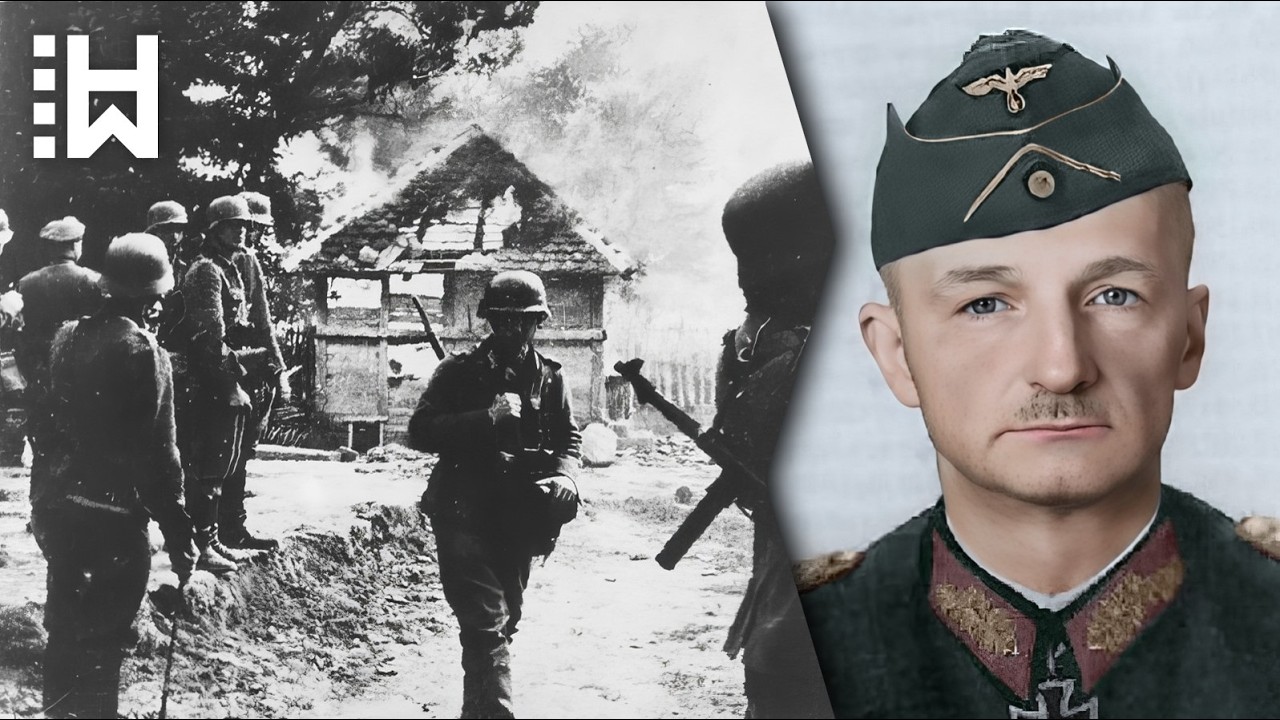
On May 27, 1940, as British and Allied forces retreated toward Dunkirk under relentless German pressure, the 2nd Battalion of the Royal Norfolk Regiment was left behind to hold the line near the small French village of Le Paradis. Surrounded and cut off, the soldiers made their final stand in a farmhouse that was soon destroyed by heavy SS shelling. With ammunition spent and many men wounded, their commanding officer, Major Lisle Ryder, consulted his men and ordered them to surrender. Ninety-nine soldiers stepped out of a cow shed with a white flag, expecting to be treated as prisoners of war under the rules of armed conflict.

Instead, the British captives, most of them wounded, were disarmed and marched to a nearby farmyard. Two machine guns had been set up near a barn. The prisoners were lined up alongside it and shot by German gunners, who continued firing until every man had fallen. The SS commander on the scene, SS-Hauptsturmführer Fritz Knöchlein, then ordered his men to use bayonets to finish off any survivors.
Ninety-seven British soldiers were killed. The Germans forced French civilians to bury the bodies in a shallow mass grave the next day. The massacre took place during the opening phase of Germany’s invasion of France, which began on May 10, 1940. Knöchlein had previously served with the SS-Totenkopfverbände during the invasion of Poland in September 1939, and his unit later became part of the newly formed SS-Totenkopf Division, an elite formation of the Waffen-SS.
As the German advance pushed British and Allied forces toward the coast, a surprising German halt on May 24 gave the Allies a critical window to evacuate more than 338,000 troops from Dunkirk. But some soldiers remained behind to keep fighting, including the Norfolks and the 8th Lancashire Fusiliers, who were tasked with defending several villages in the area. German troops attacked the British at nearby Le Cornet Malo on May 27, with heavy losses on both sides. Meanwhile, the Norfolks at Le Paradis had been informed by radio that they were isolated and would receive no assistance.
Despite the German efforts to cover up the killings, two men survived. Private William O’Callaghan managed to pull Private Albert Pooley alive from among the bodies. The pair hid in a pigsty for three days and nights, surviving on raw potatoes and water from puddles before being discovered by the farm’s owner and her son. Those civilians risked their lives to care for the two men, who were later captured by the German army and transferred to a military hospital.
News of the massacre spread to nearby German divisions and eventually reached General Erich Hoepner, the commander of German forces in France. Hoepner demanded an investigation and called for the dismissal of SS division commander Theodor Eicke if it was proven that British prisoners had been mistreated or killed. Eicke defended himself to Heinrich Himmler, head of the SS, claiming that his troops had been fired upon with illegal dum-dum bullets by the British, which caused excessive injuries. Despite the allegations, Eicke faced no consequences, and the issue was dropped.
The Allies received no information about the massacre until the summer of 1943, when Pooley, who had spent three years in a German hospital because of his injuries, was repatriated to the UK as part of a prisoner exchange organized through the Red Cross. British authorities did not initially believe his story, as it was not thought that the German army was capable of such atrocities against British troops. O’Callaghan did not return to the UK until 1945, after the liberation of his prisoner of war camp. His confirmation of Pooley’s account intensified the hunt for Knöchlein, who was eventually found in a prisoner of war camp in Sheffield and interviewed at the London Cage, a secret British interrogation center operated by military intelligence.
Justice caught up with the perpetrators unevenly. Theodor Eicke, who tried to justify the massacre by claiming British forces used illegal ammunition, was killed on February 26, 1943, when his aircraft was shot down by Red Army anti-aircraft fire south of Kharkov in Ukraine. The SS-Totenkopf Division suffered catastrophic losses as well: between February and May 1942, about 80 percent of its men were killed, wounded, or missing in action after being encircled by the Red Army near Demyansk, south of Leningrad. Knöchlein, who commanded the massacre of 97 British troops, was formally charged with committing a war crime in August 1948 and pleaded not guilty.
His trial began on Monday, October 11, 1948, in Hamburg, with both Pooley and O’Callaghan called to testify against him, along with his former Nazi comrades and the French farmers who witnessed the shootings. During the trial, Knöchlein claimed he was not responsible for the Le Paradis massacre because he had not been present on the day of the battle. He repeated the claim that the British used illegal dum-dum bullets, and he also complained that he had been tortured during his interrogation at the London Cage, saying he was stripped, deprived of sleep for four days and nights, starved, and subjected to harsh treatment. His defense did not save him.
The 37-year-old Knöchlein was found guilty of war crimes, sentenced to death by hanging, and executed on January 21, 1949.