The most successful field commander the United States Army produced in the entire Second World War sat alone in a requisitioned building in a bombed-out Bavarian city on the night of May 7, 1945, with the lights low, writing by hand the exact moment he understood he had lost.
Nineteen hours earlier, the instrument of surrender had been signed in a red schoolhouse in Reims at 2:41 that morning. The guns were to fall silent across the entire continent at one minute past eleven the following night. Outside Patton’s headquarters at Third Army forward command in Regensburg, his soldiers were firing flares into the sky.
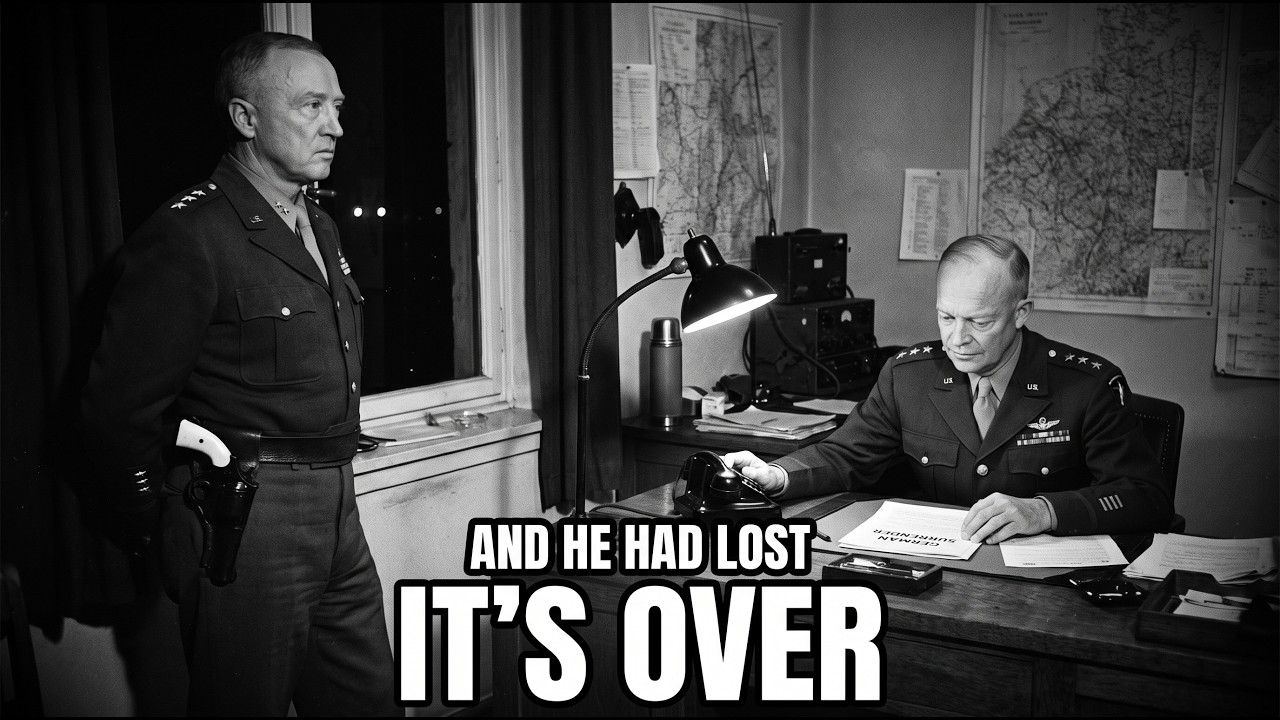 Anti-aircraft crews were emptying their magazines upward for no reason at all except that they finally could. Somewhere down the corridor, a radio was playing.
George Smith Patton Jr. , sixty years old, four stars on his collar, the man the German general staff had spent three years trying to predict, was not celebrating. He was not writing a victory message or an order of the day.
He was setting down the precise coordinates of his own defeat. Because eleven days earlier, something had happened that the newsreels would never show. A decision had been taken, not by Berlin, not by the enemy, but inside the Allied command itself.
A line had been drawn across a map of Czechoslovakia. A telephone had rung at Third Army, and an order had come down through Omar Bradley from Dwight Eisenhower that stopped the fastest army in Europe dead in open country with no enemy in front of it, and a capital city ninety kilometers away calling for help on an open radio channel.
Patton had argued. He had argued harder than he had argued about anything since Sicily. He had been overruled.
And on the night the war ended, the night every other Allied commander in Europe was drinking champagne, he sat alone and set down the words that would define the last 227 days of his life. This is the story of those eleven days, the request, the refusal, the three American generals in the middle of it, and what the war’s most aggressive commander said when he was finally told it was all over. Because Patton did not think it was over.
He thought it had barely started.
To understand the order, you have to understand where Third Army was when it arrived. By the last week of April 1945, the German army in the west had ceased to exist as a coherent organism. It had become a geography of surrenders.
Whole divisions were marching westward under their own officers, unescorted, looking for Americans to give themselves up to before the Red Army reached them. Third Army was taking prisoners faster than it could count them, tens of thousands in a single day herded into fields with a handful of guards and a language problem. Patton’s front was no longer a front.
It was a road network.
On the 18th of April, Third Army crossed into Czechoslovakia for the first time. Patton had spent the war being told to slow down. Now, for the first time, the thing slowing him down was not the enemy and not his superiors, but his own fuel trucks.
His armored spearheads were moving so fast that the maps in the operations tent could not keep pace with the pins. And in front of him lay a prize that no American commander had seriously expected to be available. Prague, the capital of Czechoslovakia, a city of a million people.
Intact. Genuinely intact in a Europe where intact had become an obsolete word. Not bombed flat like Dresden, not fought street by street like Aachen.
Bridges standing, cathedral standing, the old town untouched by five and a half years of war.
Sitting inside it was the last organized German formation of any size on the continent. Army Group Center under Field Marshal Ferdinand Schörner, somewhere near a million men, still in the field, still armed, still technically fighting. Third Army’s leading elements were closer to Prague than the Red Army was.
Let that land for a moment. In the first days of May 1945, the Americans were physically nearer to the capital of Czechoslovakia than the Soviets were. Patton’s reconnaissance units were finding the roads east open, not lightly held, open.
Czech civilians were coming out of villages to meet them, and the word coming back through the interpreters was consistent and urgent. Come to Prague. Come now.
On the 4th of May, Patton went to see Bradley. He did not go with a suggestion. He went with a plan already drafted, already staffed, already timed.
Third Army would drive east on the axis Pilsen-Prague. Two corps. He could be in the outskirts inside forty-eight hours.
He said so plainly, and he said it with the total confidence of a man who had just done exactly this three times in a row across the width of Germany, and had never once been wrong about how fast his own armor could move. And on the 5th of May, the thing that made the request urgent stopped being a matter of strategy and became a matter of blood.
Prague rose. The Czech resistance, organized, armed with whatever they had taken from German depots and convinced that the Americans were coming, seized the radio building, threw up barricades across the bridges, and went into open revolt against the German garrison. Within hours, they held large parts of the city.
Within hours after that, Schörner’s forces began to counterattack with armor and artillery into streets full of civilians, and the Czech National Council began broadcasting in the open, in English, and in Russian, asking anybody who could hear them to come. At Third Army headquarters, they could hear them. The signal sections picked up the appeals.
Staff officers stood in the operations room and listened to a city ask for help in a language they could understand from a distance their own tanks could cover before the next sunset.
Patton picked up the telephone. What happened next was not a failure of communication. It was the opposite.
Every man in the chain understood perfectly what was being asked and exactly what it would cost. The chain ran like this. Patton commanded Third Army.
Third Army belonged to 12th Army Group commanded by Omar Bradley. 12th Army Group answered to Supreme Headquarters Allied Expeditionary Force, to Dwight David Eisenhower, Supreme Commander, the man who had to hold the entire coalition together with his bare hands and had been doing it since 1942. Three Americans, three West Pointers, men who had known each other for decades, whose careers had crossed and recrossed since the 1920s, and whose relative positions were by the spring of 1945 a permanent low-grade wound in at least one of them.
Because in 1943, Patton had been the senior man. Bradley had served under him in Sicily. And after Sicily, after Patton struck two hospitalized soldiers and the story reached the newspapers, the hierarchy inverted.
Bradley went up. Patton went into the wilderness, then came back as an army commander under the man who had been his subordinate. Eisenhower, who had been junior to Patton in the old peacetime army, was now supreme commander of everything.
 Patton never fully absorbed this. He was, by the accounts of everyone who worked closely with him, a man who could take an order and a man who could not take being managed. And by May 1945, he had been managed for two years by two officers he privately regarded as cautious.
So when he asked for Prague, he asked knowing exactly who he was asking. And Eisenhower had already thought about it. On the 4th of May, Eisenhower sent a signal to the Soviet General Staff in Moscow, to General Alexei Antonov, chief of the Soviet General Staff, the man who ran Red Army operations day-to-day.
This was not a courtesy. It was the machinery of the Alliance, working exactly as designed. The two armies were converging on each other at speed in the dark in unfamiliar country with no shared radio procedure and no common language at unit level.
The single greatest fear in both headquarters was not the Germans. It was a collision between allies.
Eisenhower’s signal proposed that American forces advance to the line of the Vltava and Elbe rivers, which would have put Third Army into Prague. Antonov’s reply came back on the 5th of May. It was courteous.
It was also absolutely unambiguous. Do not advance. The Soviets asked the Americans to halt on the agreed demarcation line, the line running roughly Karlsbad-Pilsen-Budweis, and to go no further east.
Antonov’s stated reason was the one Eisenhower had used himself in his own message, the risk of two armies running into each other. He also noted pointedly that the Red Army had halted at Allied request elsewhere. The real reason was understood by everyone who read it in Reims.
Prague was going to be liberated by the Red Army because whoever liberated Prague would shape what Czechoslovakia became afterwards.
That was not a military calculation. It was a political one, and it was consistent with everything the three allied powers had been negotiating since Tehran and Yalta about zones, spheres, and postwar arrangements. Eisenhower received Antonov’s answer and did what he had done for three years.
He complied. And this is the part that matters because it is the part that is almost always told wrongly. Eisenhower did not stop Patton out of timidity.
Eisenhower stopped Patton because he had concluded, and he stated this consistently before and after, that the war’s final weeks should not be spent buying political real estate with American lives, that the boundaries had been settled by governments and not by generals, and that his authority was military. He had no instruction from Washington to race for capitals.
When the question of Berlin had come up weeks earlier, he had reached the same conclusion for the same reason and taken the same criticism for it from Churchill. He was a coalition commander. The coalition had rules.
He enforced them. The order went down the chain to Bradley. Bradley telephoned Patton.
Omar Nelson Bradley is the least dramatic figure in this story and the most important because he was the man who had to say the word out loud. Bradley was everything Patton was not. Quiet, careful with soldiers’ lives to the point that Patton considered it a defect.
A commander who had risen by being consistently unspectacularly right. He had served under Patton and been humiliated by nothing worse than Patton’s noise. And he had never once, in any record we have, taken pleasure in the reversal of their positions.
He was the buffer. That was his actual function in the Allied command. By 1945 he stood between the supreme commander and the most difficult subordinate in the American army, and he absorbed what came off both directions.
On the 6th of May, Third Army’s 16th Armored Division entered Pilsen. The Czechs came out into the streets. American tanks stopped in a European city that was, for the first and only time in that war, genuinely glad to see them and not yet frightened of what was coming next.
Pilsen was on the line, and Prague was ninety kilometers further on. The exchange between Patton and Bradley in those hours is one of the most quoted and least documented moments of the entire campaign.
Multiple accounts, including Bradley’s own later writing, describe Patton pressing the case hard and personally, arguing that the patriots in the city needed help, that his armor could be there in a day, that the Germans in front of him were finished and would not fight. Accounts differ on the exact words. They do not differ on the substance or on the temperature.
Patton asked repeatedly, and Bradley said no. Not because he disagreed with the military assessment. There is no evidence he did.
But because the Supreme Commander had given an order, and the order was lawful and clear. Here is what makes this the hinge of the story rather than a footnote. Patton had disobeyed before.
That was his reputation, and in fairness, sometimes his method.
He had stretched orders in Sicily to reach Palermo first. He had found creative interpretations of boundary lines in France. He had pushed reconnaissance further forward, then authorized more, and apologized afterwards.
Every senior officer in the theater knew that George Patton’s instinct, when handed a restrictive order, was to find the space inside it. At Pilsen in May 1945, with the door standing open and a city calling for help on the radio, he stopped. He stopped because this was not a boundary line between two American corps.
This was a demarcation line between two armies, two governments, and two ideologies agreed at the highest level. Crossing it without authority would not have been insubordination. It would have been foreign policy.
He knew the difference. Whatever else he was, he was not stupid about that.
So Third Army held on the line through the 7th of May and into the 8th, and small American patrols went east and came back, and the radio appeals from Prague continued. And in the operations room at Regensburg, officers stood and listened to a battle they had been forbidden to join. The Prague Rising held out alone.
 Barricades, improvised weapons, German armor in the streets. Thousands of Czechs were killed in those days, the resistance, the civilians caught in it, and the reprisals. The rising was eventually relieved not by the Americans ninety kilometers to the west, but by Soviet forces arriving on the 9th of May after the general surrender had already taken effect.
By then, the shape of the next forty-four years of Czech history was already set.
Now we come to the night itself, the 7th of May, nineteen hours after Reims, Third Army headquarters, Regensburg. Patton kept a diary throughout the war in his own hand, in a private and frequently impenitent voice. He also wrote constantly to his wife Beatrice, letters in which he said things he would never put in an official cable.
Between the diary and the correspondence, we have something almost no other commander of that rank left behind. A near-daily record of what he actually thought, unfiltered, including the parts that damaged him. What that record shows about early May 1945 is not triumph.
It is not even disappointment in the ordinary sense. It is grief, and it is fear, and the two are pointing in the same direction.
Three things run through everything he wrote in that period. The first is that he believed the war had been stopped one country too early, not out of blood lust. The record is clear that he considered the German army finished and expected no serious fighting.
He believed that ground given away in May 1945 would have to be bought back later at a far higher price, and that the men who had been told they were fighting for the liberation of Europe had liberated only the western half of it. The second is that he had already identified the next enemy, and it was the ally. Patton’s private views on the Soviet Union in 1945 were harsh, sweeping, and expressed in language that is genuinely ugly to read now.
He had met Soviet officers. He had watched Soviet units operate. He had reached a conclusion that this was not a partner, but an adversary in a temporary costume, and he held it with the same total certainty with which he held every other conclusion he ever reached.
He wrote that the Americans would have to fight them eventually, and that the American army would never again be as strong, as experienced, or as well positioned as it was that week. And the third is the most personal and the one that explains the last seven months of his life. He had nothing left to do.
For Patton, war was not an interruption of a career. It was the career, the identity, and in a sense, he wrote about it openly and without embarrassment.
The purpose he had spent his adult life preparing for was exactly the twenty-two months he had just finished. He was sixty. There would not be another one.
The famous sentiment he returned to again and again in his letters, that the tragedy of a soldier’s life is surviving his last war, was not a pose. It was a diagnosis, and he made it of himself. So the answer to the question of what he said that night is not a single quotable line.
Anyone who hands you one clean sentence and tells you Patton said it that night is selling you something. What he said across the diary and the letters of those days was three things at once, and they were the same thing. That the war had ended in the wrong place.
That the alliance that won it would not survive it. And that he had been the sharpest instrument the United States possessed at the exact moment when the United States decided it no longer wished to cut anything.
That is what he meant by having lost. Not the war. He had won more of it than almost anyone.
He meant the argument. He had been overruled on the largest strategic question of his life by two men he had known for twenty years. And he was certain, with the whole force of his certainty, that history would show he had been right.
He would never find out. And there is one more layer to it, which is the hardest to say and the truest. Patton was not only angry at the decision.
He was angry at who had made it. If the order to halt at Pilsen had come from Washington, from Roosevelt, or from Truman, who had been president for less than a month, Patton could have filed it under politics and despised it from a distance. Soldiers are allowed to despise politics.
It costs them nothing.
But it had not come from Washington. It had come down a chain made entirely of soldiers, from Eisenhower, who had been a major when Patton was a colonel, through Bradley, who had taken orders from him in Sicily. Two men who had come up through the same army, the same academy, the same small interwar officer corps where everybody knew everybody, and who had both, in Patton’s reading of it, chosen caution at the one moment in their lives when caution was the expensive option.
He could not accuse them of cowardice. He knew them too well, and they had both been proved too thoroughly. So he was left with something worse and less nameable.
The conviction that the profession he had given his entire life to had produced, at its summit, men who would do the correct thing rather than the necessary one. That is the sound in the diary entries of early May 1945. Not defiance.
Isolation.
He was the only one in the room who believed what he believed. And the room contained every man he respected. What happened next was not a fall.
It was a slow, entirely predictable collision between a man built for one job and a world that had stopped offering it. In the summer of 1945, Patton was made military governor of Bavaria. Consider the fit.
The task required patience, political sensitivity, administrative discipline, and the careful sorting of an entire society into the guilty, the complicit, and the merely present. It required, above all, the ability to say nothing controversial to a journalist. He held the post for roughly five months.
The core of the trouble was denazification. The policy required removing former Nazi party members from positions of authority across the occupation zone.
 Patton’s practical objection, and he made it repeatedly to his own staff and to visiting officials, was that Bavaria’s water, power, rail, and food distribution had been run by party members, because in the Third Reich, almost every professional post required party membership, and that removing all of them at once would produce a hungry, freezing, disease-ridden province by winter. There was a real administrative argument buried in that, and other officers made versions of it more carefully. Patton did not make it carefully.
On the 22nd of September 1945, at a press conference, he compared party membership to belonging to one of the two American political parties. The kind of remark that might pass in a private mess and cannot survive contact with a notebook. It ran in the newspapers within days.
To a public that had spent that spring reading about Dachau and Buchenwald, it read as an American general shrugging at the Nazi party five months after the camps were opened.
Eisenhower again. Eisenhower called him in. On the 2nd of October 1945, Patton was relieved of command of Third Army.
He was not dismissed from the service. He was moved to 15th Army, a headquarters organization compiling the operational history of the war in Europe. A desk.
Records, the writing up of other men’s battles, including his own, in the past tense. It is difficult to design a crueler posting for that specific man, and there is no evidence anyone intended cruelty. It was simply the only place left to put him.
He knew exactly what it was. His letters home that autumn are those of a man watching his own obituary being typed while he is still in the room.
On the 9th of December 1945, on a road near Mannheim, the staff car Patton was riding in collided with a truck at low speed. It was an unremarkable accident. Nobody else was seriously hurt.
Patton’s neck was broken, and he was paralyzed from the neck down. He lived twelve days in a hospital in Heidelberg, conscious, lucid, and fully aware of his condition. He died on the 21st of December 1945 at the age of sixty.
He was buried, at his own expressed wish and by his wife’s insistence, among his soldiers in the American cemetery at Hamm in Luxembourg, alongside the men of the Third Army who had died in the Ardennes the winter before. Seven months and thirteen days after Pilsen.
This is where an honest account has to slow down, because the easy version of this story is very easy indeed, and it is wrong in both available directions. The easy version says Patton was a prophet and Eisenhower was a bureaucrat who handed half of Europe to Stalin out of politeness. The other easy version says Patton was a dangerous romantic who wanted to start a third world war before the second one had finished burning.
Neither survives contact with the record. On the first point, Patton was right about the outcome. He was right that the demarcation lines of 1945 would harden.
He was right that Czechoslovakia would not be free. The communist seizure of power came in February 1948, and Prague would not choose its own government again until 1989.
He was right that the wartime alliance was already over in everything but name. And he said so while the champagne was still being poured. Within two years, the containment doctrine was American policy.
Within four, NATO existed. Within five, Americans were fighting a communist army in Korea. He read the next twenty years correctly from a headquarters in Bavaria in May 1945 while almost everyone senior to him was still talking about postwar cooperation.
And on the second point, Eisenhower was also right about what was actually on the table, because taking Prague would not have changed the outcome. The demarcation line was not a military accident. It was the physical expression of agreements between three governments.
Had Third Army driven into Prague on the 7th of May, the Americans would have been required to withdraw west to the agreed line within weeks, as they in fact did elsewhere in Germany, pulling back from territory they had taken in Thuringia and Saxony that summer because it lay in the Soviet zone.
Prague would have been liberated by Americans, photographed, and then handed over. For it to have meant anything permanent, the United States would have had to be willing to break with the Soviet Union then and there in May 1945, with a war against Japan still unfinished, with an American public that wanted its sons home by Christmas, and with the Red Army at its wartime peak sitting on the ground it had taken at a cost of tens of millions of dead. No American government was going to do that.
Eisenhower had no authority to do it, and he was correct that it was not a decision for a soldier to take by driving tanks somewhere and creating a fact. So both men were right about different questions, and the tragedy is exactly that. Patton was right about what was coming.
Eisenhower was right about what could be done.
The gap between those two truths is the space where the Cold War was born. And it is also the space where Patton spent the last seven months of his life alone, furious, and unable to explain to anybody why victory felt like defeat. That is what he was writing on the night of the 7th of May, 1945, nineteen hours into the peace, while his soldiers fired flares over Regensburg.
Not that the war was lost, but that the next one had already been decided and nobody would let him fight it. There is a photograph taken of Patton in those last months. He is in uniform, four stars, standing straight, and the face is not the face from the newsreels of 1944.
Something has gone out of it. The man in that photograph had commanded a quarter of a million soldiers, crossed two of the great rivers of Europe, relieved Bastogne in the worst winter in living memory, and driven further and faster than any American army ever has. He had done all of it in under two years.
And then, on a road in Czechoslovakia, ninety kilometers short of a city that was asking him to come, he had been told to stop by his own side for reasons that were correct, and he never got over it. Eisenhower went on to become president of the United States. He spent eight years managing exactly the confrontation Patton had predicted.
And he managed it by not fighting it, which was, in the end, the same instinct that had stopped Third Army at Pilsen. Bradley became the first chairman of the Joint Chiefs of Staff and the last five-star general the United States has ever commissioned. Patton got seven months.
But of the three of them, it was Patton who saw the shape of what came next most clearly, from the wrong chair, at the wrong moment, with no power left to do anything about it. Which may be the most complete description of his entire career that anyone has ever managed.