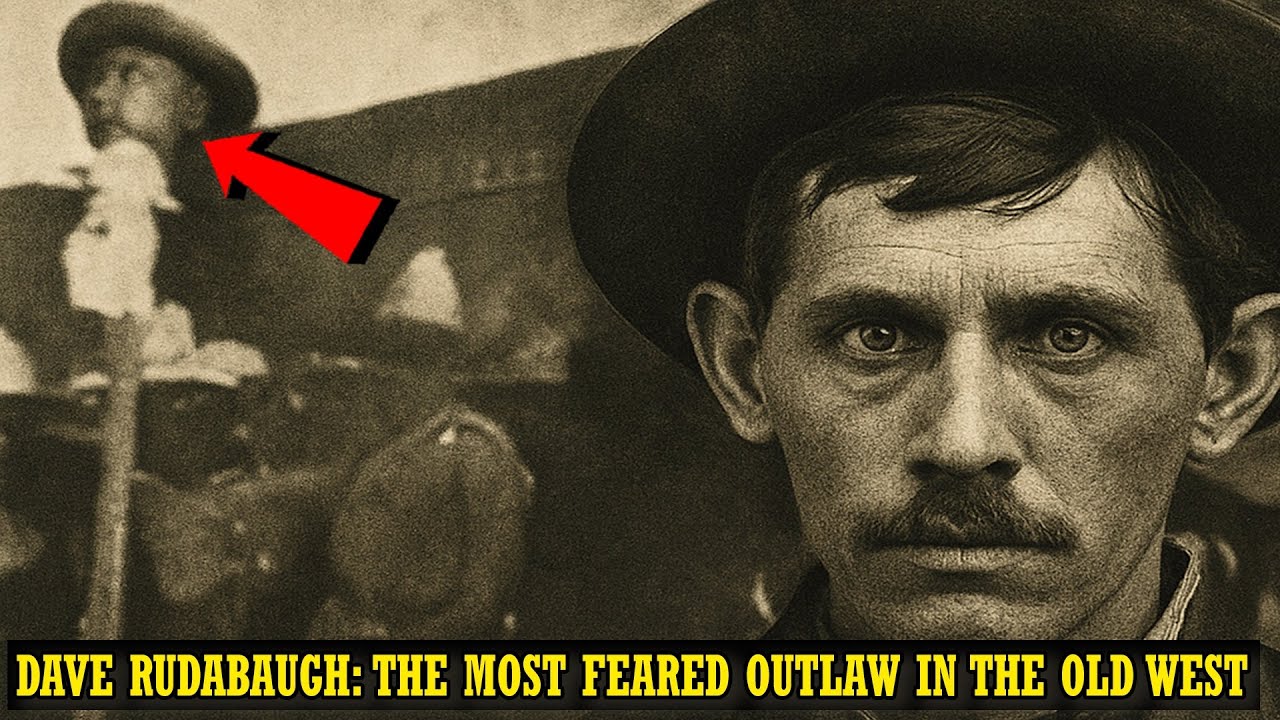
They called him Dirty Dave, and even among the bloody legends of the American Old West, David Rudabaugh stood out for the wrong reasons. A gunslinger, rustler, train robber, and hired gun with a reputation so ruthless that even Billy the Kid reportedly kept an eye on him. He cheated death repeatedly, but his life ultimately ended in a manner as grim as the frontier he roamed. Historians and writers in recent years have attached the nickname “Dirty Dave” to Rudabaugh, citing anecdotes about his supposed aversion to bathing.
Notably, no contemporary accounts from his lifetime support this label. The name likely reflects modern storytelling conventions rather than authentic 19th-century descriptions, making it a case of legend overtaking documented fact. Rudabaugh’s life began in Fulton County, Illinois, in 1854. His early years were marked by personal loss when his father died while serving during the Civil War.
Following this tragedy, the family relocated several times, first moving to Ohio and eventually settling in Kansas. During the late 19th century, Kansas was a rapidly changing region transitioning from frontier territory to a more settled part of the country, offering both opportunity and conflict for young men without a strong support system. Rudabaugh’s reputation as an outlaw took clearer shape in the early 1870s during his time in Arkansas, where he associated with men operating outside the law through theft and cattle rustling. Among his known associates were Milton Yarberry, who later became a controversial lawman in New Mexico, and a figure known as Mysterious Dave Mather.
These men operated less like a formal gang and more as a shifting alliance driven by opportunity. Their activities drew the attention of local authorities, particularly after suspicions arose around the death of a local rancher. Although no formal charges appear to have been filed, the scrutiny was intense enough that all three men left Arkansas. Historical accounts diverge at this point, with some suggesting Rudabaugh moved to Decatur, Texas, while others believe he traveled north to the Black Hills of South Dakota, where he allegedly turned to stagecoach robbery.
Around 1876, Rudabaugh reportedly teamed up with Mike Rourke and Dan Deant to form a group later dubbed the Trio by historians. While the specifics of their exploits remain vague, they appear to have cooperated on various thefts and possibly fraudulent gambling. An intriguing but unverified story claims Rudabaugh taught Doc Holliday how to handle a pistol, while Holliday returned the favor by teaching Rudabaugh gambling strategies. In October 1876, Rudabaugh allegedly participated in the robbery of a construction camp along the Santa Fe railroad line.
Following this incident, he fled southward, evading local law enforcement. His escape prompted authorities to act, and Wyatt Earp was temporarily commissioned as a deputy U. S. marshal.
Earp left Dodge City and tracked Rudabaugh across more than 400 miles. Rudabaugh reached Fort Griffin, Texas, just days ahead of his pursuer. When Earp arrived, he made his way to the town’s largest establishment, the Shanssey Saloon. The owner mentioned that Rudabaugh had recently passed through and suggested Earp speak with a local gambler named Doc Holliday, who had played cards with him.
This meeting between Earp and Holliday proved pivotal, not only in the pursuit of Rudabaugh but also in forming one of the most legendary friendships in Old West history. Holliday told Earp that Rudabaugh might be heading back toward Kansas. Acting quickly, Earp relayed this intelligence via telegram to Bat Masterson, contributing to Rudabaugh’s eventual apprehension. Rudabaugh’s involvement in train robbery began in early 1878, an era when such crimes were increasing due to the growing presence of railroads.
On January 22 of that year, Rudabaugh and his gang attempted to rob a train near Kinsley, Kansas, but the operation failed entirely. Law enforcement responded swiftly, and the very next day a posse assembled under Bat Masterson’s leadership. Masterson was joined by John Joshua Webb, who would play a recurring role in Rudabaugh’s life. Together, they apprehended Rudabaugh and one accomplice, Ed West.
Facing serious consequences, Rudabaugh agreed to cooperate with the prosecution in exchange for immunity, a strategy not uncommon in the Old West. Following his release, he accepted an offer from Bat Masterson to join a group of hired gunmen working for the Atchison, Topeka, and Santa Fe Railway. Railroad companies were engaged in fierce rivalries known as the railroad wars, prompting them to employ armed men for protection and intimidation. During this period, Rudabaugh developed a close alliance with John Joshua Webb, the same man who had helped arrest him months earlier.
They traveled together to Las Vegas, New Mexico, where they became active members of the Dodge City Gang, a loosely organized group of gamblers, saloon operators, and toughs who exerted considerable influence over the town’s political and economic life. By the spring of 1880, trouble began brewing within the gang. John Joshua Webb was arrested and charged with murder, placing him in serious legal jeopardy. On April 5, Rudabaugh and another gang member tried to break Webb out of jail.
The escape attempt failed, and in the midst of the chaos, Deputy Sheriff Antonio Lino Valdez lost his life. This incident made Rudabaugh a more urgent target for law enforcement and marked a turning point in his downward spiral. After the failed jailbreak, Rudabaugh fled southeast and made his way to Fort Sumner, New Mexico, a known gathering spot for figures living on the edge of the law. There, he became affiliated with a group of outlaws, one of whom was Billy the Kid.
Their time together came to an abrupt end at Stinking Springs near what is now Taiban, New Mexico, where a posse led by Pat Garrett surrounded and captured the group. Initially, the captives were taken to Las Vegas, but tensions were high over past incidents, particularly the death of Deputy Valdez. Authorities transferred Rudabaugh and the others to Santa Fe to face formal legal proceedings in a controlled setting. In February 1881, Rudabaugh appeared before the court and entered a guilty plea to multiple charges related to mail theft.
The court responded with a sentence of 99 years in prison. Soon afterward, he was also found guilty in connection with the death of Deputy Valdez, a case that had stirred deep resentment in the Las Vegas community. As a result, he was handed an additional sentence: capital punishment. While awaiting execution, Rudabaugh was held in jail, where he was reunited with his old ally John Joshua Webb.
At one point, the two attempted an escape during which another inmate, Thomas Duffy, lost his life under unclear circumstances. Though the attempt failed at first, Rudabaugh and Webb eventually managed to break free. Rudabaugh fled westward into Arizona territory, where he is believed to have aligned himself with the Clanton faction, a group in bitter conflict with the Earp brothers serving as lawmen in Tombstone. While there is no definitive proof, several accounts suggest Rudabaugh may have played a role in the ambush of Virgil Earp and the fatal attack on Morgan Earp.
He is also speculated to have been present at Iron Springs, where Curly Bill Brocius lost his life in a shootout with Wyatt Earp. Much of this remains part of Western lore rather than hard evidence. After the Clanton faction dissolved, Rudabaugh crossed the border into Mexico in search of a new beginning. He settled in the northern region around the town of Parral in Chihuahua, where he reportedly found work as a cowboy and, according to some accounts, became involved in livestock theft.
On February 18, 1886, Rudabaugh became involved in a dispute during a card game, an all-too-common spark for personal conflict in the Old West. In the aftermath, two men reportedly lost their lives and another was injured. Rudabaugh managed to leave the establishment unharmed. However, upon realizing he had lost track of his horse, he returned to retrieve it.
That decision proved fatal. Upon re-entering the saloon, Rudabaugh sustained multiple gunshot wounds and did not survive. Local tradition holds that his body was desecrated and publicly displayed, acts occasionally carried out in frontier communities as a symbolic warning. Over the years, legends about Rudabaugh’s final days have multiplied.
One version claims he was killed near Creede, Colorado, but this tale is not supported by historical evidence and likely confuses him with other outlaws of the period. What remains indisputable is Rudabaugh’s remarkable ability to appear at pivotal moments in Old West history. He was the only known outlaw to have crossed paths with a remarkable lineup of Western icons: Dave Mather, Bat Masterson, Pat Garrett, Wyatt Earp, Billy the Kid, and Doc Holliday. His life reflected the chaotic energy of the American frontier—unpredictable, unrooted, and endlessly entangled with the era’s lawmen, drifters, and dreamers.
From Dodge City to the dusty cantinas of Mexico, his life reads like a who’s who of Western legend and a cautionary tale about how quickly the line between outlaw and legend could blur.