On July 3, 1941, just 11 days into Germany’s invasion of the Soviet Union, Army Chief of Staff Franz Halder wrote in his diary that the campaign would likely be won within two weeks. It lasted four more years. The men who survived left behind letters and secret recordings, and what they said about the enemy bore little resemblance to the official picture. When Operation Barbarossa launched on June 22, 1941, most German soldiers crossed into Soviet territory carrying a confident set of assumptions.
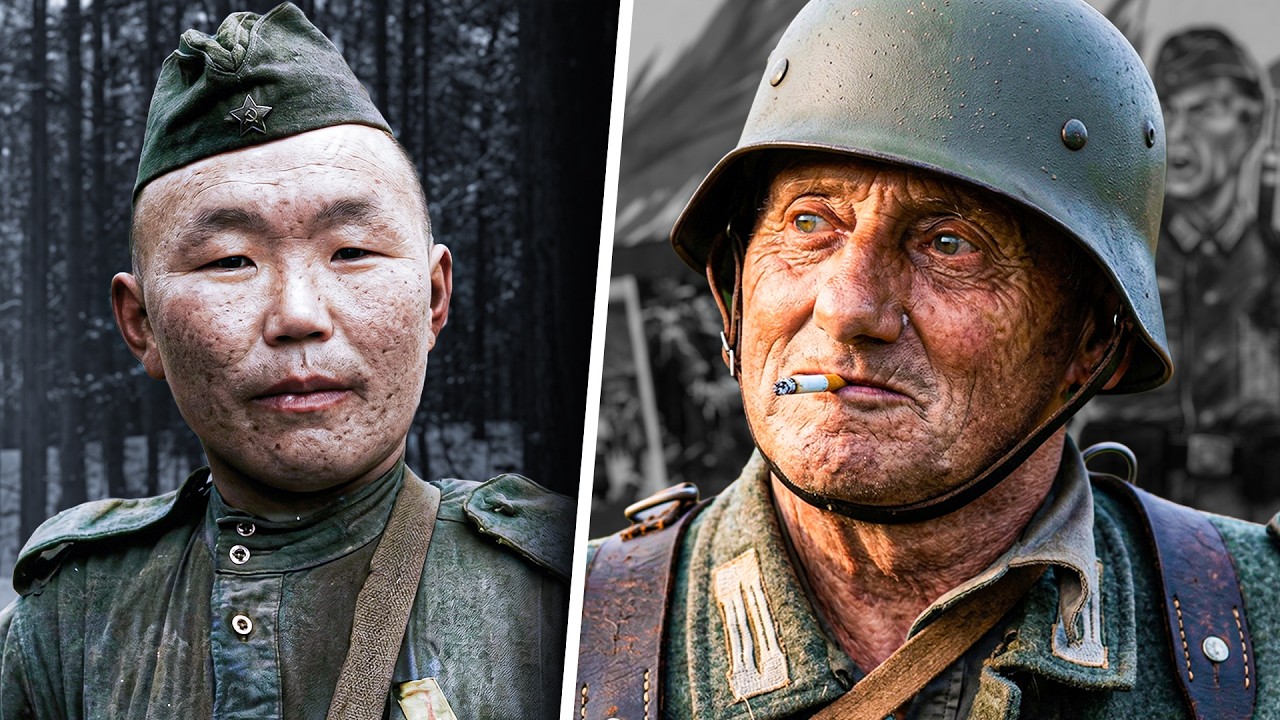
Political education sessions held in the months before the invasion had reinforced a consistent message: the Red Army was poorly trained, ideologically coerced, and led by incompetent commissars who held their men at gunpoint. Official pamphlets distributed through Wehrmacht units described the Soviet soldier as racially inferior and militarily negligible, and many men believed them. Letters home from the first weeks struck a brisk, optimistic tone. Historian Klaus Latzel, who analyzed thousands of German Feldpost letters written between 1941 and 1944, found that soldiers’ correspondence frequently echoed official propaganda.
Men wrote about rapid advances, enormous prisoner columns, and the apparent disintegration of Soviet resistance. The first signs that something was wrong appeared almost immediately. German forces expected Soviet soldiers to surrender quickly when encircled. In the border battles of late June and early July 1941, some units did collapse under the shock of the initial assault, but others did not.
Encircled Soviet formations continued fighting from forests and marshes, attacking German supply lines, and refusing to accept that the battle was over. German units moving east reported ambushes in areas they thought had already been cleared. Then came the armor. When German anti-tank crews encountered the Soviet T-34 in significant numbers during the summer of 1941, standard 37-mm rounds bounced off its sloped hull at normal combat ranges.
The vehicle outclassed most German tanks of the period in both protection and firepower. German commanders sent urgent reports requesting heavier anti-tank equipment, and some crews facing T-34s with ineffective weapons resorted to planting explosive charges by hand. By October 1941, the tone of German letters had begun to shift. Where optimistic early dispatches had described rapid advances and imminent victory, later correspondence spoke of confusion, fatigue, and an enemy that refused to break.
The Red Army had absorbed catastrophic losses in the opening months and was still fighting. According to Latzel’s research, references to a quick victory had already begun fading from private correspondence by this point. In November 1941, German forces stalled outside Moscow. Temperatures along the central front dropped to minus 35°C in places, and the Wehrmacht had not been equipped for it.
Soldiers wrapped newspaper inside their boots, used engine oil that froze overnight, and fired weapons that jammed in the cold. Supply lines stretched hundreds of kilometers east and could not keep up with demand for winter clothing, fuel, or spare parts. The Soviet soldier they faced that winter operated in a fundamentally different way. Red Army units moved through forests at night in white camouflage that made them nearly invisible against snow.
They launched attacks in temperatures that paralyzed German defensive responses, striking positions where men were too cold to react quickly, and withdrawing before reinforcements could arrive. German field reports from December 1941 and January 1942 described an enemy who navigated terrain Wehrmacht units could not cross and pressed attacks in conditions Germans had assumed would halt all movement. This forced a rethinking that went beyond tactics. German soldiers had been told they were fighting an enemy incapable of initiative, dependent on fear and compulsion.
What they observed instead were men who navigated winter terrain without hesitation, exploited darkness, and responded to field conditions with apparent ease. Historian Omer Bartov described the result as a kind of split consciousness, where ideological belief and battlefield experience existed side by side, neither fully canceling the other out. Soviet infiltration tactics added a psychological dimension that wore on German units throughout the winter. Soldiers would slip through gaps in defensive lines at night, cut telephone wire, and position themselves behind German positions before dawn.
The uncertainty was exhausting. Units that had pressed forward through open country in summer now spent nights listening for movement in the treeline. By the spring of 1942, the shift in German correspondence had become unmistakable. Letters that had once described Soviet soldiers dismissively now recorded frustration, caution, and in some cases grudging acknowledgment of their endurance.
In August 1942, German forces entered Stalingrad. Senior commanders expected it to fall within the week. Five months of close-quarters fighting followed. Urban combat dismantled the tactics that had carried the Wehrmacht across open ground.
Soviet defenders used the rubble of bombed buildings as fortified positions, tunneling between basements, placing snipers in collapsed stairwells, and launching counterattacks from sewers and factory floors. Ground cleared in the morning was often reoccupied by nightfall. German units measured their daily advances in meters rather than kilometers. Soviet snipers became a particular source of psychological pressure.
Vasily Zaytsev, operating inside the city with the 284th Rifle Division, accumulated 225 confirmed kills between November and December 1942 alone. He was one of many. German soldiers moving between positions in daylight faced a constant threat of fire from a concealed location they could not identify. Units began moving at night, abandoning daylight patrols in contested areas.
Then there were the forces German soldiers had not been told to expect at all. The 588th Night Bomber Regiment, a Soviet all-female unit that became known as the Night Witches, flew over 23,000 combat sorties during the war, including raids over the Stalingrad front. Flying light biplanes at low altitude with engines cut to reduce sound, they dropped bombs on German positions in near total darkness. Across the wider Soviet military, approximately 800,000 women served in active roles, including as pilots, snipers, tank crew, and frontline medics.
On February 2, 1943, Field Marshal Friedrich Paulus surrendered the remnants of the German 6th Army at Stalingrad. Approximately 91,000 men went into Soviet captivity. Writing after the war, General Erhard Raus, in a report compiled for the US Army in 1950, noted plainly that Soviet forces had become measurably more capable as the war progressed, refining their tactics, improving logistics, and learning from early defeats in ways German commanders had not anticipated. The clearest window into what German soldiers actually thought about their Soviet opponents did not come from official reports or postwar memoirs.
It came from conversations they believed were private. Starting in 1940, British intelligence housed German prisoners of war at Trent Park, a country estate in North London. The rooms and gardens were wired with hidden microphones. Prisoners spoke freely, unaware they were being recorded, and the transcripts ran to approximately 150,000 pages.
In 2011, historians Sönke Neitzel and Harald Welzer published a systematic analysis of those recordings. What emerged was a portrait of German soldiers that differed significantly from wartime propaganda. In private conversations, prisoners acknowledged Soviet resilience, commented on the skill of Red Army units they had faced, and expressed a respect they would not have voiced in official contexts. The language still contained the ideological framing of their upbringing, but underneath it ran a consistent thread of recognition.
These were not the helpless, driven conscripts that pamphlets had described. Klaus Latzel’s broader analysis of German Feldpost correspondence confirmed the same pattern through a different source. Letters written in 1941 and letters written in 1943 described different wars. The early confidence gave way to more measured and often grimmer assessments.
Soldiers wrote about Soviet units that recovered quickly from losses, about an enemy that contested every building and every treeline, about a front that gave no sense of approaching an end. Postwar memoirs by senior German commanders reinforced what private letters and secret recordings had already established. Field Marshal Erich von Manstein and General Heinz Guderian both credited Soviet forces with significant tactical and operational improvement over the course of the war. Their accounts noted that Red Army commanders improved faster than German planners had anticipated, that Soviet industry replaced losses at a scale that repeatedly surprised German intelligence, and that the individual Soviet soldier proved far more capable than pre-war assessments had suggested.
The sources taken together reveal a gap that widened steadily between 1941 and 1945. German soldiers entered the Soviet Union carrying an ideological certainty about the enemy they would face. The battlefield returned a different answer month after month, year after year. By the time the war ended, the men who survived it understood exactly who they had been fighting.
The propaganda had told them otherwise. Four years and millions of lives later, the evidence was impossible to ignore.