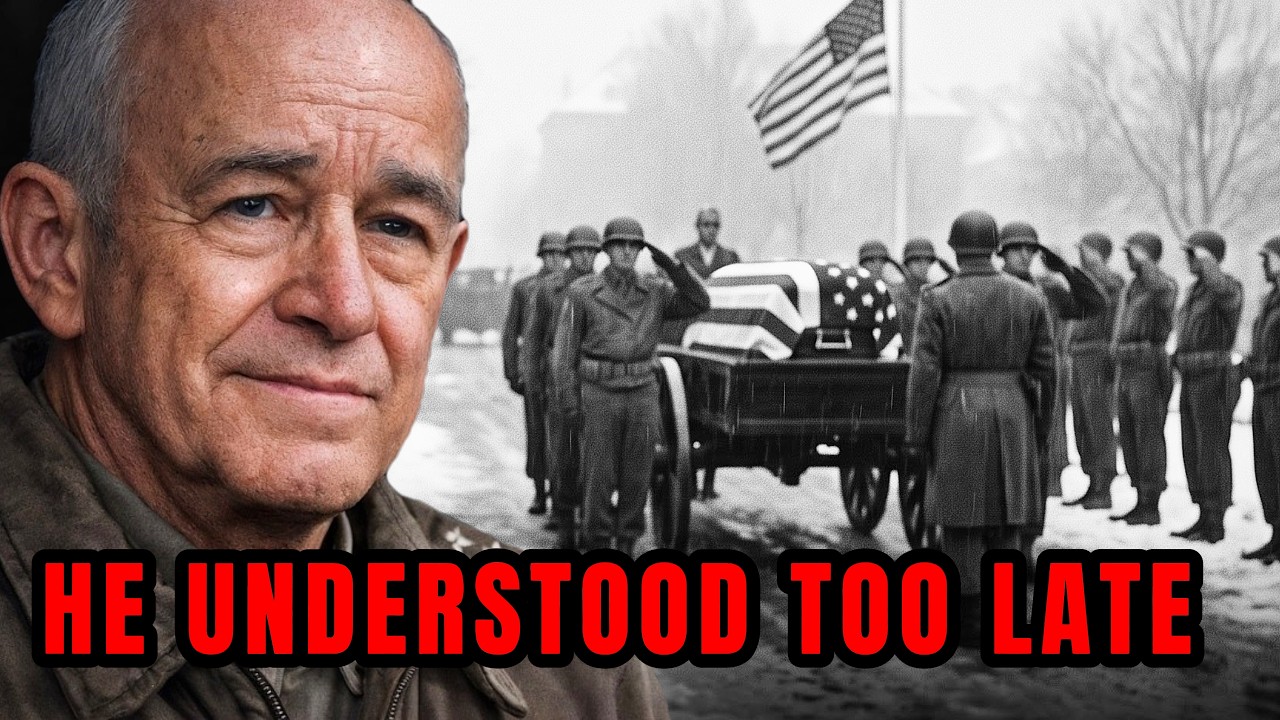
The silence from the flag-draped coffin in the cold Heidelberg winter of 1945 was deafening. General Omar Bradley, the architect of American victory in Northwest Europe, stood among the mourners as the guns fired their final salute for General George S. Patton.
The world saw a hero being laid to rest. Bradley saw something infinitely more complex, a force of nature that had been indispensable, terrifying, and ultimately impossible to fully contain. He said nothing that day, offering only clipped, polite condolences to the press, and he would maintain that public reticence for years, leaving the most powerful verdict on Patton’s legacy unspoken until the moment he chose to deliver it in print, a confession that would forever alter the historical calculus on the most controversial American commander of the war.
 The admission came in 1951, buried within the pages of Bradley’s own memoir, A Soldier’s Story. It was not a eulogy dripping with praise, nor a damning indictment. It was a stark, unvarnished acknowledgment that Patton’s value lay not in his perfection, but in his sheer, relentless effectiveness.
That single distinction, between the ideal commander and the one who actually wins the brutal, bloody business of war, became the lens through which historians would forever re-examine Patton’s campaigns, his excesses, and his indispensable role in shortening the conflict. To understand why Bradley’s words carried such seismic weight, one must journey back to the scorched earth of Sicily in July 1943, where their partnership was forged in fire, dust, and a fundamental clash of military philosophy.
The Mediterranean dawn on July 10th, 1943, was a spectacle of unimaginable scale. Nearly 3,000 ships and landing craft stretched to the horizon, carrying more than 150,000 Allied soldiers toward the rugged shores of Sicily for Operation Husky, the largest amphibious invasion in history up to that point. The objective was clear and urgent, knock Italy out of the war and open a northern road into Europe.
British forces under the methodical General Bernard Montgomery pushed from the southeast, while Patton’s newly formed Seventh Army landed along the southern coast. Serving under Patton was a studious, cautious corps commander named Omar Bradley, leading the US Second Corps. Allied planners had anticipated weak resistance, but they were catastrophically wrong within hours, as elements of the elite Hermann Göring Panzer Division launched vicious counterattacks, and the island’s brutal terrain, with its narrow roads, steep hills, and ancient stone towns, turned into a natural fortress that slowed the invasion to a grinding crawl under a blazing 40-degree sun
Bradley read the unfolding stalemate with a calculator’s precision. Consolidate the beachheads. Secure the tenuous supply lines.
Protect the infantry from costly, pointless assaults. Avoid casualties that didn’t buy a strategically necessary objective. Patton, staring at the exact same maps, saw only a clock ticking against them.
To him, speed was survival itself. Every hour lost was an hour for the Germans to dig deeper into the mountain passes. For the first time, two command philosophies that would define the entire European theater collided head-on on the same island, one trusting calculation, the other trusting pure, unadulterated momentum
By late July, the Allied advance had nearly stalled completely, with German forces conducting a masterful delaying action, blowing bridges and mining roads behind them. Montgomery demanded supply priority for his British push, leaving American forces scraping by on leftovers. Patton refused to accept the role of a spectator.
In a decision that shocked Allied headquarters and bordered on insubordination, he unilaterally changed his army’s mission, ordering a rapid, armored drive west toward Palermo instead of the cautious eastward advance. Officers called it reckless, unnecessary, even dangerous. Patton called it a weapon.
His forces covered nearly 100 kilometers in just three days, entering Palermo on July 22nd, 1943, where over 50,000 Italian soldiers surrendered en masse. American morale skyrocketed, but the campaign was far from over, as the Germans were already evacuating northeast toward the vital port of Messina, setting the stage for a frantic race
The race for Messina became the crucible of the Bradley-Patton relationship. Patton pushed his men mercilessly, day and night, with armored columns grinding along narrow coastal roads, infantry leapfrogging German positions via risky amphibious landings, and artillery firing almost without pause. Bradley watched the advance with a growing mix of awe and dread.
 Supply lines stretched to the breaking point, fuel ran desperately short in forward units, and the flanks were dangerously 𝓮𝔁𝓹𝓸𝓼𝓮𝓭. Bradley saw vulnerability in every mile of open ground, a potential trap that could isolate and annihilate entire American formations. Patton saw only the prize, the glory of arriving first.
Two commanders, two different wars, staring at the same map. On August 17th, 1943, Patton’s forces entered Messina first, hours ahead of the British. The race was won, but it carried a heavy asterisk, as historians later noted the amphibious leapfrog landings cost real casualties for what was, by then, a largely symbolic finish line.
It was an early template for a pattern that would follow Patton for the rest of the war, genuine tactical brilliance purchased with a chilling willingness to spend lives on the difference between arriving first and merely arriving on schedule
It was in the midst of that brutal race, in early August 1943, that Patton’s aggression transformed from a command philosophy into a genuine liability that nearly destroyed his career. Visiting field hospitals to inspect his wounded, Patton encountered two soldiers suffering from what doctors diagnosed as combat exhaustion, what we now understand as post-traumatic stress. Patton, reading their condition as simple, unforgivable cowardice, exploded in fury.
He slapped one soldier across the face with his gloved hand. Days later, at another hospital, he struck a second soldier, this time threatening to have him shot on the spot. The story reached Eisenhower rapidly, and war correspondents in theater, initially agreeing to suppress the story out of respect for the ongoing campaign, eventually broke it publicly back home.
The backlash was immediate and ferocious. Congressmen demanded his removal, editorials questioned his fitness for command, and Eisenhower seriously considered relieving him outright. Patton’s career was saved only by a forced public apology and quiet advocacy from senior officers, Bradley included, who argued a deeply uncomfortable proposition, that the same raw aggression that produced that ugly scene in a field hospital was inseparable from the aggression that had just captured Palermo in three days.
Bradley never defended the slapping itself, but he defended the complex, troubling idea that Patton’s effectiveness and his flaws were forged from the same steel
The dynamic shifted dramatically in June 1944, with the launch of Operation Overlord. Bradley now commanded the entire US First Army, fighting through the treacherous, dense hedgerows of Normandy, terrain that turned every single field into a fortress. For weeks, American forces gained only a few kilometers at a time against deeply entrenched German defenses.
Then, on July 25th, 1944, Operation Cobra unleashed a massive aerial bombardment near Saint-Lô that shattered the German crust. Bradley ordered the breakthrough, and it was the moment Patton had been waiting for his entire career. Within days, his newly activated Third Army surged into open France with a speed that outpaced the supply trucks meant to feed it.
Entire German formations collapsed or retreated in panic. Cities fell without the prolonged sieges anyone had planned for. Bradley later admitted that Patton moved so fast that Allied headquarters itself struggled to keep pace with its own army on the map.
 But speed created its own mortal danger, as fuel shortages reappeared, flanks stretched thin again, and the specter of encirclement loomed large
That specter nearly became a devastating reality on August 7th, 1944, when German forces launched a major counterattack at Mortain, driving directly at the narrow, vulnerable corridor Patton’s advancing columns depended on for supply and survival. For several tense, agonizing days, Bradley’s worst-case scenario seemed imminent, a spearhead army cut off from its own lifeline by an enemy everyone had assumed was too broken to counterattack. American forces held the shoulder of the attack, aided heavily by allied air power finally getting clear weather, and the German thrust ultimately failed.
Patton’s advance continued, largely unbroken, but for those few days, theid between Bradley’s caution and Patton’s aggression ceased to be an abstract debate and became a genuine question of whether an entire American army was about to be encircled and destroyed. Bradley saw the risk. Patton saw the opportunity.
The gap between their readings of the same battlefield defined the campaign once again
That gap was tested one final, climactic time in December 1944, when Hitler launched his last desperate gamble through the Ardennes, the Battle of the Bulge. Bradley, now commanding the entire 12th Army Group, watched part of his own front collapse under the initial German onslaught. In a moment of supreme crisis, he turned almost instinctively to the one subordinate he trusted to move faster than the crisis itself was spreading.
Patton’s Third Army, facing entirely the wrong direction at the start of the battle, executed a stunning 90-degree pivot and drove toward the besieged, freezing town of Bastogne in a matter of days, a feat that defied any standard planning timetable. It was the same pattern from Sicily and Normandy, played out on a larger stage with infinitely higher stakes. Bradley provided the structure, the trust, the strategic containment.
Patton provided the impossible speed that nobody else in the theater could deliver on demand. By the time Bastogne was relieved, Bradley’s private assessment of what he had witnessed was, by multiple accounts, the most unguarded praise he ever offered any subordinate during the entire war
On December 21st, 1945, General George S. Patton died in a military hospital in Heidelberg, Germany, twelve days after a mundane car accident left him paralyzed. The war was already over.
There were no battles left to fight, no armies left to command. To the American public, Patton became a legend almost overnight, his victories replayed in newspapers, his fiery speeches recited from memory, his reputation defended fiercely even by men who had once feared serving under him. But inside senior military circles, the conversation was far more complicated.
Some officers still revered his raw brilliance. Others remembered the risks, the controversies, the specific moments when his aggression had genuinely frightened Allied command, the slapping 𝒔𝒄𝒂𝓃𝒹𝒶𝓁 that nearly ended his career two full years before Germany surrendered. Omar Bradley chose silence.
 He attended the funeral, stood among the mourners, offered polite, minimal answers to reporters, confirming only that Patton was a brilliant commander, nothing more. He withheld his true verdict for years, until he finally committed it to print in 1951
Bradley’s admission was not a criticism. It was an explanation of something far harder to articulate. Patton succeeded because he consistently moved faster than war was supposed to allow anyone to move.
Most generals wait for certainty before committing their forces. Patton acted before certainty ever existed, trusting that speed itself would create the conditions other commanders were still waiting for permission to exploit. That made him dangerous, reckless, occasionally cruel.
It is also exactly what made him effective, and Bradley understood that paradox better than almost anyone who ever served alongside him. Discipline wins stability. Speed wins opportunity.
The war that actually got fought needed both qualities in the same army, even though the men who embodied them rarely agreed on which mattered more in the moment. Without commanders like Bradley, armies survive longer than they should have to. Without commanders like Patton, wars simply last longer than they need to
That is the real reason Bradley’s words carried so much weight once he finally spoke them. He was not ranking Patton above himself or below himself. He was admitting, plainly, in print, under his own name, that victory sometimes depends on men who are almost impossible to fully control.
And that knowing exactly when to unleash that kind of man, rather than restrain him, is its own form of command. Bradley never had to say any of this. By 1951, Patton had been dead for six years.
There was no career left to protect, no rivalry left to settle, no political cost to simply letting the legend stand uncomplicated. Bradley wrote the more complicated truth anyway, that the same instincts which made Patton occasionally reckless, occasionally cruel, occasionally impossible to fully trust, were inseparable from the instincts that shortened the war by months and saved American lives that caution alone would have spent more slowly, but spent all the same. It is a harder verdict to deliver than either simple praise or simple condemnation.
Bradley, characteristically, chose the harder one. And it is worth remembering that the man who understood that speed best was not Patton himself. It was the quiet, careful general standing next to him the entire time, watching the risk build with every mile gained, and deciding, again and again, to trust it anyway


