
The charred, half-submerged hull of the SS Normandy was still smoking over the Hudson River when a desperate, clandestine idea began to take shape in the corridors of American naval intelligence. The fire on February 9, 1942, which gutted the former French luxury liner that was being converted into a troopship, was officially ruled an accident by the FBI. But Captain Roscoe MacFall, the Third Naval District’s chief of intelligence, refused to accept that conclusion.
He saw sabotage, and he saw a harbor—the beating heart of America’s wartime supply chain—that was completely compromised. The threat, however, was not from Berlin or Rome. It was from Brooklyn, and it would force the United States government into a secret alliance with the very men it had spent years trying to imprison.
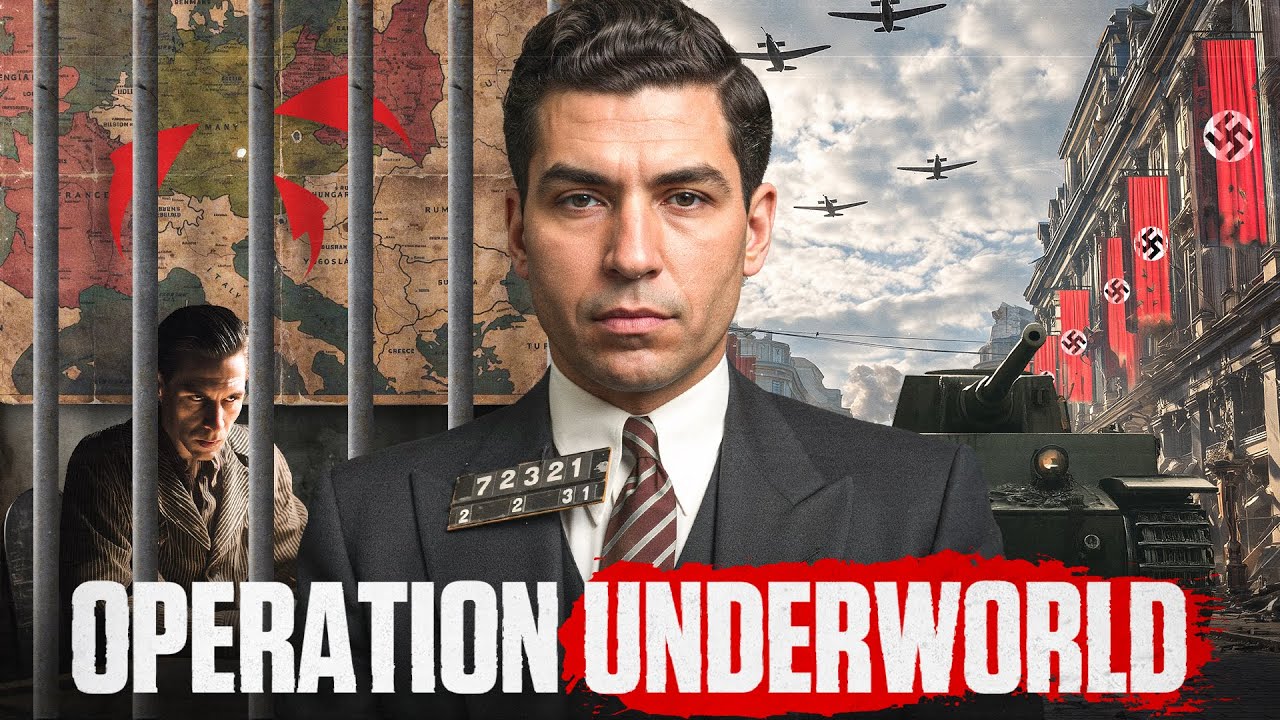 The Navy’s immediate problem was that its undercover agents were failing spectacularly on the docks. The New York waterfront was not a legitimate workplace; it was a fiefdom ruled by the Mafia. Longshoremen, union leaders, and shipping bosses all answered to the criminal empire of Charles “Lucky” Luciano, who was currently serving a 30-to-50-year sentence in a maximum-security prison for compulsory prostitution.
Despite being locked away in Dannemora, Luciano’s influence remained absolute. The Navy realized that if they wanted to secure the port, they had to go through the mob, and the only man who could “snap the whip over the whole mob” was Luciano himself. This realization sparked Operation Underworld, a covert alliance that would trade government leniency for mob loyalty.
The entry point for this unholy alliance was Joseph “Socks” Lanza, a racketeer who ruled the Fulton Fish Market with an iron fist and a rubber hose stuffed in a sock. Lanza controlled the unions, the hiring halls, and the flow of information along the waterfront. When Commander Charles Radcliffe Haffenden, the officer assigned to lead the operation, approached Lanza through intermediaries, the mobster agreed to cooperate immediately.
He began supplying Navy agents with 𝒻𝒶𝓀𝑒 union cards, allowing them to move freely among the dock workers. Within weeks, the Navy had eyes and ears on the piers, but they still lacked the authority to unify the entire harbor. That authority rested solely with Luciano, and reaching him required the help of his longtime partner, Meyer Lansky.
Lansky, a brilliant strategist who had remained free, became the crucial intermediary. He arranged for Luciano to be transferred from the frozen isolation of Dannemora to the more accessible Great Meadow Prison near Albany. In a series of secret meetings in May and June of 1942, Lansky and Lanza presented the deal to the imprisoned boss.
Luciano saw the opportunity immediately. By cooperating with the U. S.
government, he could reassert control over his scattered empire and potentially win his freedom. He agreed to authorize his men to act in his name, and almost overnight, the Mafia aligned itself behind the war effort. The docks, once a source of chaos, fell silent under mob-enforced order.
The intelligence pipeline that resulted was staggering. Through Lanza and other mob figures like Albert Anastasia and Joe Adonis, Naval Intelligence gained access to a network of informants that stretched from New York to Newfoundland. Fishermen who once smuggled whiskey now reported submarine sightings.
 Dock workers who once stole cargo now watched for German agents. The Navy’s B-3 unit, operating out of luxurious suites at the Astor Hotel, was suddenly the best-informed intelligence operation on the East Coast. But the most significant payoff came when the Allies decided to invade Sicily in 1943.
The island was a blank page to American intelligence, but it was home turf for the Mafia, and Luciano was eager to provide the maps.
Luciano’s lieutenants, including Joe Adonis and Vincent Mangano, began interrogating Italian immigrants and dock workers, extracting every piece of information about Sicilian coastal defenses, roads, and political loyalties. They compiled lists of local Mafia bosses who could assist the invasion, including the powerful Don Calogero Vizzini. This intelligence was used to create a massive relief map of Sicily, marking strategic targets for the Allied bombing campaign.
When Operation Husky began on July 10, 1943, American soldiers came ashore with a level of local knowledge that was unprecedented. The Mafia had opened a back door into Europe, and the invasion succeeded in just 38 days, a victory that would lead to Mussolini’s downfall.
The cooperation did not end with the invasion. As Allied forces pushed through Sicily, Mafia bosses who had been crushed by Mussolini’s fascist regime were reinstated as local administrators by the Allied Military Government. They were seen as anti-fascists who could restore order, but in reality, they were criminals who used their new legitimacy to consolidate power.
Vito Genovese, a former Luciano lieutenant who had fled to Italy to escape a murder charge, reinvented himself as an interpreter for the U. S. Army and became one of the most trusted civilian aides in the occupation government.
The line between liberator and gangster blurred completely, and the Mafia emerged from the war stronger and more deeply embedded in legitimate power than ever before.
 Back in New York, the payoff for Luciano was his freedom. On January 3, 1946, Governor Thomas Dewey, the man who had prosecuted him a decade earlier, commuted his sentence on the condition that he be deported to Italy. Dewey’s statement cautiously acknowledged that Luciano’s aid had been sought during the war, though he downplayed its value.
Luciano sailed into exile on February 9, 1946, exactly four years after the Normandy fire that had started it all. He would never return to America, but he remained a central figure in organized crime, helping to engineer the “French Connection” heroin pipeline from his base in Naples until his death in 1962.
The legacy of Operation Underworld is a complex and troubling one. In the short term, it achieved its military objectives. The New York waterfront remained secure for the rest of the war, with no confirmed acts of sabotage.
The intelligence gathered for the Sicilian campaign undoubtedly saved lives. However, the long-term consequences were devastating. The wartime collaboration granted the Mafia a level of legitimacy and political protection that insulated them from prosecution for decades.
The alliance created a bridge between the American and Sicilian underworlds that became a highway for narcotics, capital, and influence, fueling the heroin epidemic that would ravage American cities in the decades to come.
For more than thirty years, the story of Operation Underworld existed only as rumor. The files were burned, the participants sworn to silence, and the Navy denied everything. It wasn’t until 1977, when researcher Rodney Campbell uncovered a classified report among Dewey’s papers, that the full scope of the collaboration became public.
The report confirmed that Naval Intelligence had indeed worked with Luciano’s circle, but the government continued to downplay its significance. The truth remains murky, with some historians arguing that the Mafia’s contribution was minimal and others, like Luciano himself, claiming they won the war single-handedly.
 What is undeniable is the Faustian bargain struck at the height of the war. In fighting tyranny abroad, the United States had made a deal with tyranny at home. The Mafia helped win the war, but in doing so, it won something far more valuable for itself: credibility, influence, and time.
The consequences of that bargain rippled through the post-war era, as the five families grew richer and more powerful than ever before. The same organization that had once worked hand-in-glove with Naval Intelligence now dictated who worked, who ate, and who disappeared on the docks. The code of omertà kept law enforcement out, and the silence of the waterfront outlived the war itself.
By the late 1970s, the tide finally began to turn. The Racketeer Influenced and Corrupt Organizations Act, or RICO, gave federal prosecutors the legal weapon they needed to dismantle the mob. For the first time, the bosses themselves were vulnerable, and the walls of silence began to crack.
The Mafia Commission trial in 1985 struck at the heart of the organization, convicting the heads of the five families that Luciano had unified half a century earlier. Through the 1990s and 2000s, federal pressure intensified, and the once-invincible dons were brought down by informants and asset seizures. Today, the Mafia is a shadow of its former self, a legend and a warning of what happens when a nation compromises its principles for expediency.
The fire aboard the Normandy may have been an accident, as the FBI concluded, but the paranoia it ignited was real. It 𝓮𝔁𝓹𝓸𝓼𝓮𝓭 the fragility of America’s wartime infrastructure and the government’s willingness to make a deal with the devil to protect it. The Mafia’s help in winning the war is a fact of history, but it came at a terrible price.
The partnership legitimized a criminal empire, corrupted the post-war political landscape in both America and Italy, and left a stain on the legacy of the “Greatest Generation” that is still being debated today. The ships sailed, the invasion succeeded, and the war was won, but the cost was a moral compromise that would haunt the nation for generations.