Before you scroll away, let me ask you something. What would you do if a little boy walked into your shop, looked you in the eye, and asked, “Can you fix me?” Because that was the day Henry Wallace stopped being just a mechanic in a dying small town garage. That was the day one simple act of kindness set off a chain of events powerful enough to bring black SUVs to his door, expose a secret buried inside a billion-dollar company, and give a broken child something even more important than a new leg: a reason to believe he could stand again.
Maple Hollow was the kind of town people drove through without remembering. One main road, one old diner, one barbershop, one church with a bell that rang five minutes late every Sunday. The sidewalks were cracked, the houses leaned a little under years of wind and snow, and nobody rushed unless a storm was coming. At the far edge of town, where the pavement turned rough and the trees grew thicker, stood Wallace Auto Repair, a low brick garage with peeling blue paint and a sign so faded you could barely read the name unless the sun hit it just right.
Henry Wallace had owned that garage for thirty-eight years. He had grease permanently worked into the lines of his hands, shoulders stiff from lifting engines, and eyes that had learned to diagnose trouble before a customer finished explaining it. He was sixty-two, widowed, and stubborn enough to keep opening the shop every morning even when the world had moved on without him. The newer auto centers down by the highway had bright waiting rooms, free coffee machines, and online scheduling. Henry had a cracked vinyl chair, an old radio that only worked when it felt like it, and a coffee pot stained brown from decades of use.
But people who knew him came anyway.
They came because Henry didn’t charge a single mother full price when her minivan needed brakes. He didn’t shame an old farmer for paying in folded twenties and quarters. He fixed school buses, church vans, rusted pickups, and cars held together by prayer. If he couldn’t repair something, he said so. If he could, he made it last.
Still, honesty did not pay overdue bills.
That fall, Henry’s desk was covered with envelopes he had stopped opening. Electric. Insurance. Property tax. Parts supplier. The bank had called twice that week about his loan. He told them he needed more time, but time, like money, had become something he could no longer afford.
On a gray Thursday afternoon, Henry was bent over the engine of a 2004 Ford Taurus when the little bell above the front door gave a weak jingle.
He didn’t look up right away. “Be with you in a second.”
No answer.
Henry wiped his hands on a rag and stepped out from behind the hood.
A boy stood in the doorway.
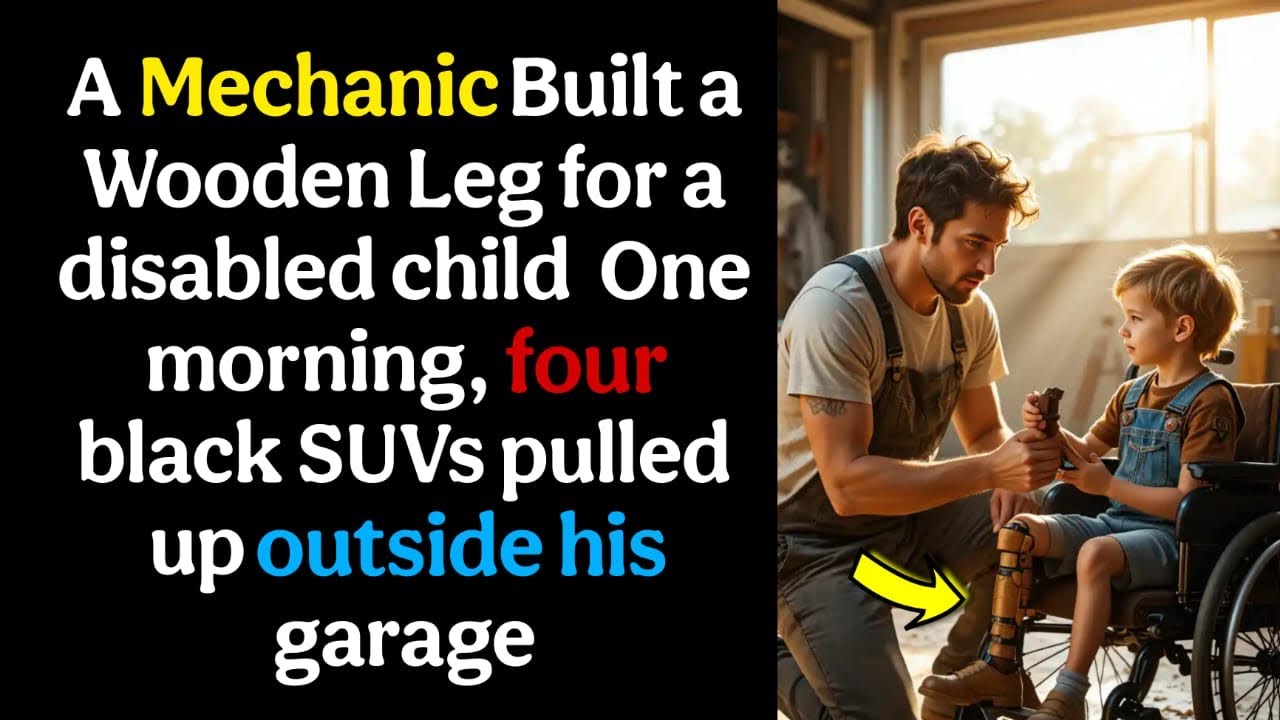
He was small, maybe ten, with sandy hair, a blue hoodie, and one sneaker planted firmly on the concrete floor. His other pant leg was folded neatly beneath his knee and pinned in place. Beside him stood a woman in a grocery store uniform, her face pale with embarrassment, her fingers gripping the strap of her purse as if she might turn around and leave at any second.
Henry’s voice softened. “Afternoon.”
The boy looked at the floor, then up at Henry. His eyes were serious in a way children’s eyes should never have to be.
“My name is Lucas,” he said. “Mom says you fix things.”
Henry crouched slightly, not too much, just enough to meet him without making a show of it. “I try.”
Lucas swallowed. “Can you fix me?”
The words landed like a wrench dropped on concrete.
His mother closed her eyes. “Lucas…”
Henry did not speak for a moment. He had heard plenty of heartbreaking requests in that garage. A man asking if an old truck could survive long enough for one more harvest. A woman asking if her car could make it to her husband’s hospital treatments. But this was different. This was a child asking a mechanic to repair what life had stolen.
“What happened?” Henry asked gently.
Lucas’s mother stepped forward. “A drunk driver hit him last year. He was riding his bike home from school.” Her voice broke, but she forced herself to continue. “They saved his life, but not his leg.”
Lucas stared straight at Henry. No tears. No drama. Just a thin, fierce hope he was trying not to show.
“The hospital gave us options,” his mother said. “But even the basic prosthetic is more than I can pay. Insurance denied most of it. I tried charities, payment plans, everything.” She looked ashamed, though she had no reason to be. “Lucas heard someone at church say you can fix anything.”
Henry looked toward the back of his shop. Against the wall, beside old tires and scrap metal, were pieces of ash wood, maple boards, aluminum brackets, leather straps, springs, bolts, and parts he had saved for years because his father had always said a good mechanic never threw away possibility.
He looked back at Lucas.
“I can’t promise pretty,” Henry said. “And I can’t promise perfect.”
Lucas leaned forward.
“But give me a few days,” Henry continued, “and I’ll see if I can build you something that helps.”
The boy’s face changed so fast it nearly broke Henry’s heart. Hope rushed in before he could stop it.
“You mean it?”
Henry nodded. “I mean it.”
His mother covered her mouth, tears filling her eyes. “Mr. Wallace, we can’t pay you.”
“I didn’t ask.”
For the next four nights, Henry barely slept. He closed the garage to regular work earlier than usual, then stayed under the harsh yellow lights long after midnight. He watched medical videos on an old laptop that wheezed like it might give up. He studied diagrams of prosthetic sockets and knee joints, not understanding everything but understanding enough. He measured, carved, sanded, adjusted, cursed, started over, and adjusted again.
He built the first version too heavy.
The second rubbed wrong.
The third cracked under pressure.
On the fourth night, exhausted and covered in sawdust, Henry held up a polished wooden prosthetic reinforced with lightweight metal brackets and leather support straps. It was not advanced. It was not sleek. It would never pass as high-tech. But it was balanced, sturdy, and made with the kind of care no factory could mass-produce.
The next morning, Lucas arrived with his mother.
He stared at the wooden leg like it was a treasure.
“You made that?”
Henry cleared his throat. “Let’s see if it works before you start praising me.”
They fitted it slowly. Henry adjusted the straps, checked the pressure points, and kept one hand close in case Lucas lost balance. Lucas stood gripping the workbench. His jaw tightened. His mother held her breath.
“Easy,” Henry said. “No rush.”
Lucas shifted his weight.
The prosthetic held.
Then he took one step.
Then another.
His mother made a sound that was half sob, half prayer.
Lucas looked down at himself, then up at Henry. His whole face opened into a smile so bright it seemed to push the shadows out of the garage.
“It works,” he whispered.
Henry’s throat tightened. “Told you I fix things.”
Lucas laughed. Then he took another step. Then another. Soon he was moving across the garage, uneven but determined, his hands out slightly for balance. When he reached the far wall, he turned around and looked as proud as if he had crossed a mountain.
For one perfect minute, the world was simple.
A boy had come in broken.
A boy was walking out standing.
Henry did not know Lucas’s mother recorded the whole thing on her phone. He did not know she would post it that night with a shaky caption about a small-town mechanic who gave her son hope when the system gave them paperwork. He did not know the video would spread from Maple Hollow to Chicago, then to New York, then across the country.
By morning, Henry’s phone had seventy-two missed calls.
At 9:04 a.m., four black SUVs pulled up outside Wallace Auto Repair.
Henry stepped out holding a coffee mug, wearing the same oil-stained shirt from yesterday. Men and women in dark suits climbed out, followed by a tall man with silver hair, polished shoes, and the calm authority of someone who was used to being obeyed.
“Mr. Wallace?” the man asked.
Henry narrowed his eyes. “Depends who’s asking.”
The man extended his hand. “Richard Langford. CEO of Langford Biomechanics.”
Henry did not take the hand right away. “I don’t know what that is, but it sounds expensive.”
Richard smiled. “It is.”
“Then you’re probably lost.”
“I don’t think so.” Richard glanced toward the garage. “I saw what you built for Lucas Bennett.”
Henry’s grip tightened around his coffee mug.
“If this is about rules or licenses,” Henry said, “I wasn’t selling medical equipment. I was helping a kid.”
“That’s exactly why I’m here,” Richard replied.
One of his assistants stepped forward with a black folder. Richard took it and held it out.
“My company builds advanced prosthetics,” he said. “Military-grade, sports-grade, pediatric, adaptive mobility. We have engineers, patents, labs, investors.” He paused. “But somewhere along the way, we forgot people like Lucas.”
Henry said nothing.
Richard continued, “You built something functional with wood, salvage parts, and instinct. More importantly, you built it for a child no one profitable was trying to reach.”
Henry looked at the folder but did not open it.
“What do you want from me?”
Richard’s smile faded. His voice became serious.
“I want to make you the head of a new affordable mobility division. We’ll fund your shop, bring in engineers, cover legal and medical oversight, and build prosthetics for families who cannot afford what companies like mine usually sell.”
Henry laughed once, dry and disbelieving. “You want a broke mechanic from Maple Hollow to run a medical engineering project?”
“No,” Richard said. “I want the man who remembered that a limb is not a luxury.”
Henry opened the folder.
The number inside made his vision blur.
A salary bigger than anything he had ever imagined. Full renovation of Wallace Auto Repair. Staff. Equipment. Research funding. A charitable arm named after Lucas.
For a second, Henry saw his late wife, Margaret, standing by the office door the way she used to, arms crossed, smiling because she had always believed he was more than he believed himself to be.
Richard watched him carefully. “Say yes, Mr. Wallace.”
Henry looked at the garage, at the cracked sign, at the unpaid bills, at the wooden dust still scattered across the floor from the leg he had built with nothing but desperation and love.
Then, behind Richard, another SUV door opened.
A woman stepped out slowly.
Henry’s face went pale.
He knew her.
Twenty-seven years ago, she had walked out of his life holding a baby girl he was never allowed to meet.
And now she was standing outside his garage, looking at him like she had finally come to collect a debt.
————
For a moment, Henry forgot about the black SUVs, the proposal folder, the cameras gathering across the street, and the silver-haired CEO waiting for an answer. All he could see was the woman standing near the curb in a dark coat, her hair streaked with gray, her eyes carrying the same guilt he remembered from another lifetime.
“Elaine,” he said.
The name came out rough.
She looked older, but so did he. Time had been unkind to both of them in different ways. On her, it had carved regret. On him, it had carved endurance.
Richard Langford glanced between them. “You two know each other?”
Elaine stepped forward. “Yes.”
Henry’s jaw tightened. “Not anymore.”
The last time Henry had seen Elaine Porter, she was twenty-six and crying in the doorway of a rented house during a thunderstorm. They had been in love once. Wildly, stupidly, completely in love. But Henry had been poor, working under his father in the garage, dreaming of owning the place someday. Elaine came from money, from polished floors and family expectations. When she got pregnant, her parents called Henry a mistake with dirty hands. Elaine disappeared before the baby was born.
One letter arrived six months later.
She is better off without this town. Please don’t look for us.
Henry kept that letter in a rusted toolbox for twenty-seven years.
Now Elaine stood in front of him again.
“What are you doing here?” Henry asked.
Elaine looked at Richard, then back at Henry. “I work with Langford Biomechanics. Pediatric outreach.”
Henry almost laughed. “Of course you do.”
Richard’s expression changed. “Henry, I didn’t know there was history.”
“No,” Henry said coldly. “You wouldn’t.”
Elaine took another step. “I saw the video. Lucas walking. I knew it was you before I even read the name.”
“Congratulations.”
“Henry—”
“You don’t get to say my name like that.”
The street had gone quiet. Even the reporters, who had begun arriving after the video went viral, seemed to sense that this was not part of the business story they came for.
Elaine’s eyes filled. “I made mistakes.”
Henry shook his head. “Mistakes are putting diesel in a gas engine. Mistakes are forgetting to tighten a bolt. You took my child and vanished.”
Richard stiffened.
Henry turned toward him. “You still want me to run your division? Good. First requirement: no secrets. No polished charity campaign hiding rotten things underneath.”
Elaine lowered her head.
Henry expected denial. Excuses. Something about her parents, her fear, her youth.
Instead, she said, “Her name is Grace.”
The air left his lungs.
Henry gripped the folder so hard the paper bent.
“She’s twenty-six,” Elaine continued. “She’s a biomedical engineer. She designed pediatric socket systems for Langford’s western lab. She was supposed to be here today, but…” Her voice shook. “She refused.”
Henry stared at her.
“Why?”
“Because she knows who you are now.”
The words hit harder than any wrench, any debt notice, any lonely winter night in that garage.
Grace knew.
His daughter knew he existed.
And she refused to come.
Henry turned away, walking back into the garage. Richard followed, but Henry raised a hand.
“Not now.”
Inside, the shop felt smaller than it had that morning. The wooden prosthetic patterns lay on the bench. Lucas’s measurements were still written on cardboard. Sawdust covered the floor like pale snow.
Henry sat heavily in his old chair.
For years, he had told himself he had made peace with losing a child he never got to hold. But peace, he realized, was often just grief that had learned to sit quietly.
An hour later, Lucas arrived.
He came in with his mother, moving carefully on the wooden leg. His face brightened when he saw Henry, then changed when he noticed the tension in the room.
“Mr. Henry?” Lucas asked. “Are you okay?”
Henry looked at the boy. A child who had lost part of himself and still came in carrying hope.
“I don’t know,” Henry admitted.
Lucas nodded as if that answer made sense. “Sometimes I don’t know either.”
His mother touched his shoulder. “Lucas wanted to show you something.”
Lucas reached into his hoodie pocket and pulled out a folded piece of paper. It was a drawing. In crayon, uneven but full of color, he had drawn Henry’s garage with a big sign over it.
THE WALKING SHOP
Underneath were children with different kinds of legs, all smiling.
Henry stared at it until the lines blurred.
“That’s what you should call it,” Lucas said. “Because you help people walk.”
Henry swallowed hard. “That’s a pretty good name, kid.”
Lucas leaned closer. “Are those people outside going to help you make more?”
Henry looked toward the window. Richard was still outside, speaking quietly with Elaine and his team. The future stood there waiting in expensive shoes.
“Maybe,” Henry said.
Lucas frowned. “You should say yes.”
Henry chuckled weakly. “That simple?”
Lucas nodded. “If you don’t, some other kid might have to keep waiting.”
That was the thing about children. They could cut through the fog adults spent years building.
By evening, Henry agreed to the partnership with one condition. The new division would not be a luxury brand. It would not sell hope only to people with enough money to deserve it. It would create affordable prosthetics, open repair clinics in small towns, and treat mechanics, woodworkers, and hands-on builders as part of the innovation team.
Richard accepted.
Elaine signed on to oversee outreach but agreed to step back from Henry personally unless he asked otherwise.
He did not ask.
The transformation of Wallace Auto Repair began within weeks. The old sign stayed, but the inside changed completely. New tools arrived. Engineers set up workstations beside Henry’s scarred wooden bench. Medical consultants came through carrying tablets and diagrams. Cameras came too, but Henry hated those and usually escaped to the back room.
The first official prototype was for Lucas.
It was light, adjustable, flexible, and painted blue because Lucas said fast things should be blue. When he tried it on, he walked across the shop, then jogged, then stopped and looked at Henry like he was afraid to believe it.
“Can I run?”
Henry crouched in front of him. “Not in here. Your mama will kill both of us.”
Lucas laughed so loudly even the engineers smiled.
The video of Lucas running outside the garage reached millions.
Donations poured in.
Applications from families came faster than the team could process. A girl in Ohio who wanted to dance again. A boy in Texas who had outgrown his prosthetic but whose parents couldn’t afford another. A teenager in Oregon who wanted to walk across the graduation stage without crutches.
Henry worked harder than he had in his thirties.
But something else kept growing in the background. Something he tried not to look at.
Grace.
He never contacted her. He had no right to force himself into a life that had been built without him. But he read her research papers after Elaine sent them through Richard. Grace Porter was brilliant. Precise. Known for her pediatric comfort designs. She had her mother’s last name and, in one small photo attached to a conference biography, Henry’s eyes.
One rainy afternoon, three months after the partnership began, a young woman walked into Wallace Auto Repair.
Henry was sanding a socket mold when the bell jingled.
He looked up.
She stood near the entrance wearing jeans, a gray coat, and no expression he could read.
He knew before she spoke.
Grace.
For a long moment, neither of them moved.
Then she said, “I almost didn’t come.”
Henry set down the sandpaper.
“I wouldn’t have blamed you.”
Her eyes scanned the garage, the old walls now filled with new machines, children’s drawings, thank-you cards, and Lucas’s crayon sign framed above the workbench.
“The Walking Shop,” she said softly.
“Lucas named it.”
Grace nodded, then looked at him. “My mother said you were a good man.”
Henry’s face tightened.
Grace continued, “For most of my life, I thought good men didn’t get left behind.”
Henry had no answer.
She stepped closer. “Then I saw what you built for that boy with nothing but wood and stubbornness. And I got angry.”
“At me?”
“At everyone.” Her voice trembled. “At Mom. At my grandparents. At myself for being curious. At you for being real.”
Henry absorbed that quietly.
Grace pulled a small notebook from her bag and placed it on the workbench. “I redesigned Lucas’s socket after watching the footage. Your alignment was rough, but your weight distribution was better than half the expensive models I’ve reviewed.”
Despite everything, Henry gave a small smile. “That a compliment?”
“Technically.”
She opened the notebook. Sketches filled the pages. Clean, brilliant designs. Pediatric joints. Low-cost adjustable parts. Notes written in the margins.
“I don’t know if I’m ready for a father,” she said. “But I’d like to work on this. With you. If that’s okay.”
Henry looked at the notebook, then at the daughter he had lost and found in the same breath.
His voice was barely above a whisper.
“That’s more than okay.”
The months that followed did not become perfect. Real life rarely does. Grace did not suddenly call him Dad. Elaine and Henry never returned to what they had been. Old pain did not vanish because the world loved a heartwarming story.
But Grace came every Thursday.
At first, they only worked. Measurements. Materials. Design issues. Safety testing. Henry taught her how to feel stress points with her hands instead of only reading data. Grace taught him how to turn his instincts into repeatable systems. Slowly, between blueprints and coffee, stories slipped through.
He told her about his father.
She told him about her first science fair.
He told her about Margaret, his late wife, who had known about the lost baby and loved him through the grief anyway.
Grace listened.
One evening, Lucas arrived for a final fitting before his school field day. He stepped onto the testing strip in his blue prosthetic, bent his knees, then sprinted the length of the garage.
Everyone cheered.
Henry clapped the loudest.
Lucas ran back breathless. “Mr. Henry! Did you see?”
“I saw.”
Grace stood beside Henry, arms crossed, smiling.
Lucas looked between them. “Is she your daughter?”
The garage went silent.
Henry froze.
Grace looked at him, then at Lucas.
Finally, she said, “We’re figuring that out.”
Lucas accepted this with a nod. “That’s good. Mr. Henry fixes things.”
Grace’s smile softened. “I’m starting to see that.”
One year after Lucas first walked into the garage, The Walking Shop opened its third clinic. The launch event was held right outside Wallace Auto Repair. Families filled the street. Children ran between folding chairs. Reporters crowded near the curb. Richard Langford gave a polished speech, then wisely kept it short.
Henry stepped up to the microphone in a clean shirt Grace had insisted he wear.
He looked uncomfortable, which made everyone love him more.
“I’m not much for speeches,” he began. “I spent my life fixing cars because cars made sense. If something rattled, you listened. If something leaked, you traced it. If something broke, you didn’t throw the whole thing away. You found the part that still wanted to work, and you helped it move again.”
He paused, eyes finding Lucas in the crowd, standing proudly beside his mother.
“Turns out people aren’t so different.”
The crowd went quiet.
“A year ago, a boy asked me if I could fix him. I couldn’t. Because he was never broken. What I could do was build him a tool. He did the rest.”
Lucas grinned.
Henry looked toward Grace, standing near the shop door with tears in her eyes.
“And sometimes, if you’re lucky, the things you try to fix end up fixing parts of you too.”
Applause rose, warm and thunderous.
After the ceremony, Grace walked over and stood beside him.
“You did good,” she said.
Henry smiled. “Technically?”
She laughed. “No. For real.”
He looked at her, this brilliant young woman he had missed for most of her life and still somehow got the chance to know.
“Grace,” he said carefully, “I know I don’t get to ask for what I lost.”
Her expression softened.
“But I’m grateful for whatever we build from here.”
Grace looked at the garage, at Lucas running across the lot, at the families waiting with forms in their hands and hope on their faces.
Then she slipped her hand into Henry’s.
“So am I,” she said.
And for the first time in decades, Henry Wallace understood something. A man could spend his whole life fixing engines, doors, wheels, and broken machines, believing that was his purpose. But sometimes, one child’s impossible question could open a door no wrench ever could.
He had not fixed Lucas.
Lucas had never been broken.
Henry had simply helped him stand.
And in return, that little boy had led Henry back to the one part of his own life he thought would never move again.
So tell me, what would you have done if you were Henry? Would you have accepted the offer, faced the woman from your past, and opened your heart to a daughter you never got to raise? Share your thoughts in the comments, and follow for more emotional stories where one act of kindness can change more lives than anyone ever expects.