THE LETTER THAT FELL ON THE FLIGHT HOME
Before you believe rejection means the end of your dream, listen to what happened to Alice Keller on the worst night of her life—because the letter she never meant anyone to read fell out of her bag on a midnight flight, landed at the feet of a stranger, and opened a door she thought the world had locked forever.
Alice was twenty-eight, broke, exhausted, and sitting alone at John F. Kennedy International Airport with a paper cup of bitter coffee growing cold between her hands. Outside the rain-streaked windows, planes lifted into the dark sky one after another, carrying people toward new beginnings. Alice was only going home.
For two weeks, she had dragged her portfolio through New York City, wearing the same black blazer to fifteen interviews, smiling through fifteen polite rejections.
“You have talent,” they all said.
Then came the knife.
“But we need someone with more large-scale experience.”
By the fifteenth rejection, the phrase no longer sounded professional. It sounded personal. Like the city itself had looked at her sketches, her sleepless nights, her five years at art school, her father’s sacrifices, and decided none of it mattered.
Her flight back to Portland boarded at midnight. Back to her grandmother’s bakery. Back to the attic room she had left one month earlier with hope folded carefully into her suitcase. Back to the life she had promised herself she would outgrow.
Inside her worn canvas bag was her leather portfolio, several copies of her resume, and one document nobody was ever supposed to see.
It was not a cover letter.
It was not a design brief.
It was a handwritten list she had written at 3:00 a.m. in a cheap Queens motel after her worst interview.
Twelve Reasons I Cannot Give Up and Spend My Life Packing Pastry Boxes in Grandma’s Bakery.
The first reason was angry.
Because I did not fight through five years of design school just to disappear behind a sugar-glaze machine.
The tenth reason hurt too much to reread.
Because Dad sold his fishing boat to help pay my tuition, and before he died, I promised him I would do something meaningful with the talent he believed I had.
Alice folded the letter between her resume and portfolio pages because part of her needed proof that she had once been brave.
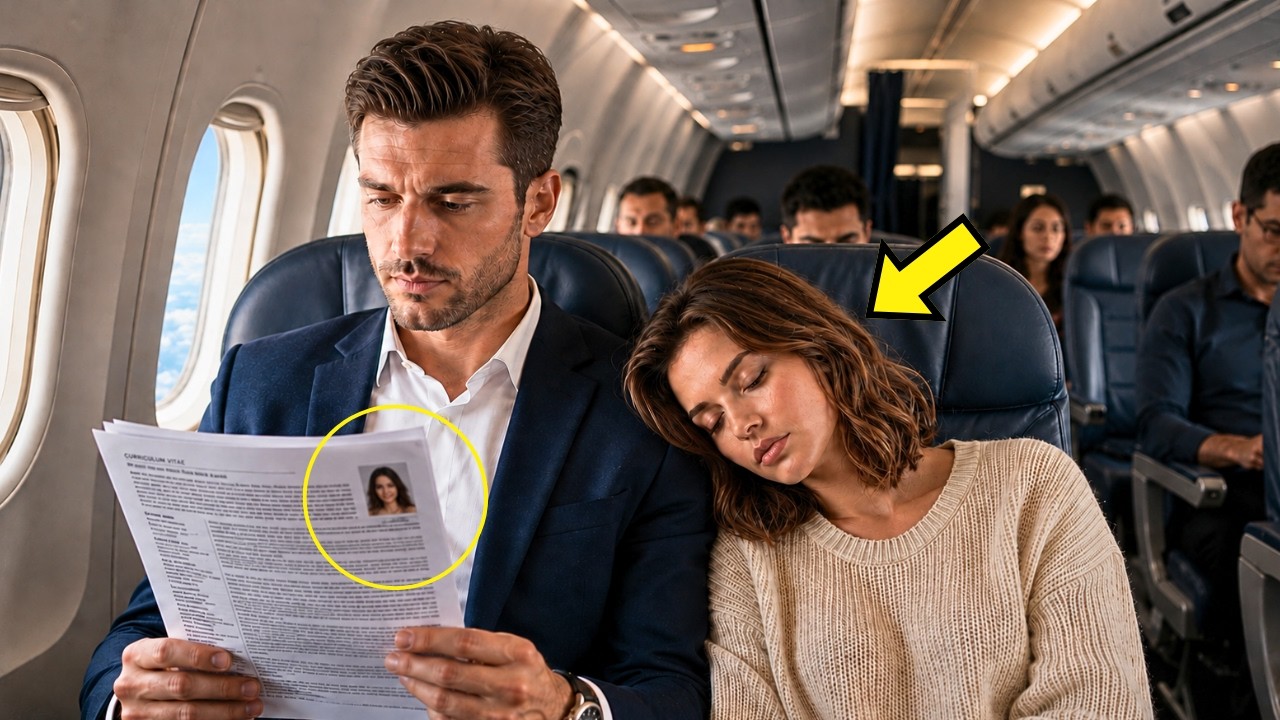
When she boarded the plane, she found her seat near the back, pressed against the window. The man beside her was already typing on a laptop. Charcoal suit. Polished shoes. Expensive watch. The kind of man who looked like he belonged in boardrooms where people said yes before he finished speaking.
He barely glanced at her.
Alice was grateful.
She had no strength left for conversation.
The plane lifted into the storm, and within minutes exhaustion dragged her under. Her head slipped sideways until it came to rest against the stranger’s shoulder. She didn’t wake. During a patch of turbulence, her portfolio slid open. Three pages slipped out and fell near the man’s shoe.
Michael Walters noticed immediately.
At first, he only meant to return them.
Then he saw the resume.
Alice Keller. Graphic designer. Maine College of Art. Three years at a small branding studio. A portfolio full of coastal cafés, bakeries, handmade labels, and local businesses brought to life with color and feeling.
The work was not flashy. It was better than flashy.
It had soul.
Then Michael saw the handwritten page.
He knew he should not read it.
But the title stopped him.
And then the words did.
Line by line, he read Alice’s private battle with herself. Her father’s fishing boat. Her grandmother’s bakery. The little girl who used to draw under the blanket with a flashlight. The small business owner who had cried when Alice showed her a logo and said, “Now my shop looks like it has a heart.”
At the bottom, Alice had written one final sentence:
If you are reading this, Alice, and you want to quit, it means you have forgotten who you are. Please remember.
Michael sat frozen in the dim cabin.
Fifteen years earlier, he had written something almost identical on a napkin in a Pittsburgh diner after thirty-two job rejections. Back then, he was broke, grieving his father, and surviving on instant noodles while his mother cleaned offices before sunrise to keep him in school.
Now he was the managing partner of one of New England’s strongest investment firms. He funded startups, design agencies, and technology companies. He had enough power to change a career with one phone call.
But he had not forgotten the pain of being invisible.
When Alice woke during landing, she realized she had been sleeping on his shoulder and turned bright red.
“I’m so sorry,” she stammered.
Michael smiled gently. “You needed the rest.”
Then he took a breath.
“Your papers fell during turbulence. I picked them up. I accidentally read your letter.”
Her embarrassment turned instantly into anger.
“That was private.”
“I know,” he said. “And you have every right to be upset.”
She clutched her portfolio to her chest.
“But I need you to understand something,” he continued. “I read it because the first line caught me, and I kept reading because I recognized myself in it.”
He told her about his father dying in a factory accident. About his mother working fourteen-hour days. About the napkin he had written in a diner when he wanted to quit.
Then he placed a business card on the tray table.
“I invest in a design agency in Portland called Amber Creative. Their director, Sophia Lewis, is looking for someone with exactly your kind of voice. Not corporate polish. Soul. If you send me your portfolio, I’ll forward it to her.”
Alice stared at the card.
“Why would you do this?”
“Because when I was where you are,” Michael said, “everyone told me I was talented. Nobody opened a door.”
The plane touched down in Portland.
Alice walked off with his card in her pocket and hope rising so carefully she was afraid to breathe too hard.
The next morning, from her grandmother’s attic bedroom, she sent the portfolio.
By noon, Michael replied.
Sophia Lewis wanted to meet her.
For the first time in weeks, Alice smiled.
The interview happened at a waterfront café overlooking the old fishing piers. Sophia Lewis arrived in a tailored trench coat, confident, elegant, and sharp-eyed. She studied Alice’s portfolio with real interest.
“Your work has emotional intelligence,” Sophia said. “That’s rare.”
Alice nearly cried from relief.
Then Sophia asked, “How do you know Michael Walters?”
Alice told the truth. The flight. The letter. The accidental connection.
Sophia’s face changed.
She closed her notebook.
“Michael Walters was my fiancé,” she said coldly. “He ended our engagement one week before the wedding.”
Alice’s heart sank.
Sophia stood. “Your work is good. Maybe even exceptional. But I won’t hire someone because Michael Walters sent her to my table. If you want a place at Amber Creative, earn it without his shadow.”
Then she walked out.
Alice called Michael from the rain-soaked sidewalk, furious and humiliated.
“You should have told me,” she said. “You used me in some old story with your ex.”
“Alice, no—”
She hung up and blocked his number.
That night, she sat in her grandmother’s kitchen and cried into a dish towel while Teresa Keller listened without interrupting. When Alice finished, her grandmother poured tea and said, “Then stop waiting for someone to open the door, sweetheart. Build something so good they have to look.”
Those words changed everything.
The next morning, Alice did not search job boards. She studied Amber Creative.
She found their weakness almost immediately. Their branding was polished, modern, expensive—and empty. It did not feel like Maine. It did not feel like weathered docks, sunrise over the Atlantic, warm bakery windows, fishermen’s hands, artists’ studios, or small businesses held together by grit and love.
So Alice built a full rebrand.
For three days, she barely slept. She created a new logo inspired by the first line of sun over Portland Harbor. She designed custom typography with edges softened like sea-worn glass. She wrote a brand manifesto about giving local businesses identities that felt lived-in, not manufactured.
Then she sent it directly to Sophia.
No recommendation. No apology. No Michael.
Just the work.
Two days passed.
Nothing.
On the third evening, Alice’s phone rang.
“Come to the studio tomorrow,” Sophia said.
At Amber Creative, Alice walked into Sophia’s office and stopped.
Her sunrise logo filled the presentation wall.
Sophia looked at her for a long moment.
“I wanted to delete your email,” she admitted. “Out of pride. Out of old anger. But then I opened it.”
Alice held her breath.
“This is the strongest unsolicited creative proposal I have seen in ten years.”
Sophia offered her a three-month paid contract.
“This position is yours,” she said. “Not because of Michael. Because of you.”
Alice accepted with trembling hands.
A month later, after Alice had already become one of the most promising young designers in the agency, Sophia came to her desk with two coffees.
“I owe you the truth,” she said.
Michael had not used Alice. His investment in Amber Creative had been arranged months before their flight. He had never once pressured Sophia to hire her. He had only asked her to look at the portfolio.
“As for the wedding,” Sophia said quietly, “he was right to end it. We were building a marriage like a merger. I hated him for seeing it first.”
Alice unblocked his number that night.
They met at an old diner on Commercial Street. Michael arrived in a casual jacket, wind in his hair, no polished boardroom armor.
“I’m sorry,” Alice said. “I thought you were manipulating me.”
“I understood why,” he replied. “When the world keeps disappointing you, kindness starts looking suspicious.”
They talked for three hours.
About fathers they missed. Mothers and grandmothers who sacrificed. Doors that closed. Doors they had to break open themselves.
By Christmas, Alice had completed her probation and accepted a permanent position at Amber Creative. She rented her first apartment overlooking a narrow street lined with brick buildings and winter lights. On her office wall, she framed two things side by side: her twelve-reason letter from Queens and Michael’s old diner napkin from Pittsburgh.
Not because either document represented failure.
Because both proved that the lowest night of a life can become the first page of something extraordinary.
Looking back, Alice understood the truth. If New York had said yes, she might have become another exhausted designer trapped in a company that never saw her heart. If Sophia had hired her immediately, Alice might have always wondered if she earned it. If Michael had never read the letter, she might have gone home believing rejection was the same as destiny.
But life rarely gives us straight roads to the future we deserve.
Sometimes it gives us storms, wrong seats, closed doors, angry phone calls, and one impossible chance to remember who we are.
So if you’ve ever felt rejected, overlooked, or forced to return home defeated, don’t mistake the delay for the end. Your door may not open the way you expected. You may have to build the key yourself.
Tell me—have you ever had a rejection that secretly redirected your life? Share your story in the comments, and follow for more emotional stories about second chances, hidden purpose, and the courage to keep going when everything says stop.