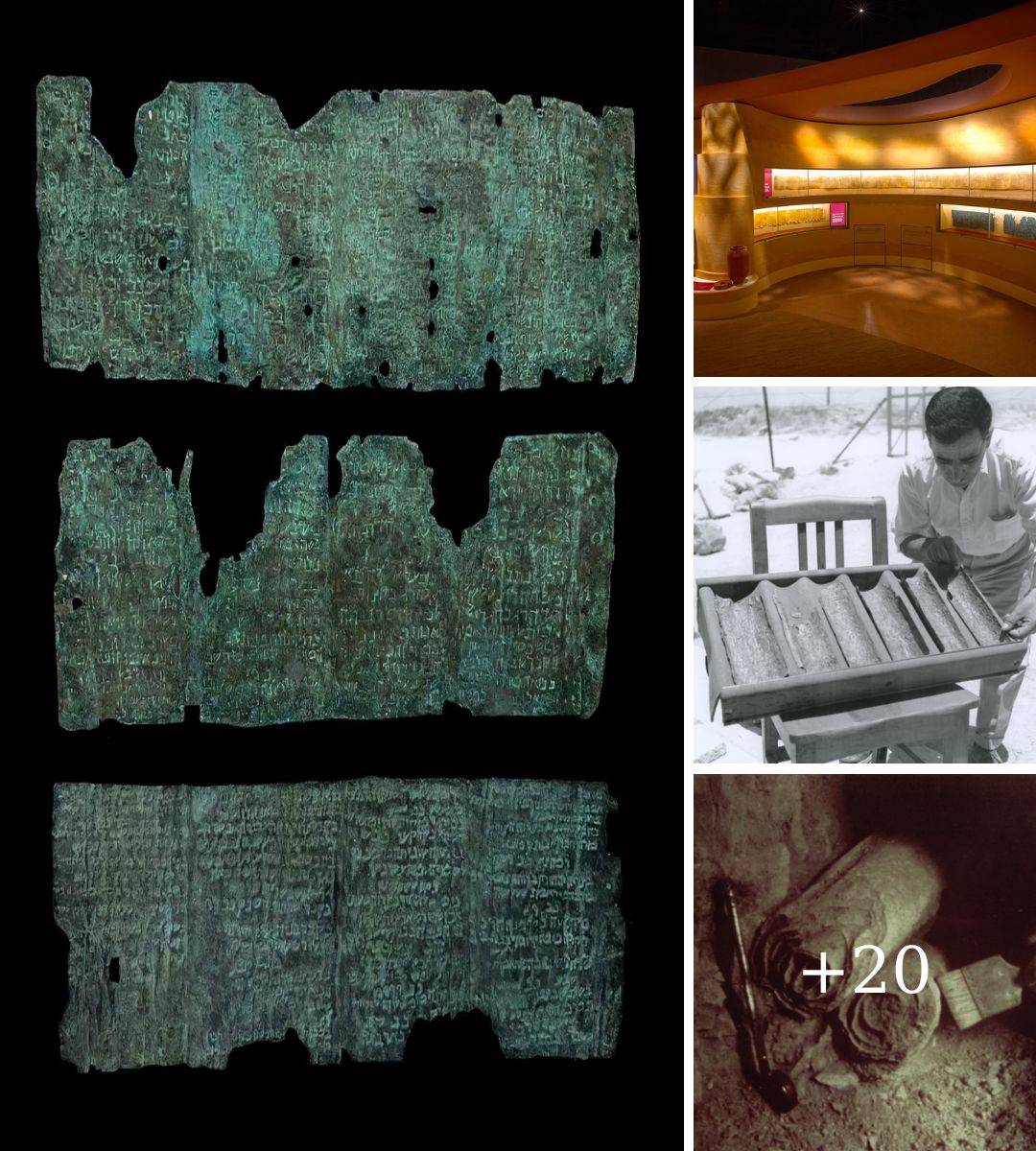
A treasure map like no other, the Copper Scroll is a tantalizing artifact from the ancient world, believed to hold the secrets of a hidden fortune. Crafted around 70 C.E., this remarkable scroll was created by the Jewish community as they faced the impending threat of Roman forces, who were set to plunder the Great Temple in Jerusalem.

The Copper Scroll, the only one of its kind inscribed on metal, details the locations and quantities of immense treasures, including silver and gold. However, it leaves treasure hunters in suspense by not indicating where to begin their search. Phrases like “In the salt pit that is under the steps: forty-one talents of silver” ignite curiosity and speculation.
Discovered in 1952 by French archaeologist Henri de Contenson and Dead Sea Scrolls expert Józef Milik in Cave 3 near Qumran, the scroll was found in two fragile pieces. After two millennia of concealment, it was too corroded to be unrolled. In a groundbreaking effort, the scroll was sent to the Manchester College of Technology in 1955, where it was carefully cut into 23 segments using a fine saw.

Fast forward forty years, and due to further deterioration, the segments were sent to the Laboratoire EDF-Valectra in Paris for restoration. Here, experts created flexible silicone molds from the segments, allowing them to reproduce the original scroll in electro-formed copper plates. While these replicas captured the text, they lacked the historical depth and character of the original, which had endured centuries of wear.
 In a remarkable collaboration, Facsimile Editions took on the challenge of creating an aged replica of the Copper Scroll for The Museum of the Bible. Over two years, they worked with specialists in 3D imaging and metallurgy to reconstruct the scroll into a stunning solid copper version. Measuring approximately 2.4 meters long and 30 centimeters wide, this three-piece facsimile faithfully replicates the original’s intricate details.
Using advanced technology, the team scanned the electro-formed plates to create a master guide for their work. They meticulously crafted the back of the plates, reversing the scans to reflect the original hammering technique used to inscribe the text. This involved routing high-density polycarbonate blocks with incredible precision, a feat never before achieved for an object of this size.

The casting process was equally rigorous, as each panel had to be flawless. Any imperfections meant a complete recast, leading to numerous attempts before achieving perfection. The final product capures the essence of an ancient artifact, with a look and feel that transports viewers back over 2,000 years.
Housed in a custom heavy-duty case designed for protection, the facsimile is not just a display piece; it’s a bridge to the past. Priced at £91,000, only one remains available, inviting collectors and history enthusiasts alike to ponder the mysteries it holds. What secrets of the ancient world might still be waiting to be uncovered?