The Blueprint in the Greenhouse
I grew up in the misty, rural hills of Oregon. The only thing I knew about my mother was that she was an eccentric, obsessed botanist who spent every waking hour inside a massive, climate-controlled glass greenhouse behind our house. She was a woman of silence, always smelling of damp soil and rare orchids. When my father walked out on us, she didn’t even look up from her plants. I spent my youth feeling invisible, believing she cared more about her green leaves than her own daughter. The day I turned eighteen, I left for Seattle, became a high-profile structural architect, and intentionally ignored her phone calls for ten years. I despised her slow, quiet life.
Three months ago, I met David. He was a landscape designer, a man who understood the language of nature and the patience it took to grow things. We got married two months ago. Last week, I received a cold letter from a lawyer. My mother had passed away quietly in her sleep, right inside her greenhouse. She died just as she lived—surrounded by plants, alone.
Yesterday, David and I drove back to Oregon to quickly clear out the property and sign the demolition papers to tear down the old greenhouse. As I stood among the dying tropical ferns, eager to leave, David suddenly shouted from the central irrigation control panel.
“Maya, you need to look at this right now!” His voice was filled with absolute shock.
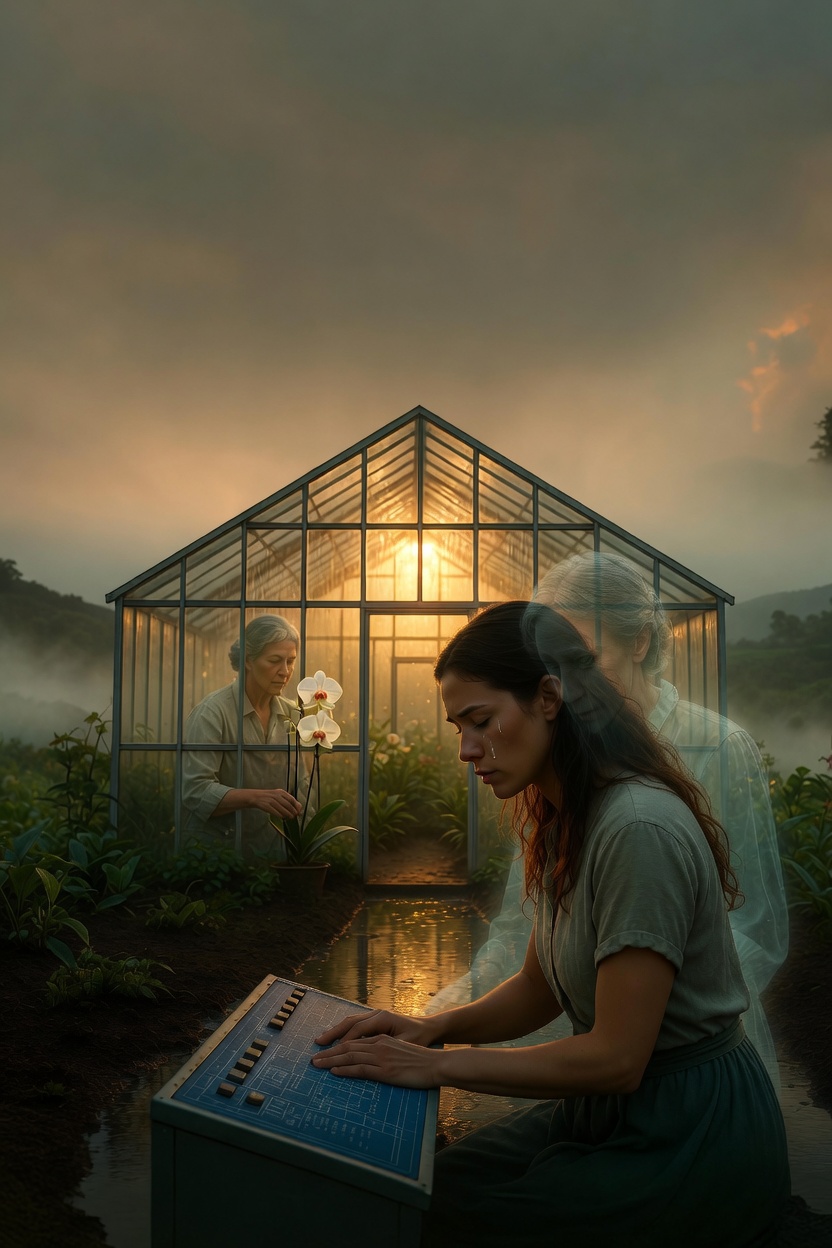
He didn’t find a hidden box or a secret stash of money. Instead, he pointed to a master structural blueprint of the greenhouse etched directly into the copper control plate, which had been covered by overgrowing ivy for years. It wasn’t a standard engineering blueprint.
As I scraped away the vines and looked closer, my heart stopped beating.
The greenhouse wasn’t built to grow rare plants. The entire structural grid, the specific angle of the glass panes, and the complex underground water filtration system were designed in the exact shape and proportions of a localized dome shield. Ten years ago, our valley was hit by a massive toxic chemical spill from a nearby industrial plant that polluted the local river. My mother hadn’t been ignoring me; she had spent a decade engineering a botanical bioshield. The plants she grew were hyper-accumulators, specifically bred to absorb the invisible, deadly heavy metals from the soil underneath our house before they could reach our well water.
Every time she told me to stay out of the dirt, every time she locked herself in the glass room to run tests, she was actively filtering the air and water I consumed, taking the toxic load into her own lungs while keeping me perfectly safe.
The final note scratched onto the blueprint, dated the day I left for college, read: “The soil is clean. Maya’s foundation is safe. She can build her skyscrapers now.”
I sank to my knees on the damp earth, crying uncontrollably as the scent of the orchids washed over me, finally realizing that her cold obsession was actually a silent, lifelong shield that kept me alive.
Chapter 2: The Poisoned Roots
I stayed on the floor for hours, my fingers digging into the rich, dark soil. The realization was suffocating. I had spent a decade building towering skyscrapers of glass and steel in Seattle, proud of my structural genius, while completely blind to the true masterpiece of engineering that had saved my life.
David knelt beside me, his hands gently pulling back a thick layer of moss from the roots of the central mother-orchid. His eyes went wide as he analyzed the soil testing kit he had brought along.
“Maya… look at the discoloration in these lower roots,” David whispered, his voice heavy with grim realization. “These aren’t natural decay markers. These are advanced heavy metal saturation burns.”
I grabbed my mother’s old lab journals from the metal desk in the corner. As a structural architect, I knew how to read data, and the charts inside these pages were terrifying. My mother hadn’t just engineered these plants to absorb toxins from the soil; she had designed them to trap the poisons permanently within their own cellular walls so the chemicals wouldn’t leak back into the environment.
But there was a catch. The plants could only hold so much. To keep the barrier from failing, someone had to manually prune the toxic roots every single week, exposing themselves directly to the concentrated chemical dust.
I flipped to the last page, dated just three weeks ago. Her handwriting was frail, drifting across the lines:
“The industrial plant is shutting down its old reactors, but the underground plume of toxins is making its final, heaviest push toward our property this month. The orchids are maxed out. My lungs are burning, and my vision is failing from the fumes. But I just need to hold the barrier for twenty more days. Maya is coming back to the valley for her wedding anniversary. I must ensure the air she breathes when she visits is pure. Just twenty more days.”
“The industrial plant is shutting down its old reactors, but the underground plume of toxins is making its final, heaviest push toward our property this month. The orchids are maxed out. My lungs are burning, and my vision is failing from the fumes. But I just need to hold the barrier for twenty more days. Maya is coming back to the valley for her wedding anniversary. I must ensure the air she breathes when she visits is pure. Just twenty more days.”
She didn’t die of old age or a peaceful sleep. She died of acute chemical inhalation, standing guard over her green fortress to intercept the final wave of poison meant for me.
Chapter 3: The Green Fortress
The next morning, I tore up the demolition papers. The corporate developers in Seattle called me, furious that I was delaying a lucrative land sale. I ignored them, blocked their numbers, and threw my expensive designer shoes into the trash.
I was no longer an architect of dead concrete. I was my mother’s daughter.
David and I moved into the old Oregon house permanently. We didn’t destroy the greenhouse; we expanded it. Using my architectural expertise, I designed a network of advanced, automated glass structures that spanned across the entire valley, mirroring my mother’s original bioshield on a massive scale.
We patented her hyper-accumulating orchid strain and founded “The Eco-Shield Architecture Group.”
Instead of building luxury high-rises for billionaires, my firm began working with industrial disaster zones and impoverished mining towns across the country. We built massive, living botanical bioshields over contaminated lands, using nature to heal the earth and protect the children who played in the dirt nearby.
Chapter 4: The Blooming Shield
Three years later, the valley had completely transformed. The murky, chemical-scented river was running clear again, filtered by miles of engineered wetlands. The old industrial plant was gone, replaced by a sprawling botanical reserve.
Yesterday, on the anniversary of my mother’s passing, we held an educational tour for local elementary students inside the main greenhouse. A little girl with bright, curious eyes walked up to the central irrigation panel, pointing at the ivy that David and I had carefully trained to grow around my mother’s original copper blueprint.
“Mister Architect,” she said, looking up at me. “Why did someone build a glass house just for flowers?”
I knelt down beside her on the damp earth, the familiar, comforting scent of the orchids filling the air. I gently pointed to the glass panes above us, glittering in the afternoon sun.
“It wasn’t built just for flowers, sweetie,” I said, a tear of profound gratitude slipping down my cheek. “It was built as a shield. A brilliant woman spent her whole life inside this glass room to make sure that the air you breathe right now is perfectly clean.”
The little girl smiled, taking a deep breath of the fresh, floral air before running off to join her classmates. I stood up, looking through the clear glass ceiling at the blue Oregon sky. I could finally hear the language of the leaves, and for the first time in my life, I knew my foundation was unbreakable.