The Algorithm in the Blueprint
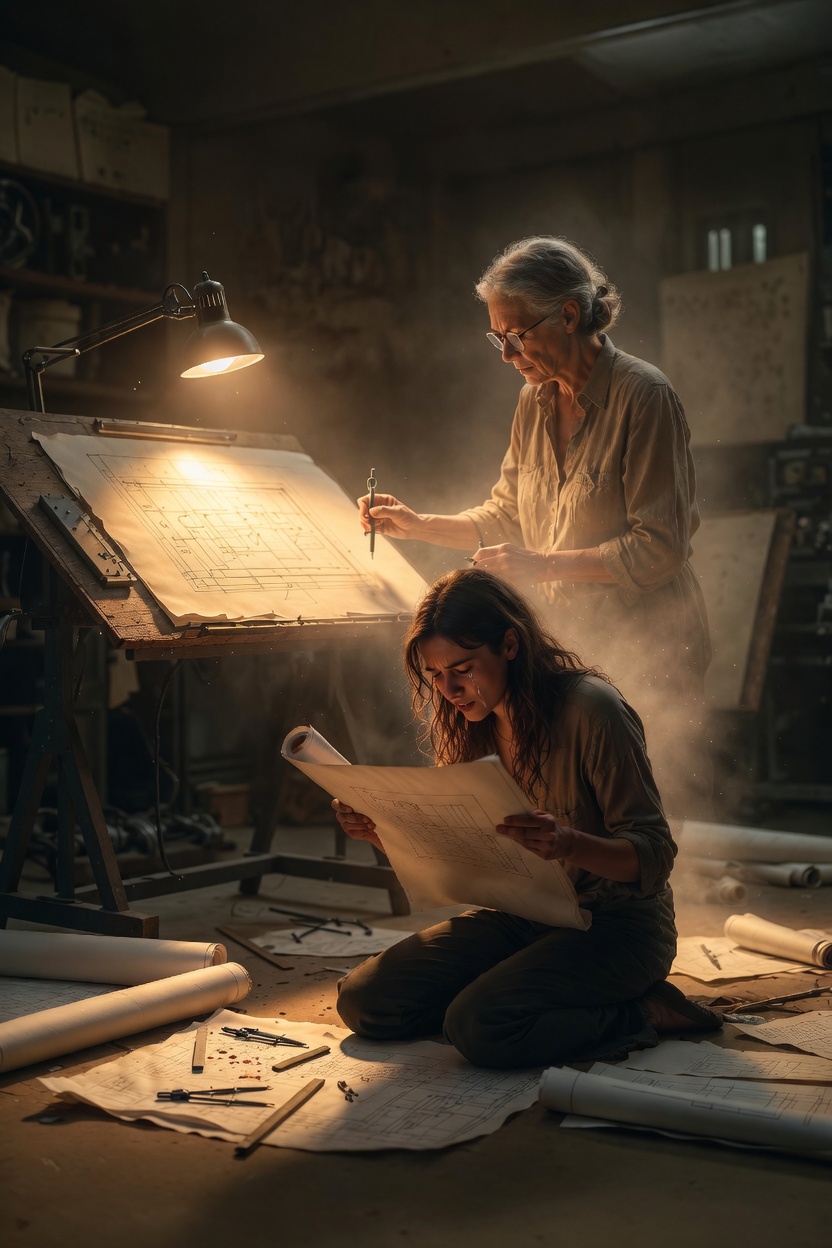
I grew up in the dusty, rust-colored town of Gary, Indiana. To me, my mother was an embarrassing relic of a bygone era. While my friends’ parents had corporate careers, she spent her entire life locked in a drafty garage, obsessively hand-drawing mechanical blueprints for obsolete steam valves. She was a woman of total silence, always smelling of blueprint ink and machine oil. When I won a full scholarship in Data Architecture at MIT, she didn’t even hug me; she just handed me a rusted steel drafting compass, which I immediately pitched into a trash can at the train station. I moved to New York, became a lead systems architect for the world’s most secure blockchain network, and cut her off completely for seven years. I despised her primitive, slow life.
Two months ago, I met Marcus. He was an advanced cryptography analyst for the government, a man obsessed with pattern recognition and offline data storage. We got married last month. Two weeks ago, I received a cold letter from a lawyer. My mother had passed away quietly in her sleep, right at her wooden drafting table. She died exactly how she lived—surrounded by ink splatters and scraps of vellum paper, completely alone.
Yesterday, Marcus and I drove back to Indiana to quickly clear out the house and sign the papers to demolish the old garage. As I stood in her dusty workshop, eager to leave, Marcus suddenly gasped from the blueprint cabinet, holding a high-resolution optical scanner.
“Maya, you need to look at this drafting structure under a structural line-density filter right now!” His voice shook violently, his face completely pale.
He didn’t find a hidden stash of money. Instead, he pointed to a massive, complex blueprint of a 19th-century steam engine turbine that my mother had been meticulously drafting for fifteen years. It looked like a chaotic maze of intersecting circles, gears, and geometric notations. But when Marcus ran a cryptographic decryption script over the scanned image, my heart stopped beating.
The blueprint wasn’t an engineering drawing. The precise line weights, the exact angles of the gear teeth, and the mathematical spacing between the drafting annotations were actually a flawless offline decryption key for a cold-storage master ledger that no digital network or quantum computer could ever breach.
Fifteen years ago, my father—a chief cryptography director for the National Security Agency—was assassinated for refusing to hand over the backdoor encryption keys to the country’s entire financial infrastructure to a global cyber-terror syndicate. Since then, they had been secretly monitoring our family’s digital footprint and devices, waiting for me to build my blockchain network so they could breach my system and trace the files. My mother understood that any digital file, any encrypted cloud server, or any hidden solid-state drive could eventually be hacked or compromised. So, she spent fifteen years converting my father’s life-saving master code into an analog geometric algorithm hidden in plain sight as a mechanical blueprint.
Every time she locked herself in the garage, she wasn’t ignoring me. She was manually compiling a physical firewall into those ink lines, letting the toxic ammonia fumes and intense eye strain ruin her health, just to keep my entire digital identity completely invisible to the world’s most dangerous state-sponsored hackers.
The final line written in microprint—revealed only under a high-magnification jeweler’s loupe on the border of the drawing—read: “The connection is cut. Maya’s architecture is safe. You can build your world now, my child.”
I collapsed onto the concrete floor of the garage, clutching the heavy roll of blueprint paper to my chest, weeping uncontrollably as the familiar smell of machine oil washed over me, finally realizing that my mother’s primitive drafting table was actually the greatest cryptographic fortress that kept me alive.
Chapter 2: The Geometry of Revenge
I stood up from the concrete floor, wiping away the tears of deep regret. A dark, intense fire ignited inside me—the focus of a systems architect. My father had been killed for a code. My mother had sacrificed her health to protect it under layers of black ink. Now, the predators outside were about to become prey inside a mathematical trap they never saw coming.
Marcus and I immediately locked down the garage. We cut off the entire local internet connection, turning the old mechanical workshop into an air-gapped data bunker. I booted up a 3D stereoscopic optical scanner to translate my mother’s drawings into C++ programming language. The dimensions of the gears were actually conditional statements; the tilt angles of the steam valves corresponded to algorithm routing keys.
By the third night, a sequence of emerald-green source code flared onto the screen.
The blueprint was completely decrypted. But it didn’t just contain the master security keys to my father’s financial system. My mother had anticipated the enemy’s next move. Woven into the geometric algorithms was a standalone “logic bomb.” The moment this code string was executed on any external server, it would automatically backtrace the digital signature of the intruder, isolate their network, and freeze their entire global blockchain asset portfolio.
“Maya! The grid is responding!” Marcus shouted, his fingers flying across the keys. “When we scanned the drawing, a microprint thermal pressure sensor hidden inside the vellum layers triggered a Very Low Frequency (VLF) transmitter. They just received our coordinates!”
The international espionage syndicate had been waiting fifteen years for this exact moment. They knew the keeper of the code was dead, and the daughter had finally opened Pandora’s box.
The heavy roar of blacked-out tactical vehicles sliced through the silent Indiana night. High-powered floodlights blasted through the dusty windows of the garage. Five heavily armed mercenaries, carrying suppressed rifles and wearing night-vision lenses, began breaching the perimeter.
Chapter 3: The Mechanical Trap
“Marcus, grab the master hard drives and get under the vehicle maintenance pit right now!” I ordered, my voice dropping into a freezing, calm zone. “Do not look up until everything goes quiet.”
I rolled the heavy sheet of blueprint paper tightly around my waist like a tactical belt, then stepped into the deep shadows of the workshop. The iron door of the garage collapsed inward with a deafening blast. Three mercenaries swept through the smoke, their red lasers scanning the tool racks.
“Target acquired! Secure the drawing and eliminate all witnesses!” the team leader barked into his radio.
They expected an easy clean-up against a defenseless New York engineer. But they had forgotten one critical detail: this was the workshop of an eccentric inventor. My mother hadn’t just drawn schemas on paper; she had engineered the entire high-pressure steam valve network of this garage to match the exact mathematical proportions of her blueprint.
I dashed to the old mechanical control panel in the corner and grabbed the rusted steel drafting compass my mother had tried to give me—the one I had almost thrown into the trash. The compass wasn’t a standard drawing tool; its heavy steel legs were a custom mechanical key that fit perfectly into the axle of the main steam release pressure system.
I jammed the compass into the slot and spun it counter-clockwise with all my strength.
HISS-SSSS!
The network of high-pressure steam valves lining the ceiling erupted simultaneously. Scorching, dense clouds of white vapor, thick with toxic ammonia fumes, blasted into the room, blinding the area within seconds. The sudden spike in temperature instantly overloaded the mercenaries’ thermal lenses and night-vision goggles, rendering them completely blind in a whiteout fog.
Using my childhood memory of being trapped in this room, I moved silently past the lathers and steel platforms. I picked up a heavy iron crowbar. Slipping behind the first operative, I slammed it into his neck, dropping him to the concrete floor instantly. The second man panicked, firing his weapon wildly into the air, but I yanked the release cable of the heavy hoist winch next to me. A two-hundred-kilogram engine block swinging from the ceiling slammed into his chest, launching him into the brick wall.
The team leader—the very man who had ordered the hit on my father fifteen years ago—spotted me through the orange glow of the furnace. He discarded his jammed rifle, drew a combat knife, and lunged at me with terrifying speed.
He pinned me against the edge of my mother’s old wooden drafting table, the razor-sharp blade hovering inches from my throat. “Where is the master key?! Speak, or I’ll send you to join that crazy old woman!”
I looked directly into his bloodshot eyes, a bloody smile spreading across my lips. “She wasn’t crazy. She was a genius.”
I gripped his knife hand with my left, grabbed the active 3D optical scanner from the desk with my right, ripped open its high-voltage power terminal, and jammed the exposed bare wires straight into his sweat-drenched tactical vest. Thousands of volts surged through his body. The mercenary leader convulsed violently and collapsed onto the floor, completely unconscious.
I stripped his secure satellite phone from his vest, patched it into my air-gapped terminal, and hit ENTER to execute the logical bomb my mother had woven into the geometry of the drawing.
The code uploaded directly to the syndicate’s mainframe. Within sixty seconds, their entire shadow financial system, cryptocurrency accounts, and global corporate espionage nodes were locked down. Their top boss in Geneva, Switzerland, was arrested in his private mansion by Interpol as his entire net worth vanished into absolute zero.
Chapter 4: The Concrete Foundation
Three weeks later, the world’s most dangerous financial cyber-syndicate was completely dismantled. I didn’t return to New York to build blockchain networks for multi-billion-dollar hedge funds. I resigned from my position, sold my luxury Manhattan apartment, and moved back to Gary, Indiana permanently.
Marcus and I used our entire savings to transform the old garage into “The Vellum Architecture Institute.” It became a non-profit cryptography center dedicated to teaching geometric algorithms and offline cybersecurity to orphaned, underprivileged teenagers.
Yesterday afternoon, a group of ten-year-old students stood around my mother’s old wooden drafting table. On the table sat the original 15-year-old steam engine blueprint, beautifully framed in heavy protective glass.
“Miss Maya?” a young boy with bright eyes asked, his finger tracing the thick ink lines on the glass. “Why do we have to learn to draw gears by hand with a compass when the whole world uses supercomputers now?”
I knelt down beside him, breathing in the familiar scent of drafting ink and machine oil—a scent I had spent my youth hating, but one that now felt like the safest place in the world.
“Because the most powerful computers out there can be breached in a single second, sweetie,” I said, a tear of profound gratitude rolling down my cheek. “But a fortress built out of a mother’s patience, precision, and lifelong love… is a code that no monster in this world can ever crack.”
The boy smiled, picked up his steel compass, and smoothly spun a perfect circle onto his blank sheet of paper. I looked out the window at the windy skies of Indiana. The network was secure. The blueprint was complete. And her geometry would live on forever.