
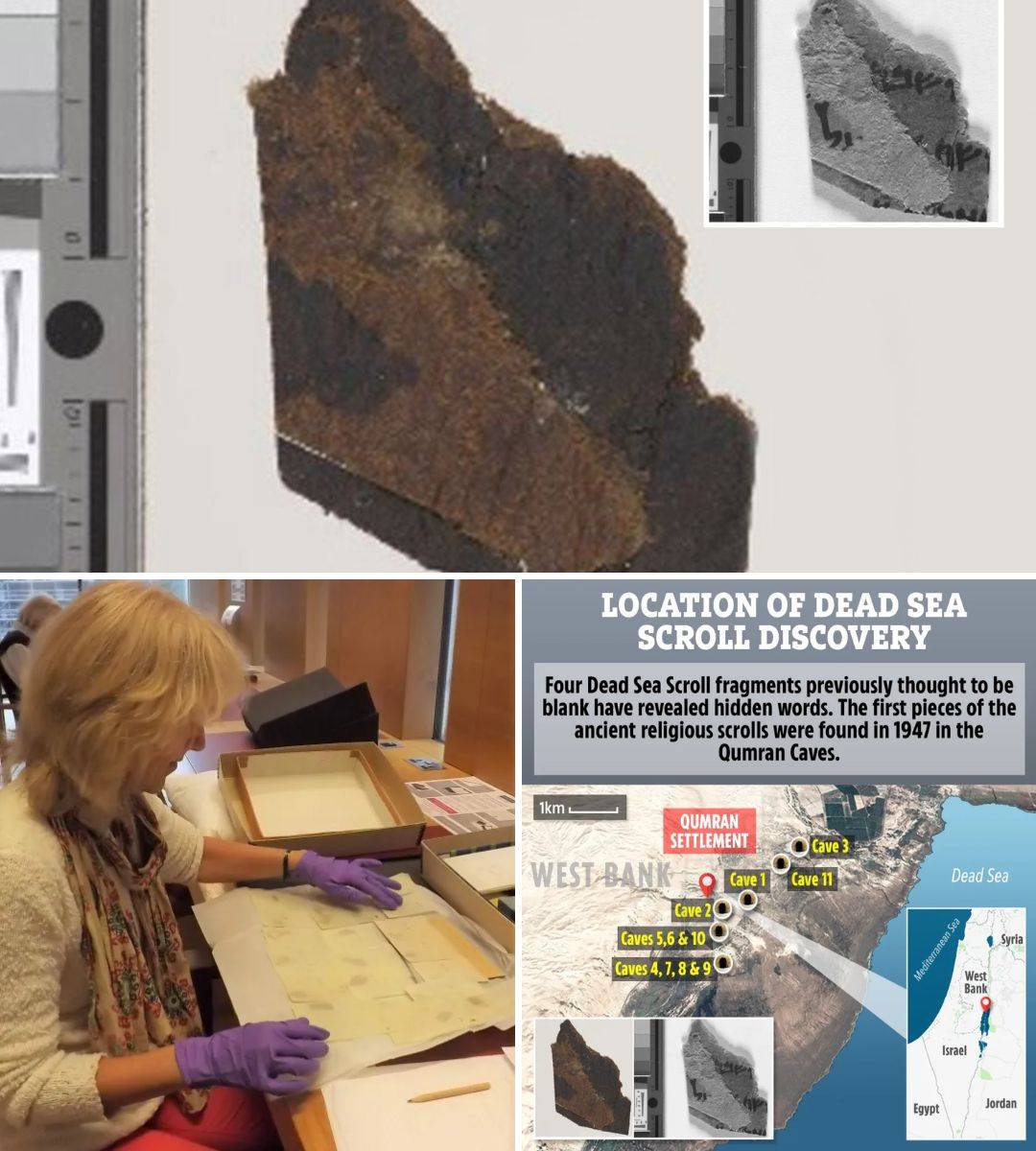

In a stunning revelation, researchers have uncovered hidden text within four fragments of the legendary Dead Sea Scrolls, shedding light on the mysteries of an ancient sect that thrived over 2,000 years ago. This groundbreaking discovery highlights the scrolls’ enduring significance in understanding early Jewish culture and religious practices.
Using advanced imaging techniques, scientists revealed that these ancient parchments contain more than just blank surfaces. Among the decipherable words is the Hebrew term “Shabbat,” which translates to Sabbath, the sacred day of rest in Judaism. This finding not only adds to the scrolls’ historical value but also connects modern audiences to their ancient roots.

The Dead Sea Scrolls, a collection of Jewish religious texts unearthed in the Qumran Caves near the Dead Sea, were first discovered in 1946 and are believed to date back to the last few centuries before Christ. Professor Joan Taylor from Kings College London was instrumental in this latest discovery, initially spotting a faded Hebrew letter while examining a fragment with a magnifying glass.
“I thought I was imagining things,” she admitted, reflecting on her first glimpse of the letter “L.” However, her curiosity led her to investigate further, and she soon realized that other fragments might also hold faint letters waiting to be revealed. “It felt like finding missing pieces of a jigsaw puzzle,” she noted.
The researchers employed multispectral imaging, a cutting-edge method that captures images using various wavelengths, to bring these hidden letters to light. The presence of the word “Shabbat” and additional letters suggests a possible connection to the biblical book of Ezekiel, specifically verses 46:1-3.
Scholars have long been captivated by the Dead Sea Scrolls, which comprise around 900 manuscripts attributed to the Essenes, an ancient Jewish sect believed to have existed from the 2nd Century BC to the 2nd Century AD in Palestine. Analysis of skeletal remains found in the Qumran area supports the idea that a community of dedicated religious men may have authored these texts.

Excavated in 2016, the remains of 33 individuals, predominantly males aged 20 to 50, align with theories about the Essenes’ lifestyle and beliefs. While earlier claims suggested a community of celibate priests resided near the caves, these findings add a new layer to the ongoing exploration of the scrolls’ origins.
Currently housed at the University of Manchester in the UK, the fragments have only recently gained attention, despite being part of a collection donated to the university in 1997. As researchers continue to delve into these ancient texts, one can’t help but wonder what other secrets might still be hidden within the scrolls. What new revelations could emerge from this fascinating chapter of history?


