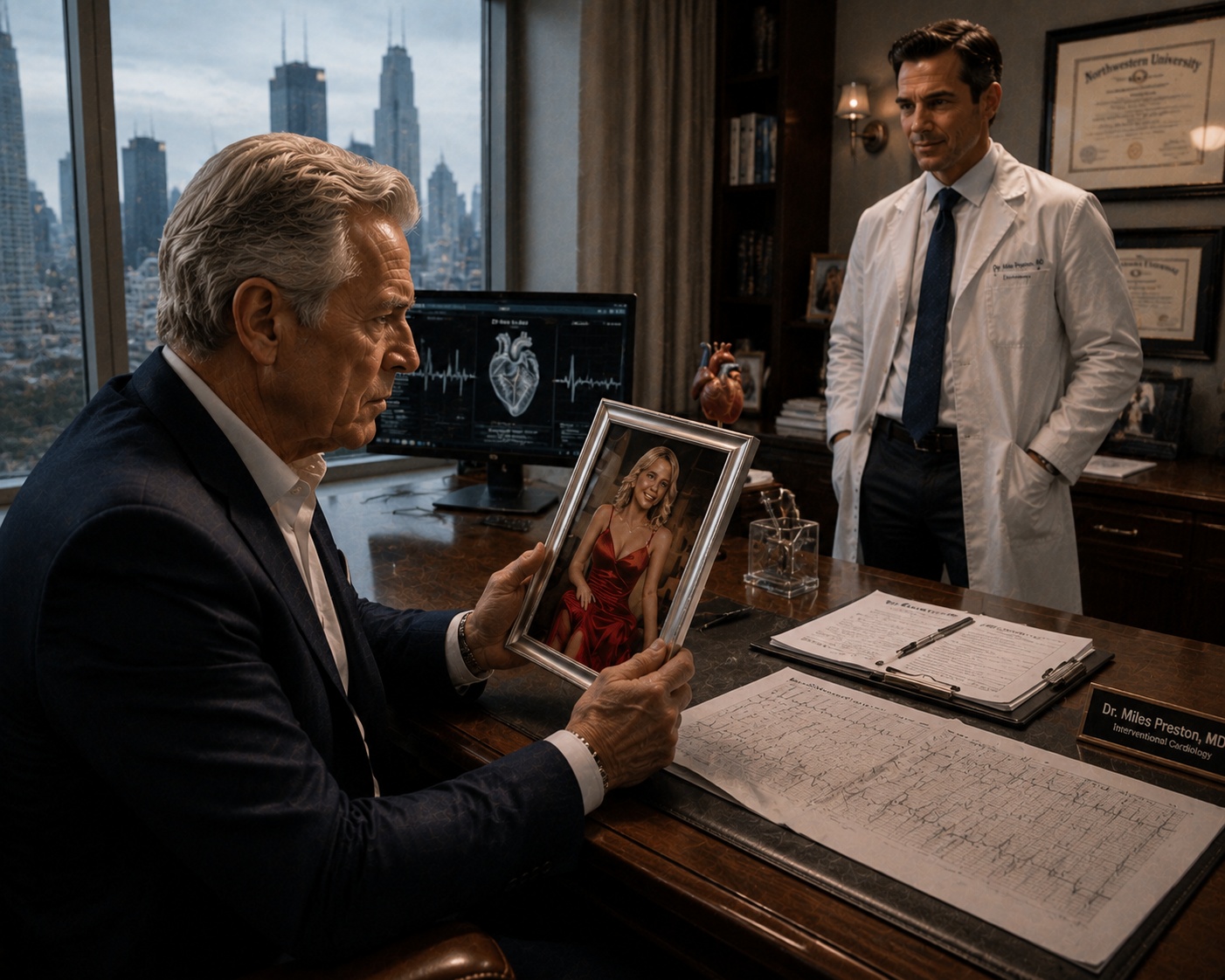
The room was full of expensive artwork and medical equipment, yet it felt empty. My father, Richard Sterling, one of the wealthiest men in the country, lay dying, and almost nobody had come to see him. His other children hadn’t visited. His grandchildren hadn’t visited.
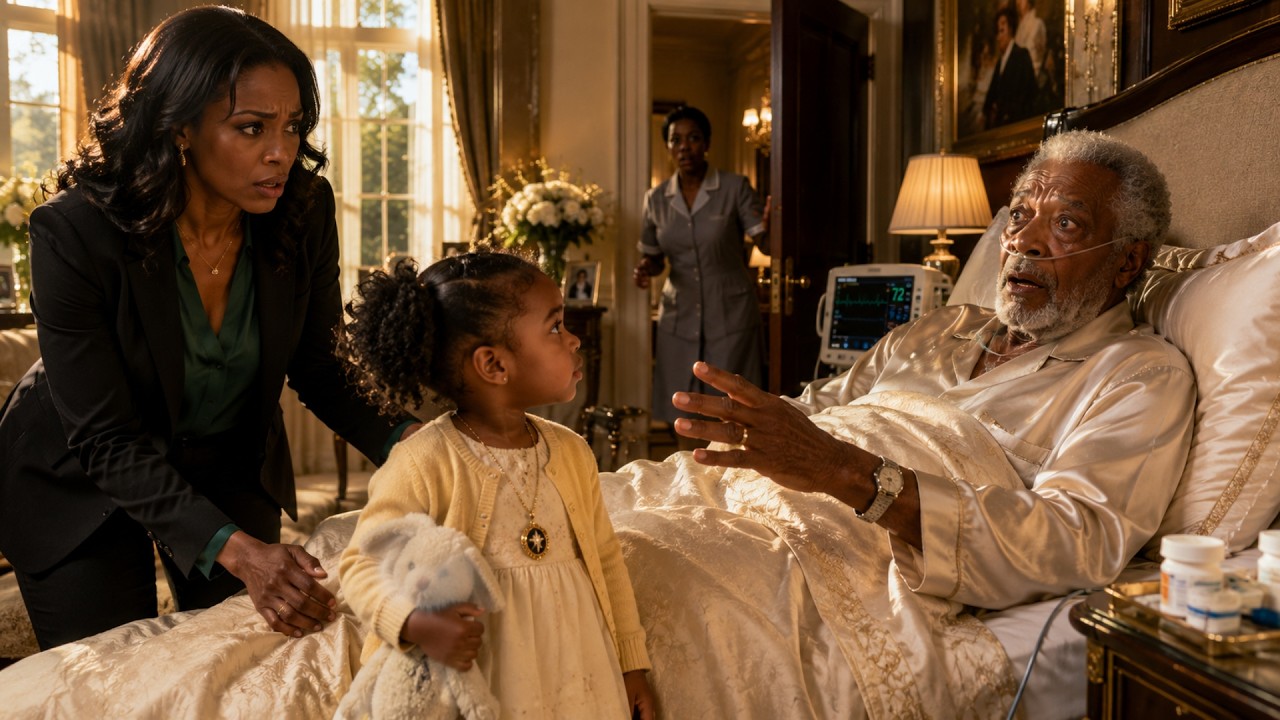
His business partners sent representatives. Even his oldest friends only stayed a few minutes. I sat beside his bed, holding his hand, when the door opened. The housekeeper’s three-year-old daughter, Lily, wandered in, clutching a small stuffed rabbit.
I moved to take her back outside. Then my father opened his eyes, smiled for the first time in days, and said something that froze me in place. “Why does that little girl have your mother’s necklace? ”
I stared at him.
“Dad, how do you know that necklace? ”
That question unraveled everything I thought I knew about my family. Growing up as the daughter of Richard Sterling meant every material advantage imaginable: private schools, luxury homes, trust funds. What I didn’t have, despite all of it, was any real closeness with my father.
He measured love through provision, not presence. He sent elaborate gifts instead of attending birthday parties and signed typed notes instead of showing up. At some point, I stopped expecting anything more. My older brother, Alexander, responded to that distance by becoming obsessed with the family business, convinced he was entitled to control it.
My younger sister, Caroline, became consumed with status and appearances. I became the difficult daughter—the one who moved away, built my own career, and refused to join the exhausting competition for his attention and inheritance. Eight months before the end, his health began failing. I visited him several times a week.
My siblings offered excuses. Alexander was too busy managing the business. Caroline claimed the doctors recommended rest. The truth, I understood, was simpler and colder.
They were waiting for him to die, waiting to see what the will would give them. Our housekeeper, Maria, had worked for our family for fifteen years. She ran the estate quietly and loyally, and her little girl, Lily, sometimes came to work with her when Maria couldn’t arrange childcare. We all assumed my father barely noticed the child.
Then, six weeks before his death, Lily accidentally wandered into his room. Instead of the indifference I expected, my father asked Maria softly, “How old is she? ” His eyes glistened, and when I asked him about it afterward, he changed the subject. Over the following weeks, I started noticing small, strange things.
He knew the name of Lily’s favorite stuffed toy. He asked Maria if she had ever told Lily about the garden. Alexander noticed too, and grew visibly agitated. “Dad doesn’t need distractions right now,” he told me, but I recognized his real worry.
It wasn’t about our father’s health. It was about what my father might reveal. I began searching the estate’s private study. In an old file cabinet, I found a sealed envelope with a faded photograph inside.
It showed my father standing beside a much younger Maria, holding an infant—a baby I recognized as Lily. The handwritten date was from over three years earlier, before Lily could possibly have been born. Next to it was an old letter that deepened the mystery. I confronted my father on one of his clearer afternoons.
What he told me changed everything. Lily wasn’t his secret child. Maria’s late older sister had been his trusted personal assistant for years. She had discovered that Alexander was systematically siphoning money from the family business, falsifying records and misdirecting transactions to hide the theft.
She confronted Alexander and planned to report it to my father. Before she could, she died suddenly. My father never fully investigated whether her death was truly an accident, unable to face that possibility. Before she died, she had preserved proof of Alexander’s theft and entrusted it to my father.
He had known for years what Alexander had done but kept the evidence hidden. Instead, he used that knowledge to quietly ensure Maria and Lily were protected and cared for, all while gathering more evidence and waiting for the right moment. “Why didn’t you tell us? ” I asked him.
He was quiet for a long time. “I was afraid,” he finally said. Afraid that revealing the connection would put Maria and Lily at further risk, given what he suspected Alexander might do to protect himself. But beneath that, I think he also simply didn’t know how to share something so vulnerable after decades of guarding his emotions from his own children.
The truth went deeper than one theft. Alexander had spent years building a narrative throughout the company and the family, convincing people that our father’s declining health made him unfit to manage the business. He was laying groundwork to take control without contest. He had been poisoning relationships for years without any of us recognizing the source.
A week after that conversation, Lily wandered into my father’s room again. She climbed onto his bed and, without hesitation, offered him her small stuffed rabbit. He began to cry, quietly but unmistakably, and accepted the toy from her outstretched hands. “I spent my whole life building something for my children,” he told me that afternoon, his voice raw in a way I had never heard.
“And somehow I forgot to become their father. ”
Two weeks later, my father’s attorney called the entire family together. Alexander arrived dressed as though he were already stepping into his new role as head of the company. Instead, the attorney presented a stack of financial records.
He walked us through years of documented theft by Alexander. He produced the evidence Maria’s late sister had preserved, along with the more extensive documentation my father had gathered himself. Then he read my father’s final instructions. My father hadn’t left everything to me.
He had established a charitable foundation designed to ensure Maria and Lily were financially protected for the rest of their lives. He had arranged benefits for the company’s longtime employees. The company itself would be placed under independent professional management. I received a meaningful inheritance, but not the controlling wealth that might have repeated our family’s corrosive dynamic.
Alexander faced serious legal consequences. Caroline lost the position and standing she had assumed would be hers. The family’s reputation suffered. Watching it unfold, I felt no satisfaction, only a heavy grief for all the unnecessary pain we had inflicted on each other, fighting over wealth our father never wanted to be the measure of our relationships.
In the weeks before his death, my father and I finally had the honest conversations I had wished for my entire adult life. He apologized directly for the years of emotional distance. “I didn’t need the money, Dad,” I told him. “I know,” he said, his hand tightening around mine.
After a long pause, he added, “I’m sorry it took me this long. ”
He died peacefully several weeks later, surrounded not by his empire or his fortune, but by a small circle of people who genuinely cared whether he was comfortable in his final moments. Maria was nearby, with Lily asleep in a chair beside her. Several months after his death, I returned to the estate.
Lily ran toward me the moment I arrived, her face lighting up with the same simple warmth she had offered my father. Maria and I have grown closer since then, our relationship shifting into genuine friendship. Standing there, watching Lily run across the grounds where I had spent so much of my lonely childhood, the estate felt different. It no longer felt like a monument to wealth.
It finally felt like a home. My father spent his entire life believing that leaving something meaningful behind meant accumulating money and building a name people would remember. But in the end, none of that brought him peace. It was a small child who had no idea he was a billionaire, who treated him like an ordinary person deserving of simple kindness.
I used to believe my father died surrounded by people who wanted something from him. I understand things differently now. He left this world surrounded by the few people he had finally learned how to love. Sometimes life has a strange way of showing us what really matters.
The people who chase everything they believe they’re entitled to can end up with nothing that lasts. And the ones we most easily overlook can remind us what we were always supposed to value. I think about that lesson often now, and I try, in my own quiet way, to make sure it never fades from how I live.